Introduction: Etiquette Is More Than Rules — It Is the Language of Respect

Modern etiquette is not a dusty set of rules from the 18th century. It is a practical tool that helps you feel confident in any situation — from business negotiations to a casual dinner with friends. When you know how to act, you stop worrying about small things and can focus on what truly matters — connecting with people.

In this article, we explore 7 situations where even experienced people make mistakes.

Important: etiquette varies across countries and cultures. What is normal in Russia might be rude in Japan, and vice versa.
We will examine the rules, their cultural roots, historical context, and give practical tips for everyday life. You will learn how to avoid awkward moments at the table, in the elevator, at a wedding, and in the office.

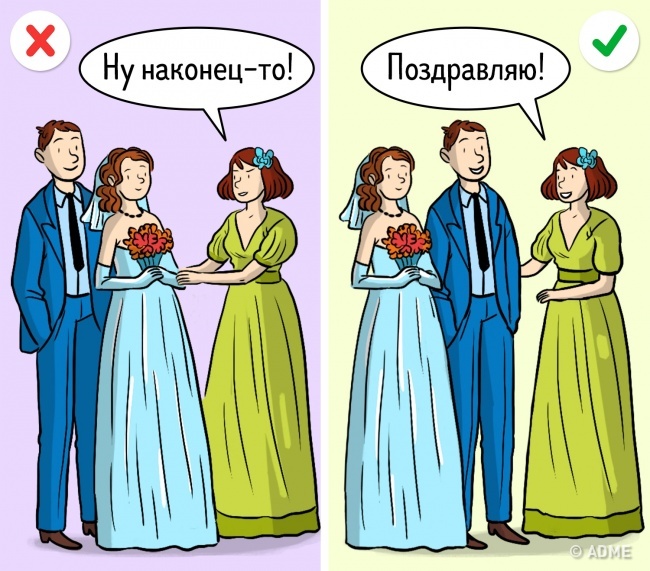
1. Congratulating the Newlyweds — Who Comes First?

Many believe you should congratulate the bride first when meeting a newly married couple — after all, she is the center of attention in her beautiful dress, and it is her special day. Classical etiquette says the opposite. The groom receives congratulations first.

This tradition goes back to the historical view of marriage as a man's conquest of a woman's heart. The groom is the active party — he won her hand, so his achievement is acknowledged first. Additionally, by older etiquette standards, the bride is not formally congratulated; she receives compliments and good wishes, while official congratulations go to the groom.

In practice: approach the couple, shake the groom's hand first with your congratulations, then turn to the bride with compliments and good wishes.

A universal safe option: "Congratulations to you both! You make a wonderful couple!" works in every situation.

Appropriate phrases for different situations:

  • To the groom: "Congratulations on this important step! Take good care of your family."
  • To the bride: "You look absolutely stunning today! Wishing you both all the happiness."
  • To both: "I am so happy for you! May your journey together be long and joyful."

2. Stirring Sugar — The Diplomatic Way

Something as simple as stirring sugar in a cup of tea or coffee has its own etiquette rules. According to table manners, the spoon should move back and forth (toward and away from you), not in circles.

Three reasons why this matters:

  1. Aesthetics: circular motions look fussy and create unnecessary noise that distracts others at the table.
  2. Efficiency: the back-and-forth motion dissolves sugar faster and more effectively, especially with larger crystals.
  3. Tradition: in diplomatic protocol, stirring clockwise is considered poor form, as it resembles stirring paint, not a noble beverage.

Loudly clinking the spoon against the cup is a common mistake. The spoon should move silently and smoothly. After stirring, place the spoon on the saucer, not in the cup — otherwise it might fall or stain the tablecloth.

Tea ceremonies around the world deserve special mention. In England, for example, stirring tea is practically an art form. The British stir so that the spoon never touches the sides of the cup. This is why English etiquette is considered the gold standard: attention to such details cultivates respect for those around you.

3. Salt and Pepper — Why They Must Be Passed Together

The rule is simple and elegant: if someone asks for salt, pass the pepper too — and vice versa. This tradition dates back to the 18th century, when salt was expensive and pepper was an even rarer and more valuable spice. Offering both together showed a host's generosity and respect for their guests.

Equally important is how you pass them. Place the salt and pepper shakers on the table near your neighbor rather than handing them directly. If you sit far away, ask others to pass them along the chain.

\u{201c}

"Manners are a sensitive awareness of the feelings of others. When you pass both salt and pepper together, you show you care about the other person's needs."

Emily Post, etiquette expert

Interesting fact: In some cultures, spilling salt was considered an ill omen. This gave rise to the tradition of throwing a pinch of salt over the left shoulder to ward off evil. In modern times, this has become a playful gesture, but its roots are quite serious.

4. Coughing and Sneezing — Which Hand Is Correct?

Most people instinctively cover their mouth with their right hand when coughing or sneezing. Etiquette recommends using your left hand or the crook of your elbow. Why? Because your right hand is used for handshakes — it should stay clean.

Imagine this: you sneeze, cover with your right hand, and a minute later shake hands with a colleague or business partner. This is not only unhygienic but also shows disregard for others. Correct sequence: cover mouth with left palm or elbow crook → use a tissue → wash hands or use sanitizer

In the post-pandemic era, this rule is more important than ever. Hygiene and care for others' health are essential parts of modern etiquette. Covering your mouth with your elbow (not your hand) is the standard recommended by the WHO.

Quick etiquette reminder:

  • Sneezed or coughed — turn away from people and cover with your elbow.
  • Always carry tissues and dispose of them immediately after use.
  • If someone sneezes near you — do not say "bless you" in formal settings (more on this below).

5. Addressing Teens — Formal or Informal?

According to formal speech etiquette standards in many cultures, teenagers over 12 should be addressed formally (using polite forms like "Mr" or the equivalent in other languages). This is not a formality — it shows respect for their developing personality. Psychologists say formal address boosts self-esteem, encourages responsible behavior, and builds mutual respect.

In practice, this rule is often broken even by teachers and relatives. Many feel that informal address shows warmth and closeness. But it is important to remember:

switching to informal address requires mutual consent or an invitation from the older person. In official settings — school, clubs, classes, formal events — formal address is mandatory.

When is it appropriate to switch to informal address?

  • If the teen asks you to ("You can call me by my first name").
  • In informal settings outside school — on walks, at parties, on vacation.
  • Within the family, if that is the custom (but in public, formal address is recommended).

6. Saying "Bless You" — Why It Is Inappropriate at Work

The phrase "bless you" (or "Gesundheit") originated as a superstition: sneezing was thought to let the soul temporarily leave the body, and the blessing was meant to protect the person from evil spirits. In modern business etiquette, this phrase is considered too familiar for formal settings.

What to do when a colleague sneezes near you?

  1. Say nothing. Business etiquette says to act as if you did not notice. Sneezing is a natural process, and drawing attention to it is unnecessary.
  2. Offer a tissue — both helpful and tactful. This shows care without words.
  3. At most — nod with a slight smile, but without a verbal blessing.

Exception: among close friends and family, "bless you" or "Gesundheit" remains warm and perfectly appropriate. Context and audience are everything.

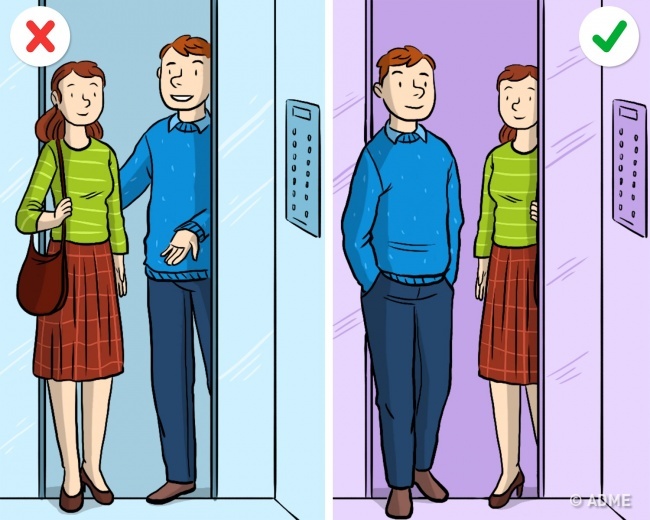
7. Elevators — Letting a Lady Enter First Is Wrong?

One of the most common etiquette myths concerns elevators. Many men believe they should let a woman enter first to show gallantry. Safety rules dictate the opposite. An elevator is a confined space with potential risks: it could get stuck between floors, start abruptly, or contain a stranger who poses a threat.

Hard rule: a man enters first, assesses the situation, and only then invites others in. The person closest to the door exits first, regardless of gender or age. This is not about etiquette — it is about personal safety.

This applies to:

  • Passenger elevators in offices and apartment buildings.
  • Service and freight elevators.
  • Elevators in unfamiliar or questionable locations.
  • Elevators at night or in sparsely populated buildings.

Exception: if you are a man entering with a woman in a well-lit, safe building (like a shopping mall) and the woman clearly expects to be let in first — you may yield. But classic safety etiquette advises a man to enter first in any unfamiliar elevator.

Comparison of Etiquette Rules Across Countries

Etiquette varies significantly by culture. What is considered highly polite in one country could be a deadly insult in another. To help you avoid awkward situations while traveling or on a business trip, here is a comparison of key norms:

SituationRussiaJapanUSAFranceUK
Greeting Firm handshake, direct eye contact Bow, avoid direct eye contact Firm handshake, broad smile Cheek kisses (la bise), even on first meeting Light handshake, maintain distance
Address Formal to elders and strangers, first name + patronymic Suffixes -san, -kun, -senpai based on status First name, even with superiors after first meeting Monsieur/Madame, strictly formal Mr/Mrs/Ms, formal until invited otherwise
Tipping Optional, usually 5-10% in restaurants Offensive, not practiced anywhere Expected, 15-20% in restaurants and taxis Included in bill (service compris), small change optional 10-12% optional if not included
Punctuality 5-15 minutes late acceptable, apologies expected Unacceptable, strictly on time, better 5 minutes early 5-10 minutes grace, must notify 15-30 minutes late acceptable, apologies optional Strictly on time, lateness is disrespect
Eating on the go Partially acceptable, not in public transport Unacceptable on street, considered rude Acceptable, widespread Unacceptable, considered uncultured Unacceptable on public transport, cautious on street

Traveler's tip: before traveling to another country, learn at least 5-10 basic local etiquette rules — it will save you time, nerves, and money.

Table Manners at a Glance

Table manners are the most extensive area of etiquette. Master these basics and you will feel confident at any dinner — from a business lunch to a formal reception. Here are the key points:

ActionCorrectIncorrect
NapkinPlace on your lap immediately after sittingTuck into collar, snap open with noise
Knife and forkFork in left hand, knife in right, fingers on handleSwitch utensils between hands, hold like a pencil
BreadBreak off small pieces by handBite from whole piece, cut with knife
SoupScoop away from you, eat silently, tilt bowl awayTilt bowl toward you, slurp, blow on soup
PhonePut away in pocket or bag, silence itPlace on the table, take calls, check social media
Fish knifeUse specialty knife or two forksUse the same knife as for meat

Golden rule of table etiquette: utensils on the right of the plate are used with the right hand; those on the left — with the left hand. Dessert utensils sit above the plate.

FAQ: Frequently Asked Questions About Etiquette

Can I congratulate the bride first?

Classical etiquette says to congratulate the groom first, then the bride. At modern weddings this rule has relaxed. Congratulating both is always a safe and universal choice.

Why shouldn't I stir sugar clockwise?

Circular motion looks fussy, creates noise, and dissolves sugar slower. Diplomatic etiquette recommends a back-and-forth motion — faster, quieter, and more elegant.

Why pass salt and pepper together?

An 18th-century tradition when both were expensive spices served together as a sign of host's generosity. Today it remains a thoughtful gesture — you save the other person from asking twice.

Which hand should I use to cover my mouth when coughing?

Your left hand or the crook of your elbow. The right hand stays clean for handshakes. Modern etiquette prioritizes hygiene and care for others' health.

When can I address a teenager informally?

By mutual consent. Under 12, informal address is acceptable. After 12, formal address is recommended in official settings. The teenager themselves may initiate the switch.

Should I say "bless you" at work?

No — in business settings it is considered too familiar. Act as if you did not notice, or silently offer a tissue. Among close friends and family, it is fine.

Who enters the elevator first?

A man enters first to assess safety, then invites others. The person closest to the door exits first regardless of gender. This is a safety rule, not a gallantry one.

What are common business dinner etiquette mistakes?

Phone on the table, loud voice, discussing politics or religion, ignoring seating arrangements, refusing a toast.

\u{201c}

"A smile costs nothing but is valued highly."

Dale Carnegie
Remember: a business dinner is an extension of negotiations.

What are basic restaurant table manners?

Sit where you are directed. Put your napkin on your lap. Do not start eating until everyone is served. Do not criticize the food. Use utensils from the outside in as courses change. Tipping in the US is 15-20%, in Europe 5-10% or included.

Does business etiquette differ across countries?

Very much so. In Japan, exchanging business cards is a full ceremony with bows. In the US, a quick handshake and smile. In China, gifts are given with both hands. In Germany, punctuality to the minute is critical. Open

Etiquette is not about "right" or "wrong". It is about respect for the people around you. Knowing these simple rules will help you feel confident in any company — from a royal reception to a casual party with friends.

What is the "three-second rule" in handshake etiquette?

Business etiquette has an unwritten rule: a handshake should last about 3 seconds. Longer can seem aggressive or dominating, shorter can seem indifferent. Practice: firm but brief handshake with a slight smile and eye contact.

Should I stand up when a woman enters the room?

Yes, a man should stand when a woman enters or when being introduced to a woman. A woman stands only when introduced to someone significantly older or higher in status. Modern etiquette allows staying seated only in confined spaces — airplane, crowded bus.

Is it acceptable to eat on public transport?

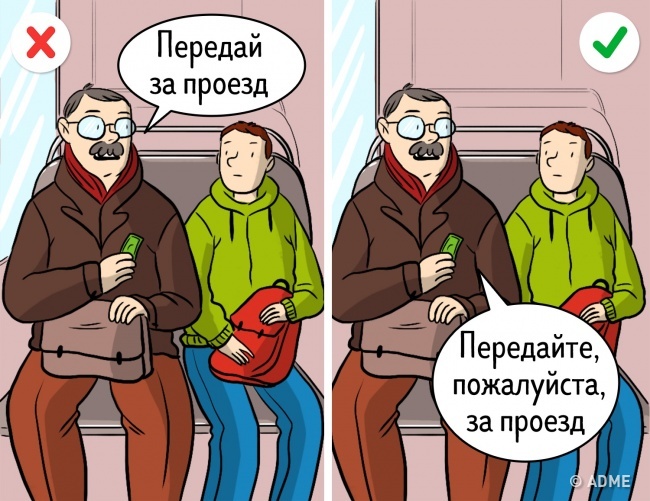
In most countries, it is acceptable but avoid strong-smelling foods (fish, fast food) and noisy wrappers. On subways and buses, eating is generally frowned upon. On long-distance trains, it is perfectly normal, especially in a compartment.

How to give flowers correctly by etiquette?

Give flowers in wrapping, remove it before handing them over. An odd number of stems is recommended in many cultures. Hold the bouquet with your left hand so your right is free for a handshake. Avoid red roses in business settings — they may be seen as a romantic gesture.

How to behave during a toast?

Look at the person being toasted. Clinking glasses with everyone at the table is optional — raising your glass in a general gesture is sufficient. You may take a sip after the toast. In Russia and Eastern Europe, toasts are an important part of the meal and social interaction — do not refuse to participate.

When can I use my phone at the table?

Only in an emergency, and warn others first. Keep your phone off the table and on silent mode. Step away from the table to take calls. Taking photos of your food is poor form at business dinners. At casual gatherings, photos are acceptable but should not be intrusive.

Tap to react