Table of Contents
- Introduction: Why Mother-and-Child Photos Move Us to Tears
- Pascal Campion — The Illustrator Who Draws the Soul of a Family
- Emotional Family Photography Techniques
- Comparison of Mother-Child Photography Styles
- Light and Composition in Mother Portraits
- Best Genres of Family Photography
- How to Photograph a Mother with Her Child: Pro Tips
- Telling a Story Through Photos: From Pregnancy to School
- Common Mistakes Beginner Photographers Make
- Frequently Asked Questions
Introduction: Why Mother-and-Child Photos Move Us to Tears
Somewhere deep inside each of us lives the memory of a mother's hands. The way she tucked the blanket, the scent of her hair when she leaned in to kiss you goodnight. Even though we snap thousands of photos in the digital age, the ones that truly grab us are those where this invisible bond between mother and child shines through. Photographers around the world chase that one moment. You cannot stage it, direct it, or fake it in Photoshop. You can only catch it.
Family photography is one of the most challenging yet rewarding genres. You work with unpredictable models (children), high emotional stakes, and limited time. But the result is worth every minute of waiting. A single frame can tell a story that lasts a lifetime. In this collection, we have gathered 25 photographs and inspiring works by artist Pascal Campion to break down the techniques that make images truly alive.
\u{201c}I simply draw what I see every day. Happiness is when your daughter falls asleep in your arms and you are afraid to move.
This collection is more than a gallery. It is an emotional textbook for anyone who picks up a camera and wants to learn how to shoot not just correctly, but feelingly.
Pascal Campion — The Illustrator Who Draws the Soul of a Family
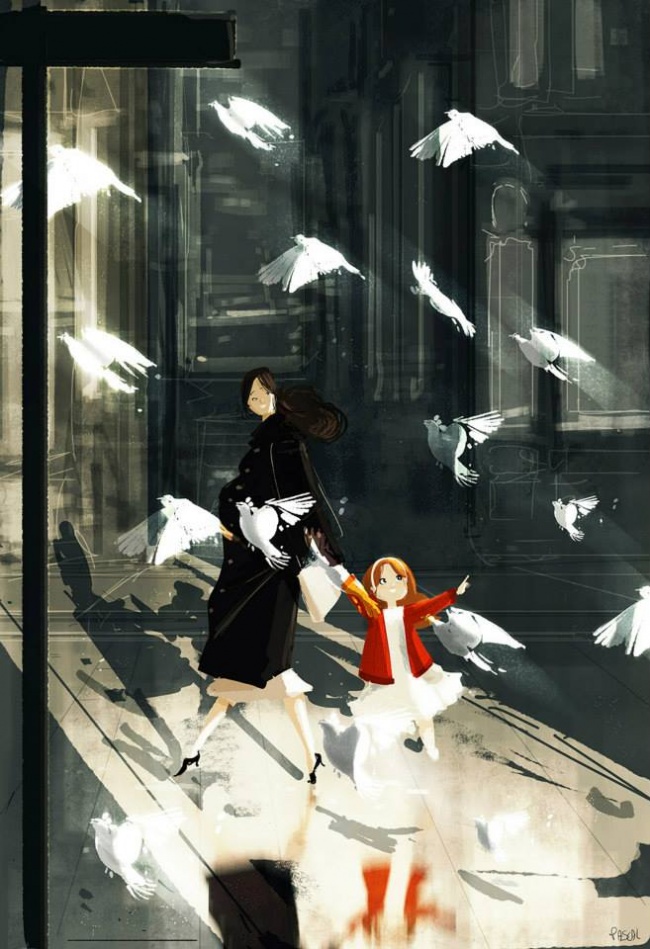
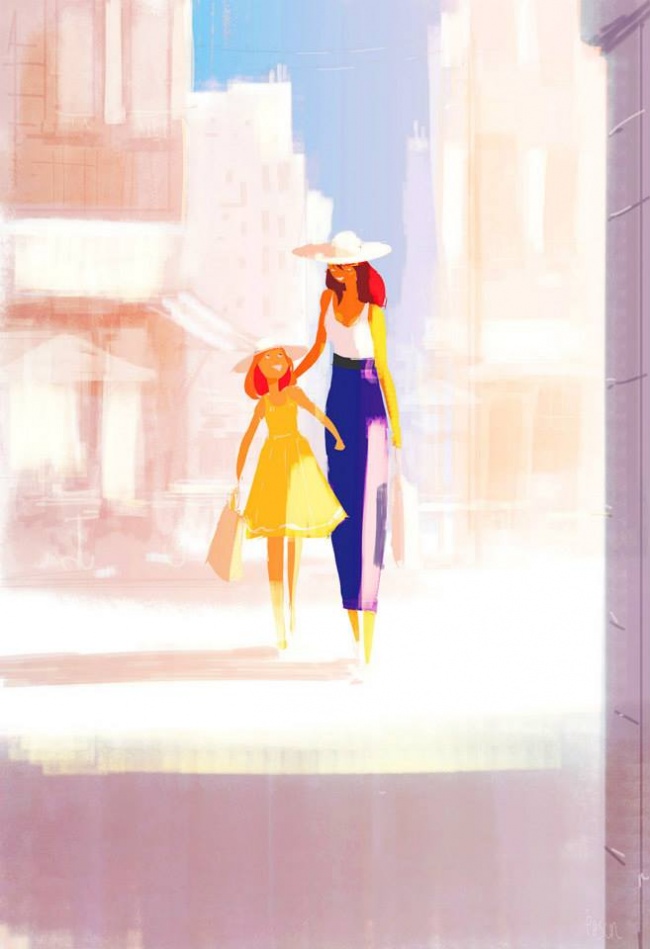
American illustrator Pascal Campion is famous worldwide for his warm, gently melancholic sketches of everyday life. He does not use complex visual metaphors. His tools are coziness, recognizability, details. A coffee cup, tousled hair, a child reaching for their mother, light streaming through a window. Campion does not draw perfect families. He draws real ones.

Photographers find an endless source of inspiration in his work. Compositional decisions, lighting accents, the ability to convey mood through simple gestures — you can learn from this forever. Every illustration of his is a ready-made storyboard for a photoshoot.
Why do Campion's illustrations resonate so deeply?
The secret is simple. He draws what every one of us experienced in childhood and experiences now with our own children. It is the universal experience of motherhood and fatherhood. When you look at his work, you do not analyze technique. You feel warmth. Great family photography works the exact same way.

Here are the key lessons photographers can take from Campion:
- Golden hour is not a luxury — it is a necessity. Almost all his scenes are lit by soft evening or morning light.
- Details tell the story. Scattered toys, an unmade bed, a mug on the table — that is not mess, it is life.
- Emotion matters more than sharpness. A blurry frame of a mother laughing with her child beats ten technically perfect portraits.
- Do not fear close-ups. Hands, eyes, tiny fingers — tenderness lives in the details.
Emotional Family Photography Techniques
Family photography is not about gear — it is about relationships. Still, there are a few technical approaches that help you capture emotion at its fullest.
Shoot at the child's eye level
This is the most common piece of advice, yet rarely followed. When you crouch or lie on the floor, the viewer enters the child's world. Perspective changes, and the frame becomes more immersive.
Use foreground elements
A blurred foreground (mother's hair, the edge of a blanket, a toy) creates depth and a feeling of peeking into a private moment. It adds a documentary quality to the shot.
Catch the glances
The most powerful frames are those where mother and child look into each other's eyes. In that look lies a universe of trust and love. Do not command: "Look at Mommy!" Just wait. Sooner or later the child will look at her, and you press the shutter.
\u{201c}The best photographs are those where people forget they are being photographed. I wait for that oblivion.
Work with textures
The wool of a sweater, the lace of a blanket, the softness of a child's cheek — tactile sensations translate beautifully through photography. Use light to emphasize texture.
Remember this simple rule: the less staging, the more life. Turn off the flash, put away the reflectors, and simply observe.
Comparison of Mother-Child Photography Styles
| Style | Key Features | Advantages | Difficulty |
|---|---|---|---|
| Documentary | No staging, natural light, handheld | Maximum sincerity, unique moments, low cost | High — requires patience and experience |
| Posed | Studio light, props, planned composition | Full control, predictability, commercial appeal | Medium — needs organization |
| Lifestyle | Hybrid: natural setting, guided actions | Balance of sincerity and quality, cozy vibe | Low — great for beginners |
| Fine Art | Focus on form, color, texture, often black-and-white | Gallery quality, timeless feel | High — requires developed eye |
| Photojournalism | Event-driven: walk, bath time, play | Real emotions, storytelling, dynamics | Medium — staying invisible |
Light and Composition in Mother Portraits
Light is the photographer's primary tool. In family photography, natural soft light is preferred. Here are some proven setups:
- A window — the best light source. Position mother and child at a 45-degree angle to the window. You get volume with soft shadows.
- Backlight. Shoot against the window. Silhouettes, a halo around the hair, airiness — this works every time.
- Diffused shade. On a clear day, look for shade from a building or tree. Harsh sunlight rarely flatters a portrait.

As for composition, the rule of thirds still holds. But there are other tricks:
- Close cropping. Frame so faces fill more than half the image. Emotions read better.
- Minimalism. Remove everything unnecessary. One chair, one light source, two people.
- Asymmetry. Do not place mother and child dead center. Let them sit slightly left, with space on the right for the viewer's eye to wander.
Best Genres of Family Photography
| Genre | Description | Ideal Format | Sample Scenario |
|---|---|---|---|
| Maternity | Belly portraits emphasizing the bump and connection with partner | Posed or fine art | Mother caresses belly, partner hugs from behind |
| Newborn with mother | First days after birth — incredibly emotional | Documentary or close-up | Mother holds baby on chest, hands intertwined |
| Mother and baby (0-12 months) | Feeding, bathing, first steps, cuddles | Lifestyle or photojournalism | Baby reaches for mom, she smiles |
| Mother with toddler | Playtime, reading, arts and crafts, walks | Natural, photojournalism | Mother reads a fairy tale, child listens on her lap |
| Mother with school-age child | Homework, hobbies, sports, travel | Photojournalism or lifestyle | Mother helps with homework, both focused |
| Generations: grandmother-mother-daughter | Three generations — passing down experience and traditions | Posed or portrait | Three women of different ages, similar poses, a legacy |
How to Photograph a Mother with Her Child: Pro Tips
After two decades of shooting, we have developed a few simple but effective principles. Here are the most important ones.
Never force a smile
A fake smile shows from a mile away. Instead of "Say cheese!" tell a joke, play some music, or make a silly face. Children start dancing, mothers relax — and that is when you shoot.
Use props
A book, a toy, bubble soap, a piece of fabric — anything that distracts the child from the camera and lets the mother be natural. Do not be afraid to include favorite toys or blankets — they are part of the child's world.
Do not command — play
Say: "Let's pretend Mommy is a tree and you are a little bird that flew into her nest." Children love games. Play melts away stiffness and brings out genuine emotions.
\u{201c}Staging does not work with children and animals. Love and patience do. If you are not ready to wait — you are not ready to shoot.
Go black and white
Monochrome removes visual noise. If the background is messy or the colors are off — convert to black and white in post-processing. The emotions only get stronger.
Download family photography checklist1.2MBTelling a Story Through Photos: From Pregnancy to School
One of the most powerful ideas for a photoshoot is to capture the same story over several years. Once a year, on the same day, in the same pose or location. After five years you do not just have a set of photos — you have a story of growth. A love story told without words.
Here is an example: a mother and daughter shoot every year on the daughter's birthday in front of the same oak tree in the park. The first frame — mother holds a tiny bundle in her arms. The second — the girl sits on the grass nearby. The third — she stands, holding mom's hand. By the fifth — she hugs her mother, almost matching her height.
Such a project requires discipline, but the result is worth the effort. One frame a year — and in 18 years you will have a complete coming-of-age album.
Keep the shooting parameters consistent:
- Use the same lens (e.g.
50mm f/1.4) - Same time of day
- Same post-processing style
Common Mistakes Beginner Photographers Make
Even experienced photographers sometimes fall into traps when shooting mothers with children. Let us go through the most common ones.
- Too many props. An excess of toys, blankets, and ribbons distracts from the main subject — the people. Minimalism works better.
- Shooting from above. When you stand while the child is on the floor or bed, you get a top-down view that distorts proportions. Get on the floor.
- Ignoring the background. A door frame sprouting from a child's head — a classic. Watch the background.
- Commanding tone. "Look here!" "Say cheese!" kills the atmosphere. Talk to the family, do not manage them.
- Overly long setup. Children get tired in 20 minutes. Rehearse your settings before the client arrives.
Frequently Asked Questions
Do I need a professional camera to shoot mother-child photos?
No. Modern smartphones with portrait mode and good light produce excellent results. Gear is not the priority. The priority is emotion, the moment, and light. However, a DSLR gives more flexibility with focal length and shutter speed.
What is the best time of day for family photography?
Golden hour — the first hour after sunrise and the last hour before sunset. The light is soft, warm, and very flattering for portraits. Indoors, mornings work best when window light is brightest and most diffused.
How do I make a child smile for photos?
You don't. Forcing a smile creates a fake one. Instead, tell a joke, make a silly sound, play their favorite song, or let them move around. The less pressure — the more natural the result.
What camera settings work best for mother-child photography?
Optimal starting settings: aperture priority A/Av, aperture f/2-f/2.8, ISO 400-800 (indoors), shutter speed at least 1/200s for moving children. Autofocus — continuous (AI Servo / AF-C).
How long does a standard family photoshoot last?
Usually 30-60 minutes. Children get tired quickly and lose interest. Better to get 20-30 great shots in one hour than 200 mediocre ones in two hours with an exhausted child.
Do family photos need professional editing?
Basic color correction and cropping — yes. Heavy retouching — usually not. Family photography values naturalness and slight imperfection. Keep mom's smile lines and the child's freckles — that is life.
How often can I use flash when photographing a child?
Flash is not recommended for newborns. For children over one year old — it is fine, but use bounced light (off the ceiling or wall) to avoid harsh shadows and discomfort.
Where is the best location for family photoshoots?
At home — the warmest and most natural shots happen there. Children feel safe, mothers are relaxed. Outdoors, the best places are a park, a beach at sunset, a field, or a quiet street with beautiful light.
Which mother-child poses look best?
Classic favorites: mother holding the child, mother kissing the child's head, mother and child lying down looking at each other, mother hugging the child from behind. A sleeping baby on the mother's chest is an all-time winner.
Is breastfeeding photography acceptable for portfolios?
Yes, it is beautiful, natural, and in high demand. The key is to shoot delicately: focus on the mother's gaze and hands, not anatomy. Black and white works exceptionally well for this subject.
Tap to react