It is 1956. Nikita Khrushchev has just delivered his Secret Speech at the 20th Party Congress. The country is rebuilding after the war. Schools across the USSR are packed with children whose parents work long shifts at factories and collective farms. Nobody is going to sit with them and check their homework. So the state steps in — not with tutors or after-school programs, but with a poster. A single sheet of paper that hangs in every classroom, every Pioneer room, every school corridor.

Soviet poster I
Soviet poster I

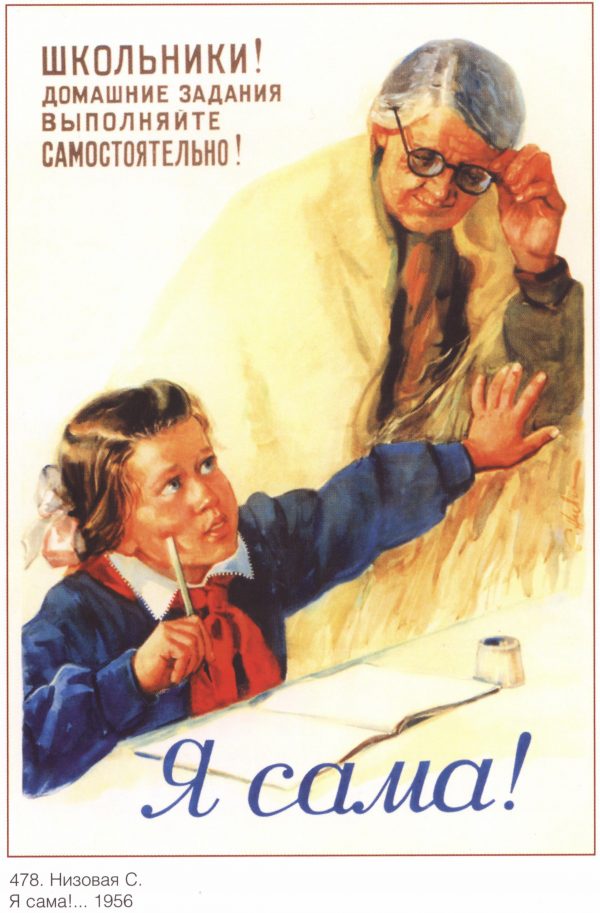
The poster shows a young schoolgirl with a determined look. Her hand is raised, palm facing outward — a gesture that says stop, don't help me. The text reads: Schoolchildren! Do your homework on your own! — I'll do it myself! That is the whole message. No subtleties, no metaphors, no clever visual puns. Just a direct command wrapped in the visual language of Socialist Realism. But here is the thing: it works. Seventy years later, the girl's gaze still hits you right in the conscience.

This poster was propaganda, not gentle advice. The Soviet education system embedded ideological training into every aspect of school life. Homework independence was framed as a civic duty, not a personal choice. Keep this context in mind when evaluating the visual materials.

The Artist Behind the Poster: S. Nizovaya

Information about S. Nizovaya is frustratingly scarce. What we know: she worked as a poster artist in the mid-1950s, part of the vast propaganda machinery that produced thousands of agitational posters annually. The Soviet poster industry was not about individual artistic expression — it was a production line. Artists received assignments, deadlines, and strict ideological guidelines. Nizovaya's name appears on educational posters for school audiences, a niche within the broader propaganda ecosystem.

The anonymity is telling. Unlike poster artists who achieved fame — Viktor Koretsky, Nina Vatolina, the Kukryniksy collective — Nizovaya remained a functionary of the system. She produced what was needed, when it was needed. No monographs analyze her work. No exhibitions feature her name. She is a ghost in the archive, known only through the imprint at the bottom of a single surviving poster. This was the fate of most Soviet poster artists: their work shaped the visual landscape of an empire, but their names evaporated.

\u{201c}

The Soviet poster artist was less an author and more a transmitter. Individual style was tolerated only insofar as it served the message. Nizovaya's clean, unfussy line work in "I'll Do It Myself" suggests an illustrator trained in the traditions of Socialist Realism — competent, efficient, ideologically reliable.

Soviet Education in 1956: Context of the Poster

To understand why this poster was produced, you need to understand what Soviet schools looked like in 1956. The post-Stalin thaw was underway, but educational structures remained largely unchanged from the 1930s. Seven years of compulsory education were the law. Schools operated on a single-shift basis in cities, double-shift in rural areas. Class sizes routinely exceeded 40 students. Teachers were underpaid, overwhelmingly female, and monitored for ideological compliance.

Homework was not optional. It was a component of the state educational plan, assigned and checked with military precision. Students who failed to complete homework faced escalating consequences: bad marks, public shaming at Pioneer meetings, notes to parents, and in extreme cases, referral to the school's Komsomol committee. The system treated academic failure as a moral failure. This poster fit perfectly into that framework — it made self-reliance a visible virtue.

Key 1950s Soviet Education Statistics
Metric 1950 1956 1960
Compulsory education (years) 7 7 8
Schools (thousands) 222 213 224
Students (millions) 34.8 30.1 36.2
Teachers (thousands) 1,475 1,733 1,933
Average class size 28 26 25

The drop in student numbers between 1950 and 1956 reflects the demographic echo of World War II — the wartime birth rate collapse reached school age in the mid-1950s. The 1958 reform law raised compulsory education to 8 years and introduced polytechnical training in upper grades.

The poster also reflected a practical demographic reality. With both parents working — women's labor force participation in the USSR exceeded 80% by the mid-1950s — there was simply no adult at home to supervise homework. The poster substituted for the absent parent, projecting the state's authority directly into the domestic space of the student's desk.

The Soviet Union achieved near-universal literacy among its younger population by the early 1950s, a remarkable accomplishment given that in 1917, roughly 70% of the population was illiterate. The education posters of the 1950s were part of a system that had already won the literacy battle and was now fighting for quality and ideological conformity.

Visual Analysis: Why the Poster Works

Let us break down the composition because there is genuine craft here worth examining. The girl is positioned slightly off-center, creating dynamic tension. Her raised arm forms a diagonal line that cuts through the rectangular frame of the poster. This is not accidental — diagonals in visual design create movement and urgency, while horizontals suggest stability and calm. The palm-outward gesture is a universal stop signal, readable across cultures and literacy levels.

The color palette is restricted: white, black, shades of brown and beige. Soviet printing technology was, to put it mildly, not sophisticated. Four-color printing was standard. If you added red, something else had to go. Nizovaya chose a restrained palette that printed cleanly and aged well. Surviving 1956 copies still show crisp lines and legible text. The brown background creates warmth that softens the commanding message; against a stark white background, the same image would feel harsher.

The girl's facial expression deserves separate attention. She is not smiling. She is not angry. She looks determined. Eyebrows slightly drawn together, mouth set in a firm line. This is the face of someone who has made a decision and will not back down. Compare this to American educational posters of the same period — they typically showed smiling children in idealized settings. The Soviet approach was direct: studying is labor, and labor demands seriousness.

The typography follows Soviet poster conventions: a bold sans-serif headline at the top, a dialogue bubble with the girl's words, and the small publisher's imprint at the bottom edge. The hierarchy is clear: first you read the command, then you see the child who embodies it, then you receive her personal testimony. It is a three-act structure compressed into a single 60 x 90 cm sheet.

The Poster as Propaganda Tool

Soviet propaganda posters were not advertisements. They were instruments of mass agitation, designed to embed ideological messages into daily visual experience. A poster in a classroom was seen by every student, every day, for an entire school year. The cumulative exposure was the point. You did not need to consciously read the poster; its message seeped in through repetition.

The production system was centralized. Publishers like Izogiz, Iskusstvo, and Plakat operated under state control, commissioning artists through official channels. Circulation numbers were printed on every poster — typical runs for educational materials ranged from 50,000 to 200,000 copies. The "I'll Do It Myself" poster had a circulation of 100,000, according to surviving imprints. At a price of 30 kopecks, it was affordable for any school budget.

Publisher Specialization Active Period
Izogiz Fine art reproductions and educational posters 1930–1963
Iskusstvo Art books, theatrical posters, cultural propaganda 1936–1991
Plakat Political and social propaganda posters 1974–1991
Gospolitizdat Political literature and agitational materials 1941–1963

The poster's effectiveness lay in its simplicity. A ten-year-old could understand it at a glance. An adult teacher could nod at it approvingly. A visiting inspector could cite it as evidence of proper ideological work. It performed multiple functions simultaneously: instruction, motivation, political signaling.

Collecting Soviet Posters: Value and Authentication

Soviet posters have become a legitimate collecting niche over the past two decades. Prices range from pocket change for mass-produced 1980s items to serious money for rare 1920s constructivist works by artists like Alexander Rodchenko and the Stenberg brothers. Where does the "I'll Do It Myself" poster fit in this market?

Originals from 1956 in good condition typically sell for $80–250. This is middle-tier pricing, reflecting the poster's large print run and the fact that educational posters are less coveted than political or military propaganda. Mint copies with no tears, no yellowing, and no creases can reach $400–600. Reproductions and authorized reprints from the 1960s–70s sell for $20–50.

The Soviet poster market has a significant forgery problem. Modern reproductions printed on artificially aged paper are common on eBay and Etsy. Always verify the publisher's imprint, paper texture, and printing method before paying collector prices. Offset printing from the 1950s has a distinct dot pattern under magnification that digital prints cannot replicate.

Authentication requires examining the bottom edge of the poster. Genuine Soviet posters carry a publisher's imprint with the following data: publisher name, year, circulation, price, and censor approval code. The imprint is small — usually 6–8 point type — and positioned along the bottom margin. Absence of this imprint does not automatically mean forgery (some were trimmed during framing), but its presence with correct data is strong evidence of authenticity.

Authentication Checklist for Soviet Posters

When examining a Soviet poster for purchase, check the following:

  • Publisher imprint at bottom edge — legible, with circulation number and price in kopecks
  • Paper quality — Soviet poster paper has a specific grain and yellows in a characteristic pattern
  • Printing method — use a loupe to verify offset printing dot pattern, not digital halftone
  • Dimensions — Soviet posters used standard sizes: 60x90 cm, 45x60 cm, 30x42 cm
  • Fold marks — original posters were often folded for distribution; pristine flat copies are suspect
  • Censor code — usually a letter-number combination like «Л-123456» or «Т-78901»
  • Price stamp — typical prices were 5, 10, 15, 20, or 30 kopecks

The Poster's Message in the Age of AI

Here is where this 70-year-old piece of paper becomes unexpectedly relevant. In 2026, a student sits at their desk with a history essay due tomorrow. They open ChatGPT, paste the prompt, and receive a complete 500-word response in three seconds. They copy it, change a few words, and submit. The homework is done. The assignment is satisfied. The learning has not happened.

The Soviet poster's core message — that the struggle of working through a problem yourself is the point of the exercise — has become more urgent, not less, in the age of large language models. The temptation to outsource cognitive effort has never been stronger. AI tools can produce essays, solve equations, write code, and summarize textbooks. They are faster than any human. They are also, from a learning perspective, completely useless if used as a substitute rather than a supplement.

Research in cognitive science confirms what the poster asserted intuitively: active recall and independent problem-solving build stronger neural pathways than passive consumption of information. The effort is the mechanism. Remove the effort, and you remove the learning.

The difference between 1956 and 2026 is that the Soviet poster addressed a problem of willpower — children not wanting to do homework. Today's problem is different: children have access to tools that make homework unnecessary. The poster's message shifts from moral exhortation to pedagogical truth. It is no longer about being a good citizen. It is about your brain literally developing differently depending on whether you do the work yourself.

Teachers are already fighting this battle. Some have moved to in-class writing assignments to eliminate AI use. Others require students to show their revision history or explain their reasoning orally. The arms race between AI tools and assessment integrity is just beginning. And somewhere in a dusty archive, a 1956 poster of a schoolgirl with a raised hand is quietly saying: I told you so.

Design Lessons from Soviet Propaganda Posters

Modern designers can extract genuine value from studying Soviet propaganda posters — not for their ideology, but for their communication techniques. The constraints under which Soviet poster artists worked — limited colors, mass reproduction, diverse audience literacy levels — forced them to develop visual communication methods of remarkable efficiency.

Lesson one: clarity beats cleverness. The "I'll Do It Myself" poster does not try to be witty. It states its message directly and reinforces it visually. In an era of design that often prioritizes novelty over function, this is worth remembering. If your audience cannot understand your message in three seconds, your design has failed.

Lesson two: composition creates emotion. The diagonal line of the raised arm, the off-center placement, the direct gaze — these are not arbitrary choices. They produce a specific emotional response: urgency, seriousness, personal accountability. Every element in the frame serves the message. Nothing is decorative.

Lesson three: constraints breed creativity. Soviet artists had four colors, cheap paper, and mass printing technology from the 1930s. Within those constraints, they produced work that remains visually compelling decades later. Modern designers drowning in unlimited tools, colors, and effects might consider imposing constraints deliberately. You will make better decisions when you cannot do everything.

Download

FAQ

Who created the "I'll Do It Myself" Soviet poster?

The poster was created by Soviet artist S. Nizovaya in 1956, published by Izogiz with a circulation of 100,000 copies. Nizovaya was part of the state propaganda poster system and specialized in educational materials for school audiences. Little biographical data about her survives in archives.

What does the text on the poster say?

The poster reads: "Schoolchildren! Do your homework on your own! — I'll do it myself!" The first line is the official directive set in bold sans-serif type. The second line, set in a speech bubble, is the schoolgirl's personal response — a technique borrowed from comic strips that humanizes the command.

How much is an original 1956 "I'll Do It Myself" poster worth?

Original prints in good condition sell for $80–250. Mint-condition copies with no damage reach $400–600. The poster's large circulation (100,000 copies) keeps prices moderate compared to rarer Soviet posters. Reproductions sell for $20–50.

How can I authenticate a Soviet poster?

Check the bottom edge for the publisher's imprint: publisher name, year, circulation, price in kopecks, and censor code. Examine paper texture and yellowing pattern. Use a loupe to verify offset printing — genuine 1950s Soviet posters show a distinct dot pattern that digital prints cannot replicate.

Why was a girl chosen as the main character?

In 1950s Soviet propaganda, girls were often depicted as diligent students who set moral examples. A girl refusing help appeared dignified rather than rebellious — a cultural coding the artist deliberately used. This aligned with broader Soviet gender ideology that positioned women as moral guardians of the household and classroom.

What were the Soviet education reforms of the 1950s?

The major reform was Khrushchev's 1958 law "On Strengthening the Ties of School with Life," which extended compulsory education to 8 years and mandated vocational training in upper grades. In 1956, when this poster appeared, schools still operated under the Stalin-era 7-year compulsory education system with rigid, ideologically saturated curricula.

Is this poster's message relevant in the age of AI homework helpers?

Yes, and arguably more so. AI tools can complete assignments instantly, but the cognitive benefit of homework comes from the struggle of solving problems independently. The poster's core insight — that learning requires effort — is pedagogically sound regardless of technology. Active problem-solving builds neural pathways that passive consumption does not.

What visual techniques make this poster effective?

Diagonal composition via the raised arm creates urgency. The limited color palette ensured clean mass printing. Direct gaze creates a personal command rather than a generic slogan. The palm-outward gesture is a culturally universal stop signal. Off-center placement generates dynamic tension.

Where can I buy Soviet educational posters?

Sources include Russian auction platforms (Meshok.ru, AU.RU), specialized galleries, eBay, Etsy, and antique shops in former Soviet republics. Always request detailed photos of the publisher's imprint. International shipping from Russia, Belarus, and Ukraine can cost more than the poster itself.

Conclusion

The "I'll Do It Myself" poster is a small artifact of a vanished empire — 60 by 90 centimeters of paper that once hung in thousands of classrooms. It outlived the system that produced it. Its visual language remains legible, its message unexpectedly current. You can read it as propaganda, as design history, as a collectible antique, or as an accidental prediction of the AI homework crisis. The schoolgirl's raised hand stops you regardless.

Frontend

Tap to react