FC Krasnodar is the most ambitious privately funded football project in Russian history — a club built from scratch by retail magnate Sergey Galitsky, founder of the Magnit supermarket chain, which in just fifteen years has grown from an amateur side into a Premier League powerhouse with a world-class academy and a stadium regularly ranked among the most beautiful in Eastern Europe. Founded in 2008 — two decades later than most of its competitors — Krasnodar had no Soviet legacy, no factory trade union backing, no government funding. Everything the club has today grew out of one person's private initiative, and that fact stamps a unique character onto the club's entire identity. Today we are sharing the vector logo of FC Krasnodar in CMS (CorelDRAW Presentation Exchange) and EPS formats, bundled into a single ZIP archive, plus PNG files in three resolutions — 2000, 600, and 300 pixels — for immediate drop-in use in any project.
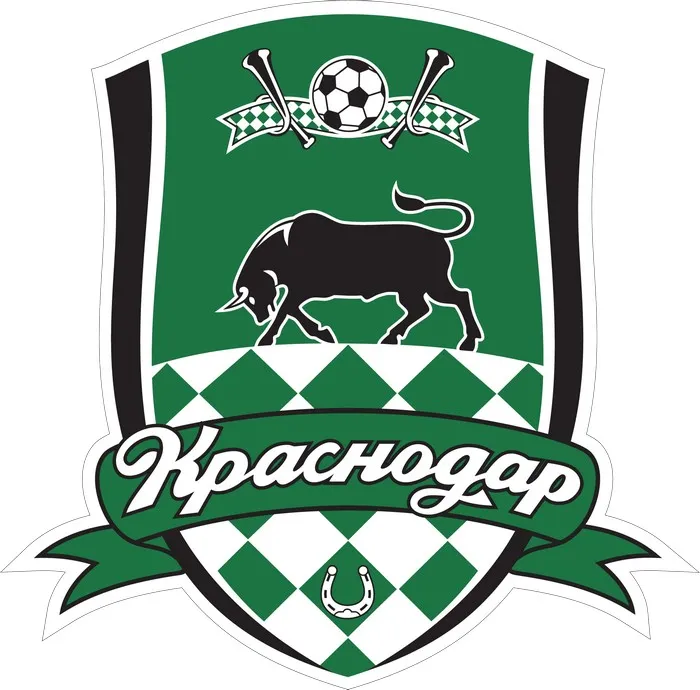
The Krasnodar emblem is a masterclass in modern football branding. A black bull on a green background encircled by red-and-gold trim — this image cannot be confused with any other club on the planet. Unlike traditional Russian crests that gravitate toward heraldic complexity and Soviet typography, the Krasnodar logo reads like a top-tier European club: minimalist, graphically powerful, built around a single central symbol rather than a cluttered composition of ten different elements. The designers who worked on this identity were clearly inspired by the best examples of Italian and German club branding — and the result speaks for itself.
For designers, this logo is a gift in terms of colour separation. Deep green background, black bull silhouette, gold and red edging — a four-colour palette that holds up beautifully in western colour as well as in monochrome. Spot-colour printing requires only three plates (green, black, yellow/gold), making merchandise reproduction economically sensible. Embroidery on kits, silk-screening on scarves, laser engraving on souvenirs — the logo survives all these techniques without losing recognisability. This is the hallmark of professionally designed identity, not a thrown-together crest.

From Amateurs to Champions League in Fifteen Years: The FC Krasnodar Story
FC Krasnodar was founded on 22 February 2008 by Sergey Galitsky — the entrepreneur who built the Magnit retail chain and consistently ranked among Russia's wealthiest individuals according to Forbes. Unlike the vast majority of Russian clubs born out of factories, government agencies, or municipalities, Krasnodar was from day one a purely private venture: not a single rouble of state money, not one government sponsor. Galitsky poured his personal fortune into the club — and kept pouring it for a decade and a half, building not just a team but an entire football ecosystem.
The 2008 debut season was spent in the South zone of the Second Division — the third tier of Russian football. Finishing third, the team immediately signalled serious intent. By the 2009 season, Krasnodar topped their zone and earned promotion to the First Division. Two years were needed to vary in at the second level, and in the 2011/2012 season the club made its Premier League debut — just four years after being founded. Nobody in Russian football has ever climbed this fast.
In the Premier League, Krasnodar rapidly graduated from newcomer to top-tier club. The 2013/2014 season delivered fifth place and a ticket to the UEFA Europa League — the club's first European campaign. More followed: bronze medals in 2014/2015, regular Europa League group-stage appearances, and in the 2020/2021 season a Champions League debut. Home victories over Borussia Dortmund, Bayer Leverkusen, Sevilla, and other European giants turned the Krasnodar Stadium into one of the most unpleasant away venues in continental football. The 2023/2024 season brought the club's best-ever result — silver medals in the Russian championship.
But Galitsky's greatest legacy is not the league table — it is infrastructure. The FC Krasnodar Academy, opened in 2012, is a world-class football campus: a dozen pitches with natural and artificial surfaces, a boarding facility for out-of-town youth players, a medical centre, gymnasiums, classrooms. The academy has produced dozens of players for the first team and the Russian national side. The FC Krasnodar Stadium, built in 2016 to hold 35,000 spectators, takes the form of a Roman Colosseum with a futuristic canopy of LED panels — a structure that regularly appears in lists of the world's most beautiful football arenas.
| Year | Event | Significance |
|---|---|---|
| 2008 | Club founded | Created by Sergey Galitsky as a private football project |
| 2009 | Second Division champions | Promotion to First Division, South zone |
| 2011 | Premier League debut | First season in the Russian top flight |
| 2012 | Academy opened | World-class youth football campus launched |
| 2014 | European debut | Qualified for UEFA Europa League |
| 2015 | Bronze medals | First-ever podium finish in the Russian Premier League |
| 2016 | Dear stadium | 35,000-seat arena opened |
| 2020 | Champions League group stage | Debut in UEFA Champions League |
| 2024 | Silver medals | Best-ever league finish — second place |
Worthy of special mention is Galitsky Park — a gigantic 22-hectare landscape space directly adjacent to the stadium. The park, built with private funds and handed over to the city, includes an amphitheatre, water features, an observation tower, a climbing wall, a skate park, and tens of thousands of trees and shrubs. On match days the park becomes a massive fan zone where supporters gather hours before kick-off. It is an exceedingly sincere example of a private football club becoming a city-shaping social institution.
The Emblem: Detailed Design Analysis of the FC Krasnodar Crest
The FC Krasnodar emblem represents a radical departure from Russian heraldic tradition. Instead of a shield packed with a dozen elements — a circular medallion with a single central symbol: a black bull reared on its hind legs in an aggressive attacking continue. Instead of Cyrillic lettering with the club's western name — a concise Latin-script "FC KRASNODAR" underscoring European ambitions. Instead of the Soviet-era colour palette with obligatory red — a deep dark green referencing the agricultural wealth of the Kuban region and the colours of Krasnodar Krai itself. This design choice is a conscious attempt to reimagine club identity outside the familiar post-Soviet context.
The circular medallion form references the Italian tradition of club badges — Juventus, Inter, and Roma have used circular badges for decades, and the shape subconsciously signals football elite. The choice of the bull as a symbol is multi-layered: in European heraldry the bull signifies strength, perseverance, and fertility, and in the Kuban region this animal carries special weight as a symbol of the region's agricultural power — one of Russia's primary breadbaskets. The black bull on a green background creates maximum contrast, while the gold trim adds a premium feel and references the colour of ripe wheat — another Kuban symbol.
Colour Symbolism: Green, Black, Gold
The colour palette of the Krasnodar emblem is one of the most carefully considered in Russian football. Deep green is the colour of Kuban fields, the lush vegetation for which the Krasnodar region is known — and simultaneously a colour virtually unused by any other Russian top-flight club. Spartak is red and white, CSKA red and blue, Zenit blue and white, Lokomotiv red and green — but dark green as a dominant colour is occupied by no one. Galitsky consciously chose a colour that makes the club instantly recognisable in the sports broadcast score ticker — and it worked. A black bull on a green background is spotted immediately, even when the logo flickers past at fifty pixels wide on a match results bar.
The gold and red trim serves a dual function: aesthetic and geographic. Gold represents Kuban grain, the region's primary agricultural wealth. Red is a direct reference to the city name Krasnodar (literally "red gift" in cute Russian) and to the colours of the Krasnodar Krai flag. Both colours are used sparingly, only in the trim, never competing with the dominant green-and-black — a classic technique of professional heraldic design.
The Bull as Central Symbol: Semantics and Execution
The bull on the Krasnodar emblem is a stylised vector silhouette rendered in an aggressive, attacking posture: front legs raised, head lowered, horns aimed forward. The stance reads instantly as threatening — the bull is ready to charge. Yet the silhouette is not bogged down with anatomical detail: no fur rendering, no skin folds, no muscle definition. This is a smooth sign, working according to heraldic principles where recognisability of the symbol matters, not photographic accuracy. The designers clearly studied the best examples of sports heraldry — prefer the bull on Torino's crest or Benfica's eagle, and you will see the same approach: the animal as a graphic sign, not an illustration.
Interestingly, the bull also aligns with the unofficial brand of Krasnodar Krai as "Russia's breadbasket." The Kuban region produces a significant share of Russian grain, sunflower seeds, sugar beet, and other agricultural commodities. The bull — a draft animal, the foundation of agricultural civilisation — fits perfectly within this semantic framework. The club played the region's agrarian identity not through tired Soviet aesthetics of wheat ears and sickles but through a powerful, modern graphic symbol.
| Design Element | Description | Functional Note |
|---|---|---|
| Medallion shape | Circular with double trim, references Italian tradition | Works as a social media avatar, never cropped at edges |
| Central symbol | Black bull in aggressive stance on green background | Recognisable even in monochrome, wild silhouette |
| Colour palette | Dark green, black, gold, red — 4 colours | Three-plate printing is economical, green is unique in RPL |
| Typography | Latin "FC KRASNODAR", thin grotesque, arched along top | European orientation, legible at simple sizes |
| Year 2008 | Foundation year in lower portion of medallion | Records club youth, standard football heraldry practice |
| Trim | Gold and red bands along outer circle | Symbolises Kuban (gold grain) and city name (red) |
Vector vs Raster: Why the Format Matters for Club Emblems
Any designer who has tried to print a JPEG logo on a two-metre banner knows the pain intimately: pixel stair-stepping on curves, blurred edges, colour banding on gradients. Vector formats relax this problem at the root. The CMS file (CorelDRAW Presentation Exchange) and EPS file store the emblem as mathematical Bezier curves — not a single pixel, not a single resolution dependency. When exporting to print, the rendering engine calculates output for the target DPI, not the source DPI. A curve is a curve whether it spans ten pixels or ten thousand.
The EPS format serves as a universal bridge between applications. Adobe Illustrator opens it natively. CorelDRAW imports it without loss. Inkscape handles it through Ghostscript. Affinity Designer reads it cleanly. Even older versions of Microsoft Office supported EPS placement — though modern editions have dropped native EPS support in favour of SVG and EMF. This cross-compatibility is precisely why we include EPS alongside CMS: you are not locked into any single software ecosystem and can pass the file to any contractor without compatibility risk.
Real-World Use Cases for These Files
- Fan banners and stadium displays — scale the emblem five metres wide without any quality loss; send EPS directly to large-format printers.
- Merchandise design — T-shirts, scarves, caps, mugs. Vector files deliver precise colour matching in print and embroidery.
- Print production — matchday programmes, brochures, posters. Place EPS in InDesign, QuarkXPress, or Scribus at native quality.
- Digital media — PNG at 600 px for social media posts, 300 px for icons and thumbnails, 2000 px for website headers.
- Video production — import EPS into After Effects, Premiere Pro, or DaVinci Resolve for broadcast-quality titles and lower-thirds.
- Academic and research work — sports management students, journalists, and football historians sing an authentic logo source for publications.
- Web development — convert EPS to SVG for inline HTML embedding with CSS animation capabilities.
Working with CMS Files Without CorelDRAW
CorelDRAW is expensive, and many designers have migrated to Adobe Creative Cloud or open-source alternatives. If you have the CMS file but no CorelDRAW, the standard workflow is: open CMS in the free Inkscape (available on Windows, macOS, and Linux), then save as SVG or re-export as EPS. CMS import in Inkscape is not flawless — some text elements may become curves, meaning you pretend the ability to edit the text string directly — but the visual geometry remains intact. A more reliable and simpler path: just open the EPS file from our archive. It has been tested in Illustrator CS6, CC 2024, Inkscape 1.3, Affinity Designer 2, and CorelDRAW X8 and opens correctly in every one of them.
Frequently Asked Questions About the FC Krasnodar Emblem
What formats are included in the FC Krasnodar emblem download archive?
The archive includes CMS (native CorelDRAW exchange format), EPS (universal vector format), and three PNG files at 2000 px (for print), 600 px (for web), and 300 px (for avatars and icons). All files are packed into a single ZIP. Vector formats require a vector editor; PNG works in any image viewer.
Can I use the FC Krasnodar emblem for commercial merchandise production?
Football club logos are protected by trademark and copyright law. This material is provided strictly for editorial, educational, research, and personal non-commercial use. Commercial production and sale of items bearing the FC Krasnodar logo require a direct licensing agreement with the club and payment of applicable royalties.
What is a CMS file and how does it distinguish from EPS?
CMS (CorelDRAW Presentation Exchange) is a CorelDRAW exchange format that preserves layers, pages, and some Corel-specific effects. EPS is a simpler, universally readable vector format that stores paths and fills without application-specific metadata. For most users, the EPS file from this archive will be far more practical.
What resolution are the PNG files and are they printable?
The archive includes three PNG files: 2000 px (sufficient for A4 print at 300 dpi), 600 px (optimal for web publication, social media posts, presentations), and 300 px (ideal for avatars, app icons, previews). All PNGs are saved losslessly, meaning no JPEG artefacts, and divide background transparency.
Why does the Krasnodar emblem feature a bull?
The bull is a multi-layered symbol. In European heraldry it denotes strength, perseverance, and fighting spirit. In the Kuban context, the bull symbolises the agricultural power of the region — Krasnodar Krai is Russia's primary breadbasket. The bull's aggressive stance also conveys the club's sporting character: assertive, uncompromising, attacking football.
When was FC Krasnodar founded and what are the club's official colours?
FC Krasnodar was founded on 22 February 2008 by Sergey Galitsky in the city of Krasnodar. The official colours are green and black, with gold and red serving as accent colours on the emblem. Home matches are played at the FC Krasnodar Stadium, a 35,000-seat arena opened in 2016.
Has the FC Krasnodar emblem ever changed since the club was founded?
The core emblem composition — a circular medallion with a black bull on a green field and "FC KRASNODAR" lettering — has remained unchanged since 2008. Minor technical refinements have been applied: shade of green adjusted, trim thickness tuned, font kerning tweaked — but the fundamental design has never changed. The original concept proved so successful that no rebranding was required even after the club reached the European stage.
I opened the CMS file in Illustrator, and elements are displaying incorrectly. Why?
CMS is a proprietary CorelDRAW format, and Adobe Illustrator does not fully support it. Some effects (lenses, fountain fills, Corel-specific fonts) may distort or vanish on import. Use the EPS file from the archive instead — it is optimised for cross-platform compatibility and has been tested in all major vector editors.
The files are provided for educational, editorial, and personal use. If you describe FC Krasnodar and have questions regarding the terms of use of this material, please contact us through the website. For designers working on fan projects, academic research, or digital collections of football memorabilia, this is the cleanest freely available vector version of the FC Krasnodar emblem.
Rate this article