The Order of Victory: A Medal That Cost More Than a Fighter Plane

The Order of Victory was not mass-produced. It wasn't stamped from sheet metal. Each one was handcrafted at the Moscow Jewellery Factory by master jewellers. The materials alone — 174 diamonds totalling 16 carats, platinum for the star frame, gold for the laurel wreath, five synthetic rubies for the rays — made the order more expensive than the Yak-9 fighter. Not an exaggeration. Soviet accounting records confirm it.

Instituted on 8 November 1943 by decree of the Presidium of the Supreme Soviet, simultaneously with the Soldier's Order of Glory, the Order of Victory was the pinnacle of the Soviet award system. It wasn't for individual bravery. It was for strategic genius — awarded exclusively to the highest commanders of the Red Army and Allied forces for successful operations on the scale of one or several fronts that radically changed the situation in favour of the USSR.

Only 20 awards were ever made. Seventeen individuals received it. Three were awarded twice: Stalin, Zhukov, and Vasilevsky. One — Leonid Brezhnev — was posthumously stripped of the award in 1989 when it was determined that his 1978 award did not meet the statutory criteria. The order was never awarded again after the war, until Brezhnev's controversial decoration broke a 33-year silence.

Order of Victory — History and Design
The vector files in this download reproduce the Order of Victory as a design resource, not as a counterfeit. The order is protected by cultural heritage laws in several countries. Reproduce it for educational and artistic purposes — not for fraudulent sale as an original.

Design and Construction: What the Vector File Captures

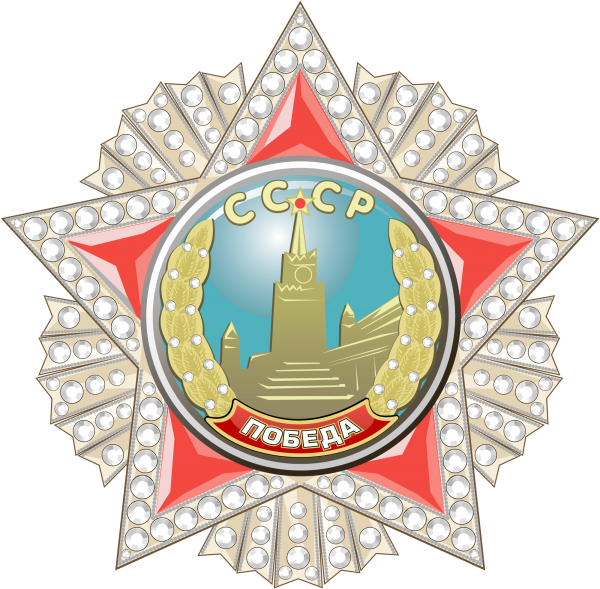
The Order of Victory is a convex five-pointed ruby star. Between the star's points are diverging rays studded with diamonds. The centre features a blue enamel medallion bordered by a laurel-oak wreath. Inside the medallion: a gold image of the Kremlin wall with Lenin's Mausoleum and the Spasskaya Tower. Above — the inscription СССР in white enamel. Below — ПОБЕДА on a red enamel ribbon.

The actual medal measures 72 mm across — the largest of all Soviet orders. The weight: 78 grams. The diamonds aren't scattered randomly. They form a precise geometric pattern in the rays between the star points, and they ring the central medallion. The vector file in this download reproduces this layout accurately.

ElementMaterialCount/DetailsVector Reproduction
Star framePlatinum5 points, convexGradient mesh with metallic sheen
Diverging raysPlatinum + diamonds174 diamonds, ~16 carats totalIndividual path objects with radial gradient
Central medallionBlue enamel + gold border31 mm diameterFlat colour + gold gradient ring
Kremlin sceneGold appliquéWall, Mausoleum, Spasskaya TowerDetailed paths with gold fill
InscriptionsWhite enamel (СССР), red enamel (ПОБЕДА)CyrillicConverted to curves (editable text)
Background starSynthetic ruby5 pointsRuby-red gradient with highlights

The Full List of Recipients

Every recipient of the Order of Victory earned it through a specific strategic operation. Here's the complete roll, in order of award date:

#RecipientRank at AwardDateOperation
1Georgy ZhukovMarshal of the Soviet Union10 Apr 1944Right-Bank Ukraine
2Aleksandr VasilevskyMarshal of the Soviet Union10 Apr 1944Right-Bank Ukraine
3Joseph StalinMarshal of the Soviet Union29 Jul 1944Liberation of Right-Bank Ukraine (collective)
4Zhukov (2nd)Marshal30 Mar 1945Vistula-Oder Offensive
5Vasilevsky (2nd)Marshal19 Apr 1945East Prussian Offensive
6Stalin (2nd)Generalissimo26 Jun 1945Victory over Germany
7Ivan KonevMarshal30 Mar 1945Liberation of Poland
8Konstantin RokossovskyMarshal30 Mar 1945Liberation of Poland
9Rodion MalinovskyMarshal26 Apr 1945Liberation of Hungary, Austria
10Fyodor TolbukhinMarshal26 Apr 1945Liberation of Hungary, Austria
11Leonid GovorovMarshal31 May 1945Defeat of German forces near Leningrad
12Semyon TimoshenkoMarshal4 Jun 1945Overall strategic planning
13Alexei AntonovArmy General4 Jun 1945General Staff planning
14Dwight D. EisenhowerGeneral of the Army (USA)5 Jun 1945Western Front operations
15Bernard MontgomeryField Marshal (UK)5 Jun 1945Western Front operations
16Michael I of RomaniaKing6 Jul 1945Romania's switch to Allies
17Michal Rola-ZymierskiMarshal (Poland)9 Aug 1945Liberation of Poland
18Kirill MeretskovMarshal8 Sep 1945Defeat of Japan (Manchuria)
19Josip Broz TitoMarshal (Yugoslavia)9 Sep 1945Liberation of Yugoslavia
20Leonid BrezhnevMarshal (revoked 1989)20 Feb 1978None — revoked posthumously

Five foreigners received the order — Eisenhower, Montgomery, King Michael I, Rola-Zymierski, and Tito. This was unprecedented in Soviet awards and signalled the USSR's recognition that the victory was a coalition effort, not a solo act.

\u{201c}

The Order of Victory is not just a decoration. It is a monument to the art of war at its highest level — where the fate of nations is decided on the map before a single soldier moves.

Georgy Zhukov, Marshal of the Soviet Union

How the Vector File Was Created

Reconstructing the Order of Victory in vector form is not trivial. The original medal is a three-dimensional object with complex light interaction — diamonds sparkle, platinum has a distinct grey-white lustre, ruby glows from within when backlit. A flat vector can't reproduce all of that. But it can capture the geometric precision and colour palette.

The vector file in this download was traced from a high-resolution photograph of the original order on display at the Central Museum of the Armed Forces in Moscow. The five-pointed ruby star establishes the primary geometry. From there, the 174 diamond positions were plotted along the ray lines using a radial array at 72-degree increments (360 divided by 5 points). The central medallion's gold laurel-oak wreath was traced leaf by leaf. The Kremlin scene — the wall crenellations, the Mausoleum's stepped profile, the Spasskaya Tower's silhouette — was reduced to its essential lines.

The result is a file that can be used for:

  • History textbook illustrations — scalable to any page format without pixelation
  • Museum exhibition graphics — printed at life size or larger for display panels
  • Documentary film graphics — animated individual elements (the rays, the inscription) for title sequences
  • Collector catalogue references — precise visual reference for authentication guides
  • Academic publications — journal articles and monographs on Soviet phaleristics
  • Wargaming and historical simulation — unit markers, award icons

Order of Victory vs Other Soviet Highest Awards

The Soviet Union had several "highest" awards, each serving a different purpose. Understanding the hierarchy puts the Order of Victory in context:

AwardInstitutedPurposeTotal AwardsMaterialsPosition in Hierarchy
Order of Victory1943Strategic military leadership20Platinum, diamonds, rubies, goldHighest military
Hero of the Soviet Union (Gold Star)1934Personal heroism or achievement12,777GoldHighest title
Order of Lenin1930Exceptional service (civil/military)~431,000Gold, platinum, enamelHighest civilian
Order of the October Revolution1967Revolutionary service~106,000Silver, gold, enamelSecond highest civilian
Order of Glory (1st class)1943Personal battlefield bravery~2,620GoldHighest soldier's
Order of the Red Banner1918Combat bravery~580,000Silver, enamelFirst Soviet order

The Order of Victory stands apart not just in materials but in concept. It wasn't about individual courage — that was the Order of Glory's domain. It wasn't about political loyalty — the Order of Lenin covered that. It was about the intellectual act of commanding armies across hundreds of kilometres and winning.

The Brezhnev Controversy and Posthumous Revocation

On 20 February 1978, Leonid Brezhnev was awarded the Order of Victory. The citation cited his "outstanding contribution to the victory of the Soviet people and its Armed Forces in the Great Patriotic War." At the time, Brezhnev was a 19-year-old political worker in 1941 — a brigade commissar, later a colonel. He served honourably, but no military historian would argue he commanded operations on the scale required by the order's statute.

The award was widely seen as part of Brezhnev's cult of personality — a period when the General Secretary accumulated over 200 medals and orders, including four Hero of the Soviet Union stars (only Zhukov had four, and his were for genuine military achievement). On 21 September 1989, Mikhail Gorbachev signed a decree of the Presidium of the Supreme Soviet revoking Brezhnev's Order of Victory "as contradicting the statute of the order."

This posthumous revocation is unique in the history of Soviet awards. No other major decoration was ever stripped from a recipient after their death by an act of state. It serves as a cautionary note about the politicisation of military honours — and as a footnote that makes the Order of Victory's history even more compelling to collectors and historians.

Using the Vector in Modern Design Projects

The Order of Victory appears in unexpected places in contemporary design:

  • Book covers — military history, Cold War studies, biography. The order's distinctive shape is instantly recognisable.
  • Video games — strategy games and historical simulations use medal icons for achievements and unit badges.
  • Museum apps — interactive guides where visitors can zoom into high-resolution reproductions of exhibits.
  • Commemorative materials — Victory Day (9 May) posters, banners, social media graphics. The order is a core symbol of the celebration.
  • Numismatic catalogues — illustrated references for collectors with precise scale reproductions.
  • Educational content — YouTube documentary thumbnails, infographics about WWII, classroom materials.

The CDR format is the most feature-complete for CorelDRAW users. The EPS is the universal exchange format. The PDF is instant print-ready. The PNG files at 2000 px, 600 px, and 300 px cover web use, presentation slides, and thumbnail sizes respectively.

Download medal-orden.zip~6 MB
All formats — CDR, EPS, PDF, and three PNG sizes — are in one archive. Extract and use whichever you need. No separate downloads, no paywalls, no registration.

Design Techniques: Styling the Order Vector for Different Media

The raw vector file is just a starting point. Here are techniques proven on real projects. For a historical portfolio website, a monochrome version works well — remove all colours, keep outlines, add a subtle drop shadow. The order becomes graphic, austere, readable on white backgrounds. For a Victory Day poster, add a ruby-red outer glow effect simulating internal illumination. The gradient-based vector file allows this without switching to Photoshop. For After Effects animation, import the EPS, separate into layers (star, rays, medallion, inscriptions), animate each with a 0.2-second delay. The result is an assembly effect. For a minimalist logo, remove everything except the five-pointed star and the ПОБЕДА inscription. Enough for recognition, not overloaded with detail.

FAQ

When was the Order of Victory instituted?

The Order of Victory was instituted on 8 November 1943 by decree of the Presidium of the Supreme Soviet of the USSR, simultaneously with the Soldier's Order of Glory. The ribbon design and wearing regulations were approved on 18 August 1944.

How many Orders of Victory were awarded?

Twenty awards in total, to seventeen individuals. Three recipients — Stalin, Zhukov, and Vasilevsky — were awarded twice. Leonid Brezhnev received it in 1978, but the award was posthumously revoked in 1989.

What materials is the Order of Victory made from?

The order is made of platinum (star frame), gold (wreath and central applique), 174 diamonds totalling approximately 16 carats, and five synthetic rubies. Each order was handcrafted individually at the Moscow Jewellery Factory.

What file formats are in the download?

The archive medal-orden.zip contains the vector in CDR (CorelDRAW), EPS, and PDF formats, plus three PNG renders at 2000 px, 600 px, and 300 px with transparent backgrounds.

Who were the foreign recipients of the Order of Victory?

Five non-Soviet citizens received the order: General Dwight D. Eisenhower (USA), Field Marshal Bernard Montgomery (UK), King Michael I of Romania, Marshal Michal Rola-Zymierski (Poland), and Marshal Josip Broz Tito (Yugoslavia).

Why was Brezhnev's Order of Victory revoked?

In September 1989, the Presidium of the Supreme Soviet determined that Brezhnev's 1978 award did not meet the statutory requirements of the order, which demanded successful command of operations on the scale of one or several fronts. The decree of revocation was signed under Gorbachev.

How large is the actual medal?

The Order of Victory measures 72 millimetres across — the largest of all Soviet orders. It weighs approximately 78 grams. For comparison, the Order of Lenin is 38 mm across.

Can I edit the vector file?

Yes. The CDR and EPS files are fully editable. You can change colours, extract individual elements (rays, medallion, inscription), resize, or adapt for your design project. Illustrator, CorelDRAW, and Inkscape all work.

Is this vector suitable for laser engraving?

The EPS can be adapted for engraving. You'll need to simplify the gradients into solid fills and adjust line weights for your engraver's specifications. The geometric structure — the star, rays, and medallion — converts well to engraving paths.

Where can I see the original Order of Victory?

Several originals are on display: the Central Museum of the Armed Forces in Moscow holds some, the Diamond Fund (Almazny Fond) in the Moscow Kremlin displays one, and Eisenhower's order is at the Eisenhower Presidential Library in Abilene, Kansas.

Tap to react