Order of the Red Banner of Labour — History, Symbolism, and Free Download in CDR, EPS, PDF, PNG
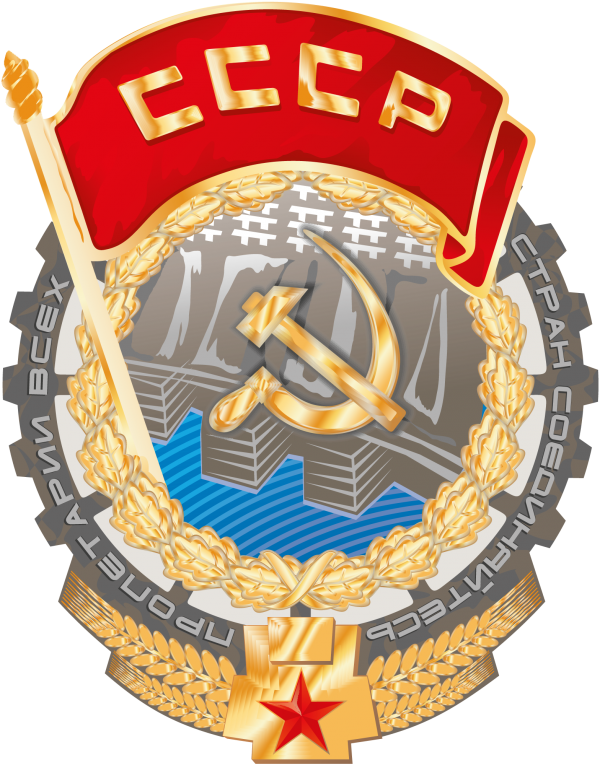
The Order of the Red Banner of Labour stands as one of the most significant civilian awards of the Soviet Union — a decoration that recognised extraordinary achievements in labour, scientific research, cultural production, and public service across more than six decades of Soviet history. Established in 1928, it predates even the Order of Lenin and represents the first all-Union order specifically dedicated to honouring productive work as a socialist virtue. The order's design is a concentrated expression of early Soviet visual ideology: a dark red enamel banner bearing the Cyrillic inscription "ПРОЛЕТАРИИ ВСЕХ СТРАН, СОЕДИНЯЙТЕСЬ!" (Workers of the World, Unite!) above the initials "СССР", a golden industrial gear framing the composition, sheaves of wheat symbolising agricultural abundance, and the omnipresent hammer and sickle and red star. A precise vector reproduction of the Order of the Red Banner of Labour enables historians, designers, educators, and collectors to work with this important symbol of Soviet labour ideology at any scale. This article traces the order's history, decodes its symbolic language, catalogues notable recipients, and provides direct download links for vector files in CDR, EPS, and PDF formats, plus high-resolution PNG images.
The Genesis of the Red Banner of Labour: Soviet Ideology of Work
The establishment of the Order of the Red Banner of Labour in 1928 occurred at a pivotal moment in Soviet history. The First Five-Year Plan (1928-1932) had just been launched, declaring an all-out campaign to transform the USSR from an agrarian society into an industrial superpower. The Soviet leadership understood that this transformation could not be achieved through coercion alone — it required a system of incentives, recognition, and symbolic rewards that would motivate millions of workers to exceed production quotas, innovate manufacturing processes, and embrace the ethos of socialist labour.
The order's precursor was the Order of the Red Banner of Labour of the RSFSR, established by the Russian Soviet Federative Socialist Republic in 1920 — at the height of the Civil War. That original order recognised not only labour achievements but also military valour, reflecting the wartime context in which productive labour was seen as inseparable from the defence of the revolution. The all-Union version, established by decree on 7 September 1928, narrowed the focus to civilian labour achievements, creating a clear distinction between military decorations (Order of the Red Banner, 1918) and civilian ones.
The symbolic importance of labour in Soviet ideology cannot be overstated. The Bolsheviks conceived of the October Revolution as the liberation of labour from capitalist exploitation. The hammer and sickle — adopted as the state emblem — represented the alliance of industrial workers (hammer) and peasants (sickle) that constituted the revolutionary class. The very name of the state — the Union of Soviet Socialist Republics — derived from the "soviets" (councils) of workers, peasants, and soldiers. In this ideological context, an order dedicated specifically to recognising labour achievements was not merely an administrative detail of the honours system but a declaration of the regime's fundamental values. Each award of the Red Banner of Labour was a public ritual that reinforced the Soviet claim that labour — not capital, not birth, not military conquest — was the true source of human dignity and social worth.
\u{201c}The Red Banner of Labour was more than a medal: it was a visible argument that the hammer-wielding worker and the tractor-driving peasant were the heroes of the new age, entitled to the same honours that the old regime had reserved for generals and aristocrats.
Design Evolution and Symbolic Components
The Order of the Red Banner of Labour underwent several design revisions during its 63-year history, though the core symbolic vocabulary remained remarkably consistent. The Type 1 design (1928-1936) featured a triangular red enamel banner at the top with the Cyrillic inscription, a silver gear below, and the hammer and sickle centred within the gear. The piece was suspended from a red ribbon with blue edge stripes. In 1936, a Type 2 version introduced a more elaborate composition: the banner became larger and more prominently folded, the gear was rendered in gold rather than silver, and wheat sheaves were added to frame the lower portion. The 1943 reform that standardised all Soviet orders on pentagonal suspension blocks produced the definitive Type 3 version that was awarded until 1991.
Each element of the order carries specific ideological meaning. The red banner with the revolutionary slogan is the most visually dominant element, proclaiming the order's allegiance to the international workers' movement. Its folds and shadows are rendered in the enamel itself, creating a trompe-l'oeil effect that animates an otherwise static metal object. The gear wheel — the defining visual motif of industrial civilisation — encircles the composition, identifying the proletariat as the order's primary constituency. Unlike the more generic laurel or wheat wreaths found on other decorations, the gear explicitly references factory production, machine building, and the physical infrastructure of modern industry.
The wheat sheaves at the bottom acknowledge the peasantry's contribution to socialist construction, creating a visual symmetry with the industrial gear above. Together, the gear and wheat form a complete circle that references both the unity of workers and peasants and the cyclical nature of production and harvest. The hammer and sickle at the centre serves as the state emblem, anchoring the entire composition. The small red star perched atop the banner functions as both a political symbol (the five-pointed star of communism) and a compositional device that draws the eye upward, creating a sense of aspiration and forward movement. The deep red of the banner — produced through multiple firings of translucent enamel over an engraved silver base — was technically identical to the enamel used in the Order of Lenin, and achieving uniform colour across large surfaces required extraordinary skill from the Moscow Mint's enamellers.
Notable Recipients and the Scale of Awarding
The Order of the Red Banner of Labour was awarded more than 1.2 million times between 1928 and 1991, making it one of the most frequently conferred Soviet orders. This high number reflects both the order's broad eligibility criteria and the Soviet practice of awarding orders to collective entities — factories, newspapers, theatres, scientific institutes, collective farms, and even entire cities and regions. The Kirov Plant in Leningrad (now St. Petersburg), one of the USSR's largest heavy machinery manufacturers, received the order multiple times for exceeding production targets. The Bolshoi Theatre, the Moscow State University, and the newspaper Pravda were among the cultural and educational institutions so honoured.
Among individual recipients, the spectrum ranged from celebrated figures of Soviet culture to ordinary workers whose extraordinary productivity was held up as a model for the nation. Maxim Gorky, the writer regarded as the founder of socialist realism, received the order. Dmitri Shostakovich, the composer whose relationship with the Soviet regime oscillated between acclaim and condemnation, was also a recipient. Beyond the famous names, the order recognised Stakhanovites — workers who dramatically exceeded production norms, named after the coal miner Alexei Stakhanov, who reportedly extracted 102 tonnes of coal in a single shift in 1935 (fourteen times the quota). The Stakhanovite movement became a nationwide campaign, and the Red Banner of Labour was its primary symbolic reward.
| Recipient | Year | Reason for Award |
|---|---|---|
| Kirov Plant, Leningrad | 1939 | Exceeding heavy machinery production targets |
| Bolshoi Theatre | 1937 | Contribution to Soviet theatrical art |
| Maxim Gorky | 1932 | Literary contributions to socialist realism |
| Moscow Metro | 1945 | Construction and operation of the metro system |
| Dmitri Shostakovich | 1940 | Composition of the Seventh Symphony (Leningrad) |
| Moscow State University | 1944 | Contributions to Soviet science and education |
| Pravda newspaper | 1945 | Role in wartime propaganda and information |
Archive Contents and Format Specifications
The downloadable Orden-trudovogo-krasnogo-znameni.zip archive contains the complete Order of the Red Banner of Labour across multiple formats optimised for different design workflows:
| Format | Extension | Primary Application | Compatible Software | Editability |
|---|---|---|---|---|
| CorelDRAW | .cdr | Professional print, engraving, signmaking | CorelDRAW X3+ | Full |
| Encapsulated PostScript | .eps | Offset printing, publishing, archival | Illustrator, CorelDRAW, Inkscape, Affinity | Full |
| Portable Document Format | Preview, client presentation, sharing | Any PDF viewer, Illustrator, Acrobat | Limited | |
| PNG (2000 px) | .png | High-resolution print layouts | Any raster editor or layout software | N/A |
| PNG (600 px) | .png | Web graphics, presentations, social media | Any image editor or viewer | N/A |
| PNG (300 px) | .png | Icons, thumbnails, reference images | Any image editor or viewer | N/A |
How to Download and Use
Click the download link below to obtain the archive. Extract the contents to your working directory for immediate use.
DownloadFrequently Asked Questions
When was the Order of the Red Banner of Labour established?
The order was established on 7 September 1928 by decree of the Central Executive Committee and the Council of People"s Commissars of the USSR. It was the first all-Union labour award and remained in use until the dissolution of the USSR in 1991.
What do the symbols on the order represent?
The red banner represents the socialist revolution; the gear symbolises industry and the working class; the wheat wreath represents agriculture; the hammer and sickle is the state emblem of the USSR; the red star symbolises the Red Army and communist ideals.
What formats are included in the download?
The archive Orden-trudovogo-krasnogo-znameni.zip contains the order in CDR, EPS, and PDF vector formats, plus high-resolution PNG images at 2000 px, 600 px, and 300 px with transparent backgrounds.
How many awards were issued?
Over 1.2 million Orders of the Red Banner of Labour were awarded between 1928 and 1991, making it one of the most frequently awarded Soviet orders. Recipients included individual workers, factories, collective farms, scientific institutes, and cultural organisations.
Can I use this vector for commercial projects?
Yes. The image is free for personal and commercial use including educational materials, publications, design projects, and merchandise without royalties or attribution requirements.
Which software opens CDR files?
CDR files open in CorelDRAW X3 or newer. The EPS files in the archive serve as complete replacements in Adobe Illustrator, Inkscape, and Affinity Designer for users without CorelDRAW.
What distinguishes this order from the Order of Lenin?
The Red Banner of Labour was established earlier (1928 vs 1930) and specifically focused on labour achievements. The Order of Lenin was the highest award covering all fields of service. The Red Banner of Labour features industrial and agricultural symbols (gear, wheat), while the Order of Lenin centres on Lenin"s portrait.
Can I edit the order in Inkscape?
Yes. The EPS file opens in Inkscape with editable paths. You can recolour the ribbon, adjust the gold metallic tones of the gear and wreath, or extract individual elements for use in composite designs.
What are the PNG resolutions?
PNG files at 2000 px (print quality), 600 px (web graphics), and 300 px (icons and thumbnails), all with transparent backgrounds for direct placement over any layout.
What was the physical size of the medal?
The Order of the Red Banner of Labour measures approximately 44 mm by 37 mm. The vector file preserves these exact proportions for reproduction at any scale from favicon to banner.
Production, Collecting, and Modern Significance of the Red Banner of Labour
The Order of the Red Banner of Labour was manufactured at the Moscow Mint and the Leningrad Mint. Like other Soviet orders with enamel elements, it required exceptional skill from enamellers. The red enamel on the banner was applied in multiple layers with intermediate firings at temperatures of 750-800 degrees Celsius. Each layer was ground smooth before the next was applied. Specimens with enamel defects were remelted — the Soviet awards system tolerated no compromises in state decoration quality.
Today, the order appears actively on the numismatic market. Well-preserved specimens range from to depending on type, condition, and documentation. Type 1 specimens (1928-1936) command higher prices due to rarity. For design practice, the vector image serves historical publications, museum catalogues, educational materials, and creative projects. Its industrial aesthetic offers rich opportunities for graphic reinterpretation, from constructivist-style retro posters to modern takes on Soviet visual culture. Download Orden-trudovogo-krasnogo-znameni.zip and begin working with this important historical symbol today.
Tap to react