Order of Lenin Vector — History of the Highest Soviet Award, Design Analysis, and Free Download CDR, EPS, SVG, PDF, PNG

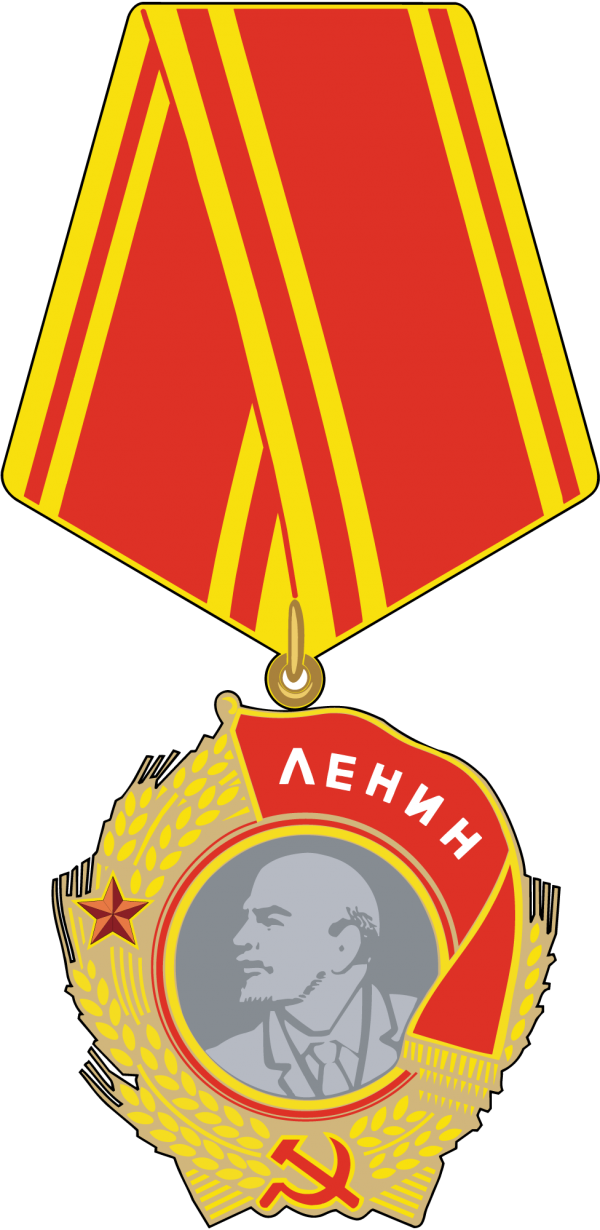
The Order of Lenin stands as the supreme civilian decoration of the Soviet Union, awarded from 1930 until the state's dissolution in 1991. Conceived as the pinnacle of the Soviet honours system, it recognised exceptional service to the socialist state — achievements in science, industry, agriculture, arts, military leadership, and public service that advanced the goals of the USSR. The medal itself is a masterpiece of decorative art and precision metallurgy: a gold-bordered medallion bearing a platinum profile portrait of Vladimir Lenin, framed by a ruby-red enamel star, a golden wheat wreath, and a red banner bearing the leader's name in Cyrillic gold letters. A high-quality vector reproduction of the Order of Lenin enables historians, designers, educators, and collectors to work with this iconic symbol at scale — whether for publication illustration, educational display, design reference, or creative reinterpretation. This article provides a comprehensive history of the award, a detailed analysis of its evolving design, and direct download links for the Order of Lenin in CDR, EPS, SVG, and PDF vector formats, plus high-resolution PNG images.

Historical Context: The Creation of the Order of Lenin

By the late 1920s, the Soviet Union had accumulated several state awards, including the Order of the Red Banner (established 1918 for military valour) and the Order of the Red Banner of Labour (established 1928 for labour achievements). However, no single decoration encompassed the full spectrum of service to the Soviet state — no equivalent to the highest honours of other nations. In early 1930, the Presidium of the Central Executive Committee resolved to create an all-encompassing supreme award. On 6 April 1930, the decree establishing the Order of Lenin was signed. The statute declared that the order would be awarded for "exceptional services in the field of socialist construction" — a deliberately broad formulation that permitted recognition across every domain of Soviet life.

The first design, known as Type 1 (1930-1932), was radically different from the familiar later version. It featured a silver, industrial-looking composition: a central roundel with Lenin's profile surrounded by factory smokestacks, a tractor, and construction scenes — a constructivist aesthetic reflecting the Five-Year Plan era's obsession with industrialisation. The letters "CCCP" (USSR) appeared at the bottom, and the piece was struck in silver rather than gold. Only about 700 Type 1 orders were minted before the design was revised. Today, surviving Type 1 specimens are among the rarest and most valuable Soviet decorations in the collectors' market, with auction prices regularly exceeding 50,000 US dollars for well-preserved examples.

\u{201c}

The Order of Lenin represents the intersection of state ideology, precious metal craftsmanship, and industrial design — a physical object whose every element was scrutinised by the highest levels of Soviet power before approval.

In 1934, a Type 2 design was introduced that established the visual vocabulary we associate with the order today. The constructivist smokestacks were replaced by a radiant gold wreath of wheat ears — an agricultural motif referencing both the Soviet Union's breadbasket identity and the classical iconography of triumph. The central medallion now featured only Lenin's portrait, executed in platinum and set against a dark grey enamel background, framed by a gold border bearing the inscription "ПРОЛЕТАРИИ ВСЕХ СТРАН, СОЕДИНЯЙТЕСЬ!" (Workers of the World, Unite!). The most striking addition was the ruby-red enamel star in the upper left, which would become the order's defining visual signature. Further refinements produced Type 3 (1936-1943), suspended from a red ribbon bar, and Type 4 (1943-1991), the most commonly encountered version, which introduced the pentagonal suspension block standardised across all Soviet orders after 1943.

Symbolic Components of the Order of Lenin Design

Every element of the Order of Lenin carries deliberate ideological and aesthetic meaning. Understanding these components enriches the use of the vector file in any design or educational context:

The platinum portrait of Lenin. The central element is a profile of Vladimir Lenin facing left, executed in platinum — a metal rarer and more valuable than gold, symbolising the singular status of both the man and the award. The portrait was modelled after a photograph taken by Pyotr Otsup in 1918, showing Lenin in a three-quarter left profile. The platinum was applied as a thin foil pressed onto a silver base, creating a striking tonal contrast with the dark grey enamel background. The choice of platinum for the highest Soviet award deliberately placed Lenin above gold — the material of imperial Russian honours.

The ruby-red enamel star. The five-pointed red star in the upper left quadrant is the most visually arresting element of the composition. The star is filled with translucent ruby-red enamel — a technique requiring multiple firings at precisely controlled temperatures to achieve uniform colour without cracking. The red star, of course, is the universal symbol of communism, representing the five continents (or alternatively, the five fingers of the worker's hand) united under the red banner of revolution. Its placement — slightly overlapping the medallion — creates spatial depth in what is fundamentally a flat metal object.

The golden wheat wreath. Encircling the lower portion of the medallion, the wheat wreath serves dual symbolic functions. It represents agriculture — the economic foundation that Soviet ideology claimed to liberate from feudal and capitalist exploitation — and it echoes the laurel wreaths of classical antiquity, placing the Soviet order within the millennia-old tradition of victory crowns. The wheat ears are rendered in gold with remarkable precision, each kernel individually defined — a testament to the skill of the Moscow Mint's engravers.

The red enamel banner. Crossing the lower portion of the wreath is a folded red banner bearing the name "ЛЕНИН" in raised gold Cyrillic letters. The banner's folds and shadows are rendered in the enamel itself — darker red in the creases, brilliant scarlet on the raised surfaces — creating a trompe-l'oeil effect that simulates fabric in a rigid metal and glass medium. The banner explicitly names the award, ensuring that even at a distance or in monochrome reproduction, the order is immediately identifiable.

The hammer and sickle. At the very bottom of the composition, partially obscured by the banner, lies a small gold hammer and sickle — the state emblem of the USSR. Its placement is modest, almost an afterthought in the grand composition, yet its presence anchors the entire design in the specific ideological framework of the Soviet state rather than allowing it to float as generic decorative art.

Notable Recipients and Award Statistics

The Order of Lenin was awarded approximately 431,418 times between 1930 and 1991 — a surprisingly high number for a "supreme" award, explained by the Soviet practice of awarding orders to collective entities. Not only individuals but also factories, collective farms, military units, newspapers, scientific institutes, cities, and entire republics received the order. The newspaper Komsomolskaya Pravda was the first recipient on 23 May 1930. The first individuals honoured were a group of firefighters who extinguished blazing oil wells at the Maikop oil fields in 1931 — a civilian rescue operation that the Soviet press elevated to heroic status.

Among the most notable recipients: Nikolai Vavilov, the geneticist whose seed bank preserved global crop biodiversity (awarded 1931, later arrested and died in Stalin's purges); Sergei Eisenstein, the film director of Battleship Potemkin (awarded 1939); Yuri Gagarin, the first human in space (awarded 1961); Fidel Castro (awarded 1972); and Valentina Tereshkova, the first woman in space (awarded 1963). Multiple awards were possible — 11 individuals received the Order of Lenin an extraordinary eleven times each, including Marshal Dmitry Ustinov and aviation designer Alexander Yakovlev.

RecipientAward YearReason for Award
Komsomolskaya Pravda newspaper23 May 1930First recipient — "active assistance in strengthening the pace of socialist construction"
Maikop firefighting brigade1931Extinguishing oil well fires at Maikop fields
Yuri Gagarin14 April 1961First human spaceflight — Vostok 1 mission
City of Leningrad26 January 1945Heroic defence during the 872-day Siege of Leningrad
Moscow Metro1947Construction of the first metro lines
Valentina Tereshkova22 June 1963First woman in space — Vostok 6 mission
Fidel Castro1972Solidarity with the Soviet Union and socialist revolution
Artek Pioneer Camp1945Contribution to Soviet youth education

Archive Contents and Format Specifications

The downloadable Orden-Lenina.zip archive contains the complete Order of Lenin illustration across four vector and three raster formats:

FormatExtensionBest ApplicationSoftwareEditable
CorelDRAW.cdrProfessional print production, engravingCorelDRAW X3+Full
Encapsulated PostScript.epsOffset printing, editorial publishingIllustrator, CorelDRAW, Inkscape, AffinityFull
Scalable Vector Graphics.svgWeb, interactive media, responsive designAll browsers, Inkscape, Illustrator, FigmaFull
Portable Document Format.pdfPreview, client review, archivingAny PDF viewer, Illustrator, AcrobatLimited
PNG (2000 px).pngHigh-resolution print layoutsAny raster editorN/A
PNG (600 px).pngWeb hero images, presentationsAny image editorN/A
PNG (300 px).pngThumbnails, icons, referencesAny image editorN/A

How to Download and Use the Order of Lenin Vector

Click the download link below to obtain the archive. Extract to your working directory. All vector files contain the complete Order of Lenin illustration at original proportions.

Download
All PNG files feature alpha-channel transparency. The Order of Lenin appears on a completely clear background, suitable for direct placement over any colour, texture, or photograph in layout software or web design.
CDR files require CorelDRAW X3 (2005) or newer. Users without CorelDRAW should use the EPS or SVG formats — they contain identical vector data with identical visual results.
Inkscape users: the SVG file opens with full editability and preserved layer structure. You can isolate individual components — the star, the medallion, the banner — for selective editing or colour adjustment. Use Inkscape 1.2 or later for best compatibility.

Frequently Asked Questions

When was the Order of Lenin established?

The Order of Lenin was established on 6 April 1930 by decree of the Presidium of the Central Executive Committee of the USSR. It was the highest civilian award of the Soviet Union until its dissolution in 1991.

What materials are used in the Order of Lenin medal?

The central medallion features a platinum portrait of Lenin. The surrounding elements include gold, red enamel, and a ruby-red enameled star. The red banner shows the name LENIN in raised gold letters (Russian Cyrillic).

What formats are included in the download?

The archive Orden-Lenina.zip contains the Order of Lenin vector in CDR, EPS, SVG, and PDF formats, plus high-resolution PNG raster images at 2000 px, 600 px, and 300 px with transparent backgrounds.

Who received the first Order of Lenin?

The first recipient was the newspaper Komsomolskaya Pravda on 23 May 1930. The first individual recipients were firefighters who extinguished blazing oil wells at the Maikop oil fields in 1931.

Can I use this vector image in commercial projects?

Yes. The image is provided for personal and commercial use including educational materials, historical publications, design projects, and merchandise without royalty payments or attribution requirements.

What software opens CDR vector files?

CDR files open in CorelDRAW X3 or newer. The EPS and SVG files in the archive contain identical vector data and work in Illustrator, Inkscape, and Affinity Designer as complete replacements.

How many Orders of Lenin were awarded?

Approximately 431,418 Orders of Lenin were awarded between 1930 and 1991. Recipients included individuals, enterprises, military units, cities, regions, and entire republics of the USSR.

Can I edit the Order of Lenin vector in Inkscape?

Yes. The SVG file opens natively in Inkscape with full path editability. You can recolour the enamel elements, adjust the gold tones, or extract individual components of the medal for use in composite designs.

What is the physical size of the Order of Lenin medal?

The actual medal measures 38 mm in height by 38 mm in width at its widest point. The platinum portrait medallion is 25 mm in diameter. The vector file preserves these exact proportions at any scale.

Is the PNG file on a transparent background?

Yes. All PNG files at 2000 px, 600 px, and 300 px resolutions feature alpha-channel transparency. The Order of Lenin sits on a clear background for any layout purpose.

Tap to react