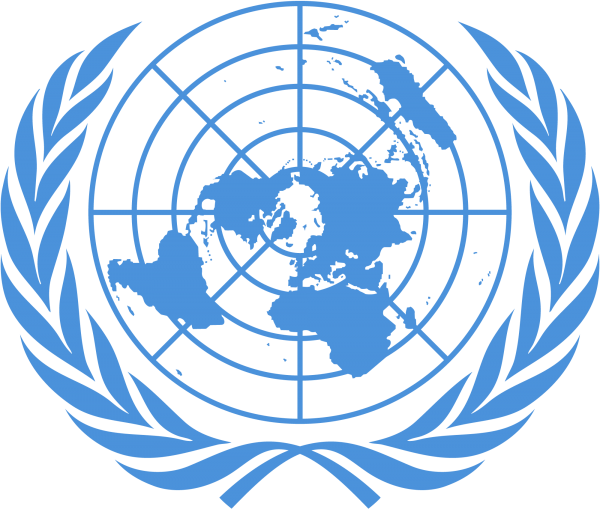
The emblem of the United Nations is among the most recognized symbols on the planet — a cartographic projection of the world embraced by olive branches, rendered in the unmistakable UN Blue against a white field. Designed in 1945 by a team led by Oliver Lincoln Lundquist working for the Office of Strategic Services, the emblem was prepared for the San Francisco Conference where fifty nations gathered to sign the UN Charter. The graphic designer primarily responsible for the map projection was Donal McLaughlin, who later recalled sketching the logo on a deadline measured in hours rather than days. We provide the official UN emblem in vector formats — EPS, SVG, CDR — and high-resolution PNG at 2000, 600, and 300 pixels. Whether you are preparing an academic presentation, designing an NGO publication, or developing a website that references the United Nations, these files give you professional-grade reproduction quality at any scale.
What makes the UN logo enduring after nearly eight decades is its ruthless economy of symbolism. Two olive branches — the ancient Greek and Biblical emblem of peace — cradle a world map projected from the North Pole. The pole-centric projection was a deliberate political choice: no single country gets to be at the visual centre. The map extends to 60 degrees south latitude, stopping before Antarctica, which at the time had no permanent population and whose inclusion might have emphasized colonial territorial claims. Blue was chosen as the opposite of red — the colour historically associated with war. The combination is instantly legible in any language, which is precisely the point for an organization with six official languages and 193 member states.
History of the UN emblem
The story begins in the spring of 1945. Franklin Roosevelt had died three weeks earlier. Harry Truman was president. In Washington, the OSS — precursor to the CIA — assembled a Presentations Branch under the direction of Lundquist, an architect by training. Their task was to produce all the graphical material for the upcoming United Nations Conference on International Organization in San Francisco, scheduled to run from April 25 to June 26, 1945, and to culminate in the signing of the UN Charter.
McLaughlin was assigned the logo. He worked from an existing State Department design that showed a circular world map. His innovation was the azimuthal equidistant projection centred on the North Pole — a view that shows all continents at equal visual weight, with the Americas on the left, Eurasia on the right, and Africa below. The olive branches were added as a wreath around the map, drawing on a symbol that traces back to the fifth century BCE in Greek art and to the story of Noah in Genesis, where a dove returns with an olive leaf as proof of receding floodwaters.
\u{201c}The only way to ensure a world at peace is for the nations of the world to work together. The emblem says that without words.
The original design was approved for the San Francisco conference. In 1946, the first session of the UN General Assembly adopted the emblem as the official seal of the United Nations through resolution 92(I). A year later, resolution 167(II) adopted the UN flag — the white emblem on a light blue ground. The colour specification has been refined over the decades and is now generally matched to Pantone 2925. The flag proportions were set at 2:3 for outdoor use and 3:5 for indoor ceremonial displays.
One of the less-told stories of the emblem's creation involves the last-minute scramble in the OSS offices in Washington. McLaughlin's team worked through the night before the conference materials had to be shipped to San Francisco. The original sketches were done on tracing paper, and the final version was inked by hand — no computers, no vector software, just drafting tools and India ink. The fact that this analog design has translated so cleanly into digital vector formats is a testament to the discipline of mid-century graphic design.
Symbolism and design analysis
Every element of the UN logo carries meaning that has been reaffirmed through decades of international diplomacy. The design operates on multiple levels — cartographic, heraldic, and colour-symbolic — and each layer was deliberately chosen to project neutrality, universality, and peace. Here is a breakdown of the visual components and their historical origins:
| Element | Symbolism | Historical origin |
|---|---|---|
| World map (azimuthal projection) | Universal scope; all nations equal | Cartographic choice by McLaughlin, 1945 |
| Olive branches (left and right) | Peace, reconciliation | Ancient Greece & Biblical tradition |
| North Pole centre | No single nation at visual centre | Deliberate political neutrality |
| 60° S latitude cutoff | Focus on inhabited world | Excludes Antarctica (no population in 1945) |
| UN Blue (Pantone 2925) | Peace — opposite of red (war) | Chosen by Lundquist team |
| Circular composition | Unity, wholeness, global community | Classic diplomatic seal tradition |
The emblem has undergone subtle refinements over the decades. The most notable change came in the 1946 revision, which adjusted the map projection to show Argentina, Chile, and the southern tip of South America. An early version had truncated South America at roughly 40 degrees south latitude, and Latin American delegations at the first General Assembly objected strenuously, arguing that their nations were being symbolically erased from the world community. The correction was made, and the revised map has been the standard ever since.
Format comparison for designers
When you download the UN emblem, you get a ZIP archive containing three vector versions plus separate PNG renders at multiple resolutions. Each format serves a distinct purpose in a professional workflow. Knowing which one to use for which context saves time and ensures the best output quality:
| Format | Type | Best for | Editable? | Scalable? | Transparency? |
|---|---|---|---|---|---|
| EPS | Vector | Professional printing, Illustrator | Yes | Yes — infinite | Yes |
| SVG | Vector | Websites, HTML, responsive design | Yes | Yes — infinite | Yes |
| CDR | Vector | CorelDRAW workflows | Yes | Yes — infinite | Yes |
| PNG 2000 px | Raster | High-quality print, large posters | No | Up to native size | Yes |
| PNG 600 px | Raster | Web headers, presentations | No | Up to native size | Yes |
| PNG 300 px | Raster | Small icons, thumbnails, footers | No | Up to native size | Yes |
Usage rules and restrictions
The UN emblem is not in the public domain. General Assembly resolution 92(I) of 1946 prohibits the use of the UN seal and emblem without authorization from the Secretary-General. In practice, the enforcement has been nuanced. The UN distinguishes between uses that align with its principles and those that do not. Educational institutions, news organizations, and non-profit entities generally receive latitude for informational use. Commercial use — placing the emblem on merchandise, using it in advertisements, implying UN endorsement of a product or service — is a clear violation and the UN Legal Counsel has issued cease-and-desist letters in such cases.
The specific categories break down as follows:
- Permitted: educational materials, academic publications, news reporting that references UN activities, non-commercial NGO reports aligned with UN values, historical documentaries.
- Prohibited: commercial products, endorsements implying UN approval, alteration that changes the emblem's meaning, use in political campaigns, use on letterheads that could be mistaken for official UN correspondence.
- Requires permission: conference materials, exhibition displays, film and television productions, any use that could reasonably be interpreted as official UN endorsement.
The UN flag and its specifications
The UN flag consists of the white emblem centred on a light blue field. The official proportions are hoist to fly ratio of 2:3 — the same as most national flags. Indoor ceremonial flags use a 3:5 ratio. The blue is specifically UN Blue — a shade standardized across all UN offices, peacekeeping uniforms, and official publications. While Pantone 2925 is the common reference, the exact hex code for digital use is #009EDB, and the CMYK values are approximately C80 M0 Y10 K0. These numbers are not arbitrary; they were chosen after extensive testing to ensure the colour renders consistently across printing technologies, screen types, and fabric dyes used in flag manufacturing.
The flag flies at UN Headquarters in New York — a 39-story tower on the East River — at UN offices in Geneva, Vienna, and Nairobi, at peacekeeping missions worldwide from Cyprus to South Sudan, and at the headquarters of specialized agencies like UNESCO in Paris, WHO in Geneva, and FAO in Rome. It is also raised at national government buildings during UN Day — October 24 — in some member states, though this practice varies by country and has declined in recent decades.
Evolution of the design: 1945 to present
The UN emblem has remained remarkably stable compared to the logos of many international organizations. The core concept — polar map projection, olive branches, circular composition — has not changed since 1945. The changes have been technical rather than conceptual. Compare this to the WHO logo, which was redesigned in 1948 and again in the 1960s, or the UNESCO temple logo, which has gone through multiple iterations. The UN's visual restraint reflects its institutional identity: slow, deliberate, and built to outlast political fashions.
- 1945: Original San Francisco version, South America partially truncated at approximately 40°S.
- 1946: Map corrected to show all of South America; olive branches slightly repositioned for better visual balance.
- 1947: Flag adopted by resolution 167(II); UN Blue field formally specified.
- 1950s–1990s: Periodic minor vector cleanups as the emblem was reproduced for offset printing, then digital publishing.
- 2000s–present: Colour standardized to Pantone 2925; digital master files created for web and print distribution.
Working with the files in practice
If you open the EPS file in Adobe Illustrator, you will find clean, well-organized vector paths. The world map grid lines — latitude and longitude markers — are present in the vector and render accurately at any scale, from a postage stamp to a building-sized banner. The olive branches are composed of individual leaf shapes, each a closed path that can be recoloured independently if needed, though we recommend keeping the original white-on-blue colour scheme for any official-context usage.
For web developers, the SVG can be embedded inline with the img tag, or the SVG markup can be placed directly in the HTML document. The paths are reasonably optimized, though for production use you may want to run the file through SVGO to remove editor metadata and reduce file size by 20–40%. The CDR file is compatible with CorelDRAW X4 and later. Users who work primarily in Corel but need to export to other formats should consider opening the EPS file in Illustrator or Inkscape for the most reliable cross-format conversion — Corel's EPS import has historically been less reliable than Adobe's.
For print designers, the recommended workflow is: open EPS in Illustrator, set up your artboard at the target print dimensions, scale the emblem to size, and export as a press-ready PDF with bleeds if needed. The vector data will remain sharp at any DPI — 300, 600, 1200 — without pixelation.
The UN emblem in the digital age
The rise of the internet and social media has added new dimensions to the question of UN emblem usage. In the 2000s, the UN launched its own web portal and began a more active digital presence. This required the creation of clear guidelines for logo use in digital environments: minimum display sizes, clear-space rules, and prohibitions on aspect-ratio distortion during resizing. Today, un.org hosts a dedicated section on the organization's visual identity, covering everything from PowerPoint templates to social media avatar specifications.
Film and video game usage of the UN emblem is a separate challenge. Hollywood routinely depicts UN Headquarters in New York on screen, with the emblem visible — producers typically coordinate this with the Department of Global Communications. Video games present a more complex situation: use of the UN emblem generally requires special permission, and not all studios obtain it. This is why many games feature fictional international organizations with similar but non-identical logos — developers simply do not want to deal with the legal exposure.
For a designer working on a project featuring the United Nations, the practical advice is straightforward: download the vector files from our archive, study the official visual identity guidelines on un.org, and — if the project has any commercial dimension whatsoever — contact the UN press office. Better to spend a week on clearance than to receive a letter from the lawyers of an international organization.
Why the design endures
In an era when corporate logos change every five to ten years chasing trends of minimalism or maximalism, the stability of the UN emblem is striking. The reason is not simply bureaucratic conservatism — though that plays a role — but the fact that the design is built on archetypal symbols that are immune to fashion. A world map, an olive branch, a circle — these are visual archetypes understood by any human being, of any culture, at any level of education, in any era. McLaughlin and Lundquist may not have framed it in Jungian terms, but they intuitively hit the mark.
A second factor is the functional honesty of the design. There is nothing extraneous in the emblem. No decorative elements that could be removed without losing meaning. No typographic choices that would age poorly with the next generation of typefaces. There is only the map and the branches — two elements whose symbolism does not weaken but only strengthens with each decade of the organization they represent.
FAQ
Who designed the UN emblem?
Donal McLaughlin, an American architect and graphic designer with the OSS Presentations Branch, designed the map projection in 1945 under the direction of Oliver Lincoln Lundquist. The team prepared all visual materials for the San Francisco Conference where the UN Charter was signed. McLaughlin later recalled working through the night before the deadline, sketching the final version on tracing paper with drafting tools and India ink.
What does the UN logo symbolize?
A world map centred on the North Pole represents the universality of the United Nations — all peoples, all nations, under one visual umbrella. Two olive branches forming a wreath around the map symbolize peace, a motif originating in ancient Greek and Biblical traditions. The UN Blue colour was chosen as the opposite of red, which is historically associated with war and bloodshed.
What vector formats are available for download?
The ZIP archive emblema_oon.zip contains three vector formats: EPS for Adobe Illustrator and professional printing, SVG for web use and browser rendering, and CDR for CorelDRAW workflows. All three formats preserve the full vector data with infinite scalability and transparency support.
What PNG sizes are included in the download?
Three PNG sizes are provided with transparent backgrounds: 2000 pixels for high-resolution print and large displays, 600 pixels for website banners and presentation slides, and 300 pixels for thumbnails, favicons, and small footer placements. All maintain crisp clarity at their native resolutions.
Can I use the UN logo for commercial purposes?
Generally no. General Assembly resolution 92(I) of 1946 restricts commercial use of the UN emblem. The emblem may be used for educational, journalistic, and informational purposes that align with UN principles and do not imply endorsement. Any commercial application requires explicit written authorization from the UN Secretary-General's office.
When was the UN flag adopted?
The UN flag was officially adopted on October 20, 1947, through General Assembly resolution 167(II). It features the white UN emblem centred on a light blue field. The outdoor flag has a 2:3 hoist-to-fly ratio, while indoor ceremonial flags use a 3:5 ratio.
Is the world map on the logo geographically accurate?
The azimuthal equidistant projection centred on the North Pole is mathematically accurate for the area it covers. However, it intentionally excludes Antarctica below 60 degrees S latitude. This projection was chosen to give all populated continents equal visual prominence without centring any single country.
How do I use the SVG version on a website?
Embed the SVG directly in HTML using the standard img tag, or copy the SVG markup inline for CSS-stylable rendering. For optimal performance, run the file through SVGO to strip editor metadata and reduce file size. The vector data scales perfectly at any screen resolution from mobile phones to 4K monitors.
What is the exact UN Blue colour specification?
The official reference is Pantone 2925. For digital use, the hex code is #009EDB, and the RGB values are R0, G158, B219. For CMYK print, the approximate values are C80, M0, Y10, K0. These specifications are used consistently across all UN communications.
Has the UN emblem changed since it was created?
The core design has remained stable since 1945 — a rare feat in institutional branding. The only significant revision occurred in 1946 when the map projection was corrected to fully show South America after Latin American delegations objected. Subsequent changes have been limited to technical refinements for digital reproduction and colour standardization to Pantone 2925.
Tap to react