The Peoples' Friendship University of Russia — RUDN — is one of Russia's most recognizable university brands and the country's largest international educational centre. Founded in 1960 to train personnel from developing countries in Asia, Africa, and Latin America, RUDN has transformed into a global research university ranked among the world's top 500. On its campus in southwest Moscow, students from over 150 countries study side by side, with up to 80 languages heard in the corridors simultaneously. We provide the vector emblem of RUDN in CMX, EPS, and SVG formats bundled in emblema_rudn.zip, plus high-resolution PNG at 2000, 600, and 300 pixels. Whether preparing an international conference presentation, formatting a thesis, or building a student organization website, these files deliver professional quality.
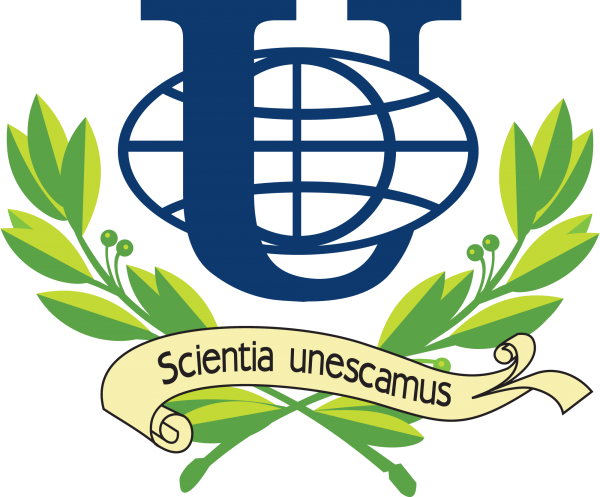
The RUDN emblem is a classic example of Soviet-era university heraldry that survived transformation and remains relevant. At the composition's centre is a stylized globe with a coordinate grid, directly referencing the university's mission: education without borders, science for the whole world. The globe is framed by laurel branches — the symbol of academic achievement dating back to the ancient tradition of crowning victors with laurel wreaths. At the bottom is an open book, the universal symbol of knowledge and enlightenment. The blue-and-gold palette, standard for academic institutions, emphasizes the university's status. Taken together, the message is instant: this is a place where people from around the world learn, and the quality of that education is time-tested.
History of RUDN: from Lumumba to the present
The decision to create the Peoples' Friendship University was made by the USSR Council of Ministers on February 5, 1960. This was a period of active decolonization: dozens of Asian and African countries were gaining independence, and the Soviet Union sought to strengthen its influence by training national personnel. The university was named after Patrice Lumumba, the first prime minister of independent Congo, who was assassinated in 1961. The first 539 students from 59 countries began classes in 1961 at the preparatory faculty, where they studied Russian — without which further education was impossible.
The university's rapid growth was remarkable. By the late 1960s, it had become a full-fledged university with its own campus, dormitories, clinics, and sports facilities. Students from Africa, Asia, and Latin America lived and studied alongside Soviet students — a unique intercultural experience at a time when foreign travel was inaccessible to most Soviet citizens. In 1992, after the dissolution of the USSR, the university was renamed the Peoples' Friendship University of Russia. The name change did not alter its essence — the international vector remained central.
Today, RUDN is a comprehensive academic and research institution with an annual budget exceeding 5 billion roubles, a staff of over 2,000 faculty and researchers, and a student body approaching 30,000. The university offers bachelor's, master's, doctoral, and residency programmes across a broad spectrum — from medicine and engineering to international relations and linguistics. The globe logo on the facades of its buildings is a daily reminder to tens of thousands of students that they are part of a global academic community.
Symbolism and heraldry
| Element | Symbolism | Historical origin |
|---|---|---|
| Globe | International reach, global education | Globalist rhetoric of the 1960s |
| Laurel branches | Academic achievement, victory of knowledge | Ancient Greece, Olympic tradition |
| Open book | Knowledge, enlightenment, science | Universal symbol of education |
| Blue-and-gold palette | Academic status, higher education affiliation | Traditional university heraldry |
| Coordinate grid | Scientific approach, precision, global scope | Cartographic tradition |
Formats and their applications
| Format | Type | Purpose | Editable | Scalable |
|---|---|---|---|---|
| CMX | Vector | CorelDRAW, exchange | Fully | Lossless |
| EPS | Vector | Print, Illustrator | Fully | Lossless |
| SVG | Vector | Web, HTML, responsive | Fully | Lossless |
| PNG 2000 px | Raster | High-quality print | No | Up to 2000 px |
| PNG 600 px | Raster | Websites, presentations | No | Up to 600 px |
| PNG 300 px | Raster | Icons, thumbnails | No | Up to 300 px |
RUDN in numbers and facts
Over more than six decades, the Peoples' Friendship University has trained over 200,000 specialists for 170 countries worldwide. Alumni include presidents, prime ministers, ministers, diplomats, doctors, and engineers working on every continent. The RUDN Alumni Association counts tens of thousands of members and is actively active in Africa, the Middle East, Southeast Asia, and Latin America. This is not just a university — it is a global network of professionals united by a shared educational experience.
The RUDN campus on Miklukho-Maklaya Street in Moscow covers more than 50 hectares. It includes academic buildings, hotel-style dormitories, a medical centre, a sports complex with a swimming pool and stadium, its own internet service provider, a clinic, and even a post office. For international students arriving from hot climates, Soviet architects designed covered walkways between buildings to minimize exposure to freezing temperatures. The university infrastructure is a separate page of architectural and urban planning history.
Practical recommendations
When working with the RUDN logo in vector, pay attention to the following points. First, do not alter globe proportions — it must remain circular, not elliptical after scaling. Hold Shift while resizing in Illustrator or CorelDRAW. Second, do not substitute the blue colour for other shades — the university blue is part of the corporate identity and is protected by the brand guide. Third, when placing on a coloured background, use PNG with a transparent background or the vector format to avoid a white square around the logo.
For RUDN students and staff preparing thesis defences, conference presentations, or publications: you have every right to use the official university logo in an academic context. Place it in the corner of a slide or on the title page — this lends official status to the work and visually connects it to the university brand. For external organizations collaborating with RUDN: obtain permission from the university press office before using the logo, especially for public events or printed materials.
RUDN's role in educational diplomacy
RUDN occupies a unique niche in the Russian higher education system — one that no other institution fills, not Moscow State University, not St. Petersburg State University, not the Higher School of Economics. This is the niche of educational diplomacy: training elites for developing countries as part of long-term cultural and political influence. When a RUDN graduate becomes a health minister in Zambia, Guyana's ambassador to the UN, or dean of a medical faculty in Bangladesh, it is not merely personal success — it is a dividend for Russian influence in the region, one that cannot be measured in monetary terms but is entirely real in geopolitical dimensions.
The Soviet model on which the university was built in the 1960s was pragmatic and far-sighted. Students from developing countries received not just a diploma but a full higher education to Soviet standards — with strong fundamental training, practice at leading institutions, and immersion in Russian culture and language. A graduate returned home not merely as a specialist but as a bearer of a specific cultural code, later transmitted through their professional and political activities. This model proved so successful that China borrowed elements of it when creating its own programmes for African students in the 1990s and 2000s.
Today, in an era of intense geopolitical competition for minds and loyalties, RUDN once again serves as a tool of what political scientists call soft power. The globe logo we provide for download symbolizes precisely this mission: education as a bridge between cultures and civilizations. Every time this logo appears in an international conference presentation, on a foreign graduate's diploma, or on the website of a joint research project, it reminds us: national borders are lines on a map, but the boundaries of knowledge have no such lines.
How RUDN's international character influences its design
From a graphic design perspective, the RUDN emblem is interesting because it must read equally well in vastly different cultural contexts. The blue-gold palette, the globe, the laurel branches — these symbols are understood by a student from Nigeria, a lecturer from Vietnam, and an applicant from Bolivia alike. Unlike many European and American university coats of arms, which often contain specific local symbols (particular buildings, patron saints, historical figures), the RUDN emblem is deliberately universal. This is a smart design choice that continues to work six decades after the logo's creation.
For designers working with this logo, this means additional responsibility. When adapting the emblem for different media and audiences, it is important to preserve its universal character: do not add local cultural markers, do not change the colour scheme for national preferences, do not distort the globe's proportions. The RUDN logo derives its strength from its supranational character, and any attempt to localize it only weakens the brand.
Academic programmes and research schools
The university today comprises twenty-two faculties and institutes, united in a single structure but retaining academic autonomy. The RUDN Medical Institute trains physicians to standards recognized by the World Health Organization, and its graduates successfully pass licensing examinations in the United States (USMLE), the United Kingdom (PLAB), India (MCI), and other countries. The Engineering Academy conducts research in space technologies and nanomaterials. The Law Institute is known for its school of international law, sought after by diplomatic services of dozens of countries. The Agrarian-Technological Institute develops agricultural technologies for tropical and subtropical climates — a field in which Russia, a predominantly temperate-climate country, would at first glance seem to lack competence, but which RUDN has successfully cultivated for half a century.
RUDN's research schools deserve special mention. The mathematics school, led by Academician Vladimir Filippov (who served as Russia's Minister of Education from 1998 to 2004 and as RUDN Rector), is known for its work in differential equations. The chemistry school — for research in catalysis and new materials. The medical school — for work in tropical medicine and infectious diseases specific to regions of Africa and Southeast Asia. This is not abstract science: research results are implemented in clinical practice in the students' and postgraduates' home countries, creating a real, measurable contribution to global healthcare.
Why a vector logo matters for an international university
In an international context, a university logo performs a function that is often underestimated. It is not just a pretty picture but an element of institutional trust. When Zambia's Ministry of Education or a Malaysian university rectorate receives a document bearing the RUDN logo, that logo instantly communicates: this is an official document from a recognized university with a sixty-year history. A low-resolution raster logo printed on an office printer conveys the exact opposite impression — sloppiness and unprofessionalism. The vector EPS from our archive, by contrast, ensures impeccable quality in any reproduction method.
This is why we recommend that everyone working with RUDN documents — whether a joint scientific publication, a conference invitation, or a thesis — download the vector version of the logo. Do not use screenshots from the website. Do not cut the logo from PDFs of unknown origin. Download the official vector from emblema_rudn.zip and be confident that every line, every coordinate grid point, and every shade of blue matches the university's corporate identity.
What is RUDN University?
The Peoples' Friendship University of Russia (RUDN) is one of Russia's leading universities, founded in 1960. It is known as the largest international educational centre in the country, with students from more than 150 countries. RUDN ranks in the top 500 globally according to QS World University Rankings.
What does the RUDN emblem symbolize?
The emblem features a stylized globe surrounded by laurel branches, with an open book at its centre. The globe symbolizes the university's international character, the laurel branches represent academic achievement, and the book stands for knowledge and education. The blue and gold palette is traditional for academic institutions.
What formats are available for the RUDN logo?
The logo is available in three vector formats — CMX (CorelDRAW), EPS (Encapsulated PostScript), and SVG (Scalable Vector Graphics), bundled in emblema_rudn.zip. High-resolution PNG is also provided at 2000, 600, and 300 pixels.
Why is SVG better for web use?
SVG is an XML-based text vector format that browsers render natively. It is lighter than EPS, supports CSS animation, and scales perfectly on any screen. For websites or web applications, SVG is the optimal choice.
How do I download the RUDN logo in PNG?
PNG versions are available in three resolutions. Files have transparent backgrounds and are ready for immediate use in presentations, websites, and documents. Click on the logo image to download the full-size version.
Can I use the RUDN logo in commercial projects?
The RUDN logo is a registered trademark of the university. Commercial use without permission is prohibited. Educational, informational, and scientific use is generally permitted, provided the logo's integrity is preserved.
What is the history of RUDN?
The university was founded on February 5, 1960, by decree of the USSR Council of Ministers. Originally named Patrice Lumumba Peoples' Friendship University, it was created to train personnel for countries in Asia, Africa, and Latin America. In 1992 it was renamed the Peoples' Friendship University of Russia.
How many countries are represented at RUDN?
As of 2024, RUDN has students and postgraduate researchers from more than 150 countries. The university has cooperation agreements with over 250 foreign universities and is one of Russia's most international higher education institutions.
What faculties does RUDN have?
RUDN comprises more than 20 faculties and institutes: medicine, engineering, economics, law, philology, agricultural technology, ecology, and others. The university trains specialists across a wide range of disciplines.
How do I convert CMX to EPS or SVG?
Open the CMX in CorelDRAW and export to EPS or SVG via the File > Export menu. For a free alternative, use Inkscape with installed CMX import plugins. Note that some Corel-specific effects may be simplified during conversion.
Tap to react