Vector Emblem of the Ukrainian Navy — History, Symbolism, and Free Download in CMX, EPS, PNG
The Ukrainian Navy (Viiskovo-Morski Syly Zbroinykh Syl Ukrainy — VMS ZSU) is the maritime component of the Armed Forces of Ukraine, responsible for defending Ukraine's maritime interests in the Black Sea and the Sea of Azov, protecting its coastline and territorial waters, and contributing to international maritime security operations. Its official emblem — a heraldic composition that combines Ukraine's national symbols with traditional naval iconography — represents the Navy's institutional identity, its connection to Ukraine's maritime heritage, and its role as a sovereign naval force. This comprehensive article provides the history of the Ukrainian Navy, a detailed analysis of its emblem's design and symbolic meaning, and direct download links for vector files in CMX and EPS formats, plus high-resolution PNG raster images.
Quick Reference Card
| Parameter | Details |
|---|---|
| Armed Force | Naval Forces of the Armed Forces of Ukraine (VMS ZSU) |
| Founded | April 1992 (modern); origins in Black Sea Fleet (1917–1921) |
| Commander | Vice Admiral (varies by appointment) |
| Operational area | Black Sea, Sea of Azov, Danube River, Dnieper River |
| Emblem type | Heraldic emblem of the Ukrainian Navy |
| Key symbols | Trident (Tryzub), anchor, naval crown, crossed cannons |
| Vector formats | CMX (CorelDRAW Exchange), EPS, high-res PNG |
1. The Ukrainian Navy: History and Development
1.1. Early Origins: The Ukrainian People's Republic Navy (1917–1921)
The modern Ukrainian Navy traces its institutional origins to the period of Ukraine's brief independence following the collapse of the Russian Empire. In December 1917, the Ukrainian Central Rada declared the establishment of the Ukrainian People's Republic (UNR) and asserted sovereignty over the Black Sea Fleet vessels stationed in Ukrainian ports, particularly in Sevastopol and Odessa. The Naval Ministry of the UNR was established, and the Ukrainian naval flag — a blue-yellow banner — was raised on several warships in the Black Sea Fleet.
On April 29, 1918, in a dramatic assertion of naval sovereignty, the commander of the Black Sea Fleet, Rear Admiral Mykhailo Sablin, ordered the raising of Ukrainian flags on all ships under his command in Sevastopol. This act, though short-lived (the fleet was subsequently seized by German forces under the terms of the Treaty of Brest-Litovsk), established a symbolic precedent that the modern Ukrainian Navy would later invoke as the founding moment of Ukraine's naval forces.
During the subsequent Civil War and Ukraine's loss of independence to Bolshevik forces in 1921, the Ukrainian naval forces were dissolved and absorbed into the Soviet Red Fleet. The majority of the Black Sea Fleet remained based in Crimea — primarily in Sevastopol — and operated as the Black Sea Fleet of the Soviet Navy throughout the Soviet period.
\u{201c}The raising of Ukrainian flags on the Black Sea Fleet by Rear Admiral Sablin in April 1918 remains one of the most symbolically powerful moments in Ukrainian naval history. Though the fledgling Ukrainian Navy of 1917–1921 was extinguished by the Soviet reconquest, the flag-raising in Sevastopol established an institutional memory that the modern Ukrainian Navy consciously invokes through its emblem and traditions.
1.2. The Modern Ukrainian Navy: Creation and Division (1991–2014)
Following Ukraine's declaration of independence on August 24, 1991, the question of the Black Sea Fleet's disposition became one of the most contentious issues between Ukraine and the Russian Federation. The fleet — numbering approximately 350 ships and vessels, plus naval aviation and coastal defense units — was divided through a protracted negotiation process that culminated in the Partition Treaty of May 28, 1997. Under this agreement, Russia received 81.7% of the fleet's vessels, while Ukraine received 18.3%, along with naval infrastructure in several Crimean ports.
The Ukrainian Navy was formally established in April 1992, with personnel who had sworn allegiance to Ukraine being organized into a new service branch. The initial fleet consisted mainly of smaller vessels — frigates, corvettes, minesweepers, landing ships, and auxiliary vessels — while Russia retained the most powerful surface combatants and submarines. The Sevastopol basing agreement allowed the Russian Black Sea Fleet to continue using its historical base in Sevastopol on a lease arrangement, while the Ukrainian Navy established its headquarters there as well, creating an unusual situation of two navies sharing the same port city.
1.3. Post-2014: Transformation and Modernization
The 2014 Russian annexation of Crimea was a catastrophic blow to the Ukrainian Navy. Russia seized approximately 70% of Ukraine's naval vessels that were stationed in Crimean ports, along with naval infrastructure, warehouses, and headquarters facilities. The sailors and officers who remained loyal to Ukraine evacuated with the vessels that could be moved to Odessa, which became the new main base of the Ukrainian Navy.
In the years since 2014, the Ukrainian Navy has undergone a comprehensive modernization program, transitioning from a predominantly Soviet-legacy force to a modern navy capable of operating alongside NATO forces. This transformation includes the introduction of Island-class patrol boats transferred from the United States, Turkish-built Ada-class corvettes under the "Hetman Ivan Mazepa" program, British-supplied Sandown-class minehunters, and domestically produced small armored artillery boats (the "Gyurza-M" class). The Navy has also significantly enhanced its maritime special operations capabilities and coastal defense systems.
The emblem of the modern Ukrainian Navy has evolved alongside this institutional transformation, with updated heraldic symbols that reflect both Ukraine's national identity and the Navy's new international orientation.
| Period | Navy Status | Key Events | Main Base |
|---|---|---|---|
| 1917–1921 | Ukrainian People's Republic Navy | Flag raised on Black Sea ships, 1918 | Sevastopol, Odessa |
| 1921–1991 | Absorbed into Soviet Navy | Black Sea Fleet of USSR, Cold War operations | Sevastopol |
| 1992–2014 | Independent Ukrainian Navy | Fleet partition treaty 1997, joint basing in Crimea | Sevastopol |
| 2014–Present | Reformed Ukrainian Navy | Loss of Crimean bases, NATO-standard modernization | Odessa |
2. The Ukrainian Navy Emblem: Design and Symbolism
2.1. Official Description
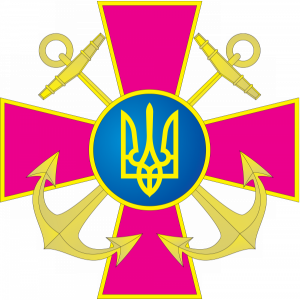
The official emblem of the Ukrainian Navy is a heraldic composition centered on the Tryzub (Trident) — the state emblem of Ukraine, adopted on February 19, 1992. The trident is a symbol of Ukrainian statehood with origins dating to the 10th century, when it was the personal seal of Volodymyr the Great (Volodymyr Sviatoslavych), the Grand Prince of Kyiv who baptized Kyivan Rus into Eastern Christianity in 988. The trident in the naval emblem is typically rendered in gold (yellow) on a dark blue field, reflecting the national colors of Ukraine — blue and yellow.
Surrounding and complementing the trident are traditional naval heraldic elements: an anchor (representing the maritime character and the Navy's connection to the sea), crossed cannons (representing naval combat power and readiness), a naval crown (symbolizing sovereignty and naval authority), and sometimes a laurel wreath (victory, honor, and the glory of naval service). The composition is rendered on a dark blue background with gold accents, creating a striking visual identity that clearly signals "Ukrainian naval forces" while adhering to international naval heraldic conventions.
2.2. Symbolic Analysis
Click to expand: Complete Symbolic Breakdown
The Tryzub (Trident): The trident is the definitive national symbol of Ukraine, appearing on the state coat of arms, the presidential standard, official documents, and the uniforms of all branches of the Ukrainian Armed Forces. Its origins in the 10th century — as the personal heraldic sign of Volodymyr the Great — give it a historical depth that few national symbols can match. In the naval context, the trident serves multiple functions: it unequivocally identifies the force as Ukrainian, connects the modern navy to over a millennium of Ukrainian statehood, and projects national sovereignty onto the maritime domain. The trident's three-pronged shape has been interpreted as representing the three elements of Ukraine's historical identity, or, in a naval context, the three maritime dimensions the Navy defends: surface, subsurface, and littoral.
The Anchor: Universally recognized as the primary symbol of naval forces, the anchor represents stability, steadfastness, and the Navy's permanent presence on the seas. In the Ukrainian Navy emblem, the anchor specifically references Ukraine's status as a Black Sea naval power with responsibilities for maritime security, freedom of navigation, and the protection of national economic interests in its maritime zones. The anchor also symbolizes hope — in nautical tradition, the anchor represents the last refuge and the certainty of a safe return to port.
Crossed Cannons: The crossed cannons are a traditional element of naval and coastal artillery heraldry, representing firepower, combat readiness, and the Navy's capacity to project force in defense of national interests. Historically, naval cannons also symbolize the technological and industrial dimension of naval warfare, distinguishing the navy from land-based armed forces. The crossed cannons in the Ukrainian Navy emblem are typically rendered in gold or yellow to match the trident and maintain the blue-and-gold color scheme.
The Naval Crown: The naval crown — a distinctive heraldic crown featuring alternating ship sterns and sails — is an internationally recognized symbol in naval heraldry across European navies (the British Royal Navy, the French Marine Nationale, the Italian Marina Militare, and others). Its presence in the Ukrainian Navy emblem positions Ukraine within this broader European naval heraldic tradition. The crown represents sovereignty at sea, naval command authority, and the dignity of naval service.
Blue and Gold Color Scheme: The blue background represents the sea — both the Black Sea and the Sea of Azov, Ukraine's maritime domains — as well as the sky. Gold (yellow) represents the wealth and prosperity that maritime trade brings to the nation, the golden wheat fields of Ukraine's agricultural heartland, and the brightness of freedom and sovereignty. Together, blue and gold form the national colors of Ukraine, making the naval emblem instantly recognizable as a Ukrainian national institution.
2.3. Comparison with Other Black Sea Navies
| Navy | Country | Emblem Characteristics | Key Symbols |
|---|---|---|---|
| Ukrainian Navy | Ukraine | Gold trident on blue, anchor, naval crown | Tryzub (trident), anchor, crossed cannons, naval crown |
| Russian Navy | Russia | Double-headed eagle with anchor | Anchor, Admiralty emblem, St. Andrew's cross |
| Turkish Navy | Turkey | Crescent and star with anchor | Anchor, crescent, star, naval crown |
| Romanian Navy | Romania | Eagle with cross in beak, anchor | Golden eagle, anchor, naval crown |
| Bulgarian Navy | Bulgaria | Lion rampant with anchor | Golden lion, anchor, national tricolor |
3. Vector Formats for Professional Use
3.1. CMX Format (CorelDRAW Exchange)
CMX (CorelDRAW Exchange) provides broad compatibility across different versions of CorelDRAW, the vector graphics platform widely used in Ukraine and the post-Soviet region for government documentation, institutional branding, and professional printing. The CMX version of the Ukrainian Navy emblem enables Ukrainian naval institutions, maritime museums, educational organizations, and design professionals to work with the emblem in their preferred software environment.
3.2. EPS Format
EPS (Encapsulated PostScript) delivers the highest quality reproduction for professional offset and digital printing. The vector paths in EPS precisely encode the trident's fine lines, the anchor's curvature, the cannons' barrels, and the naval crown's intricate details — ensuring that the emblem reproduces flawlessly at any scale, from uniform patches and ship's badges to large-format displays at naval headquarters and public exhibitions.
3.3. High-Resolution PNG
PNG raster files are provided at high resolution with transparent background, enabling immediate use in digital documents, presentations, websites, and electronic publications. The transparent background is particularly important for naval applications, where the emblem may need to be placed on dark blue uniforms, equipment cases, presentation slides, or document headers without a visible rectangular border.
4. Download the Ukrainian Navy Emblem
4.1. Vector Files (Archive)
Archive contents:
- CMX — CorelDRAW Exchange format (cross-version compatibility)
- EPS — Encapsulated PostScript (professional printing and prepress)
4.2. High-Resolution PNG
The high-resolution PNG file with transparent background is suitable for:
- Digital document layouts and electronic correspondence
- Presentation slides and educational materials
- Website headers and informational portals
- Reference material for designers and heraldic researchers
5. Frequently Asked Questions
What is the Ukrainian Navy?
The Ukrainian Navy (Viiskovo-Morski Syly Zbroinykh Syl Ukrainy — VMS ZSU) is the maritime component of the Armed Forces of Ukraine. It is responsible for defending Ukraine's maritime interests in the Black Sea and the Sea of Azov, protecting its coastline and territorial waters, ensuring freedom of navigation in Ukraine's maritime zones, and participating in international maritime security and humanitarian operations. The Navy operates surface combatants, patrol vessels, mine countermeasures ships, landing craft, naval aviation, coastal defense artillery, and marine infantry units.
When was the modern Ukrainian Navy established?
The modern Ukrainian Navy was established in April 1992 following Ukraine's declaration of independence from the Soviet Union on August 24, 1991. It was created from personnel and vessels of the former Soviet Black Sea Fleet who swore allegiance to Ukraine. The fleet was formally divided between Ukraine and Russia under the 1997 Partition Treaty, with Ukraine receiving approximately 18.3% of the vessels. After Russia's 2014 annexation of Crimea and the loss of approximately 70% of Ukraine's naval assets, the Navy relocated its main base to Odessa and began a comprehensive modernization program.
What does the Ukrainian Navy emblem represent?
The emblem centers on the Tryzub (trident) — the state emblem of Ukraine, dating to the 10th century as the personal seal of Volodymyr the Great. The trident on a blue field represents Ukrainian national sovereignty at sea. Surrounding elements include an anchor (maritime character and naval presence), crossed cannons (naval combat power), and a naval crown (sovereignty and naval authority). The blue-and-gold color scheme mirrors Ukraine's national flag and symbolizes the sea, sky, freedom, and prosperity.
What is the history behind the Ukrainian Navy trident?
The trident (Tryzub) is Ukraine's state coat of arms, adopted on February 19, 1992. Its origins trace to the 10th century Kyivan Rus, where it appeared on coins, seals, and architectural decorations as the personal heraldic sign of the ruling Rurikid dynasty. Volodymyr the Great, who ruled from 980 to 1015 and baptized Kyivan Rus in 988, used the trident as his personal seal. The trident's presence in the naval emblem connects the modern Ukrainian Navy to over a millennium of Ukrainian sovereign tradition and emphasizes that the Navy is a national institution defending national interests.
What happened to the Ukrainian Navy after 2014?
The 2014 Russian annexation of Crimea resulted in the loss of approximately 70% of the Ukrainian Navy's vessels, which were seized in Crimean ports. The Navy relocated its main base from Sevastopol to Odessa and evacuated the vessels that could be moved. Since then, Ukraine has pursued a comprehensive naval modernization program, acquiring Island-class patrol boats from the United States, Turkish-built Ada-class corvettes, British Sandown-class minehunters, and domestically produced Gyurza-M-class armored artillery boats. The Navy has also enhanced its special operations and coastal defense capabilities and aligned its doctrine with NATO standards.
What vector formats are available for the Ukrainian Navy emblem?
Two vector formats are available: CMX (CorelDRAW Exchange — cross-version compatible, suitable for design professionals in Ukraine and the CIS) and EPS (Encapsulated PostScript — professional prepress standard for offset and digital printing). Both are provided in a ZIP archive along with a high-resolution PNG raster file with transparent background.
How is the Ukrainian Navy emblem different from the Russian Black Sea Fleet emblem?
The Ukrainian Navy emblem uses the Tryzub (trident) as its central element, set in a blue-and-gold color scheme corresponding to Ukraine's national flag. The Russian Black Sea Fleet (and Russian Navy generally) uses the double-headed eagle with the St. Andrew's cross and anchor motifs, in a white-blue-red color scheme. The most obvious distinction is the trident versus the double-headed eagle — once you recognize these two symbols, the emblems are unmistakably distinct. The naval crown, anchor, and cannon motifs appear in both traditions but are rendered in different styles reflecting each nation's heraldic conventions.
Is the Ukrainian Navy emblem the same as the Ukrainian Sea Guard emblem?
No. The Ukrainian Sea Guard (Morska Okhorona) is a component of the State Border Guard Service of Ukraine and uses its own emblem, which differs from the Navy emblem. While both use the trident and operate in the maritime domain, the Sea Guard emblem incorporates green border guard colors and border post symbols, while the Navy emblem uses blue and gold with traditional naval symbols (anchor, cannons, naval crown). These are separate branches with distinct emblems and distinct operational mandates.
What role does the Ukrainian Navy play in international security?
The Ukrainian Navy participates in international maritime security operations and exercises alongside NATO and partner navies, including Sea Breeze (co-hosted with the United States in the Black Sea), NATO's Operation Sea Guardian, and various mine countermeasures exercises. The Navy also contributes to maritime security in the Black Sea region through patrol operations, search and rescue missions, and humanitarian assistance. Ukraine's naval modernization program is aligned with NATO interoperability standards, enhancing the Navy's ability to operate as part of multinational maritime task forces.
Where is the Ukrainian Navy headquartered today?
Since the loss of its Crimean base in 2014, the Ukrainian Navy's headquarters is in Odessa, Ukraine's largest Black Sea commercial port. Odessa serves as the administrative and operational center of the Navy, while forward naval bases operate at Ochakiv (near the mouth of the Dnieper-Bug estuary) and Berdiansk (on the Sea of Azov), subject to operational conditions. The Odessa port infrastructure has been significantly expanded to accommodate the Navy's growing fleet and operational requirements.
Tap to react