Vector Emblem of the Investigative Committee of Russia — Color and Black-and-White — History, Powers, and Free Download in CDR, EPS, PDF, SVG, PNG
The Investigative Committee of the Russian Federation (Sledstvenny Komitet) is one of the most powerful and independent investigative bodies in the Russian legal system. Directly subordinate to the President of the Russian Federation, the Committee is responsible for investigating the most serious categories of crimes: murders, terrorist acts, crimes committed by public officials and law enforcement officers, tax crimes, and offenses against constitutional order and state security. Its official emblem — a meticulously composed heraldic design available in both full-color and black-and-white versions — conveys the Committee's authority, its connection to the historical traditions of Russian criminal investigation, and its commitment to the rule of law. This comprehensive article provides the complete history of the Investigative Committee, a detailed analysis of its emblem's symbolic meaning, and direct download links for vector files in CDR, EPS, PDF, and SVG formats, plus PNG raster images with transparent background at 2000 px, 600 px, and 300 px resolutions.
Quick Reference Card
| Parameter | Details |
|---|---|
| Agency | Investigative Committee of the Russian Federation |
| Founded | January 15, 2011 (as independent federal body) |
| Chairman | Alexander Bastrykin (since 2011) |
| Predecessor | Investigative Committee at the Prosecutor's Office (2007–2011) |
| Emblem type | Heraldic sign — emblem |
| Versions | Full-color + black-and-white (monochrome) |
| Vector formats | CDR (CorelDRAW), EPS, PDF, SVG |
| PNG resolutions | 2000 px, 600 px, 300 px (transparent background) |
1. The Investigative Committee: History and Institutional Independence
1.1. The Petrine Origins of Russian Criminal Investigation (1713)
The institutional lineage of criminal investigation in Russia traces back to the early 18th century. On July 25, 1713, Emperor Peter the Great established the first specialized investigative offices — the "Major Investigative Chancelleries" — directly subordinate to the monarch. These chancelleries were charged with investigating crimes of state significance: treason, embezzlement of state funds, and high-level corruption. The Petrine reform established the principle — revolutionary for its time — that criminal investigation should be structurally separate from administrative authority, with investigators reporting directly to the supreme power rather than being embedded in local governance structures.
Throughout the 18th and 19th centuries, the investigative function migrated between institutions. Under Catherine the Great, investigative authority was vested in police departments. The Judicial Reform of 1864, one of the most progressive legal reforms of the 19th century, created an independent judiciary and established the institution of judicial investigators (sudebnye sledovateli) within district courts — professional jurists whose independence was protected by law. This system functioned until the Bolshevik Revolution of 1917 dismantled the tsarist judicial apparatus.
\u{201c}Peter the Great's 1713 reform was remarkable for its time: by placing investigators under direct monarchical authority, he established a model of investigative independence that would echo through Russian legal history. The Investigative Committee's contemporary status — directly subordinate to the President and independent of the Prosecutor General's Office — represents a modern reincarnation of this Petrine principle.
1.2. Soviet and Post-Soviet Investigative Structures (1917–2007)
After the 1917 Revolution, investigative functions were initially distributed across multiple Soviet agencies — the Revolutionary Tribunals, the Cheka (predecessor of the KGB), and the People's Courts. In the 1930s, the Prosecutor's Office of the USSR consolidated criminal investigation authority, with prosecutors simultaneously supervising, directing, and conducting investigations. This model — the "prosecutorial investigation" — remained in place throughout the Soviet period and for the first 15 years of the Russian Federation. Critics argued that the fusion of prosecutorial supervision and investigative conduct created an inherent conflict of interest: the same agency that performed the investigation also passed judgment on its legality.
The tension between prosecutorial and investigative functions drove repeated reform attempts. In 2007, a significant structural change occurred: the Investigative Committee at the Prosecutor's Office of the Russian Federation was created, separating the investigative apparatus from the prosecutorial supervisory function within the Prosecutor's Office. Although still formally under the Prosecutor General, the new Committee marked the first institutional recognition that investigation and prosecution should be organizationally distinct.
1.3. Independence: The Investigative Committee of Russia (2011–Present)
On January 15, 2011, the final and decisive step was taken: the Investigative Committee was removed from the Prosecutor's Office entirely and established as an independent federal state body, directly subordinate to the President of the Russian Federation. Alexander Bastrykin, who had chaired the committee since its creation in 2007, was appointed the first Chairman. The newly independent Committee was given jurisdiction over:
- Grave and especially grave crimes against life and health (murder, causing death by negligence in aggravated circumstances)
- Crimes against sexual inviolability
- Crimes committed by public officials (including judges, prosecutors, investigators, and law enforcement officers)
- Crimes committed by members of the Federation Council and State Duma
- Tax crimes
- Crimes of a terrorist nature and extremist crimes
- Crimes against constitutional order and state security
- Corruption-related crimes by persons with special legal status
| Period | Investigation Model | Key Characteristics |
|---|---|---|
| 1713–1864 | Petrine Chancelleries | Direct monarchical authority, investigation of state crimes |
| 1864–1917 | Judicial Investigators | Independent jurists within courts, protected by law |
| 1917–2007 | Prosecutorial Investigation | Prosecutors simultaneously supervise and investigate |
| 2007–2011 | Investigative Committee at Prosecutor's Office | Partial separation, still under Prosecutor General |
| 2011–Present | Independent Investigative Committee | Full independence, direct presidential subordination |
2. The Investigative Committee Emblem: Design and Symbolism
2.1. Official Description of the Emblem
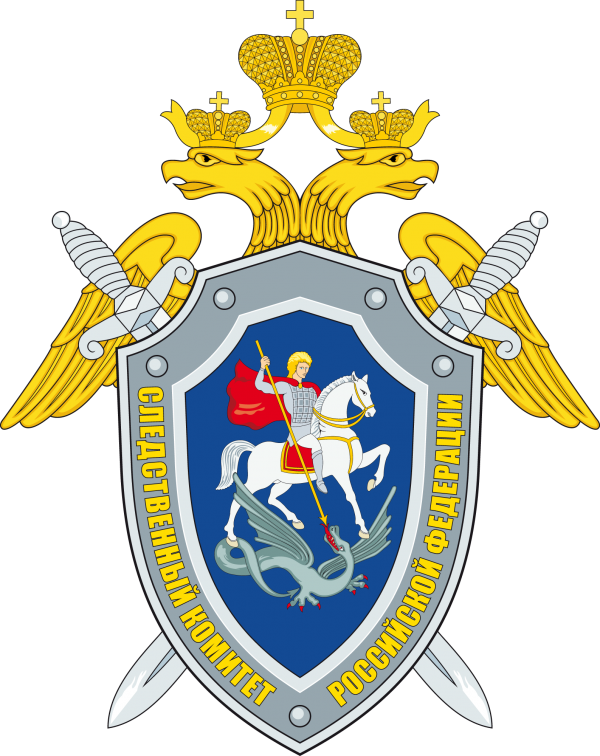
The official emblem of the Investigative Committee of the Russian Federation is a heraldic sign — emblem featuring a golden double-headed eagle with raised, spread wings, crowned with a golden crown. On the eagle's chest is a heraldic shield with the emblem of the Committee — stylized symbols representing the investigative profession: a flaming torch, scales of justice, crossed swords, and other heraldic elements specific to criminal investigation. The composition exists in two official versions: full color for ceremonial use, flags, banners, and official seals; and black-and-white for documentation, stamping, engraving, and reproduction where color is unavailable or impractical.
2.2. Symbolic Analysis
Click to expand: Complete Symbolic Breakdown
The Golden Double-Headed Eagle: The foundational element of the emblem is the golden double-headed eagle — the heraldic symbol of Russian statehood since the late 15th century. In the Investigative Committee's context, the eagle represents the federal-level authority of the Committee and its status as a body operating under the direct authority of the President of the Russian Federation. The two heads symbolize the Committee's jurisdiction over all subjects of the federation, encompassing investigations from Crimea to Kamchatka, from the Arctic to the North Caucasus.
The Crown: The golden crown surmounting the eagle is a crucial symbolic element. It signifies that the Investigative Committee derives its authority directly from the sovereign power of the Russian state — specifically, the President — rather than from any intermediate ministry or agency. This distinguishes the Committee from investigation departments within the Ministry of Internal Affairs (MVD) or the Federal Security Service (FSB), which, although powerful, operate within ministerial or service hierarchies.
The Flaming Torch: The torch, with its ascending flame, represents truth-seeking, enlightenment, and the illumination of concealed facts — the fundamental purpose of criminal investigation. The flame also symbolizes the unquenchable pursuit of justice and the determination to bring hidden crimes to light, no matter how deeply buried or carefully concealed.
The Scales of Justice: Representing impartiality, balance, and the weighing of evidence, the scales are a universal symbol of the legal profession and the judicial function. In the Investigative Committee's emblem, they emphasize that investigation is not merely about gathering incriminating evidence but about establishing the objective truth through balanced, comprehensive examination of all circumstances — both incriminating and exculpatory.
Crossed Swords: The crossed swords represent the state's coercive power — the authority to compel testimony, execute searches, make arrests, and, through the conclusions of investigation, set the machinery of criminal prosecution in motion. They also symbolize the protective function of the Committee: the shield of the law defended by the sword of investigation.
The Black-and-White Version: The monochrome variant serves practical functions: it is used for stamp impressions, official rubber seals, engraving on metal plates and badges, and printed materials produced in single-color processes. The black-and-white version preserves all heraldic elements while reducing reproduction complexity, and it serves as the basis for gravure and intaglio printing on official documents.
2.3. Comparison with Other Law Enforcement Emblems
| Feature | Investigative Committee | Prosecutor General's Office | Ministry of Internal Affairs |
|---|---|---|---|
| Status | Independent federal body, presidential subordination | Independent federal body, presidential subordination | Federal ministry |
| Core function | Criminal investigation of serious crimes | Prosecutorial supervision, state prosecution | Policing, public order, administrative law |
| Emblem type | Federal heraldic emblem with profession-specific symbols | Federal heraldic emblem with legal symbols | Federal heraldic emblem with law enforcement symbols |
| Distinctive symbols | Torch, scales, crossed swords | Pillar of Law, eye of vigilance | Shield and sword, law enforcement wreath |
3. Vector Formats for Professional Use
3.1. CDR Format (CorelDRAW)
CDR is the preferred format for Russian government and law enforcement documentation workflows, where CorelDRAW remains the dominant vector graphics platform. The CDR file of the Investigative Committee emblem enables layout designers in the Committee's press service, territorial investigative departments, and the Committee's educational institutions (such as the Moscow and St. Petersburg Academies of the Investigative Committee) to prepare official documents, certificates, diplomas, and informational materials with precision.
3.2. EPS Format
EPS ensures the highest quality output for professional printing, including the production of official letterheads, identity cards, badges, and publications of the Committee. EPS files encode every heraldic detail — the flames of the torch, the balance arms of the scales, the fine edges of the crossed swords — as mathematical vector paths, ensuring flawless reproduction at any scale.
3.3. PDF Format
PDF provides universal compatibility, allowing the emblem to be viewed and placed on any device without specialized software. The PDF version is suitable for integration into official reports, presentations, and electronic document management systems used by the Committee and partner law enforcement agencies.
3.4. SVG Format
SVG is the web and digital standard, enabling the emblem to appear with full vector quality on the Committee's official website, digital information displays, electronic document systems, and interactive educational materials used at the Committee's academies. SVG files are lightweight, responsive, and natively supported by all modern browsers.
4. Download the Investigative Committee Emblem
4.1. Color Emblem — PNG (Transparent Background)
- 2000 px — Professional printing and large-format displays
- 600 px — Standard documentation and presentations
- 300 px — Web and inline document placement
4.2. Black-and-White Emblem — PNG (Transparent Background)
- 2000 px — High-resolution monochrome for engraving and stamping
- 600 px — Standard monochrome for documentation
- 300 px — Compact monochrome for inline use
4.3. Vector Archive
Archive contents: Both color and black-and-white versions in all vector formats:
- CDR — CorelDRAW
- EPS — Encapsulated PostScript
- PDF — Portable Document Format
- SVG — Scalable Vector Graphics
5. Frequently Asked Questions
What is the Investigative Committee of Russia?
The Investigative Committee of the Russian Federation is an independent federal state body directly subordinate to the President of Russia, responsible for investigating the most serious categories of crimes: murders, terrorist acts, crimes by public officials and law enforcement officers, tax crimes, and offenses against constitutional order and state security. It was established as a fully independent entity on January 15, 2011, separating from the Prosecutor's Office.
When was the Investigative Committee founded?
The Investigative Committee was established as an independent federal body on January 15, 2011, by Federal Law No. 403-FZ. Prior to this, an Investigative Committee at the Prosecutor's Office existed from 2007 to 2011, representing a transitional phase toward full independence. The Committee's historical roots trace back to Peter the Great's investigative chancelleries of 1713 and the judicial investigators established by the Judicial Reform of 1864.
What does the Investigative Committee emblem represent?
The emblem features a golden double-headed eagle (federal authority under the President), crowned with a golden crown (direct presidential subordination). On the eagle's chest shield are the flaming torch (truth-seeking and illumination of crimes), scales of justice (impartiality and balanced investigation), and crossed swords (state coercive power and protection of law). Both full-color and black-and-white versions are officially recognized.
How is the Investigative Committee different from the Prosecutor's Office?
The Investigative Committee conducts criminal investigations independently, while the Prosecutor's Office performs prosecutorial supervision over the legality of investigations, represents the state in court, and maintains the state prosecution function. After 2011, these functions are institutionally separate: the Committee investigates crimes, and the Prosecutor's Office supervises the investigation's legality and represents the prosecution in court.
Who is the Chairman of the Investigative Committee?
The Chairman of the Investigative Committee of Russia is Alexander Ivanovich Bastrykin, a doctor of juridical sciences and former First Deputy Prosecutor General. He has led the Committee since its creation within the Prosecutor's Office in 2007 and continued as Chairman when the Committee became an independent body in 2011. Bastrykin is appointed and dismissed by the President of Russia.
What crimes does the Investigative Committee investigate?
The Committee investigates grave and especially grave crimes against life and health (murders), crimes against sexual inviolability, crimes committed by public officials (judges, prosecutors, law enforcement officers), crimes by parliament members, tax crimes, terrorist and extremist crimes, crimes against constitutional order and state security, and corruption-related crimes by persons with special legal status.
What vector formats are available?
Four vector formats: CDR (CorelDRAW), EPS (Encapsulated PostScript), PDF (Portable Document Format), and SVG (Scalable Vector Graphics) — all bundled in a ZIP archive with PNG raster files at 2000 px, 600 px, and 300 px in both color and black-and-white.
What are the historical predecessors of the Investigative Committee?
The institutional lineage includes Peter the Great's investigative chancelleries (1713), the judicial investigators established by the Judicial Reform of 1864, the prosecutorial investigation model of the Soviet period, and the Investigative Committee at the Prosecutor's Office (2007–2011). The Investigative Committee Day is celebrated on July 25, commemorating Peter the Great's 1713 decree.
Where can the emblem be used?
The emblem is used on official letterheads, identity cards, seals, badges, flags and banners, building signage, vehicles, publications of the Committee and its academies, award certificates, and informational materials of the Committee's central apparatus and territorial investigative departments.
How is the emblem related to Peter the Great's reforms?
The Investigative Committee officially recognizes its historical continuity from Peter the Great's 1713 decree establishing investigative chancelleries. The Committee Day is celebrated on July 25 — the date of Peter's decree. The emblem's inclusion of investigation-specific symbols (torch for truth-seeking, scales for justice, swords for state authority) reflects this centuries-long institutional tradition of independent criminal investigation.
Tap to react