Vector Emblem of Rosstat — Federal State Statistics Service — History, Symbolism, and Free Download in CDR, EPS, PDF, SVG, PNG

Rosstat — the Federal State Statistics Service of the Russian Federation — is the principal government body responsible for the collection, processing, analysis, and publication of official statistical information on the social, economic, demographic, and environmental conditions of Russia. As the authoritative source of quantitative data that informs government policy, business strategy, and academic research across the country, Rosstat occupies a unique position in the federal administrative system. Its heraldic emblem — a meticulously composed image of a golden double-headed eagle bearing a blue shield with silver scrolls, black statistical tables, and a golden scepter — is a masterwork of institutional symbolism that encodes the agency's mission, methods, and mandate into a single visual statement. This article presents the complete history of Rosstat, a detailed analysis of its emblem's symbolic components, and direct download links for vector files in CDR, EPS, PDF, and SVG formats, plus PNG raster images at 2000 px, 600 px, and 300 px resolutions.

Quick Reference Card
ParameterDetails
AgencyFederal State Statistics Service (Rosstat / FSGS)
FoundedMarch 9, 2004 (modern form); origins in 1811, 1918
PredecessorState Committee on Statistics (Goskomstat); Central Statistical Administration
Emblem typeHeraldic sign — emblem of Rosstat
Key symbolsGolden double-headed eagle, blue shield, silver scrolls, black tables, golden scepter with quill pen
Vector formatsCDR (CorelDRAW), EPS, PDF, SVG
PNG resolutions2000 px, 600 px, 300 px

1. Rosstat: History and Institutional Development

1.1. Origins of State Statistics in Russia (1811–1917)

The systematic collection of statistical data in Russia began in the early 19th century. In 1811, a Statistical Division was established within the Ministry of Police of the Russian Empire — the first specialized government body dedicated to statistics. In 1834, the Statistical Division was reformed into the Statistical Committee under the Ministry of Internal Affairs, which initiated the first systematic population censuses and economic surveys of the empire.

A watershed event was the First General Census of the Russian Empire in 1897, organized and conducted by the Central Statistical Committee. Covering a population of approximately 125 million, the census gathered unprecedented detail on demographics, literacy, occupations, languages, and religious affiliations across the empire's vast territory. The methodology and scope of the 1897 census established standards that would influence Russian statistical practice for the next century.

1.2. Soviet Period: Goskomstat and the Central Statistical Administration (1918–1991)

After the October Revolution, the Soviet government immediately recognized the strategic importance of statistics for central economic planning. On July 25, 1918, the Council of People's Commissars established the Central Statistical Administration (TsSU) — the first nationwide statistical body of the Soviet era. The TsSU conducted the 1920, 1926, 1937, 1939, 1959, 1970, 1979, and 1989 censuses, each reflecting the political priorities and methodological capabilities of its era.

In 1987, the TsSU was reorganized into the State Committee on Statistics of the USSR (Goskomstat), a reform intended to enhance the independence and professional standing of the statistical service. The transition from a subordinate administration to a state committee was a significant institutional upgrade, reflecting growing recognition that statistical integrity requires organizational autonomy from the ministries whose performance is being measured.

\u{201c}

The Soviet statistical system was a paradox: methodologically sophisticated in its sampling techniques and mathematical training, yet politically constrained in what it could report. Published figures on agricultural yields, industrial output, and mortality rates were frequently adjusted to align with political narratives. The institutional memory of this tension between data integrity and political pressure profoundly shaped the post-Soviet reform of Russia's statistical services.

1.3. Post-Soviet Reforms and the Creation of Rosstat (1991–Present)

Following the dissolution of the USSR, the State Committee on Statistics of the Russian Federation (Goskomstat of Russia) assumed responsibility for the national statistical system. The transition to a market economy demanded a complete overhaul of statistical methodology — Soviet-era indicators like "gross social product" and "national economic balance" had to be replaced with internationally comparable metrics including GDP, consumer price indices, unemployment rates, and trade balances.

On March 9, 2004, as part of the broader federal administrative reform, Goskomstat was transformed into the Federal State Statistics Service (Rosstat) and placed under the jurisdiction of the Ministry of Economic Development. In 2017, Rosstat was transferred to direct subordination of the Government of the Russian Federation, further elevating its institutional status. Today, Rosstat conducts the All-Russian Population Census (the most recent was in 2021), manages the Unified State Register of Statistical Indicators, coordinates departmental statistical production across ministries, publishes the authoritative annual statistical compendium "Russia in Figures," and provides the statistical foundation for the national "Data Economy" strategy.

PeriodOrganizationKey EventsStatistical Milestones
1811–1917Statistical Division / CommitteeFirst state statistics body, 1834 reform1897 First Empire-wide census
1918–1987Central Statistical Administration (TsSU)Soviet central planning data systemEight national censuses, industrial statistics
1987–1991Goskomstat USSRElevated to state committee statusPerestroika-era statistical reforms
1991–2004Goskomstat of RussiaPost-Soviet transition to market economy metricsAdoption of GDP, CPI, SNA methodology
2004–PresentRosstat (FSGS)Federal service, direct government subordination2021 Census, digital statistics, big data integration
Rosstat's transition from subordinate administration (TsSU) to state committee (Goskomstat) to federal service reflects a broader global trend: statistical offices in mature democracies are increasingly organized as autonomous bodies to ensure methodological independence from political influence. The transformation is ongoing — Rosstat continues to implement reforms aimed at aligning with the UN Fundamental Principles of Official Statistics.

2. The Rosstat Emblem: Design and Symbolic Meaning

2.1. Official Description and Visual Elements

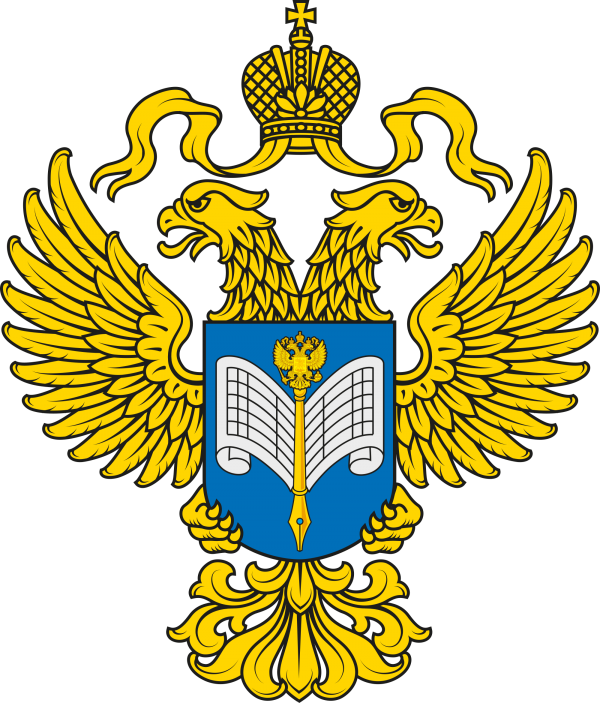
The official heraldic sign — emblem of the Federal State Statistics Service is described as follows: a golden double-headed eagle with raised, spread wings, crowned with a golden crown with flowing ribbons. The eagle holds in its claws a blue heraldic shield positioned on its chest, on which are depicted two silver scrolls diverging upward and toward the edges of the shield, bearing black statistical tables. Centered on the shield, placed over the scrolls, is a golden scepter topped with a small double-headed eagle and finished below with a writing quill pen.

2.2. Detailed Symbolic Breakdown

Click to expand: Complete Symbolic Analysis

The Golden Double-Headed Eagle: The double-headed eagle, the foundational heraldic element, establishes Rosstat's status as a federal executive body operating under the sovereign authority of the Russian state. The two heads facing east and west symbolize the agency's responsibility for statistical coverage of the entire national territory — from Kaliningrad to Kamchatka, from the Arctic to the Caucasus. The raised, spread wings convey comprehensiveness, reach, and the constant state of data collection that characterizes Rosstat's operations.

The Blue Heraldic Shield: Blue (azure) in heraldry symbolizes loyalty, clarity, truth, and intellect — all qualities essential to statistical work. The placement of the shield on the eagle's chest creates a visual focal point that draws attention to the profession-specific symbols on the shield. Blue is also associated with information, knowledge, and analytical precision, making it particularly appropriate for a statistical agency.

The Silver Scrolls with Black Statistical Tables: The two silver scrolls represent the dual nature of statistical work: the collection and registration of primary data (raw information gathered from surveys, censuses, and administrative records) and the analytical processing and publication of that data in usable forms. The black statistical tables depicted on the scrolls are the most direct symbolic representation of Rosstat's core function. Tables — rows and columns of numbers, categories, and cross-tabulations — are the fundamental format through which statistical knowledge is organized, compared, and communicated. The divergence of the scrolls upward and outward suggests the dissemination of statistical information to all branches of government and all sectors of society.

The Golden Scepter with Eagle Top and Quill Pen Base: The scepter is the most symbolically complex element of the emblem. Crowned at the top with a miniature double-headed eagle, it represents Rosstat's sovereign authority to collect, validate, and disseminate official statistical data. The quill pen at the scepter's base is a powerful dual symbol: in one sense, it connects to the historical tradition of clerical labor — the millions of ledger entries, census enumerations, and handwritten tables that built Russia's statistical tradition; in another sense, it represents the continuing act of recording, documenting, and publishing data that defines Rosstat's daily work. The scepter positioned vertically down the center of the shield creates an axis that unifies the composition and suggests that statistical truth serves as a pillar of state governance.

Gold and Silver Color Scheme: The dominance of precious metals — gold for the eagle, crown, and scepter; silver for the scrolls — reinforces the institutional dignity and the value of the statistical information Rosstat produces. In heraldic tradition, these colors represent wisdom and knowledge elevated to the level of national treasure.

2.3. Comparisons with Sister Statistical Agencies

AgencyCountryEmblem CharacteristicsCommon Elements
RosstatRussiaGolden eagle, blue shield, scrolls with tables, scepter-quillFederal heraldic structure, data symbolism
BelstatBelarusNational emblem, statistical charts, booksData representation, national symbols
INESpainAbstract geometric design, stylized data pointsModern statistical iconography
ONSUnited KingdomTypography-based logo, royal coat of arms variantState authority markers
Census BureauUnited StatesMinimalist shield, stars, data wave motifGovernment seal tradition
The Rosstat emblem should not be confused with the logos or emblems of Goskomstat (its predecessor) or other statistical agencies such as the Central Bank's statistical department or the Ministry of Economic Development's analytical divisions. Rosstat's emblem is the only heraldic sign with the distinctive combination of scrolls, tables, and the eagle-topped scepter with quill pen base. Always verify you are using Rosstat's official emblem for proper documentation.

3. Vector Formats for Statistical Documentation

3.1. CDR Format (CorelDRAW)

CDR, the native format of CorelDRAW, is the predominant vector graphics platform in Russian government documentation workflows and publishing environments. The CDR file of the Rosstat emblem enables direct editing in CorelDRAW for statistical publication layouts, annual report covers, and official forms. Government printing offices and design departments within Rosstat's territorial branches rely on CDR files for consistency across thousands of document types produced annually.

3.2. EPS Format

EPS (Encapsulated PostScript) provides the highest quality output for professional offset printing. For Rosstat's flagship publications — the "Russia in Figures" compendium, the "Russian Statistical Yearbook," and the monthly "Socio-Economic Situation in Russia" reports — EPS ensures the emblem appears with absolute precision on title pages, covers, and official letterheads.

3.3. SVG Format

SVG (Scalable Vector Graphics) is the format of choice for Rosstat's increasingly digital-first operations. The agency's official website (rosstat.gov.ru), its Unified Interdepartmental Statistical Information System (EMISS), and its data visualization platforms can incorporate the emblem via SVG with full resolution independence and small file sizes optimal for web delivery.

3.4. PDF Format

PDF serves as the universal distribution format for the Rosstat emblem, ensuring that any recipient — whether a regional statistics office, a ministry analyst, or an international partner organization — can open and use the emblem without specialized vector editing software.

All four vector formats (CDR, EPS, PDF, SVG) are provided in a single ZIP archive, along with the PNG raster versions. This ensures you have the emblem in every format needed for any statistical documentation scenario — from printed yearbooks to interactive data dashboards.

4. Download the Rosstat Emblem

4.1. Vector Files (Archive)

Archive contents:

  • CDR — CorelDRAW native format
  • EPS — Encapsulated PostScript for professional printing
  • PDF — Portable Document Format for universal access
  • SVG — Scalable Vector Graphics for web and digital use
Download

4.2. PNG Raster Files

  • 2000 px — Maximum resolution for high-quality printing
  • 600 px — Standard resolution for documents and presentations
  • 300 px — Compact resolution for web and inline use
Download
The Rosstat emblem's intricate details — particularly the fine lines of the statistical tables on the scrolls and the miniature eagle atop the scepter — benefit significantly from vector formats. When scaling the emblem to large sizes for exhibition displays or conference materials, vector files ensure these details remain crisp and legible rather than pixelating. The PNG files are provided for convenience but vector formats are recommended for professional applications.

5. Frequently Asked Questions

What is Rosstat and what does it do?

Rosstat — the Federal State Statistics Service — is the primary government body responsible for official statistics in Russia. It collects, processes, analyzes, and publishes statistical data on the country's social, economic, demographic, and environmental conditions. Its work underpins government policy formulation, business planning, academic research, and public understanding of national trends. Rosstat conducts the national population census, manages the Unified State Register of Statistical Indicators, and coordinates statistical production across all federal ministries and agencies.

When was Rosstat established in its current form?

Rosstat was established in its current form on March 9, 2004, when the State Committee on Statistics (Goskomstat) was transformed into the Federal State Statistics Service as part of Russia's federal administrative reform. In 2017, it was moved from the jurisdiction of the Ministry of Economic Development to direct subordination of the Government of the Russian Federation, further elevating its institutional independence.

What is the historical predecessor of Rosstat?

Rosstat's institutional lineage begins with the Statistical Division created in 1811 within the Russian Empire's Ministry of Police. The modern line traces through the Central Statistical Administration (TsSU), established in 1918 after the Revolution, which was reorganized into the State Committee on Statistics (Goskomstat) in 1987, and finally into Rosstat in 2004. The 1897 First General Census of the Russian Empire is a key historical milestone in this lineage.

What does the Rosstat emblem symbolize?

The Rosstat emblem depicts a golden double-headed eagle (representing federal authority) holding a blue shield (symbolizing truth and analytical clarity) with two silver scrolls featuring black statistical tables (representing data collection and publication). At the shield's center is a golden scepter topped with a small eagle and ending in a quill pen — symbolizing the sovereign authority to collect official statistics and the act of recording data. Every element reinforces Rosstat's core mission: the authoritative collection and dissemination of statistical knowledge.

What makes the Rosstat emblem unique among Russian federal emblems?

The Rosstat emblem is distinguished by its profession-specific symbols: the silver scrolls with black statistical tables and the scepter topped with an eagle and finished with a quill pen. While most federal agency emblems use generic heraldic elements (shields, eagles, wreaths), Rosstat's emblem incorporates direct representations of statistical work — tables, scrolls of data, and a writing instrument — making it one of the most functionally descriptive federal emblems in Russia's heraldic system.

What vector formats are available for the Rosstat emblem?

Four vector formats are available: CDR (CorelDRAW — standard in Russian government), EPS (Encapsulated PostScript — professional printing), PDF (Portable Document Format — universal access), and SVG (Scalable Vector Graphics — web and digital platforms). All four are bundled in a single ZIP archive together with PNG raster files at 2000 px, 600 px, and 300 px resolutions.

What is the difference between Goskomstat and Rosstat?

Goskomstat (State Committee on Statistics) was the principal statistical body from 1987 to 2004, succeeding the Soviet-era Central Statistical Administration. Rosstat, created in 2004, replaced Goskomstat as part of Russia's federal administrative reform. The key difference is institutional status: Goskomstat was a state committee, while Rosstat is a federal service — a status that, combined with its 2017 transfer to direct governmental subordination, gives it greater operational autonomy.

What major statistical activities does Rosstat conduct?

Rosstat conducts the All-Russian Population Census (most recently in 2021), annual enterprise surveys, household budget surveys, demographic statistics (births, deaths, migration), economic indicators (GDP, industrial production, retail trade, inflation), labor market statistics (employment, unemployment, wages), foreign trade statistics, and environmental statistics. It also manages the Unified Interdepartmental Statistical Information System (EMISS) and publishes the annual "Russia in Figures" and "Russian Statistical Yearbook" compendiums.

Where can the Rosstat emblem be used?

The Rosstat emblem is used on official letterheads, statistical publications and reports, the Rosstat website and digital platforms, building signage at headquarters and territorial offices, employee identification documents, conference and exhibition materials, and official seals and stamps of Rosstat institutions. Proper use follows federal regulations governing the application of official state symbols.

How has Rosstat adapted to the digital data economy?

Rosstat has implemented significant digital transformation initiatives, including the Unified Interdepartmental Statistical Information System (EMISS) for integrated data access, the development of big data methodologies using administrative records and alternative data sources, the digitization of census-taking through online questionnaires, and the creation of interactive data visualization platforms. These efforts align with the national "Data Economy" strategy and international best practices for modern statistical offices.

Tap to react