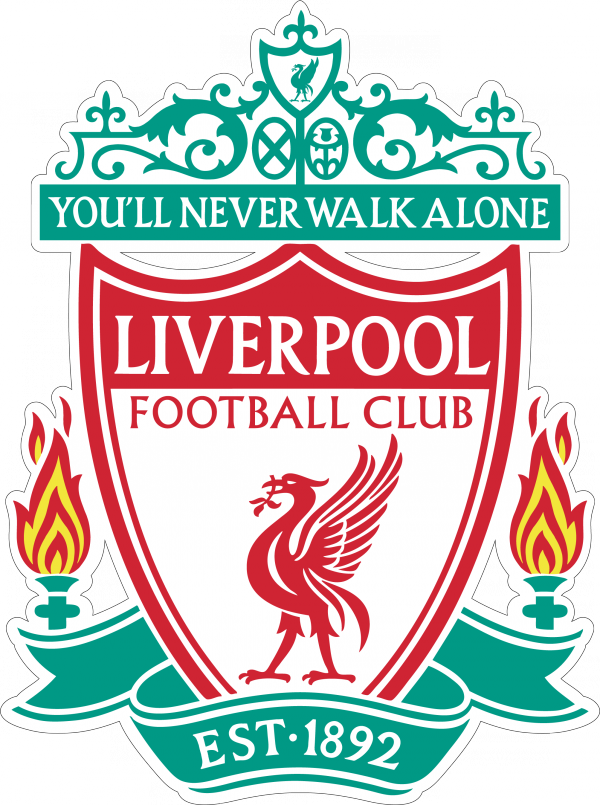
Liverpool Football Club is one of the most successful and recognisable sporting institutions in the world — six-time European champions, nineteen-time English league champions, and the owners of arguably football's most iconic badge: the Liver Bird crest. Founded in 1892, this club from the Merseyside docks has grown from a local dispute over rent at Anfield into a global phenomenon with hundreds of millions of supporters. Today we share the vector emblem of Liverpool FC in CMX (CorelDRAW), EPS, and SVG formats, plus high-resolution PNG renders at 2000, 600, and 300 pixels. Whether you are a designer creating fan content, a historian cataloguing football emblems, or simply a Liverpool supporter looking for a clean reproduction of the crest you love, this package delivers professional-grade quality in every format.

What makes the Liverpool emblem genuinely iconic — as opposed to merely famous — is the strength of its central symbol. The Liver Bird, a mythical cormorant-like creature that has been the symbol of the city of Liverpool for over eight hundred years, dominates the crest with an authority that few football badges can match. This is not a generic football logo with a ball and some text; it is civic heraldry elevated to sporting iconography, connecting the football club directly to the history and identity of the city it represents.

The Story Behind the Crest: Liverpool FC From 1892 to Today

Liverpool FC was born from a dispute. In 1892, Everton FC left Anfield after a disagreement with the stadium's owner, John Houlding. Rather than let the ground go unused, Houlding founded a new club — Liverpool FC — and the rest, as they say, is history. Within a decade, Liverpool had won their first league title. Within a century, they had conquered Europe four times. And by the twenty-first century, they had established themselves as the most successful English club in European competition.

The club's emblem has evolved alongside its achievements. The earliest Liverpool kits featured the city's coat of arms rather than a dedicated club badge. The Liver Bird was present from the beginning — it appears on the city's official seal dating back to 1229 — but its incorporation into a dedicated football crest was a gradual process that reflected the club's growing identity as something distinct from the municipal authority.

The current iteration of the Liverpool emblem crystallised in the late twentieth century and early 2000s. It features the Liver Bird perched atop the club's name, with the Shankly Gates and the eternal flame — memorials to the victims of the Hillsborough disaster of 1989 — incorporated into the design. Below, «You'll Never Walk Alone» — the club's anthem and motto — completes the composition. This is an emblem that carries extraordinary emotional weight: it simultaneously represents sporting excellence, civic pride, and solemn remembrance.

The Hillsborough elements were added in the 1990s following the tragedy, transforming the crest from a sports logo into a memorial. The twin flames on either side of the Liver Bird represent the 97 supporters who lost their lives at Hillsborough on April 15, 1989. This makes the Liverpool emblem unique in world football: it is simultaneously a badge of sporting achievement and a monument to the dead, worn over the hearts of players and fans alike.

Design Deconstruction: Anatomy of an Icon

The Liverpool FC emblem is a masterclass in layered symbolism, designed to work at multiple levels of engagement. A casual observer sees a bird on a shield. A football fan sees one of the world's great clubs. A Liverpudlian sees a millennium of city history, a century of sporting glory, and a permanent memorial to a tragedy that changed British football forever. Each element has been chosen with intention and carries specific meaning.

The Liver Bird is the crest's dominant element. The mythical bird — usually depicted as a cormorant holding a branch of laver seaweed in its beak — has been associated with Liverpool since the city's founding charter. In the club's emblem, the bird is rendered in a stylised, modern design that balances recognisability with graphic impact. The colour treatment varies: on the home kit, the bird typically appears in white or gold, while on promotional materials, a richer golden version is common.

The Shankly Gates, positioned below the Liver Bird, are named after Bill Shankly, the legendary manager who transformed Liverpool from a second-division club into English and European champions. The gates at Anfield bear the words «You'll Never Walk Alone» and serve as a physical and symbolic entrance to the club's spiritual home. Their inclusion in the emblem connects past glory to present identity.

The eternal flames flanking the Liver Bird are the Hillsborough memorial flames, burning in perpetuity for the 97. This is the most significant and emotionally charged element of the entire design. No other major football club carries a memorial to its own supporters as part of its official crest. It transforms the badge from corporate branding into something approaching sacred iconography.

The vector files preserve every detail of this extraordinary design — every feather of the Liver Bird, every contour of the Shankly Gates, every flicker of the eternal flames. Raster copies inevitably degrade these details; vector versions maintain them with mathematical precision.

The Liver Bird: Eight Centuries of Civic Symbolism

To understand the Liverpool emblem, you must understand the Liver Bird. The creature first appeared on Liverpool's corporate seal in 1229, when King Henry III granted the town a charter. Historians debate the bird's exact origins. The most widely accepted theory is that it derives from the eagle of St. John the Evangelist, which appeared on the seal of King John — the monarch who granted Liverpool its original charter in 1207. Over time, the eagle was misinterpreted or deliberately altered into a cormorant-like bird holding a sprig of seaweed, a plant known locally as «laver».

The two most famous Liver Birds in Liverpool are the statues atop the Royal Liver Building at Pier Head, installed in 1911. Local legend holds that if the two birds ever fly away, Liverpool will cease to exist. This folk mythology adds a layer of magical thinking to the civic symbol — and, by extension, to the football club that bears it. When you see the Liver Bird on the Liverpool FC crest, you are seeing not just a team logo but an eight-hundred-year-old piece of urban mythology rendered in twenty-first-century graphic design.

This depth of historical resonance is what separates truly great football emblems from merely competent ones. The Liverpool crest does not just identify a club; it connects that club to a city's entire history, from medieval charter to modern metropolis. Few sports logos anywhere in the world can claim such cultural density.

File Formats: Everything You Need in One Download

Our download package contains three vector formats and three PNG sizes. Here is a breakdown of what each format offers and when to use it.

FormatTypeBest ApplicationEditableScalability
CMXVectorCorelDRAW users, detailed editingYesUnlimited
EPSVectorPrint shops, Illustrator, cross-platformYesUnlimited
SVGVectorWeb embedding, responsive designYesUnlimited
PNG 2000pxRasterHigh-resolution print, large displaysNoLimited
PNG 600pxRasterWeb pages, social media, documentsNoLimited
PNG 300pxRasterThumbnails, email signatures, iconsNoLimited

The vector files render the Liver Bird with complete precision, from the curve of its beak to the tips of its feathers. The Shankly Gates text and the eternal flames are preserved as editable vector elements. For any project where quality matters — and when dealing with an emblem of this significance, quality always matters — the vector is the correct choice.

The Liverpool FC emblem is a registered trademark. Our files are provided for personal, educational, and archival use. Commercial reproduction — on merchandise for sale, in advertising, or as part of a brand identity — requires licensing from the rights holder. Treat the crest with the respect it deserves.

Practical Design Scenarios for the Liverpool Crest

Let us walk through the most common use cases for the Liverpool emblem and the optimal file choice for each.

For fan art and posters, open the vector file. The Liver Bird's intricate feather details and the Shankly Gates' architectural lines demand resolution that only vectors can provide at print sizes. Design your composition in Illustrator, CorelDRAW, or Affinity, then export to PDF or high-resolution TIFF for your print shop. The result will be gallery-quality — sharp enough to examine from inches away.

For social media graphics, the 600 px PNG is ideal. Platforms like Instagram, Twitter, and Facebook compress uploads aggressively, so a larger file offers diminishing returns. The 600 px PNG provides clean resolution at platform display sizes while keeping file sizes manageable. The transparent background means you can place the crest on any photo or background colour without white-box syndrome.

For web development, SVG is the clear winner. The file size is dramatically smaller than a comparable PNG — often by a factor of ten or more. It scales infinitely on Retina, 4K, and 8K displays. You can change colours via CSS for dark mode, hover states, or seasonal variations. For a Liverpool fan site, a statistics dashboard, or a football encyclopedia entry, SVG is the professional's choice.

For video projects, the 2000 px PNG serves as an excellent overlay element. Its resolution exceeds 1080p video, giving you room to scale and reposition without visible quality loss. Import into your video editor, place over footage or a background, and use the alpha channel for seamless compositing. For 4K video work, however, switch to the vector files and render at your exact project resolution.

Archive tip: save the complete ZIP with all formats in your design assets folder. The Liverpool emblem is a design you will use repeatedly — having every format ready saves the frustration of converting or searching for the right file type each time a new project starts.

Liverpool vs Other Global Football Emblems: A Comparison

Where does the Liverpool crest rank among the world's great football badges? Comparing it to other globally recognised emblems reveals why it has achieved such iconic status.

ClubCentral SymbolEmotional WeightHistorical DepthGlobal Recognition
Liverpool FCLiver Bird (civic symbol since 1229)Extremely high (Hillsborough memorial)800+ years via civic heraldryAmong top 5 globally
FC BarcelonaSt. George's Cross + Catalan flagHigh (Catalan identity)Regional heraldryAmong top 5 globally
Real MadridCrown + monogramModerateRoyal patronageAmong top 3 globally
Manchester UnitedDevil + ship (city coat of arms)Moderate (Munich memorial via nickname)Industrial heritageAmong top 5 globally
AC MilanSt. George's Cross + monogramModerateCity of Milan flagAmong top 10 globally

What sets Liverpool apart in this company is the fusion of civic history, sporting achievement, and solemn remembrance into a single coherent design. Barcelona has political symbolism; Real Madrid has royal prestige; Manchester United has commercial reach. Only Liverpool has a crest that functions simultaneously as a sports logo, a civic emblem, and a war memorial — and makes all three readings work without contradiction.

Download vector emblem (CMX + EPS + SVG)ZIP

Frequently Asked Questions

What vector formats are included for the Liverpool FC emblem?

The ZIP contains CMX (CorelDRAW), EPS (universal vector), and SVG (web-native vector). PNG renders at 2000, 600, and 300 pixels are also provided.

What is the Liver Bird?

The Liver Bird is a mythical cormorant-like creature that has been the symbol of the city of Liverpool since at least 1229. It appears on the city's official seal and on Liverpool FC's crest.

What do the flames on the crest represent?

The eternal flames flanking the Liver Bird are memorial flames for the 97 supporters who lost their lives in the Hillsborough disaster on April 15, 1989.

What are the Shankly Gates?

The Shankly Gates are the entrance to Anfield, named after Bill Shankly, the legendary Liverpool manager. They appear on the crest below the Liver Bird and bear the words "You'll Never Walk Alone".

When was Liverpool FC founded?

Liverpool FC was founded in 1892 by John Houlding after Everton left Anfield. The club has since become one of the most successful in English and European football history.

Can I use the Liverpool emblem commercially?

The Liverpool FC crest is a registered trademark. Our files are for personal, educational, and archival use. Commercial use requires licensing from the club.

Which format is best for printing at large sizes?

Use EPS or CMX. Vector files scale to any physical dimension without quality loss. A PNG, even at 2000 px, will show pixelation when printed at banner or poster sizes.

Does the SVG work on all browsers?

Yes, SVG is supported by all modern browsers including Chrome, Firefox, Safari, and Edge. It is the recommended format for web use.

Are the PNG files suitable for t-shirt printing?

No. Textile printing requires vector files at actual print size. PNG files do not have sufficient resolution for fabric printing and will produce visibly pixelated results.

Has the Liverpool emblem changed over time?

Yes, the emblem has evolved significantly. Early versions featured the city coat of arms. The Liver Bird became the dominant element in the mid-20th century, and the Hillsborough memorial elements were added in the 1990s.

Tap to react