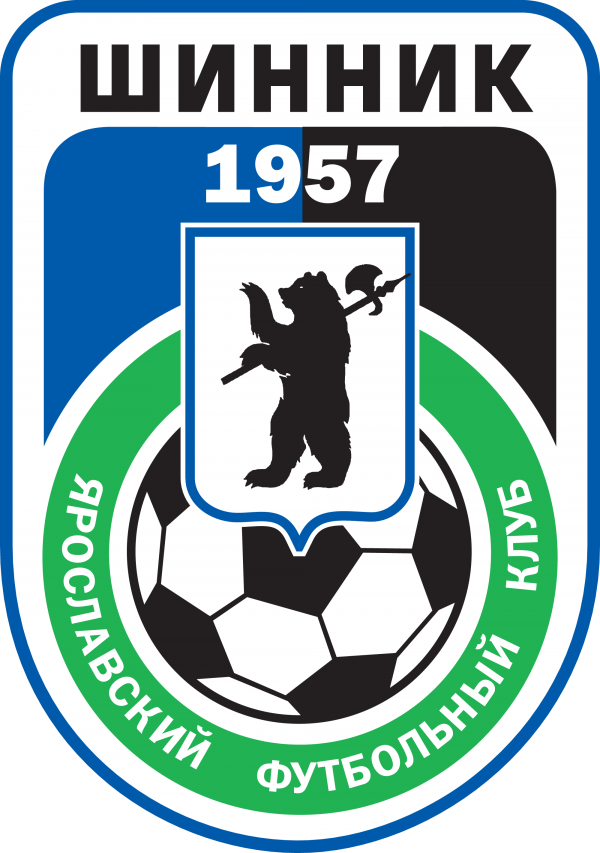
FC Shinnik Yaroslavl is the quintessential Russian industrial football club — founded in 1957 by workers of the Yaroslavl Tyre Plant, its very name translates to «tyre maker», and for over six decades its black-and-blue crest has represented one of the most distinctive sporting identities in the Russian football pyramid. The emblem carries the founding year 1957 in its design, anchoring the club firmly in the post-war Soviet sports society tradition from which it emerged. Today we share the vector emblem of FC Shinnik Yaroslavl in CMX (CorelDRAW), EPS, and SVG formats, plus high-resolution PNG renders at 2000, 600, and 300 pixels — a complete package for anyone who needs this piece of Russian football heraldry in professional-grade quality.

What sets the Shinnik emblem apart from other Russian football crests is its unapologetic industrial aesthetic. Where many clubs have migrated toward abstract, corporate-friendly logos, Shinnik has retained a design that wears its factory-floor origins openly. The black-and-blue palette, the typography, the geometric composition — every element speaks to a club that knows exactly what it is and where it comes from.

Black and Blue: The Shinnik Story Through Six Decades

The club was established in 1957 at the Yaroslavl Tyre Plant, one of the largest tyre manufacturing facilities in the Soviet Union. Like many Soviet sports clubs, Shinnik was created as part of the voluntary sports society system, providing factory workers with access to organised athletics. The name «Shinnik» is derived from the Russian word «shina» meaning tyre — a direct and honest brand identity that has never needed rebranding because it has always been authentic.

Shinnik spent the Soviet era primarily in the second tier of the all-Union championship, with occasional appearances in the top division. The club's finest hour came in the late 1960s when it competed in the Soviet Top League, facing the country's footballing giants. This period established Shinnik as Yaroslavl's premier sporting institution — a status it has maintained to the present day.

After the dissolution of the USSR, Shinnik entered the Russian football league system and quickly established itself as a yo-yo club — frequently promoted to and relegated from the Premier League. The club's ability to punch above its weight, given Yaroslavl's relatively modest population and economic base, is a testament to strong institutional management and a passionate local fan base that fills the Shinnik Stadium match after match.

The most remarkable aspect of Shinnik's history is perhaps its stability. In a football landscape where clubs routinely disappear due to financial collapse, ownership disputes, or relocation, Shinnik has remained in Yaroslavl, under its original name, for over sixty years. This continuity is encoded in the emblem itself: the founding year prominently displayed, the black-and-blue colours unchanged, the industrial identity unapologetically preserved.

Decoding the Shinnik Crest: Design Analysis

The Shinnik emblem is constructed as a shield — the traditional shape for football club crests — but the treatment inside the shield is anything but conventional. The primary colours are black and blue, a combination that immediately evokes the industrial origins of the club. Black represents the rubber and carbon black of tyre manufacturing; blue suggests the Volga River that flows through Yaroslavl, connecting the city's industrial heritage to its geographical identity.

At the crest's centre, the word «ШИННИК» appears in bold Cyrillic lettering. The typography is assertive and muscular — exactly what you would expect from a club named after a factory product. Below the club name, the founding year «1957» anchors the design in time, while «Ярославль» identifies the city. This tripartite text arrangement — club name, founding year, city — is a classic Russian football emblem convention that Shinnik executes with particular clarity and conviction.

A football appears as a central graphic element, rendered in a traditional panel pattern. The ball is integrated with the shield shape rather than simply placed on top of it, creating a unified composition where the graphic and typographic elements work together rather than competing for attention. This is the mark of a designer who understood that a football crest is not just a logo — it is a piece of visual communication that must function at multiple scales and in multiple contexts simultaneously.

The vector files preserve every contour of the shield, every letter of the Cyrillic text, and every panel of the football with complete mathematical accuracy. Raster copies lose precision through compression; vector versions maintain the original design indefinitely.

Industrial Identity in Football Branding: Why Shinnik Matters

In an era when football clubs increasingly adopt abstract, globally marketable brand identities, Shinnik stands as a counterexample. Its emblem makes no attempt to hide its working-class roots. The black colour palette — unusual in football, where bright colours dominate — is a deliberate choice that signals the club's connection to heavy industry. This is not a brand designed by a London marketing agency; it is a badge designed by and for the people of Yaroslavl.

The industrial football club is a distinctly Soviet and post-Soviet phenomenon. In Western Europe, factory teams evolved into commercial enterprises or disappeared entirely. In Russia and the former USSR, many of these clubs survived the transition to market economies, retaining their original names and identities even as their founding enterprises privatised or closed. Shinnik is one of the most prominent survivors of this tradition, alongside clubs like Torpedo Moscow (automobile plant), Metallurg Lipetsk (steel works), and Khimik Dzerzhinsk (chemical plant).

For design historians, the Shinnik emblem is a valuable case study in how industrial aesthetics can be translated into sports branding. The bold, unapologetic typography; the stark black-and-blue palette; the integration of the founding year as a permanent design element — these choices reflect a design philosophy that prioritises authenticity over trendiness. The result has aged remarkably well, looking as relevant in 2026 as it did in 1957.

Vector Formats: Choosing the Right Tool for Your Project

This download package includes three vector formats, each optimised for a different workflow. Understanding the strengths of each format saves time and produces better results.

CMX (CorelDRAW) is the native format for CorelDRAW users. Given that CorelDRAW has a particularly strong user base in Russia and Eastern Europe, this format is likely the most useful for many of our visitors. It preserves all CorelDRAW-specific features including fill types, transparency effects, and object groupings.

EPS (Encapsulated PostScript) is the universal standard for vector interchange. Open it in Adobe Illustrator, Affinity Designer, Inkscape, or any professional graphics application. This is the format to send to print shops, collaborators, and anyone whose software you are not certain about.

SVG (Scalable Vector Graphics) is the web-native format. Embed it directly in HTML, style it with CSS, animate it with JavaScript, and scale it responsively across all devices. For fan websites, online databases, and interactive football visualisations, SVG is the optimal choice.

The PNG renders at 2000, 600, and 300 pixels cover every raster use case from high-resolution print to web thumbnails. All have transparent backgrounds via alpha-channel transparency.

FormatTypeBest WorkflowEditableScalability
CMXVectorCorelDRAW users, Cyrillic text handlingYesUnlimited
EPSVectorCross-platform, print shops, archivingYesUnlimited
SVGVectorWeb embedding, responsive designYesUnlimited
PNG 2000pxRasterHigh-res print up to A5 at 300 DPINoLimited
PNG 600pxRasterWeb pages, blog posts, presentationsNoLimited
PNG 300pxRasterThumbnails, small inserts, emailNoLimited
When ordering printed merchandise with the Shinnik emblem, always provide the vector file. A PNG printed at physical size will show visible pixelation. T-shirts, scarves, and flags demand vector source material for professional results.

Practical Applications: Real-World Usage Scenarios

Let us walk through the most common scenarios where designers and fans need the Shinnik emblem, and which format to reach for in each case.

For fan merchandise design — creating custom t-shirts, scarves, or banners — use the vector files. Open the EPS in your design software, scale the emblem to the physical dimensions your printer requires, and export as a print-ready PDF. This workflow guarantees that every letter of «ШИННИК» and every line of the shield remains razor-sharp on the finished product.

For digital fan content — social media graphics, YouTube channel art, match preview images — the 600 px PNG is the most practical choice. It provides clean resolution at typical screen sizes, has a transparent background for easy layering, and loads quickly. For a Twitter header or Instagram post, 600 px is more than sufficient.

For football data projects — league tables, club databases, statistical visualisations — SVG is the superior format. You can resize it dynamically based on the surrounding layout, change colours programmatically to indicate divisions or status, and serve it at exactly the resolution each user's device requires.

For archival and historical documentation, download the complete ZIP. Having the vector source means the emblem can be faithfully reproduced decades from now, regardless of what software becomes standard. This is how football historians preserve visual culture for future generations.

Pro workflow tip: keep the ZIP with all vector files as your master archive. Export PNG copies as needed for specific projects. This prevents the classic designer nightmare of needing a high-res version of a logo and discovering that the only copy is a 150 px thumbnail saved from Google Images in 2011.

The Shinnik Emblem in Russian Football Context

Compared to other Russian football emblems, Shinnik's crest occupies a unique position. It is neither as globally recognisable as Spartak Moscow's red-and-white diamond, nor as ornate as the heraldic shields of older provincial clubs. What it offers instead is clarity, honesty, and a direct connection to the community it represents.

FeatureShinnik YaroslavlTypical Russian Club Emblem
Colour schemeBlack and blue (industrial)Red, blue, white (national colours)
Design philosophyFactory identity, minimal ornamentHeraldic shield, complex symbolism
TypographyBold Cyrillic, founding year prominentVaried: some traditional, some modern
Global recognitionRegional cult followingVaried by club prestige
Authenticity factorExtremely high — unchanged for 60+ yearsMixed: many clubs have rebranded

This authenticity is Shinnik's greatest branding asset. In a world saturated with focus-grouped, marketing-department-approved logos, a crest that has looked essentially the same since 1957 carries a weight that no amount of design budget can buy. The vector file preserves this authenticity in its purest form, ready for whatever project you have in mind.

Download vector emblem (CMX + EPS + SVG)ZIP

Frequently Asked Questions

What vector formats are included for the Shinnik emblem?

The ZIP contains CMX (CorelDRAW), EPS (universal vector), and SVG (web-native vector). PNG renders at 2000, 600, and 300 pixels are also provided.

What does the name «Shinnik» mean?

«Shinnik» is derived from the Russian word «shina» meaning tyre. The club was founded by workers of the Yaroslavl Tyre Plant in 1957.

When was FC Shinnik founded?

The club was founded in 1957 at the Yaroslavl Tyre Plant. The founding year is prominently displayed on the club's emblem.

Why are the club colours black and blue?

Black represents the rubber and carbon black of tyre manufacturing. Blue symbolises the Volga River that flows through Yaroslavl.

Has the Shinnik emblem changed over time?

The emblem has remained remarkably consistent since 1957, preserving its industrial identity and bold typography through decades of social and political change.

Which format should I use for printing a fan scarf?

Use EPS or CMX. Textile printing requires vector source files at actual print size. PNG files will produce visible pixelation on fabric.

Can I use SVG on my fan website?

Absolutely. SVG embeds directly in HTML, scales perfectly on all screens, and can be styled with CSS to match your site's colour scheme.

Do the PNG files have transparent backgrounds?

Yes. All PNG renders include alpha-channel transparency, so the emblem appears without any background colour.

Is the text in the emblem editable?

In the vector files, text has been converted to outlines for compatibility. You can scale and modify the shapes freely, but you cannot type directly into the existing text fields.

What league does Shinnik currently play in?

Shinnik has historically oscillated between the Russian Premier League and the First Division. It remains one of Russia's most recognisable second-tier clubs with a dedicated fan base.

Tap to react