FC Niva Vinnytsia is one of those football clubs that carries the weight of its region on its badge — a team from the heart of Podolia, central Ukraine, whose name translates to «cornfield» and whose green-and-white crest speaks directly to the agricultural identity of the land it represents. Founded in 1958, Niva has spent decades navigating the turbulent waters of Ukrainian football, oscillating between the top division and the lower tiers, but always maintaining a devoted local following. Today we share the vector emblem of FC Niva Vinnytsia in CDR (CorelDRAW), EPS, and SVG formats, plus high-resolution PNG renders at 2000, 600, and 300 pixels — a complete package for designers, fans, and football historians.
What makes this particular emblem worth studying is how it encapsulates an entire regional philosophy in a few square centimetres of graphic design. The colour palette, the typography, the central symbol — every element has been chosen to tell a story about the club and its relationship to the Vinnytsia region. This is not generic sports branding; it is local identity distilled into visual form.
The Club Behind the Crest: Niva Vinnytsia's Football Journey
Founded in 1958 as part of the Soviet sports society system, Niva Vinnytsia began its life as a regional team representing the agricultural workers of the Vinnytsia oblast. The name «Niva» — meaning a cultivated field, a cornfield — was a deliberate choice, embedding the club's identity in the agrarian character of the region from day one. In the Soviet era, Niva competed primarily in the Ukrainian SSR league system and the lower tiers of the all-Union championship.
After Ukraine gained independence in 1991, Niva entered the newly formed Ukrainian Premier League and enjoyed its golden era in the early 1990s. The 1992-93 season saw the club finish in the upper half of the table, competing against the likes of Dynamo Kyiv and Shakhtar Donetsk on equal footing — a remarkable achievement for a provincial club with modest resources. These years established Niva as a recognised name in Ukrainian football and cemented the club's place in the national sporting consciousness.
The years that followed brought financial challenges that are all too familiar in post-Soviet football. Niva dropped into the lower divisions, rebounded, dropped again, and has spent much of the twenty-first century fighting to maintain its professional status. Through it all, the club's supporters — known for their passionate, vocal presence at the Lokomotyv Stadium — have remained a constant. In a football landscape increasingly dominated by a handful of wealthy metropolitan clubs, Niva represents the ideal of community-centred sport.
Emblem Design: Reading the Niva Crest
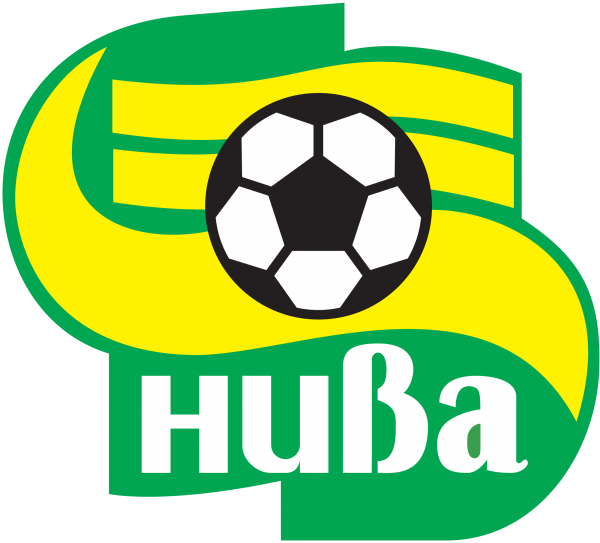
The Niva Vinnytsia emblem is built around a classic shield shape, a form that immediately communicates tradition and gravitas. Dominated by green and white — the club's traditional colours — the crest uses a colour palette that directly references the agricultural landscape of the Podolia region. Green stands for the fields that gave the club its name; white represents purity, openness, and the winter snows that blanket the Ukrainian steppe each year.
At the centre of the emblem sits a stylised football, rendered in a traditional hexagon-panel pattern. This is the universal symbol of the sport, placed at the heart of the design to leave no doubt about what this organisation represents. Surrounding the ball, decorative elements frame the composition and give the crest a formal, official appearance suitable for everything from kit badges to official club correspondence.
The word «Ніва» appears prominently in Ukrainian Cyrillic lettering. This is significant: the club chose to use Ukrainian-language text rather than Russian, aligning the emblem with the national identity of independent Ukraine. In the 1990s, when many Ukrainian clubs were still using Russian-language branding inherited from the Soviet era, Niva's Ukrainian text was a quiet but meaningful statement of cultural affiliation. Below the club name, «Вінниця» anchors the emblem geographically, leaving no ambiguity about which city this club calls home.
Vector Formats Explained: CDR, EPS, and SVG
This download includes three vector formats, each serving a different purpose in the modern design workflow. Understanding which to use saves time and prevents frustration down the line.
CDR (CorelDRAW) is the native format for CorelDRAW users. If you are part of the large CorelDRAW community in Eastern Europe and the post-Soviet space, this is the file you want. It opens with all layers, colour swatches, and path data intact. CorelDRAW's handling of Cyrillic typography is excellent, so any text-based elements in the design will display correctly without font substitution issues.
EPS (Encapsulated PostScript) is the universal vector standard. Virtually every professional graphics application reads EPS: Adobe Illustrator, Affinity Designer, Inkscape, Scribus, and countless others. This is the format to send to a print shop, a collaborator using different software, or to archive for long-term preservation. EPS has been the industry standard for vector interchange since the 1980s and remains the safest choice for cross-platform compatibility.
SVG (Scalable Vector Graphics) is the web-native vector format. Unlike CDR and EPS, which are designed for desktop publishing, SVG is built for the browser. You can embed an SVG emblem directly into an HTML page, style it with CSS, animate it with JavaScript, and scale it responsively across devices. For a fan website, a Wikipedia-style club page, or an interactive football infographic, SVG is the superior choice.
The PNG files at 2000, 600, and 300 pixels round out the package. Rendered directly from the vector source, they have transparent backgrounds and accurate colour reproduction. Use them for quick placement when you do not need the editability of a vector file.
| Format | Type | Best For | Transparency | Scalability |
|---|---|---|---|---|
| CDR | Vector | CorelDRAW users, Cyrillic-heavy workflows | Yes | Unlimited |
| EPS | Vector | Cross-platform sharing, print shops | Yes | Unlimited |
| SVG | Vector | Web embedding, responsive design, CSS styling | Yes | Unlimited |
| PNG 2000px | Raster | High-quality print up to A5 | Yes | Limited |
| PNG 600px | Raster | Web pages, blog posts, presentations | Yes | Limited |
| PNG 300px | Raster | Thumbnails, small inserts, email signatures | Yes | Limited |
How to Choose the Right Format for Your Project
The sheer number of file formats can feel overwhelming if you are not a professional designer, but the decision logic is straightforward once you know the basics. Let us break it down by project type.
If you are building a website about Ukrainian football, use SVG. The file is tiny compared to a PNG of equivalent quality, it scales perfectly on Retina and 4K screens, and you can change the colours with CSS without touching the original file. An SVG emblem on a dark-themed website can be instantly recoloured to white; on a light theme, back to the original green. No other format offers this flexibility.
If you are designing for print — a match programme, a fan poster, a piece of merchandise — use EPS or CDR. These formats embed colour profiles and path data that professional printing equipment reads natively. A PNG sent to a commercial printer will often be rejected or, worse, printed with visible pixelation. Vector files eliminate this risk entirely.
If you are working in CorelDRAW and plan to make modifications — changing colours, extracting elements, combining the emblem with other graphics — use the CDR file. It preserves CorelDRAW-specific features like fountain fills, PowerClip objects, and lens effects that may not translate perfectly through EPS conversion.
If you just need a quick image for a social media post or a document, grab the appropriate PNG. The 600 px version is ideal for Facebook, Twitter, and Instagram — platforms that compress uploads anyway, so the extra resolution of the 2000 px file would be wasted. For a Microsoft Word document or a PowerPoint slide, 600 px is also the sweet spot between quality and file size.
Ukrainian Football Branding: Niva in Context
To understand the Niva emblem, it helps to place it within the broader context of Ukrainian football branding. After independence in 1991, Ukrainian clubs faced a choice: retain Soviet-era visual identities, adopt Western European corporate aesthetics, or develop something distinctly Ukrainian. Niva chose a path that blended tradition with national identity.
The use of the Ukrainian language on the crest — rather than Russian or English — was a political and cultural statement at a time when the status of the Ukrainian language in public life was still being contested. The green-and-white colour scheme, while not uniquely Ukrainian, aligned the club with the verdant agricultural landscape that defines the Vinnytsia region and, by extension, much of central Ukraine.
Compared to the emblems of Dynamo Kyiv (which retained its Soviet-era Cyrillic «D» motif) or Shakhtar Donetsk (which adopted a more international, English-language branding approach in the 2000s), Niva's crest occupies a middle ground. It is unmistakably Ukrainian without being aggressively nationalistic, traditional without being dated, and professional without being corporate. This balance is difficult to achieve in sports branding, and the fact that Niva managed it with presumably limited design resources makes the achievement all the more impressive.
| Club | Emblem Style | Language | Design Philosophy |
|---|---|---|---|
| Niva Vinnytsia | Traditional shield, agricultural motifs | Ukrainian | Regional identity, community roots |
| Dynamo Kyiv | Modernised Soviet-era motif | Cyrillic D symbol | Historical legacy, national icon |
| Shakhtar Donetsk | International corporate style | English-friendly | Global brand, commercial appeal |
| Karpaty Lviv | Traditional badge, forest motifs | Ukrainian | Western Ukrainian identity |
This diversity in Ukrainian football branding reflects the regional and cultural diversity of the country itself — something that a uniform, FIFA-imposed design template would erase. The Niva emblem is a small but meaningful piece of this broader tapestry.
Download vector emblem (CDR + EPS + SVG)ZIPFrequently Asked Questions
What vector formats are included for the Niva Vinnytsia emblem?
The ZIP contains CDR (CorelDRAW), EPS (universal vector), and SVG (web-native vector). PNG renders at 2000, 600, and 300 pixels are also provided.
What does the name «Niva» mean?
«Niva» is a Ukrainian word meaning a cultivated field or cornfield, directly referencing the agricultural heritage of the Vinnytsia region in central Ukraine.
When was FC Niva Vinnytsia founded?
The club was founded in 1958 as part of the Soviet sports society system, representing agricultural workers of the Vinnytsia oblast.
What was Niva's best period in Ukrainian football?
The early 1990s, particularly the 1992-93 season, when Niva competed in the Ukrainian Premier League and finished in the upper half of the table alongside Dynamo Kyiv and Shakhtar Donetsk.
What colours does the Niva emblem use?
The primary colours are green and white. Green represents the agricultural fields of Podolia; white symbolises purity and the winter landscape of the Ukrainian steppe.
Which format is best for web use?
SVG is the optimal choice for websites. It scales perfectly on all screen sizes, supports CSS styling for colour changes, and has a smaller file size than PNG at comparable quality levels.
Can I edit the vector files without CorelDRAW?
Yes. The EPS file opens in Adobe Illustrator, Affinity Designer, and Inkscape. The SVG file opens directly in Inkscape (free) and any modern web browser for preview.
Do the PNG files have transparent backgrounds?
Yes. All PNG renders use alpha-channel transparency, so the emblem appears without any background — ideal for overlaying on photos, coloured layouts, or dark backgrounds.
Is the text on the emblem in Ukrainian or Russian?
The text is in Ukrainian: «Ніва» (the club name) and «Вінниця» (the city). This aligns with the club's identity as a Ukrainian club in post-independence Ukraine.
How large can I print the emblem from the PNG files?
The 2000 px PNG prints well up to approximately A5 size at 300 DPI. For anything larger — posters, banners, flags — use the vector files for unlimited scaling.
Tap to react