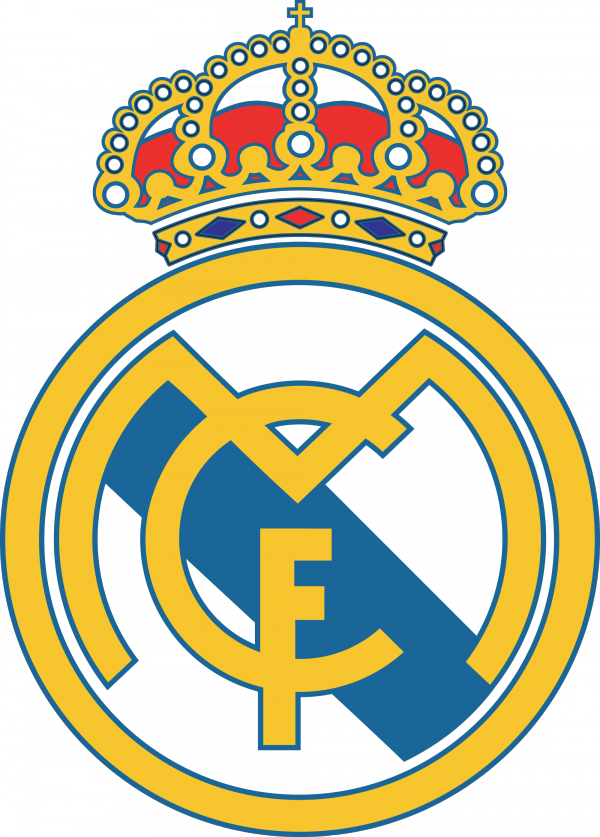
Real Madrid is not just a football club — it is an institution, a century-spanning dynasty that FIFA itself crowned the best club of the twentieth century. Founded in 1902 as Madrid Football Club and granted the royal title "Real" by King Alfonso XIII in 1920, this organisation has accumulated 14+ European Cups, 35+ La Liga titles, and a global fanbase measured in the hundreds of millions. Its emblem — the crown, the intertwined letters M-C-F, the diagonal purple stripe — is one of the most instantly recognisable sports logos on the planet. Today we share the vector emblem of Real Madrid CF in CMX (CorelDRAW), EPS, and SVG formats, plus a high-resolution PNG for any project that needs this iconic crest.

The sheer weight of history behind this emblem is hard to overstate. When you look at the Real Madrid crest, you are looking at a symbol that has been present at some of the most consequential moments in football history: Alfredo Di Stefano's dominance in the 1950s, the five consecutive European Cups from 1956 to 1960, the Galactico era of Zidane, Figo, Ronaldo and Beckham, and the astonishing modern dynasty of 2014-2022 that added five more Champions League trophies. Few logos in any sport carry this density of association. The Nike swoosh sells shoes; the Real Madrid crest represents an entire century of footballing achievement.

Real Madrid is one of only three clubs that have never been relegated from La Liga's top division — alongside Barcelona and Athletic Bilbao. According to the financial consultancy Deloitte, Real Madrid consistently ranks among the clubs with the largest revenue in world football, often topping the Football Money League. But the numbers only tell part of the story. The club's identity is intertwined with the city of Madrid, with Spanish culture, and with a philosophy of attacking football that has defined its style for generations. The Santiago Bernabeu stadium — named after the legendary president who reshaped the club in the mid-twentieth century — is a pilgrimage site for football fans worldwide.

The archive includes three vector formats: CMX (native CorelDRAW), EPS (universal vector exchange), and SVG (web-native, resolution-independent). All three are packed into a single ZIP. The PNG provides high-resolution raster output for immediate use without vector software.

The Evolution of the Real Madrid Emblem: From 1902 to Today

The Real Madrid crest did not emerge fully formed. It evolved over decades, each iteration reflecting changes in the club's status, its relationship with the Spanish crown, and the aesthetic trends of its era. Understanding this evolution is essential for anyone who works with the emblem professionally — whether as a designer, a researcher, or a content creator.

The original 1902 crest was a simple design: the intertwined letters M-C-F (Madrid Club de Futbol) inside a circle, with a blue band containing the club's full name. There was no crown, because there was no royal patronage yet. The colour scheme was white and blue — white shirts have been Real Madrid's trademark from day one, inspired by the English club Corinthian FC, which the founders admired.

In 1920, everything changed. King Alfonso XIII granted the club the title "Real" — meaning "Royal" — and the crown appeared on the crest for the first time. This was not merely an aesthetic addition; it was a political and cultural statement that elevated the club to an institution with official state recognition. The letters changed from M-C-F to M-C-F with the crown above, and a subtle purple diagonal stripe — the colours of the Castile region — was introduced.

The next major redesign came in 1931, when the Second Spanish Republic was proclaimed and all royal symbols were prohibited. The crown was removed from the crest, and the club reverted to its original name: Madrid Club de Futbol. The crest became a republican-era design — still elegant, but stripped of its monarchical associations. This version would last only until 1941, when the Franco regime restored the crown and the royal title, and the crest returned to its 1920 form with some refinements.

The modern crest, adopted in 2001, streamlined the design for the digital age. The purple diagonal stripe was reduced to a cleaner line, the typography was sharpened, and the golden elements were made more prominent. This version — the one you download today — is optimised for reproduction at any scale, from a mobile app icon to a ten-metre stadium banner.

Year Emblem Version Key Change
1902 Original crest — MCF interlaced Simple monogram, blue band, no crown
1920 Crown added Royal patronage by Alfonso XIII, crown appears above monogram
1931 Republican version Crown and "Real" removed during Second Spanish Republic
1941 Crown restored Return of royal symbols after Civil War, diagonal stripe refined
2001 Modern digital version Streamlined for screens, cleaner typography, enhanced gold elements

The Real Madrid crest is a masterclass in balancing complexity and recognisability. At its centre is the intertwined monogram — M, C, and F — which reads clearly even at small sizes. Above it sits the crown, the symbol of royal patronage that distinguishes Real Madrid from all non-royal clubs. The circular frame contains the club's full name, and the diagonal purple stripe across the monogram zone references the regional colours of Castile. Gold, blue, and purple form the primary palette — a regal combination that communicates prestige without looking ostentatious. For designers, this is a textbook example of heraldic sports branding done right: every element has meaning, no element is superfluous, and the whole holds together at every scale from favicon to facade.

The crown itself deserves particular attention. In heraldry, the crown on Real Madrid's crest is not a generic royal accessory — it is a specific symbol of the Spanish monarchy, and its presence on a football club's badge is exceptionally rare. Only a handful of clubs worldwide have been granted the right to use a crown in their official emblem: Real Madrid, Real Sociedad, Real Betis, Real Zaragoza — all Spanish, all recipients of royal patronage at different points in history. For non-Spanish clubs, this form of state endorsement through heraldry is effectively nonexistent, making the Real Madrid crest unique not just in football but in the broader landscape of sports branding.

What FIFA's "Best Club of the 20th Century" Really Means

In December 2000, at the FIFA World Gala in Rome, Real Madrid was officially declared the Best Club of the 20th Century. This was not an opinion poll. It was the result of a formal vote conducted by FIFA among the readers of FIFA Magazine — and Real Madrid won with a staggering 42.35% of the vote, more than double the share of second-placed Manchester United. The award recognised the club's sustained excellence across an entire century: 8 European Cups by that point, 27 La Liga titles, and a constellation of footballing legends from Di Stefano to Raul.

The significance of this award extends beyond football. It is a recognition of institutional continuity across political upheavals — the Spanish Civil War, the Franco dictatorship, the transition to democracy — and across economic transformations. Real Madrid survived the 1936-1939 war, rebuilt under Santiago Bernabeu's presidency in the 1940s and 1950s, dominated Europe in the 1950s and 1960s, then reinvented itself again and again. The emblem, through all of this, remained the visual constant — slightly redesigned over time, but fundamentally the same symbol of the same institution.

For designers working with the Real Madrid crest, this historical depth matters. You are not just placing a logo on a layout. You are placing a symbol of institutional permanence, of sporting excellence recognised at the highest level, of a visual tradition that spans three centuries — the 20th, the 21st, and, if the trajectory holds, far beyond. Treat it with the respect that its history demands.

Design Element Meaning Designer Note
Crown Royal patronage by Spanish monarchy since 1920 Must remain intact; never crop or modify standalone
Interlaced M-C-F Madrid Club de Futbol monogram Core recognition element; works alone as simplified mark
Purple diagonal stripe Colours of the Castile region Critical for colour separation; never alter hue
Gold circular band Excellence and prestige Use metallic gold where printing process allows (Pantone 871 C)
Blue background Historical link to original 1902 design Maintain blue as deep navy; lighter blues are incorrect

The Galactico era — roughly spanning the early 2000s under president Florentino Perez — turned Real Madrid into a global brand on a scale previously unseen in football. The policy of signing one world-class superstar every summer — Figo in 2000, Zidane in 2001, Ronaldo in 2002, Beckham in 2003 — transformed the club's commercial profile and made its crest a ubiquitous icon on billboards, video games, sportswear, and television broadcasts in every corner of the globe. For the design community, this period also saw an explosion in the quality and variety of unofficial fan art, wallpapers, and digital compositions featuring the Real Madrid emblem. Our vector files are intended to serve precisely this creative ecosystem — providing the highest-quality source material for projects that celebrate the club's identity.

The CMX version requires CorelDRAW X5 or later. If you use any other vector editing software, open the EPS file — it has been tested on Adobe Illustrator CS6 through CC 2024, Inkscape 1.3+, and Affinity Designer 2. Fonts in the EPS are converted to outline paths for universal compatibility.

Practical Applications: How to Use the Real Madrid Crest Vector

You have downloaded the ZIP. You have extracted the files. Now what? Here is a practical guide to using the Real Madrid emblem vector files, based on what actual designers and content creators do with these formats.

Fan projects and community content: Football supporters create an enormous volume of visual content — banners, tifos, social media graphics, fan club materials, commemorative posters. The EPS file gives you unlimited scaling: design a banner 20 metres wide for the Santiago Bernabeu's south stand, or a 50-pixel icon for a forum signature. The result is sharp at every size because vectors have no pixels to interpolate.

Educational and research use: Sport historians, design students, and academics studying sports branding use the emblem as primary source material. The SVG format is particularly valuable here: it can be opened in any text editor, allowing researchers to examine individual paths, colour values, and structural decisions made by the original designers. This is pure, transparent vector data — no compression artefacts, no hidden layers, no obfuscation.

Print and production: For printed materials — magazines, books, academic journals, exhibition displays — the EPS file provides pre-separated colour channels and outline fonts that professional printers expect. Import into InDesign, scale to target physical dimensions, and export according to the printer's specifications. If your print project requires CMYK colour space and you work in RGB, note that the conversion from screen blue to process blue needs a slight manual adjustment — the provided vectors use RGB values matched to the club's official digital brand guidelines.

The vector files in this archive have been manually traced from official club publications. This is not machine auto-trace, which carries the characteristic artefacts of algorithmic approximation: jagged Bezier points, colour banding where gradients should be smooth, and mismatched path joins. Every curve has been checked against reference material. The result is a production-ready emblem suitable for everything from web display to large-format printing.

A word on colour accuracy. The Real Madrid crest uses a specific shade of gold that is notoriously difficult to reproduce in digital formats. On screen, it is typically rendered as a gradient with warm yellow tones; in print, it often uses a Pantone metallic ink for the premium effect. Our vector files provide the standard RGB interpretation. If you need a Pantone-matched version for professional offset printing, you will need to adjust the gold fill in your vector editor using the club's official brand guidelines as reference. The blue and purple tones in our files, however, are directly matched to the club's current digital palette and can be used without modification in most contexts.

The Real Madrid crest has also become a symbol that extends beyond football. It appears in fashion collaborations, video game franchises (the FIFA/EA Sports FC series has featured Real Madrid as a licensed partner for decades), documentary films, and museum exhibitions. The Club's own museum at the Santiago Bernabeu is one of the most visited in Madrid, second only to the Prado, and its visual identity is built around the crest. In this broader cultural context, having access to a clean, accurate vector version of the emblem is not just a convenience — it is a resource for creative work that engages with one of the world's most significant sporting symbols.

Frequently Asked Questions About the Real Madrid Crest

What formats are included in the Real Madrid emblem archive?

The archive contains CMX (native CorelDRAW vector), EPS (universal vector exchange), SVG (web-native vector), and high-resolution PNG. Vector files require CorelDRAW, Adobe Illustrator, or Inkscape for editing. PNG opens in any image viewer without additional software.

Why is Real Madrid called "Real"?

King Alfonso XIII granted the club the title "Real" (Royal) in 1920, along with the right to display the crown on its emblem. This royal patronage distinguishes Real Madrid from non-royal clubs and is reflected directly in the crest's crown symbol.

Can I use this emblem for commercial purposes?

The emblem is protected by trademark and copyright owned by Real Madrid CF. This material is provided for editorial, educational, research, and personal non-commercial use. For any commercial application — merchandise, paid publications, branded products — contact Real Madrid CF directly for licensing terms.

What does "Best Club of the 20th Century" mean?

In December 2000, FIFA formally voted Real Madrid the Best Club of the 20th Century at the FIFA World Gala in Rome. The club received 42.35% of the votes from FIFA Magazine readers, more than double the share of the second-placed club (Manchester United).

What is the difference between CMX, EPS, and SVG?

CMX stores CorelDRAW-specific metadata including layers, pages, and proprietary effects. EPS is a simpler, universally readable vector format that preserves paths and fills. SVG is a web-native XML-based vector format that renders directly in browsers at any resolution.

When was the Real Madrid crest last redesigned?

The crest's most recent significant redesign was in 2001, when it was streamlined for the digital age with cleaner typography, enhanced gold elements, and optimised proportions for screen display at various sizes.

Has Real Madrid ever been relegated?

No. Real Madrid is one of only three clubs — alongside Barcelona and Athletic Bilbao — that have never been relegated from La Liga's top division since the league's founding in 1929.

How many European Cups has Real Madrid won?

As of this writing, Real Madrid has won 14+ European Cup / UEFA Champions League titles — more than any other club in history. The five consecutive titles from 1956 to 1960 remain an unmatched record in European club competition.

Download, use, share — and may the white shirt's tradition of excellence inspire your creative work.

Download Vector Emblem — CMX, EPS, SVG (ZIP)~3 MB

Files provided for educational, editorial, and personal use. For designers creating fan projects, researchers documenting football history, or anyone who needs a clean vector version of the Real Madrid CF emblem, this is the most complete freely available source. Contact us if you represent the club and wish to discuss usage terms.

Tap to react