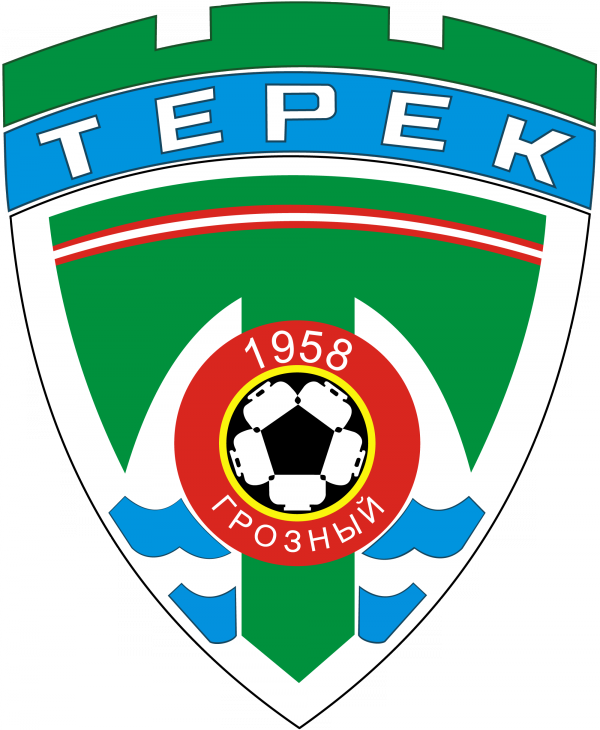
FC Terek Grozny is a club born from a war-torn republic that fought its way into the Russian Premier League and carved out a respectable position in the country's football hierarchy. Founded in 1958 and reborn after the Chechen conflicts, this team represents one of the most remarkable comeback stories in post-Soviet football. The club's visual identity — centred around a green-and-white emblem featuring a dynamic football in flight — tells the story of resilience, regional pride, and sporting ambition. Today we share the vector emblem of FC Terek Grozny in CMX (CorelDRAW) and EPS formats, plus high-resolution PNG renders at 2000, 600, and 300 pixels. Whether you need it for a fan project, a design mockup, or an archival collection of Russian football heraldry, this package gives you everything in one download.

Few clubs in European football carry the emotional weight that Terek does. For years, the team played its home matches hundreds of kilometres away from Grozny because the city's stadium was destroyed. Players trained wherever they could find a pitch. Yet through sheer determination, the club not only survived but thrived — reaching the Russian Cup final in 2004 and spending over a decade in the top flight. When you look at the emblem now, you are not just seeing a football logo: you are looking at a symbol of endurance.

The Club Behind the Crest: FC Terek Through the Decades

The club was established in 1958 under the name «Terek», named after the Terek River that flows through the Caucasus region. In the Soviet era, Terek toiled in the lower divisions of the USSR football pyramid — a regional team with modest resources and a loyal local following. The collapse of the Soviet Union in 1991 brought a new set of challenges. The two Chechen wars that followed devastated infrastructure across the republic, and football became a secondary concern when basic survival was at stake.

Yet football in Chechnya refused to die. The club was resurrected in 2001 with the backing of the Chechen government, and within three years it pulled off one of the greatest cup runs in Russian history. A First Division side at the time, Terek marched to the 2004 Russian Cup final, defeating top-flight opposition along the way. In the final, they beat Krylya Sovetov Samara 1-0 at Luzhniki Stadium — a David-versus-Goliath moment that stunned the country and earned the club a place in the UEFA Cup.

That victory remains the defining moment of Terek's existence. A club without a proper home stadium, from a region still rebuilding from war, holding a national trophy aloft in Moscow. The 2004 Cup win launched Terek into the Premier League for the first time. From that point forward, the club established itself as a mid-table fixture in the top division, surviving relegation battles and occasionally pushing for top-half finishes.

In 2017, the club was renamed FC Akhmat in honour of Akhmat Kadyrov, the first president of the Chechen Republic. The rebranding sparked debate among fans and football historians, but the original Terek emblem remains a collector's item — a piece of football design history that captures the club's identity before the rebrand.

Design Analysis: What Makes the Terek Emblem Tick

The Terek emblem is deceptively simple at first glance, but there is genuine design craft at work. The crest is a rounded shield — a shape common in Russian football heraldry, borrowed from Soviet-era sports society badges. The dominant colours are green and white, set against a dark background. Green represents the fertile lands of the Chechen plains and, more broadly, the club's ties to the natural landscape of its home region. White brings contrast and legibility, ensuring the emblem reads well at both large and small sizes.

The central motif is a classic leather football — the kind with visible hexagonal panels — captured in mid-flight, suggesting motion, dynamism, and forward momentum. Above the ball, the word «ТЕРЕК» appears in white Cyrillic lettering. The typography is bold and straightforward, using a sans-serif font that prioritises readability over decoration. Below the ball, a stylised ribbon element anchors the composition, adding a touch of formality and echoing the scroll motifs found in traditional heraldry.

What sets this emblem apart from many Russian club logos of the same era is its restraint. There are no excessive gradients, no overcomplicated iconography, no cluttered text. The designer clearly understood that a football crest needs to work on a kit badge (roughly 6-8 cm wide), a website header, a printed programme, and a television scoreboard — often simultaneously. This versatility is the hallmark of professional sports branding.

The vector version preserves the original design intent: clean curves, sharp text outlines, and accurate colour reproduction. Unlike raster images that degrade with scaling, the CMX and EPS files maintain perfect quality at any size — from a mobile thumbnail to a stadium banner.

Vector vs Raster: Why Format Matters for Emblems

When you download a club emblem from a random fan site, you typically get a JPEG or PNG that someone has already resized — often poorly. These raster images are made of pixels. Enlarge them, and the edges turn jagged. Shrink them, and fine details blur into unintelligible smudges. For any serious design work — a supporter's flag, a matchday poster, a t-shirt print — a raster download is a dead end.

Vector graphics solve this problem permanently. Instead of recording colour information per pixel, vectors describe shapes mathematically using curves defined by control points. The result: infinite scalability without quality loss. A vector emblem that is 2 centimetres wide on a business card looks just as crisp as the same emblem blown up to 2 metres on a stadium wall.

Our download package includes CMX (CorelDRAW's native format) and EPS (Encapsulated PostScript, compatible with Adobe Illustrator, Inkscape, Affinity Designer, and virtually every professional vector application). Both files open as fully editable layered documents, so you can recolour elements, tweak the typography, or extract individual components for use in larger compositions.

FormatTypeBest ForEditable LayersMax Size
CMXVector (CorelDRAW)CorelDRAW users, commercial printingYesUnlimited
EPSVector (universal)Illustrator, Inkscape, cross-platform sharingYesUnlimited
PNG 2000pxRaster (bitmap)High-res print, large displaysNo2000 px width
PNG 600pxRaster (bitmap)Websites, presentations, documentsNo600 px width
PNG 300pxRaster (bitmap)Thumbnails, email signatures, small layoutsNo300 px width

The PNG files are rendered directly from the vector source, so there are no compression artefacts or colour shifts between the vector and raster versions. All files use the same RGB colour profile, ensuring consistency across different applications and display devices.

If you plan to use the emblem commercially — on merchandise, in a publication, or as part of a brand identity — check the club's current trademark status. While our files are free to download, the emblem design itself may be protected. For personal projects and fan content, there are typically no restrictions.

How Designers Actually Use Vector Club Emblems

People download football emblems for a wide range of purposes, and the use case determines which format you should work with. Let us walk through the most common scenarios so you can pick the right file without trial and error.

If you are creating a fan banner or flag, open the vector file in your preferred editor, scale it to the desired physical dimensions (typically 100 × 150 cm for a standard flag), and export as a high-resolution TIFF or PDF for the print shop. The vector file ensures that the emblem's text remains sharp even at flag-scale — something a low-res PNG simply cannot deliver.

For digital content — social media graphics, YouTube thumbnails, match preview images — the 600 px PNG is usually sufficient. It loads fast, has a transparent background (PNG supports alpha channels), and looks crisp on Retina and 4K displays at typical viewing sizes. If you need to overlay the emblem on a photo, drag the PNG directly onto your background layer; the transparency means no white box around the crest.

For print publications — fanzines, matchday programmes, posters — always work from the vector file. Print requires 300 DPI at the final physical size. A 600 px PNG printed at A4 size gives you roughly 72 DPI — visibly pixelated. The vector file bypasses this entirely because it has no inherent resolution.

For archival and research purposes, the complete package is valuable. Having the vector source means the emblem can be reproduced faithfully decades from now, regardless of what software becomes standard. This matters for football historians cataloguing the visual evolution of clubs over time.

Downloader's checklist: grab the ZIP with vector files (CMX + EPS) for editing and scaling. Add the PNG pack for quick placement in web and social media projects. Keep all files together in one folder — future you will thank present you for the organisation.

Terek vs the Rebrand: What Changed in 2017

When the club became FC Akhmat in 2017, the emblem underwent a significant redesign. The word «АХМАТ» replaced «ТЕРЕК» in the crest, and the overall colour scheme shifted to incorporate more gold and red elements. The football motif remained but was rendered in a more modern, stylised fashion. The new emblem is sharper, more corporate-looking — a deliberate departure from the understated charm of the original.

Many long-time supporters still prefer the old Terek badge. It represents the club's identity before the political rebrand: the cup-winning era, the underdog story, the symbol of a team that refused to quit despite unimaginable circumstances. This is why the original vector emblem continues to circulate among collectors and fan communities.

AspectTerek Emblem (pre-2017)Akhmat Emblem (post-2017)
Typography«ТЕРЕК» in white sans-serif«АХМАТ» in gold serif-style
Primary coloursGreen, white, dark backgroundGreen, gold, red
Ball styleClassic hexagon-panel footballModern stylised football
Overall feelTraditional, understatedModern, corporate, polished
Historical significance2004 Cup winner, Premier League debutPost-rebrand era

Both versions have their place in football design history. Our download focuses on the original Terek emblem because it is the version most requested by designers, historians, and fans collecting pre-rebrand memorabilia.

Practical Tips for Working With These Files

Open the CMX file in CorelDRAW X3 or later. The file was created in an older version for maximum compatibility. If you use Adobe Illustrator, go with the EPS file instead — Illustrator handles EPS natively and preserves all layer information. Inkscape users (free and open-source) should also use EPS; the import dialogue will walk you through the conversion process.

When opening the EPS on a Mac, you may encounter a font substitution warning if your system does not have the exact typeface used in the original design. The text has been converted to outlines (curves), so no font installation is necessary — the warning can be safely ignored. The lettering will render as vector shapes regardless of your installed fonts.

If you only need a quick visual reference, open one of the PNG files. Each size has its place: 300 px for inserting into documents and emails, 600 px for web pages and blog posts, 2000 px for prints up to roughly A5 size at 300 DPI.

Download vector emblem (CMX + EPS)ZIP

Frequently Asked Questions

What formats are included in the Terek emblem download?

The ZIP archive contains CMX (CorelDRAW) and EPS vector files. PNG renders at 2000 px, 600 px, and 300 px are also available for quick use without a vector editor.

Why was FC Terek renamed to FC Akhmat?

The club was renamed in 2017 in honour of Akhmat Kadyrov, the first president of the Chechen Republic, who played a key role in rebuilding football infrastructure in the region after the Chechen wars.

When was FC Terek founded?

The club was founded in 1958. It played in the lower Soviet divisions before being resurrected in 2001 and entering the Russian football league system in earnest.

What is Terek's biggest achievement?

Winning the 2004 Russian Cup as a First Division side. They beat Krylya Sovetov Samara 1-0 in the final, becoming the first club from a lower division to win the Cup since the Soviet era.

Can I use this emblem for commercial projects?

The emblem design is the intellectual property of the football club. Our files are provided for personal, educational, and archival use. For commercial applications, verify the current trademark status with the rights holder.

What is the difference between CMX and EPS?

CMX is CorelDRAW's proprietary vector format, ideal if you work in CorelDRAW. EPS is a universal vector interchange format compatible with Adobe Illustrator, Inkscape, Affinity Designer, and most professional design software.

Which PNG size should I use?

Use 300 px for thumbnails and small inserts, 600 px for web pages and social media, and 2000 px for print layouts up to A5 size. For anything larger, work from the vector files directly.

Do I lose quality when scaling the PNG files?

Yes — PNG is a raster format. Enlarging beyond the native pixel dimensions introduces blur and jagged edges. The vector files (CMX and EPS) scale infinitely without quality loss.

Where did Terek play its home matches after the Chechen wars?

Before Grozny's stadium was rebuilt, the club played home matches in Pyatigorsk and other cities far from Chechnya. Returning to Grozny was a huge symbolic moment for the club and its supporters.

Does the vector file include transparent background?

Yes — the CMX and EPS files have no background fill. The emblem exists as isolated vector shapes, and all PNG renders are exported with alpha-channel transparency.

Tap to react