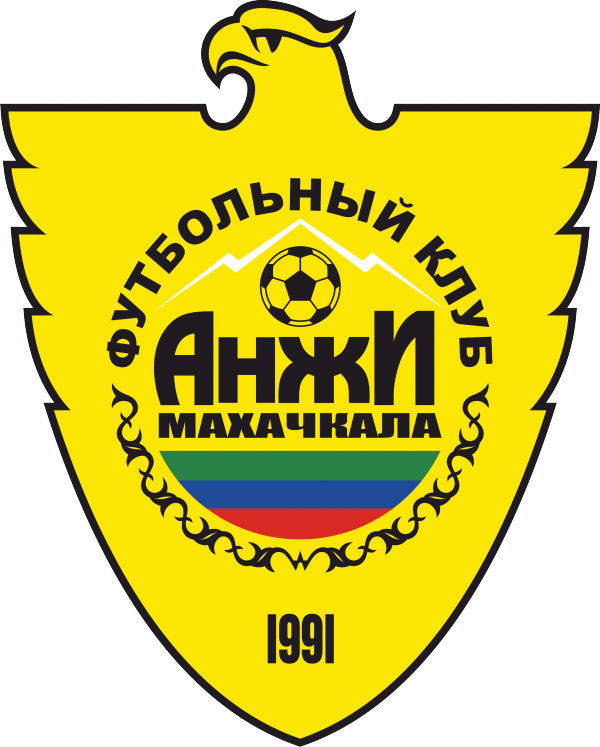
FC Anzhi Makhachkala is one of the most extraordinary stories in modern football — a club from Dagestan, a republic in Russia's North Caucasus, that briefly became one of the wealthiest and most talked-about teams on the planet. For a few extraordinary years starting in 2011, Anzhi signed Samuel Eto'o as the world's highest-paid footballer, brought in Roberto Carlos as both player and later manager, and hired Guus Hiddink as head coach. The club's emblem — a distinctive crest featuring the eagle, a symbol deeply rooted in Dagestani identity — was suddenly visible on televisions, newspapers, and websites worldwide. Today we share the vector emblem of FC Anzhi Makhachkala in three professional formats: SVG (web-ready vector), CMX (CorelDRAW native), and EPS (universal vector exchange), plus PNG renders at 2000, 600, and 300 pixels for every practical use case.

The Anzhi emblem is more than a sports logo — it is a statement of regional identity from one of Russia's most culturally distinct republics. Dagestan, a mountainous region on the Caspian Sea coast, is known as the Land of Mountains and boasts a population of over three million people from more than thirty ethnic groups. The eagle on the Anzhi crest draws directly from this heritage: a proud, powerful bird surveying the landscape from above, embodying the independence and resilience that characterise the Dagestani people. For designers working with this emblem, understanding this cultural context is essential — the eagle is not an arbitrary design choice but a deliberate invocation of regional pride.

The archive includes three vector formats: SVG (optimised for web, CSS animation-ready, inline embeddable), CMX (native CorelDRAW with full editing capabilities), and EPS (universal vector exchange for Illustrator and other software). Three PNG sizes — 2000px, 600px, and 300px — cover every common resolution scenario.

The Anzhi phenomenon: from regional club to global headline

FC Anzhi was founded in 1991, just as the Soviet Union was collapsing, in Makhachkala, the capital of the Republic of Dagestan. The name Anzhi itself is a historical reference — it derives from the ancient Kumyk word for the region around Makhachkala, connecting the club to centuries of local history before Russian colonisation. For its first two decades, Anzhi was a modest operation. The club reached the Russian Premier League for the first time in 2000, spent a few seasons in the top flight, was relegated, and bounced between divisions — a typical trajectory for a regional Russian club with limited resources.

Everything changed in January 2011. Suleyman Kerimov, a Dagestan-born billionaire oligarch with an estimated fortune of over 7 billion dollars at the time, purchased the club outright. What followed was one of the most dramatic transformations in football history. Within months, Anzhi signed Roberto Carlos from Corinthians, bringing a World Cup winner to the shores of the Caspian Sea. Then came the signing that shook world football: Samuel Eto'o from Inter Milan. The Cameroonian striker was made the highest-paid footballer in the world, with reported annual earnings of 20 million euros after tax. Other big names followed — Yuri Zhirkov, Lassana Diarra, Mbark Boussoufa, Christopher Samba — and suddenly a club from a city most football fans could not find on a map was competing in the Europa League and challenging for the Russian title.

The Kerimov era was as volatile as it was spectacular. In August 2013, just two and a half years after the takeover, Kerimov announced a drastic change in strategy. The club's budget was slashed, the star players were sold or released, and Anzhi returned to a more sustainable model focused on developing young Russian talent. The dream was over almost as quickly as it began. But for that brief, extraordinary period, the Anzhi emblem was one of the most recognisable football badges anywhere in the world — worn by some of the greatest players of a generation, seen on Champions League-adjacent broadcasts, and forever etched into the memory of football fans who followed one of the sport's wildest experiments in ambition and excess.

Year Event Significance
1991 Club founded Established in Makhachkala as the Soviet Union dissolved
2000 Premier League debut First season in Russia's top division
Jan 2011 Kerimov purchase Billionaire oligarch Suleyman Kerimov buys the club
2011 Star signings begin Roberto Carlos, then Samuel Eto'o join the project
2011-2013 Peak spending era Top players, Hiddink as coach, Europa League campaigns
Aug 2013 Budget slashed Kerimov announces new sustainable development strategy
2013-2019 Post-crash era Club continues at reduced budget, eventually relegated

The Anzhi emblem: a deep dive into design and symbolism

The Anzhi crest is built around a single powerful image: the eagle. In Dagestani culture, the eagle — specifically the golden eagle that nests in the Caucasus Mountains — is a symbol of freedom, strength, and nobility. It appears in the coat of arms of the Republic of Dagestan itself, making the Anzhi logo a direct visual link between the football club and the region it represents. This is not a generic sports eagle lifted from clip art. It is a culturally specific symbol with centuries of local meaning behind it.

The colour scheme reinforces the connection to Dagestan's natural environment. The dominant green evokes the mountain landscapes and forests of the region, while the gold and blue accents reference the sun, the sky, and the Caspian Sea. Together, the palette creates a visual identity that is unmistakably Dagestani — warm, earthy, and distinct from the reds, blues, and whites that dominate most Russian club crests. For any designer familiar with Russian football, the Anzhi badge is immediately identifiable by its colour scheme alone, even before the eagle shape registers.

The typographic treatment on the emblem is a study in restraint. The club name is presented in clean, legible lettering — Cyrillic in the primary version — with the year of foundation displayed as a discreet element rather than a dominant feature. This typographic minimalism allows the eagle motif to command the visual space, which is exactly what a logo built around a strong central symbol should do. Too many football emblems try to do everything at once — text, graphics, decorative borders, and secondary symbols all competing for the viewer's attention. The Anzhi emblem avoids this trap. The eagle is the star. Everything else supports it.

The SVG format in this archive is optimised for web use with clean, standard-compliant XML that embeds directly in HTML. The CMX requires CorelDRAW X5+, and the EPS has been tested against Illustrator CS6 through CC 2024, Inkscape 1.3+, and Affinity Designer 2. Fonts in EPS are converted to outline paths.

What makes the Anzhi crest unique among Russian football logos

Most Russian football emblems fall into one of two categories: Soviet-derived designs that incorporate industrial motifs (hammers, gears, wheels) and post-Soviet designs that mimic Western European crests with shields, balls, and founding years. The Anzhi emblem belongs to neither category. Its reliance on a single natural symbol — the eagle — places it closer to the tradition of clubs like Benfica or Lazio, where avian imagery serves as the primary identity marker. In the context of Russian football, this approach was genuinely innovative when the emblem was introduced.

The eagle also carries a subtle but important political dimension. Dagestan, like many of Russia's North Caucasian republics, has a complex relationship with the central government in Moscow. The assertion of a distinctly Dagestani visual identity on a national stage — through a football club playing in the Russian Premier League — was a form of cultural representation that resonated with Dagestanis far beyond the sport itself. When Anzhi players wore that eagle on their chests against CSKA, Spartak, or Zenit, they were representing not just a football club but an entire region and its people.

Design element Description Cultural significance
Eagle motif Stylised eagle as central graphic element Symbol of Dagestan, appears on republic's coat of arms
Green colour Dominant background and accent colour Evokes mountain landscapes and forests of the Caucasus
Gold accents Used for the eagle and decorative elements References sunlight, nobility, and the region's ancient history
Blue accents Secondary colour for contrast and depth References the Caspian Sea and the sky above the mountains
Typography Clean Cyrillic, minimal, supporting role Lets the eagle dominate, avoids visual clutter

Why three vector formats (and three PNG sizes) matter

Different projects demand different file formats. The SVG included in this archive is web-first: it can be embedded directly inline in HTML, styled with CSS, animated with JavaScript, and rendered at any resolution without pixelation. If you are building a website about Russian football history, the SVG is the file you want. Drop it into your HTML, and it will render perfectly on phones, tablets, laptops, and 4K monitors — all from the same single file.

The CMX is the power user's choice. CorelDRAW's native format preserves every effect, every layer, and every piece of editable metadata that the original designer might need. If you are producing physical merchandise — embroidered patches, screen-printed shirts, engraved plaques — the CMX gives you full access to the emblem's internal structure, allowing you to separate colours for spot printing, adjust stroke weights for embroidery digitising, or export individual elements for specialist production processes.

The EPS bridges the gap. It is the universal format that every professional vector application can open. If you work in Adobe Illustrator and a collaborator sends you a CMX file, the EPS is your guaranteed safe fallback. It renders identically across platforms and applications, making it the format of choice for print shops, publishers, and collaborative design workflows where multiple people with different software need to work with the same asset.

The three PNG sizes cover the raster use cases. The 2000px version is for archival storage and large-format printing. The 600px version is for website headers, blog illustrations, and social media posts. The 300px version is for thumbnails, forum avatars, and mobile-optimised inline graphics. Rather than providing a single resolution and forcing you to resize it yourself — with the inevitable quality loss that comes from scaling rasters — we provide each size pre-rendered at the exact pixel dimensions you are most likely to need.

All vector files in this archive were manually traced from official club imagery and colour-corrected against multiple reference sources. They are not auto-traced approximations. Every Bezier curve, every colour value, and every path join has been verified for accuracy. You will not find the jagged artifacts, colour banding, or misaligned nodes that characterise machine-generated vector conversions.

Frequently asked questions about the FC Anzhi emblem

What formats are included in the FC Anzhi emblem download?

The archive contains SVG (web-ready vector for inline HTML embedding), CMX (native CorelDRAW vector with full editing support), EPS (universal vector exchange for Illustrator, Inkscape, Affinity Designer), and three PNG renders at 2000px, 600px, and 300px width. All vector formats preserve full resolution independence.

What does the eagle on the Anzhi emblem symbolise?

The eagle is the primary symbol of the Republic of Dagestan, appearing on the republic's official coat of arms. It represents freedom, strength, nobility, and the mountainous character of the region. On the Anzhi crest, it directly connects the football club to Dagestani cultural identity and regional pride.

Who owned FC Anzhi during its famous spending period?

Suleyman Kerimov, a Dagestan-born billionaire and one of Russia's wealthiest individuals, purchased Anzhi in January 2011. He invested heavily in the club, signing Samuel Eto'o as the world's highest-paid footballer and bringing in stars like Roberto Carlos. The high-spending era lasted from 2011 to mid-2013.

Can I use this emblem for commercial purposes?

The emblem is protected by trademark and copyright held by the club or its rights holders. This download is provided for editorial, educational, research, historical documentation, and personal non-commercial use. For any commercial application — merchandise, publications for sale, or branded products — contact the club directly for licensing.

What is the difference between SVG, CMX, and EPS?

SVG is a web-standard XML-based vector format that embeds directly in HTML and supports CSS animation. CMX is CorelDRAW's native format with full layer and effect support. EPS is the universal vector exchange format readable by all professional vector editors. Each serves a different workflow.

Why are there three different PNG sizes?

2000px serves as a master raster for archival use and large-format printing. 600px is optimised for website headers, blog posts, and social media. 300px is sized for thumbnails, inline graphics, and mobile-optimised contexts. Providing all three eliminates the need for manual resizing and its associated quality loss.

When was FC Anzhi founded and where is it based?

FC Anzhi was founded in 1991 in Makhachkala, the capital city of the Republic of Dagestan in Russia's North Caucasus region. The club's name derives from an ancient Kumyk word for the area around modern-day Makhachkala, connecting the modern football club to centuries of local history.

What happened to Anzhi after the Kerimov era ended?

After Kerimov slashed the budget in August 2013, Anzhi transitioned to a sustainable development model focused on young Russian talent. The club continued competing in the Russian league system at various levels but never regained the global prominence of the 2011-2013 period. Despite the decline, the club remains an important symbol of Dagestani identity in Russian sport.

Download vector emblem — SVG, CMX, EPS (ZIP)~2 MB

These files are provided for educational, editorial, historical research, and personal use. The Anzhi emblem is one of the most culturally significant football badges in Russian sport — a symbol of Dagestan, of ambition, and of one of modern football's most extraordinary experiments. We are proud to share it in the quality it deserves.

Tap to react