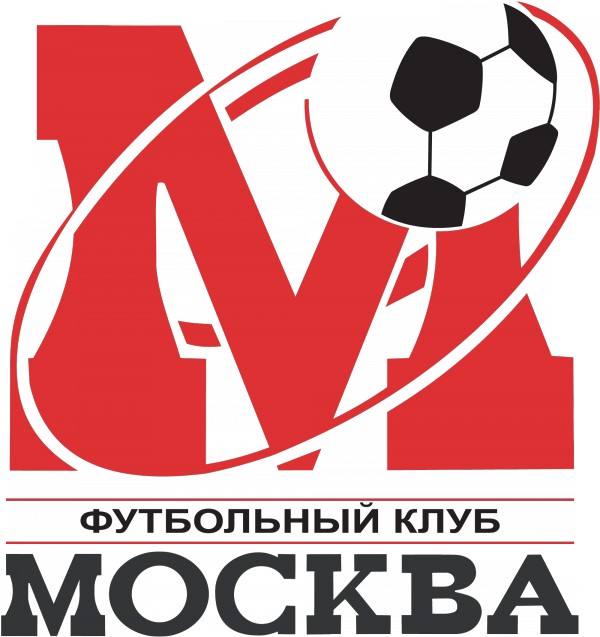
FC Moskva is a ghost of Russian football — a Premier League club that existed for just thirteen years, reached a Cup final, played in European competition, and then vanished as if it had never been there at all. Founded in 1997, the club climbed to the top division by 2001 and spent nearly a decade among Russia's elite before financial collapse forced it to withdraw from the championship in early 2010. On December 28, 2010, FC Moskva officially ceased to exist. But while the legal entity is gone, the emblem remains — a distinctive crest that once represented the ambitions of a club that dared to carry the name of Russia's capital on its badge. Today we share the vector emblem of FC Moskva in CMX (CorelDRAW) and EPS formats, plus PNG renders at 2000, 600, and 300 pixels for any project that needs this piece of football history.
The disappearance of a Premier League club is always a shock to the football ecosystem. Players suddenly become free agents. Staff lose their jobs. Fans lose their team. But something else disappears too: the visual identity — the logos, the typefaces, the colour combinations — that fans wore and displayed for years. These design assets scatter across old hard drives, forgotten websites, and low-resolution screenshots. Having a clean, high-quality vector version preserves at least one part of the club's legacy against total oblivion. For designers, historians, and football archivists, these files are more than graphics — they are artefacts of a lost institution.
The rise and fall of FC Moskva: a complete history
FC Moskva was founded in 1997 — not from scratch, but as the successor to a series of earlier Moscow-based football projects that had struggled to establish themselves. The club's initial years were spent in the lower divisions, building infrastructure and assembling a competitive squad. By 2001, the club had earned promotion to the Russian Premier League, the top tier of the country's football pyramid. This was a significant achievement for a club barely four years old, and it marked the beginning of FC Moskva's most visible period.
For nearly a decade — from 2001 through 2009 — FC Moskva was a fixture of the Premier League. The club was never a title contender in the way that CSKA, Spartak, or Zenit were, but it was consistently competitive, regularly finishing in the upper half of the table and occasionally threatening the European qualification places. The club's most successful season came in 2007, when it reached the final of the Russian Cup. Although FC Moskva lost that final — to Lokomotiv Moscow, in extra time — the achievement of reaching the showpiece match of Russian knockout football was a historic moment for the club and its supporters.
The Cup final also qualified FC Moskva for the UEFA Cup, giving the club its only taste of European competition. Playing against continental opponents was a new experience for the squad and the fans, and while the European campaign was brief, it gave the club a level of international exposure it had never previously enjoyed. For the players, it was a career highlight. For the supporters, it was validation that their club could compete beyond Russia's borders.
The decline, when it came, was swift and brutal. Financial problems that had been building for several seasons came to a head at the start of 2010. The club's ownership could no longer sustain the costs of running a Premier League operation, and in February 2010 — just weeks before the new season was due to begin — FC Moskva announced that it was withdrawing from the championship. The Russian Football Union accepted the withdrawal, and the club's place in the top division was vacated. For the remainder of 2010, the club existed only on paper while its assets were liquidated, its players were released, and its debts were settled. On December 28, 2010, the legal entity was formally dissolved. FC Moskva was no more.
| Year | Event | Significance |
|---|---|---|
| 1997 | Club founded | Established as successor to earlier Moscow football projects |
| 2001 | Premier League promotion | Reached Russia's top division for the first time |
| 2001-2009 | Premier League tenure | Nine consecutive seasons in the top flight |
| 2007 | Russian Cup finalist | Lost to Lokomotiv Moscow in extra time |
| 2007 | UEFA Cup qualification | Club's only European competition appearance |
| Feb 2010 | Withdrawal from league | Financial collapse forced mid-season withdrawal |
| Dec 28, 2010 | Club dissolved | Legal entity formally ceased to exist |
The emblem: what the FC Moskva crest represents
The FC Moskva emblem did something bold and potentially presumptuous: it placed the name of Russia's capital city — the largest city in Europe, the political and economic heart of the country — directly on a football badge. This was not a regional identity like Spartak or a departmental identity like CSKA. This was a city-branded club, and the name itself made a statement: we represent Moscow. In a city already saturated with historic clubs, this was either a declaration of ambition or an act of hubris, depending on who you asked.
The design language of the emblem reflected this metropolitan identity. Unlike the aggressively traditional crests of older Russian clubs with their complex heraldic devices and Soviet-era symbolism, the FC Moskva badge leaned toward a cleaner, more contemporary aesthetic. The typography was direct. The colour palette was restrained. The geometry was purposeful rather than decorative. This was a logo designed in the post-Soviet era by people who understood that football badges were now brand assets competing for attention in a global media landscape, not merely municipal symbols to be hung on a stadium wall.
Design elements of the FC Moskva crest
The emblem is built around a clean shield or badge form — a shape that immediately communicates football identity while avoiding the specific heraldic traditions that would tie it to a particular historical period. The colour scheme, dominated by deep tones with contrasting accents, gives the badge visibility on both white and dark backgrounds, an important practical consideration for a logo that would appear on everything from white away kits to dark advertising hoardings.
The typographic treatment of the club name uses straightforward, legible letterforms rather than ornate calligraphy. This was a deliberate choice that aligned the club's visual identity with modern European football branding trends of the late 1990s and early 2000s, when clubs across the continent were simplifying their logos to work better in digital media and on television graphics. For designers studying the evolution of Russian football aesthetics, the FC Moskva emblem represents a transitional moment — the point at which the Soviet visual heritage began to give way to international branding conventions.
| Design element | Description | Design rationale |
|---|---|---|
| Badge form | Clean shield or badge shape, non-heraldic | Communicates football identity without historical baggage |
| Colour scheme | Deep primary tones with contrasting accents | Strong visibility on both light and dark backgrounds |
| Typography | Modern, legible, sans-serif letterforms | Optimised for digital media and television graphics |
| City name | Moscow prominently displayed | City-branded identity, rare in Russian football of the era |
Why preserving emblems of defunct clubs matters
When a football club dies, its visual identity dies with it — unless someone makes the effort to preserve it. Websites go offline. Official merchandise stops being produced. Match programmes become collectors' items. The high-resolution logos that once sat on club servers are eventually deleted or lost in hard drive failures. What remains — scattered across fan forums, cached search results, and old social media posts — is typically low-resolution, poorly cropped, and colour-inaccurate. For anyone who needs a clean version of the FC Moskva emblem for research, journalism, fan projects, or historical documentation, finding a usable file becomes an archaeological exercise.
This is why we maintain and distribute these vector files. They are not just free downloads — they are acts of digital preservation. Every defunct club's emblem that survives in clean vector form is one fewer piece of football history that disappears into the digital void. For graphic designers building comprehensive collections of football heraldry, for journalists writing retrospective articles about the Russian Premier League, for fans who supported FC Moskva and want to keep its memory alive — having access to the original emblem in professional-grade vector formats is irreplaceable.
The FC Moskva crest also has value beyond nostalgia. Design students analysing the visual language of post-Soviet sports branding can study the emblem as a case study in identity design under specific cultural and economic constraints. The choices made by the club's designers — the typefaces, the colours, the badge shape, the relationship between the club name and the city name — were not arbitrary. They were responses to a specific moment in Russian history, and understanding those responses contributes to a fuller picture of how design functions in society.
Practical guide: using the FC Moskva emblem files
For print projects: Open the EPS file in Adobe Illustrator, scale to your required physical dimensions, and export with the colour profile your printer requires. The emblem will render at full sharpness regardless of whether you are printing a programme cover at A5 or a banner at three metres wide.
For web and social media: Use the 600px PNG for most online contexts — website headers, blog post illustrations, social media posts. The 300px PNG is ideal for thumbnails and inline graphics. The 2000px PNG serves as a master raster for any custom resizing you might need to do in Photoshop or GIMP.
For video projects: Import the EPS into After Effects or DaVinci Resolve. The vector data means the emblem can be scaled continuously during keyframe animations without any pixelation artifacts — essential for professional-looking motion graphics.
Frequently asked questions about the FC Moskva emblem
What formats are included in the FC Moskva emblem download?
The archive contains CMX (native CorelDRAW vector format), EPS (universal vector exchange format), and three PNG renders at 2000px, 600px, and 300px wide. The vector files require CorelDRAW, Adobe Illustrator, or Inkscape. The PNGs work in any image viewer without additional software.
What happened to FC Moskva?
FC Moskva was a Russian Premier League club founded in 1997. After nine seasons in the top division (2001-2009), a Russian Cup final appearance in 2007, and a brief UEFA Cup campaign, the club collapsed financially in early 2010. It withdrew from the championship in February 2010 and was formally dissolved on December 28, 2010.
Can I use this emblem for commercial purposes?
Although FC Moskva no longer exists as a legal entity, the intellectual property rights may still be held by former owners or liquidators. This download is provided strictly for editorial, educational, research, historical documentation, and personal non-commercial use. Verify the current IP status before any commercial application.
Why are there three different PNG sizes?
Each size serves a different purpose. The 2000px PNG is a full-resolution master for archival use and large-format printing. The 600px PNG is optimised for website headers, blog posts, and social media. The 300px PNG is sized for thumbnails, inline graphics, and mobile applications.
What was FC Moskva's greatest achievement?
The club's greatest achievement was reaching the final of the Russian Cup in 2007. Although FC Moskva lost the final to Lokomotiv Moscow in extra time, the result qualified the club for the UEFA Cup, marking its only appearance in European competition.
Is the FC Moskva emblem still protected by copyright?
Even though the club has been dissolved, the design of the emblem may still be protected by copyright law depending on the jurisdiction. The term of protection varies by country. This material is provided for non-commercial use with the understanding that it is a historical artefact of a defunct organisation.
How do I open the CMX file if I do not have CorelDRAW?
Open the CMX in Inkscape (free, cross-platform), then save as SVG or export to EPS. Alternatively, skip the CMX entirely and use the EPS file from this archive, which opens correctly in Adobe Illustrator, Affinity Designer, and Inkscape without any conversion steps.
What does the FC Moskva emblem look like in terms of design?
The emblem features a clean, contemporary badge with the club name and city reference prominently displayed. The design reflects the post-Soviet era of Russian football branding with a simplified, modern aesthetic optimised for visibility across print, digital, and broadcast media.
These files are provided for educational, editorial, historical research, and personal use. FC Moskva may be gone, but its visual identity deserves to be remembered and properly preserved. For designers, historians, and fans — this is the emblem as it was meant to be seen, in the quality it deserves.
Tap to react