Vector Emblem of FC Barcelona — History, Design, and Free Download in PDF, CDR, SVG, EPS, PNG

FC Barcelona — known worldwide simply as Barça — is far more than just a football club. Founded in 1899 and carrying the iconic motto «Més que un club» (More than a club), it has grown into one of the most recognized and celebrated sporting institutions on the planet. Its vector emblem — a masterful composition of the Cross of Saint George, the Catalan senyera flag, and the distinctive blaugrana stripes — is among the most reproduced and requested sports crests in the world. This comprehensive guide covers the complete history of the Barcelona crest from its origins through every redesign, the deep symbolic meaning embedded in each element, detailed technical specifications for all available file formats, and direct access to PDF, CDR, SVG, and EPS vector files, plus PNG raster files at 2000 px, 600 px, 300 px, and 150 px resolutions.

Whether you are a graphic designer working on a Barcelona-themed project, a print shop producing fan merchandise, a historian documenting football heraldry, or a collector building a comprehensive emblem library — this article delivers the authentic, verified vector files you need alongside the rich historical context that makes this crest one of the most fascinating symbols in modern sport.


1. The Complete History of FC Barcelona

1.1. Foundation: November 29, 1899

The story of FC Barcelona begins with a small newspaper advertisement. In October 1899, a 22-year-old Swiss football enthusiast named Hans-Max Gamper Haessig (later known as Joan Gamper) placed a notice in the Barcelona sports magazine Los Deportes. The advertisement was simple and direct: Gamper was looking for people interested in playing football, a sport still relatively unknown in Spain at the time. The response exceeded expectations: on November 29, 1899, Gamper, alongside Swiss, British, Spanish, and Catalan footballers, formally established Futbol Club Barcelona at the Gimnasio Sole. The founding group was remarkably international — exactly the cosmopolitan character that would define the club throughout its history.

Gamper was not merely the founder but became the club’s spiritual father, serving as president on five separate occasions and personally intervening to rescue the institution from financial collapse multiple times. His vision was clear from the start: Barcelona would be an open, democratic club owned by its members (socis), not by wealthy individuals or corporations — a principle that remains at the core of the club’s identity to this day.

1.2. The Motto: Més que un club

In 1968, club president Narcís de Carreras delivered a speech in which he declared that «Barça is something more than just a football club». The phrase resonated so deeply that it was formally adopted as the club’s official motto: «Més que un club». This was not hyperbole. During the Franco dictatorship (1939–1975), when Catalan language, culture, and political expression were systematically suppressed, Camp Nou became one of the only public spaces where Catalan identity could be freely expressed. Singing the club anthem, waving the senyera, and supporting Barça became acts of cultural resistance. The club’s deep connection to Catalan identity transformed it from a sporting institution into a symbol of democratic values, regional pride, and community solidarity.

1.3. Camp Nou: The Cathedral of Football

Opened on September 24, 1957, Camp Nou stands as one of the most iconic sporting venues ever built. Designed to replace the old Camp de Les Corts, which had become too small for Barcelona’s growing supporter base, the new stadium was a statement of ambition and grandeur. With an official capacity of 99,354, it is the largest stadium in Europe and the fourth largest football stadium in the world. Over the decades, Camp Nou has hosted Champions League finals, World Cup matches, Olympic football, concerts by legendary artists, and countless unforgettable nights of sporting drama. For millions of football fans worldwide, visiting Camp Nou is a pilgrimage, and the stadium itself has become as much a symbol of the club as the crest on the players’ shirts.

YearEventSignificance
1899FoundationClub established by Joan Gamper
1957Camp Nou opensLargest stadium in Europe
1968Motto adopted«Més que un club» becomes official
2008–2012Guardiola era14 trophies, revolutionary playing style

2. The Barcelona Emblem: Design and Symbolism

2.1. Evolution Through the Decades

The FC Barcelona crest has undergone several redesigns since 1899, each reflecting the club’s evolving identity while preserving core symbolic elements. The original crest closely resembled the coat of arms of the city of Barcelona. The current version, refined and modernized, maintains the essential visual language that makes the emblem instantly recognizable anywhere in the world. The design is a masterclass in heraldic composition: every element has meaning, every color tells a story, and the overall effect is one of timeless elegance and forceful identity.

2.2. Key Heraldic Elements

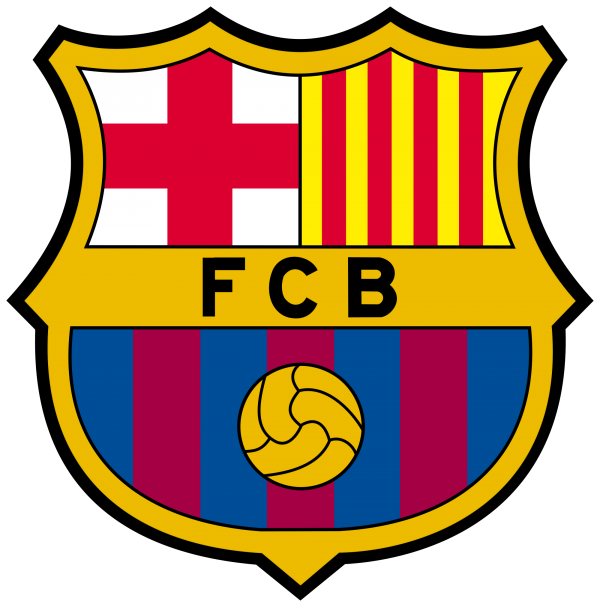
  • The Cross of Saint George (upper left): A red cross on a white field, this is the patron saint’s cross of both the city of Barcelona and Catalonia. It directly connects the club to the city’s historical and religious heritage and appears on both the Barcelona city coat of arms and the Catalan flag in variant forms.
  • The Senyera (upper right): Four red stripes on a gold background, the senyera is the official flag of Catalonia and one of the oldest national flags still in use in Europe. Its presence on the club crest cements Barcelona’s identity as a Catalan institution.
  • The Blaugrana stripes (lower half): The famous blue and garnet vertical stripes that give Barcelona its nickname and visual identity. The origin of these colors is debated — some historians claim they were Gamper’s tribute to his former club FC Basel, while others suggest they derive from the colors of a Swiss canton. Whatever the origin, the blaugrana has become one of football’s most iconic color schemes.
  • The football: A classic leather football sits at the center of the crest, framed against the blaugrana stripes. This straightforward symbolic element grounds the crest in the sport itself, ensuring that the emblem communicates its purpose without ambiguity.
  • The initials FCB: The letters «FCB» appear on a central band across the middle of the crest, providing a clean typographical anchor that identifies the club even in monochrome reproduction.

2.3. Comparison with Other World-Famous Club Crests

ClubCountryFoundedCrest StyleKey Symbol
FC BarcelonaSpain1899Shield with heraldic elementsSenyera + St. George Cross
Real MadridSpain1902Circle with crownRoyal crown + MCF initials
Manchester UnitedEngland1878Shield with shipShip + devil + footballs
Bayern MunichGermany1900Circle with diamondsBavarian lozenges
JuventusItaly1897Modern minimal JStylized letter J

The Barcelona emblem is widely regarded as one of the most beautifully designed club crests in world football. Its perfect balance of heraldic tradition, civic pride, and sporting identity has made it a benchmark for sports logo design. The clean vector version we provide captures every detail of this masterful design with absolute precision.


3. Why Professional Vector Files Matter

For a crest as globally recognized and frequently reproduced as Barcelona’s, vector quality is paramount. Raster images (JPEG, standard PNG) cannot scale without visible degradation, leading to blurry prints, pixelated embroidery, and unprofessional results. Vector formats (PDF, CDR, SVG, EPS) use mathematically defined paths, enabling infinite scaling with zero quality loss. This is critical for applications ranging from business card prints to building-sized banners, from embroidered patches to high-definition digital displays.

3.1. Format Specifications

FormatTypeBest ForSoftware
PDFVector/DocumentPrinting, sharing, archivingAdobe Acrobat, all PDF viewers
CDRVectorProfessional editing, sign makingCorelDRAW X3+
SVGVectorWeb design, responsive graphicsAll browsers, all vector editors
EPSVectorCross-platform exchange, printingAdobe Illustrator, CorelDRAW, Inkscape
PNG 2000 pxRasterHigh-quality printingAny image viewer/editor
PNG 600 pxRasterWebsite headers, presentationsAny image viewer/editor
PNG 300 pxRasterBlogs, email, social mediaAny image viewer/editor
PNG 150 pxRasterThumbnails, favicons, UIAny image viewer/editor

The FC Barcelona crest is a protected trademark. Any reproduction for commercial purposes requires appropriate licensing from the club. The files provided here are intended for educational study, personal research, historical documentation, and editorial use. Always verify current trademark policy before commercial application.


4. Download the FC Barcelona Emblem

The complete verified collection of FC Barcelona emblem files:

Download

Archive contents:

  • Vector PDF — universal format for printing and sharing
  • Vector CDR — CorelDRAW native with full editability
  • Vector SVG — web standard for browser and CSS integration
  • Vector EPS — cross-platform professional exchange format

PNG resolutions available: 2000 px (print), 600 px (web headers), 300 px (content), 150 px (thumbnails).

All files are organized in a single ZIP archive. No registration, no payment, no hidden conditions — instant access for educational, personal, and editorial use.


5. Frequently Asked Questions

When was FC Barcelona founded?

FC Barcelona was officially founded on November 29, 1899, by a diverse group of Swiss, British, Spanish, and Catalan footballers who were brought together under the leadership of Joan Gamper. The club’s founding meeting took place at the Gimnasio Sole in Barcelona, marking the beginning of what would become one of the most iconic institutions in world sport. Gamper, a Swiss entrepreneur and former footballer, placed an advertisement in the local newspaper Los Deportes calling for enthusiasts interested in forming a football club, and the response laid the foundation for over 120 years of sporting history.

What does the motto «Més que un club» actually mean?

The Catalan phrase «Més que un club» translates to «More than a club» in English. This motto encapsulates the unique position that FC Barcelona occupies in Catalan society and culture. During the Franco dictatorship, when the Catalan language and cultural expression were suppressed, Barcelona became a rallying point for Catalan identity and resistance. The Camp Nou was one of the few places where Catalan could be spoken freely. The motto was officially adopted in 1968 and continues to define the club’s identity as an institution that transcends sport, serving as a symbol of Catalan pride, democratic values, and community solidarity.

What is Camp Nou and why is it significant?

Camp Nou (meaning «New Field» in Catalan) is the iconic home stadium of FC Barcelona, located in the Les Corts district of the city. Opened on September 24, 1957, it was designed by architects Francesc Mitjans, Josep Soteras, and Lorenzo Garcia-Barbon. With a current official seating capacity of 99,354 spectators, Camp Nou is the largest football stadium in Europe and the fourth largest in the world. It has hosted numerous historic matches including UEFA Champions League finals, 1982 FIFA World Cup matches, and the 1992 Olympic football tournament. The stadium is more than a sporting venue — it is a pilgrimage site for millions of football fans worldwide and an essential symbol of the club’s grandeur.

What vector formats are included in the Barcelona emblem download?

The download package contains four professional vector formats: PDF (Adobe Portable Document Format, widely compatible and suitable for both viewing and printing), CDR (CorelDRAW native format for advanced professional editing), SVG (Scalable Vector Graphics for web integration and responsive design), and EPS (Encapsulated PostScript for universal cross-platform exchange). All formats are bundled together in a single convenient ZIP archive for easy access.

What PNG resolutions are included in the download?

Four PNG resolution variants are included: 2000 pixels for high-resolution offset printing and poster production, 600 pixels for website headers and digital presentations, 300 pixels for everyday web content and social media, and 150 pixels for thumbnails, favicons, and interface icons. Each resolution is optimized for its specific use case, providing the ideal balance of quality and file size.

Can the Barcelona emblem be used for commercial merchandise?

The FC Barcelona crest is a registered trademark protected by international intellectual property laws. Any commercial usage requires proper licensing from the club’s authorized representatives. The files provided here are intended for educational purposes, historical research, personal design study, and editorial use. For commercial applications including merchandise production, we strongly recommend consulting FC Barcelona’s official licensing department to ensure full legal compliance.

Is the vector emblem suitable for high-quality merchandise printing?

Absolutely. The PDF, CDR, and EPS vector formats are specifically engineered for professional-grade output including offset printing, digital printing, screen printing, embroidery digitization, and vinyl cutting. The mathematically precise paths ensure that the emblem retains perfect sharpness and color fidelity at any scale, from a small lapel pin to a stadium-sized banner.

Who was Joan Gamper and what role did he play in founding Barcelona?

Joan Gamper (born Hans-Max Gamper Haessig) was a Swiss football pioneer and businessman who became the driving force behind FC Barcelona’s creation. Arriving in Barcelona for professional reasons, Gamper was a passionate sportsman who missed playing football. In October 1899, he placed a small advertisement in the sports magazine Los Deportes calling for football enthusiasts to form a team. The response led to the founding meeting on November 29, 1899. Gamper served multiple terms as club president and is credited with saving the club from financial crisis on several occasions. His vision and dedication established the institutional foundation upon which the modern FC Barcelona was built.

What software is required to work with the CDR file?

The CDR format is the native file format of CorelDRAW and is fully compatible with CorelDRAW X3 and all subsequent versions, including the current CorelDRAW Graphics Suite. If you do not have access to CorelDRAW, the archive also includes the same emblem in EPS, PDF, and SVG formats, all of which offer extensive compatibility with alternative software including Adobe Illustrator, Inkscape, and Affinity Designer.

What notable achievements define Barcelona’s football legacy?

FC Barcelona’s legacy includes membership in an elite group of three clubs that have never been relegated from Spain’s top division (La Liga), alongside Real Madrid and Athletic Bilbao. The club has won multiple UEFA Champions League titles, numerous La Liga championships, Copa del Rey trophies, and FIFA Club World Cups. The 2008–2012 period under Pep Guardiola is widely regarded as one of the greatest eras in football history, with the team winning 14 trophies in four years while pioneering a revolutionary possession-based playing style that influenced football globally.

Tap to react