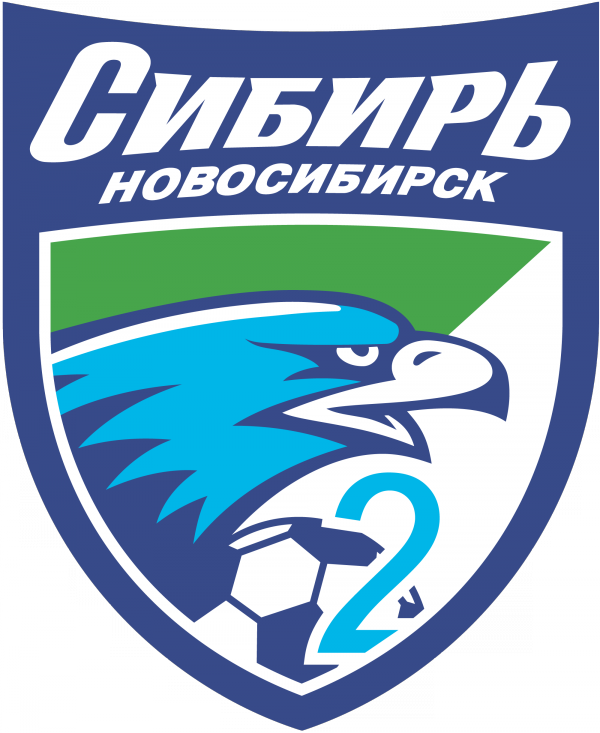
FC Sibir-2 is not a headline-grabbing giant — it is a farm club, a breeding ground, a proving ground for talent that hopefully graduates to the main squad of FC Sibir Novosibirsk. But do not let the designation fool you. Farm clubs are where football's future is forged, where young players who might not survive a trial at the senior level get the game time and the coaching attention that turns raw athleticism into professional readiness. Founded in 2008 as a separate legal entity strategically integrated into the FC Sibir structure, Sibir-2 has its own identity, its own fans, and its own emblem — the subject of this article. Today we share the vector emblem of FC Sibir-2 Novosibirsk in CMX and EPS formats, plus a high-resolution PNG for any project that needs it.

The story of Sibir-2 begins with Andrey Nikolaevich Arefin, the coach who was invited in 2004 to lead what was then the reserve team of FC Chkalovets-1936. Arefin did not just manage a squad — he built a programme. He assembled a core group of players who, year after year, competed successfully in the Siberia zone of the KFK amateur league. In 2007, that team won the tournament outright, taking first place and earning the right to enter the professional ranks. By 2008, Sibir-2 was officially founded as a distinct entity, and in 2009 it competed in the East zone of the PFL Second Division, the third tier of Russian professional football.

Financial realities caught up in 2009. The club's operations were temporarily suspended, and the players were either loaned out to other clubs or integrated into the senior FC Sibir squad. But the shutdown was a pause, not a full stop. In 2011, Sibir-2 resumed competition in the East zone of the Second Division, continuing its mission as a development pathway for Siberian football talent.

The archive includes two vector formats: CMX (CorelDRAW native) and EPS (universal vector exchange). Both formats are bundled in a single ZIP. The PNG is provided at full original resolution for immediate use without any vector editing software.

What a farm club actually means in Russian football

In European football, the concept of a farm club or reserve team is well established. Barcelona B plays in the Segunda Division. Real Madrid Castilla competes in the third tier. Bayern Munich II has its own history and identity. The Russian system, by contrast, has been slower to formalise the farm club model. For years, reserve teams played in a separate parallel competition with little competitive pressure and minimal public attention. The move to integrate reserve and farm teams into the regular league pyramid — allowing them to compete for real points against independent clubs — was a significant structural reform that brought clubs like Sibir-2 into sharper focus.

Sibir-2 exists for several specific purposes. First, it provides competitive match experience for young players aged 18 to 22 who are too old for the youth academy but not yet ready for the senior FC Sibir squad. Second, it serves as a rehabilitation platform for senior players recovering from injury, giving them match fitness before returning to the first team. Third, and perhaps most importantly from a scouting perspective, it gives the club's coaching staff a controlled environment to evaluate talent under competitive conditions — something that training matches and friendly games can never fully replicate.

The club's relationship with FC Sibir is formalised but not suffocating. Sibir-2 operates as a separate legal entity, which gives it administrative autonomy while remaining strategically aligned with the parent club. This structure is fairly common in Russian football and solves a real problem: how to develop players without the administrative overhead of running a fully independent club at the third-tier level.

Year Event Significance
2004 Arefin appointed to reserve team Core squad assembled for Chkalovets-1936 reserves
2007 KFK Siberia zone champions Won amateur league, earned professional licence
2008 FC Sibir-2 officially founded Registered as separate legal entity within FC Sibir structure
2009 PFL Second Division debut Competed in East zone of third-tier professional league
2009 Temporary suspension Operations paused, players loaned or moved to senior squad
2011 Return to competition Resumed Second Division participation in East zone

Siberian football occupies a unique position in the Russian sporting landscape. The distances are vast, the climate is punishing, and the talent pool is spread thin across enormous geographic areas. Novosibirsk — Russia's third-largest city — is the cultural and economic capital of Siberia, and its football infrastructure reflects that status. The presence of a dedicated farm club in this ecosystem is not a luxury; it is a structural necessity. Without Sibir-2, promising players from small Siberian towns like Tomsk, Barnaul, or Kemerovo would have nowhere to go after outgrowing local youth programmes. They would drift to amateur leagues, get ordinary jobs, and disappear from the professional talent pipeline entirely. This is the unglamorous but essential function that farm clubs perform, and Sibir-2 has been doing it since 2008.

The emblem carries this story in its design. Every element — the heraldic shield structure, the regional colour references, the numeric designation — tells the viewer that this club is both rooted in a specific place and connected to a larger project. For graphic designers who collect football emblems as historical specimens, the Sibir-2 crest is a document of Russian football's developmental tier: not glamorous enough to appear on television, but real enough to represent thousands of hours of training, hundreds of competitive matches, and the careers of players who may one day wear the senior team's shirt in front of sixty thousand people.

Design analysis: the FC Sibir-2 emblem

The FC Sibir-2 emblem is visually related to the senior FC Sibir crest — and this is entirely intentional. Farm clubs benefit from visual continuity with the parent brand. When a player wears the Sibir-2 shirt and sees the same design language as the senior team, the psychological message is clear: you are part of the same organisation, you are on the same pathway, and performance here is performance for the mother club. The emblem uses the distinctive colour scheme and design motifs of the Sibir identity, adapted for the second team with clear numerical designation.

The design itself reflects the practical constraints and opportunities of a farm club logo. Unlike the ornate, highly detailed crests of established Premier League clubs, the Sibir-2 emblem prioritises clean geometry and strong contrast — qualities that make it legible at the small sizes typical of league tables, website thumbnails, and printed fixture lists. The vector files we provide preserve every contour, every colour separation, and every typographic element at full mathematical precision.

The CMX version requires CorelDRAW X5 or newer. If you are using any other vector editing software, open the EPS file — it has been tested against Adobe Illustrator CS6 through CC 2024, Inkscape 1.3+, and Affinity Designer 2. Fonts in the EPS have been converted to outline paths.

Why the emblem matters for a farm club

There is a tendency to dismiss farm club branding as secondary or unimportant. This is a mistake. Every touchpoint where a young player encounters the club identity — on his training kit, on the matchday programme, on the team bus — reinforces the message that he belongs to something professional and serious. The emblem is the most visible and most frequently encountered expression of that identity. A poorly designed or inconsistently reproduced logo sends the opposite message: that the farm club is an afterthought, a budget line item, not a real team worth taking seriously.

FC Sibir's decision to invest in a proper, distinct emblem for its second team demonstrates an understanding of this principle. The crest is not a lazy copy-paste with a number slapped on. It has its own visual weight, its own character, while remaining unmistakably part of the Sibir football family.

Design aspect Description Practical implication
Visual continuity Colour scheme and motifs derived from senior FC Sibir crest Reinforces organisational identity and player motivation
Numerical designation Clearly marked as the second team Avoids confusion in league contexts and media coverage
Geometric clarity Clean lines, strong contrast, minimal ornaments Reads well at small sizes in web and print applications
Colour reproduction Limited palette suitable for two-colour printing Economical for merchandise, programmes, and banners

Vector files for practical use: what you actually need to know

You have downloaded the ZIP. You have extracted the files. Now what? Here is the practical guide to using the FC Sibir-2 emblem vector files, based on what real designers and content creators actually do with these formats.

Printing banners and flags: Open the EPS file in Adobe Illustrator or Inkscape. Scale the emblem to your target physical dimensions — 2 metres, 4 metres, whatever the job requires. Set the export resolution to match your printer's specification. Send to print. The result will be sharp at any size because vectors have no pixels to interpolate.

Creating social media graphics: Open the EPS, scale down to your target pixel dimension (1080x1080 for Instagram, 1200x630 for Facebook link previews, and so on), then export as PNG. The conversion from vector to raster happens at export time, meaning your final PNG is perfectly sharp at exactly the right pixel count — no upscaling, no downscaling, no quality loss anywhere in the pipeline.

Website integration: Convert the EPS to SVG using Inkscape or an online converter. Embed the SVG inline in your HTML for resolution-independent rendering on any screen, including high-DPI Retina and 4K displays where raster images look fuzzy.

The vector files in this download were manually traced from official club imagery. They are not machine-auto-traced conversions that carry the telltale artifacts of algorithmic approximation: jagged Bezier points, colour banding where gradients should be smooth, and misaligned path joins. Every curve has been checked against reference material.

Frequently asked questions about the FC Sibir-2 emblem

What formats are included in the FC Sibir-2 emblem download?

The archive contains CMX (native CorelDRAW vector), EPS (universal vector exchange), and a high-resolution PNG. The vector files require CorelDRAW, Adobe Illustrator, or Inkscape for editing. The PNG opens in any image viewer without additional software.

What is FC Sibir-2 and how is it related to FC Sibir?

FC Sibir-2 is the farm club of FC Sibir Novosibirsk, founded as a separate legal entity in 2008. It competes in the East zone of the Russian Second Division and serves as a development pathway for young players aged 18-22 and a rehabilitation platform for senior players recovering from injury.

Can I use this emblem for commercial purposes?

The emblem is protected by trademark and copyright held by the club. This download is provided for editorial, educational, research, and personal non-commercial use. For any commercial application — merchandise, publications for sale, branded products — contact FC Sibir directly for licensing terms.

What is the difference between CMX and EPS?

CMX stores CorelDRAW-specific metadata including layers, pages, and proprietary effects like lens objects. EPS is a simpler, universally readable vector format that preserves paths and fills but drops application-specific features. For users without CorelDRAW, the EPS file is the practical choice.

What resolution is the PNG file?

The PNG is supplied at high resolution suitable for print at A4 size at 300 dpi. It is a lossless raster format with no JPEG compression artifacts and a transparent background for flexible placement in any layout.

When was FC Sibir-2 founded?

FC Sibir-2 was founded in 2008 as a separate legal entity within the FC Sibir Novosibirsk structure. Its origins trace back to 2004 when coach Andrey Arefin was appointed to manage what was then the reserve squad of FC Chkalovets-1936, assembling a core group that would become the foundation of Sibir-2.

Why does a farm club need its own emblem?

A distinct emblem reinforces professional identity for young players, provides visual continuity with the parent club, and serves as a branding asset for matchday programmes, merchandise, and media coverage. It signals that the farm team is a serious professional operation, not an afterthought.

How do I convert the CMX file for use in software other than CorelDRAW?

Open the CMX in Inkscape (free, cross-platform), then save as SVG or export to EPS. Some text elements may convert to paths, losing direct text editability. Alternatively, simply use the EPS file from this archive, which has been pre-converted to outline paths for universal compatibility.

Download vector emblem — CMX, EPS (ZIP)~2 MB

These files are provided for educational, editorial, and personal use. For designers building fan projects, researchers documenting Russian football history, or anyone needing a clean vector version of the FC Sibir-2 emblem, this is the most complete freely available source. Contact us if you represent the club and wish to discuss usage terms.

Tap to react