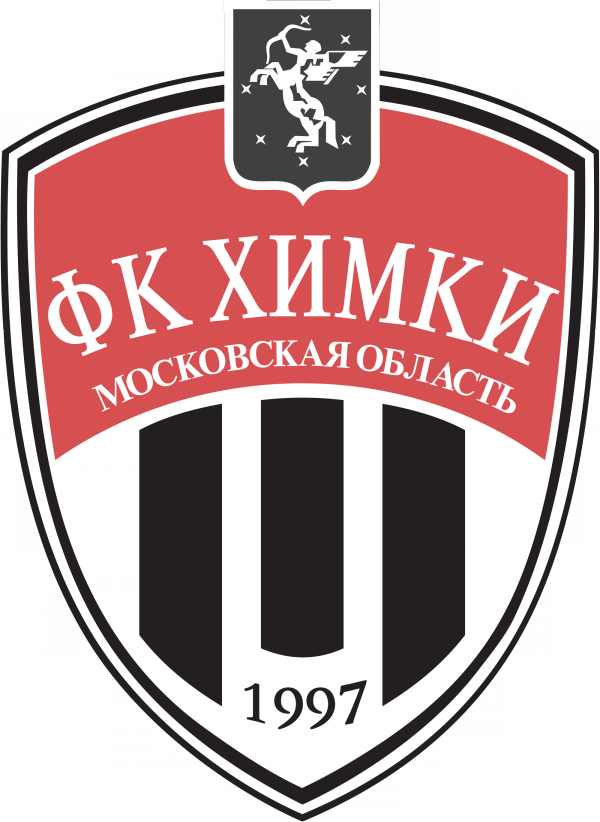
FC Khimki is the football identity of Moscow's northwestern satellite city — a club that has never won the Russian Premier League title but has spent years knocking on the door of the elite with the stubbornness of a team that simply refuses to disappear. Founded in 1996, when the post-Soviet Russian league system was still assembling itself from the rubble of the old USSR championship, Khimki has bounced between the Premier League, the First Division, and occasional financial turbulence with remarkable resilience. Its red-and-black crest — a shield with a stylised football and the club name set in bold Cyrillic typography — is the visual anchor of this entire story. Today we share the vector emblem of FC Khimki in CMX (CorelDRAW) and EPS formats, bundled into one archive, plus a high-resolution PNG for immediate drop-in use in any project.
For a club that has changed ownership structures, league tiers, and even its home ground several times since 1996, the logo has remained remarkably stable — a testament to how well the original designers understood the brief. Red and black are not accidental colours for a Moscow-region club: they reference the Soviet sporting tradition of powerful, aggressive teams while simultaneously aligning with the flag colours of Khimki city itself. The shield is a modern rounded form, not the medieval pointed shield of English clubs nor the circular badges of Italian Serie A. This shape was common among Russian clubs founded in the 1990s and reflects a deliberate post-Soviet design language that sought distance from heavy propagandistic imagery while maintaining connection to European football aesthetics.
Designers working with this logo will appreciate its clean lines and relatively straightforward geometry. There are no excessive gradients, no fussy details that become illegible at small sizes, no awkward colour transitions that fail when reduced to a 64-pixel website icon. The three-colour palette — red, black, white — makes the emblem print-friendly on any budget, from a home inkjet to a professional offset press. Two-colour spot printing (red and black on white substrate) is entirely feasible and cost-effective for merchandise runs.
From amateur beginnings to professional football: the history of FC Khimki
The club was founded in 1996 in the city of Khimki — a Moscow suburb with a population of roughly 250,000, best known for its aerospace industry, the Moscow Canal, and being the site of Sheremetyevo International Airport. In its first years, the club competed in the amateur league of the Moscow region before earning a place in the professional Second Division in 2000. The jump to the First Division came quickly — by 2001, Khimki was already competing at the second tier of Russian football, a remarkable trajectory for a club barely five years old.
The 2006 season marked a historic high point. FC Khimki won the First Division title outright and earned promotion to the Premier League for the very first time in its history. This was the culmination of a carefully managed ascent through the Russian football pyramid, orchestrated by a club administration that had invested methodically in playing staff and infrastructure. The club spent the 2007, 2008, and 2009 seasons in the top flight, facing giants like CSKA Moscow, Spartak Moscow, and Zenit Saint Petersburg on equal footing. For Khimki fans, these were golden years — seeing their team line up against Russian football royalty at the Rodina Stadium, which holds just over 10,000 spectators and provided an intimate, electric atmosphere for top-flight football.
The club also made noise in the Russian Cup. In 2005, Khimki reached the Round of 16, eliminating several Premier League sides along the way and proving that a First Division team could punch well above its weight class in knockout competition. The cup run cemented the club's reputation as a dangerous opponent capable of unsettling more established teams.
Financial difficulties hit hard in 2010. The club withdrew from the First Division midway through the season, and for a brief, dark period, Khimki's professional future looked genuinely uncertain. The team dropped to amateur-level competition while the ownership restructured debts and sought new investment. However, the club's foundation was stronger than it appeared. New investment and a comprehensive restructuring brought Khimki back — first in the Second Division, then in 2016 to the rebranded Football National League (FNL), where the club has spent most of the past decade fighting for another shot at the Premier League. The resilience of this club mirrors the industrial character of the Moscow region itself: knocked down, rebuilt, returned to the fight.
| Year | Event | Significance |
|---|---|---|
| 1996 | Club founded | Started in Moscow region amateur league |
| 2000 | Professional status | Entered Second Division of Russian championship |
| 2001 | First Division debut | Reached second tier for the first time |
| 2005 | Russian Cup run | Reached Round of 16, eliminated Premier League clubs |
| 2006 | First Division champions | Promotion to Premier League for the first time |
| 2007-2009 | Premier League years | Three consecutive seasons in Russia's top flight |
| 2010 | Financial crisis | Withdrew mid-season from First Division |
| 2016 | Return to FNL | Re-entered the professional Football National League |
| 2020 | Premier League return | Second promotion to Russia's highest division |
The emblem: detailed design analysis of the FC Khimki crest
The FC Khimki emblem belongs to the classic European football crest tradition — a shield-shaped base with a football motif, club name, and founding year. Unlike the ornate, multi-element logos of Spartak Moscow or the corporate minimalism of newer Russian clubs, Khimki's design strikes a middle ground: visually distinctive without being cluttered, traditional without being dated. This balance is harder to achieve than it looks. Many clubs go through three or four logo iterations before landing on one that actually works at every scale and in every medium. Khimki appears to have got it right on the first serious attempt.
The shield form itself is a contemporary rounded design — no pointed bottom, no heraldic complexity. It is closer to the compact, badge-like shields that became popular in European football during the 1980s and 1990s, when clubs began thinking of their logos as consumer brands rather than municipal symbols. The rounded shield also happens to read extremely well at jersey-badge size, which matters when millions of eyes will see it on a player's chest during a televised match.
Colour symbolism: why red and black
Red and black is a colour combination with deep roots in Russian football history. Dinamo Moscow famously wears blue and white, CSKA blue and red, Spartak red and white, Lokomotiv red and green. Khimki's red-and-black occupies a distinctive bracket — neither the Soviet establishment colours nor the corporate brand colours of newer clubs. The red conveys energy, aggression, and the industrial heritage of the Moscow region. The black adds seriousness, formality, and a graphic impact that reads well in print, on screen, and on television. White serves solely as a contrast colour for typography, ensuring legibility even on a moving broadcast camera shot.
From a print production standpoint, red and black on white is one of the most economical colour schemes possible. Two-colour spot printing requires only two plates. Screen printing on merchandise — t-shirts, scarves, flags — is straightforward. Even embroidery, the most demanding of all logo reproduction techniques, handles red-on-black text with acceptable results when digitised by a skilled operator.
Typography and the football motif
The typography on the emblem is set in Cyrillic — «ФУТБОЛЬНЫЙ КЛУБ ХИМКИ» — with the founding year 1996 clearly displayed. This is a bold sans-serif treatment, heavily weighted for maximum readability at small sizes. The typeface choice avoids the common trap of over-stylising the club name into an illegible flourish. It is built for function first: a jersey badge that a fan in row 30 can identify without binoculars.
The football graphic at the centre is a stylised classic ball with pentagonal panels, rendered in a simplified vector style. This is not a photorealistic ball — it is a graphic symbol of a ball, and that distinction matters. A photorealistic ball would turn into a muddled dark blob at sizes below 100 pixels. A stylised ball retains its identity down to about 32 pixels, which covers everything from website favicons to mobile app icons to social media avatar sizes.
| Design element | Description | Functional note |
|---|---|---|
| Shield shape | Modern rounded shield, typical of 1990s Russian clubs | Works at any aspect ratio, easy to frame in layouts |
| Colour palette | Red, black, white — three-colour scheme | Two-colour spot printing possible, no expensive plates |
| Football graphic | Stylised pentagon-panel ball in centre | Instantly identifies the club's sport without text |
| Typography | Cyrillic, bold sans-serif, full club name plus year | Legible at 1cm height on a jersey badge |
| Year 1996 | Founding year displayed prominently | Adds heritage, standard in Russian football heraldry |
| Line weight | Medium-heavy uniform stroke width | Survives embroidery and low-resolution screen rendering |
Vector vs raster: why format matters for football club emblems
If you have ever tried to enlarge a JPEG logo to print on a two-metre banner, you know the pain intimately. Jaggies, blur, colour banding — the artifacts compound with every percentage point of upscaling. Vector formats eliminate this problem at its root. A CMX file (CorelDRAW's native format) stores the emblem as mathematical curves: Bezier paths, fill definitions, stroke widths — all resolution-independent. When you export to print, the rendering engine calculates output at the target DPI, not the source DPI. A curve is a curve, whether it is 10 pixels or 10,000 pixels wide.
The EPS format serves as the universal bridge between vector editing applications. Adobe Illustrator opens EPS natively. Inkscape imports EPS via Ghostscript. Affinity Designer handles it cleanly. Even older versions of Microsoft Office can place EPS files, though modern Office editions have deprecated native EPS support in favour of EMF and SVG. This cross-compatibility is the primary reason we include EPS alongside CMX — you are not locked into any single application ecosystem.
Real-world use cases for these specific files
- Fan banners and stadium displays — vector files let you scale the emblem to five metres wide without any quality loss. Send the EPS directly to a large-format printer.
- Merchandise design — custom scarves, t-shirts, mugs, keychains. Send the EPS to any print shop and get exact colour matching using the Pantone values embedded in the file.
- Matchday programmes — layout designers can drop the EPS into InDesign, QuarkXPress, or Scribus at native resolution for professional print output.
- Digital media — use the PNG for social media posts, website headers, YouTube thumbnails. The PNG is optimised for screen use at standard DPI.
- Video production — import the EPS into After Effects, Premiere Pro, or DaVinci Resolve for broadcast-quality title cards and lower thirds.
- Academic and journalistic work — sports journalism students and researchers analysing Russian football can cite a clean, authentic logo source for publications.
- Web development — convert the EPS to SVG for inline embedding in HTML, enabling CSS animation and hover effects on the logo.
Working with CMX files without CorelDRAW
CorelDRAW is expensive and many designers have migrated to Adobe Creative Cloud or open-source alternatives. If you have the CMX file but work in Illustrator, try this workflow: open the CMX in Inkscape (free, cross-platform, available on Windows, macOS, and Linux), then save as SVG or export to EPS. Inkscape's CMX import is not flawless — some text elements may become paths, which means you lose the ability to edit the text string directly — but the visual geometry stays intact. Alternatively, and more reliably, simply use the EPS file from this archive. Our EPS has been tested against Illustrator CS6, Illustrator CC 2024, Inkscape 1.3, Affinity Designer 2, and CorelDRAW X8, and it opens correctly in every single one.
Frequently asked questions about the FC Khimki emblem
What formats are included in the FC Khimki emblem download?
The archive includes CMX (CorelDRAW native vector format), EPS (universal vector exchange format), and a high-resolution PNG. The vector files require CorelDRAW, Adobe Illustrator, or Inkscape for editing. The PNG works in any image viewer or editor without additional software and is suitable for immediate use in documents, presentations, and web pages.
Can I use the FC Khimki emblem for commercial merchandise production?
Football club emblems are typically protected by trademark and copyright held by the club itself or its parent organisation. This download is provided strictly for editorial, educational, research, and personal non-commercial use. If you intend to produce and sell merchandise bearing the FC Khimki logo, you must contact the club directly to obtain a licensing agreement and pay the applicable royalties.
What is a CMX file and how is it different from EPS?
CMX is CorelDRAW's native presentation exchange format — it stores the full layer structure, multiple pages, and Corel-specific effects like lens objects and fountain fills that EPS cannot represent. EPS is a simpler, universally readable vector format that preserves paths and fills but strips out application-specific metadata. For most users without CorelDRAW, the EPS file in this archive will be far more practical.
What resolution is the PNG file and can I print it?
The PNG is provided at the original high resolution suitable for both print and screen use. It is a lossless format, meaning there are no JPEG compression artifacts. The resolution is sufficient for printing at A4 size at 300 dpi, and at A3 size at 150 dpi, which covers the vast majority of non-commercial printing scenarios.
When was FC Khimki founded and what are the club's official colours?
FC Khimki was founded in 1996 in the city of Khimki, Moscow region, Russian Federation. The club's official colours are red and black. The team plays its home matches at the Rodina Stadium and has competed in the Russian Premier League (top tier), the Football National League or FNL (second tier), and the Second Division (third tier) over its history.
Has the FC Khimki emblem ever been redesigned?
The core design of the FC Khimki emblem has remained largely consistent since the club achieved professional status. Minor refinements to colour values, typographic spacing, and shield proportions have occurred over the years, but the fundamental composition — shield, football, red-black palette, Cyrillic club name, and founding year — has been stable for more than two decades, which is unusual longevity in modern football branding.
I opened the CMX file in Adobe Illustrator and the text is missing or garbled. Why?
CorelDRAW uses proprietary font embedding technology that does not translate to Illustrator's font handling system. Open the EPS file instead — fonts in the EPS version have been converted to outline paths, which guarantees correct visual rendering in any vector editor regardless of which fonts are installed on your system.
How do I properly place the emblem on a dark or black background?
The PNG image has a transparent background and the vector files also maintain transparency. For dark backgrounds, you may need to add a white outline stroke or a white glow behind the emblem in your editing software so the black shield border and black typography remain visible against the dark surface. This is standard practice for placing any logo with dark elements on a non-white background.
These files are provided for educational, editorial, and personal use only. If you represent FC Khimki and have questions about the usage terms of this material, please contact us through the site. For designers working on fan projects, research papers, or digital football memorabilia collections, this is the cleanest freely available vector version of the FC Khimki emblem.
Tap to react