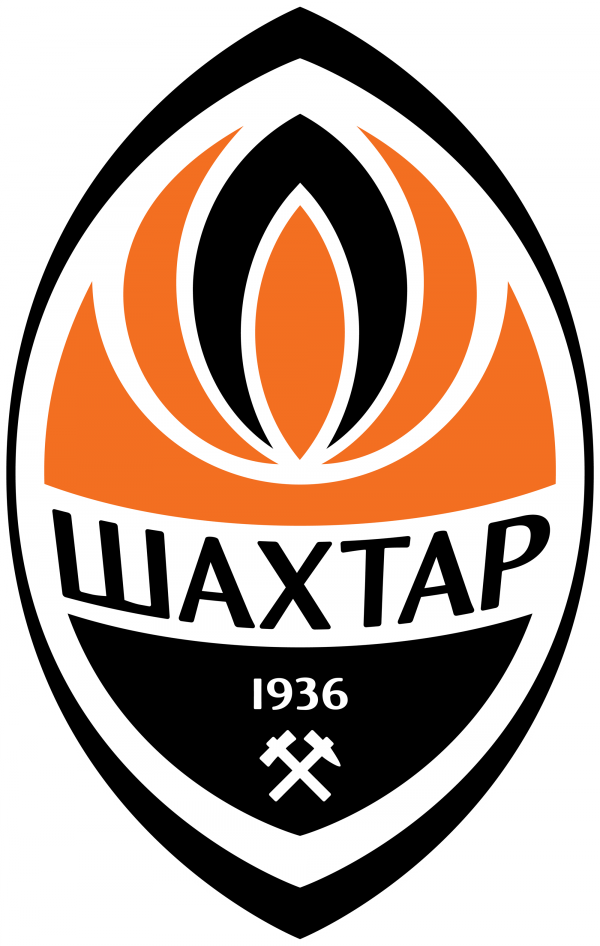
FC Shakhtar Donetsk is not just a football club — it is the sporting identity of an entire region. Founded on May 24, 1936, the club has grown from a local miners' team into a European powerhouse, winning the UEFA Cup in 2009 and dominating Ukrainian football for over two decades. At the heart of its visual identity stands a bold, instantly recognizable emblem: crossed hammers over a football, wrapped in the distinctive orange-and-black palette of Donbas. Today we are sharing this emblem in every format a designer could need — vector CMX for CorelDRAW, universal EPS and SVG, plus a high-resolution PNG for quick placement.
Whether you are preparing a fan banner for the stadium, designing merchandise for a supporters' club, laying out a matchday programme, or simply building a collection of football heraldry, having the logo in pure vector form saves hours of tracing and guessing. No pixelation at any scale, no colour mismatch from poorly converted raster files. Every curve, every letter, every hammer contour is preserved exactly as the club intended.
A club born in the mines: the history of FC Shakhtar Donetsk
The story of Shakhtar begins underground. Donetsk, at the time called Stalino, was the industrial heart of Soviet Ukraine — coal mines, steel mills, and blast furnaces defined the landscape. In the spring of 1936, two local sports societies, Stakhanovets and Ugolschiki, merged to form a single football team. The name Stakhanovets was chosen in honour of Alexei Stakhanov, the legendary Soviet miner who reportedly extracted 102 tonnes of coal in a single shift — fourteen times the quota.
The club's early years were modest. Stakhanovets debuted in the Soviet Top League in 1938, finishing mid-table. World War II interrupted all competition, and many players and staff joined the front. After the war, in July 1946, the club was renamed Shakhtyor — literally "Miner" in Russian. This name would become synonymous with Donbas football for the next eight decades.
\u{201c}"Shakhtar is more than football. It is the character of a region that extracts its fortune from the earth, with hands hardened by coal and hearts burning with orange fire." — Club motto, paraphrased
The Soviet era brought sporadic success. Shakhtyor won the Soviet Cup four times (1961, 1962, 1980, 1983), often playing the role of giant-killer against Moscow and Kyiv clubs. The 1980s team, coached by Viktor Nosov, featured legends like Viktor Grachev and Igor Petrov. But true transformation arrived with Ukrainian independence.
In 1996, businessman Rinat Akhmetov took control of the club. Investment poured into infrastructure — the modern Donbas Arena was built, world-class training facilities followed, and international stars began arriving. The result: 15 Ukrainian Premier League titles, 13 Ukrainian Cups, and the crowning achievement — the 2009 UEFA Cup (now Europa League), won after defeating Werder Bremen 2-1 in extra time in Istanbul.
| Period | Club name | Major achievements | Home ground |
|---|---|---|---|
| 1936–1946 | Stakhanovets | Soviet Top League debut (1938) | Shakhtyor Stadium |
| 1946–1991 | Shakhtyor Donetsk | 4 Soviet Cups, 2 Soviet Super Cups | Shakhtyor Stadium / Lokomotiv |
| 1992–2009 | FC Shakhtar Donetsk | 4 Ukrainian titles, UEFA Cup 2009 | Shakhtyor Central / RSK Olimpiyskiy |
| 2009–present | FC Shakhtar Donetsk | 11 Ukrainian titles, 9 Ukrainian Cups | Donbas Arena (2009–2014) |
The club's home since 2009 was the magnificent Donbas Arena — a 52,000-seat stadium built to UEFA Elite standards, which hosted matches during Euro 2012. Forced relocation in 2014 meant the club played home matches in Lviv, Kharkiv, and now Kyiv, but the Donbas identity remains unshaken. The orange-and-black colours still fill stands wherever Shakhtar plays.
Evolution of the Shakhtar emblem: five decades in crests
A football club's crest is never static. It grows, simplifies, modernises. Shakhtar's emblem has gone through at least five distinct eras, each reflecting the political and aesthetic sensibilities of its time. Let us trace that journey — from Soviet-era heavy metal to the sleek international shield we distribute today.
The Stakhanovets years (1936–1946)
The original crest was, by all accounts, a simple typographic logo. No shield, no miner's tools, no football. Just the word "Stakhanovets" in bold Cyrillic script — fitting for a club named after a labour hero. Photographs from the period show players wearing plain jerseys with minimal insignia. The emblem as we know it today did not yet exist.
Post-war redesign (1946–late 1970s)
With the club's renaming to Shakhtyor, the first true emblem appeared. It featured a round medallion with a football at the centre, flanked by the Cyrillic text "ШАХТЁР". The colour scheme introduced orange and black — though in a more subdued palette. Crossed hammers were present but as a minor decorative element, not the dominant visual they would later become.
The classic Soviet shield (late 1970s–1991)
This is the crest that most veteran fans remember from childhood. A traditional heraldic shield shape, divided diagonally into orange and black halves. A football occupied the centre, with the Cyrillic "ШАХТЁР" arched above. The crossed hammers appeared beneath the ball. A red Soviet star crowned the top. This emblem was rich in detail and unmistakably Soviet in character — heavy, proud, ideological.
Post-independence modernisation (1992–2007)
With Ukraine's independence came a cleaner design. The Soviet star was removed, the shield shape softened, and the colour palette brightened. The club name appeared in both Ukrainian ("Шахтар") and English ("Shakhtar") — a nod to growing international ambitions. The crossed hammers were repositioned above the football, creating a vertical composition that emphasised strength. This emblem saw the club rise to prominence under Akhmetov's ownership.
The modern emblem (2007–present)
The current crest, introduced in 2007, is a masterclass in sports branding. It retains every historical symbol but executes them with contemporary precision. Let us examine what makes this version the definitive one — and the one you are downloading today.
Anatomy of the current emblem: what every element means
The modern Shakhtar emblem is deceptively simple, but every component carries deliberate meaning. Here is a breakdown of what your vector file contains:
| Element | Symbolism | Design detail |
|---|---|---|
| Crossed hammers | The mining heritage of Donbas; tools of labour that built the region | Metallic gradient finish, positioned prominently at centre-top |
| Football | The sport itself; universal symbol of the game | Classic pentagon-hexagon pattern, centred below hammers |
| Orange colour | Fire, energy, the sun — the warmth and passion of Donbas | Dominant in the shield background, bright and saturated |
| Black colour | Coal — the mineral that made Donetsk an industrial giant | Accent stripes and outlining, providing contrast |
| Club name | International branding in Latin script | "FC SHAKHTAR" in bold sans-serif, arched above the shield |
| Year 1936 | Founding year of the club | Positioned at the bottom of the emblem, small but present |
| Shield shape | Heraldic tradition, defence, honour | Modern pointed shield, orange with black stripe detailing |
| Black stripes | Coal seams — the underground layers of Donbas | Two horizontal black bands crossing the shield |
The transition from Cyrillic to Latin script on the emblem was a strategic move. As Shakhtar became a regular Champions League participant, its visual brand needed instant recognition across Europe. "ШАХТЁР" was replaced with "FC SHAKHTAR" — a design decision that sparked debate among traditionalists but ultimately proved correct for international marketing. The club now sells merchandise from Brazil to Japan, and the Latin crest is a key part of that reach.
Vector formats: why each one matters
A common question from newcomers: "I downloaded a PNG — why do I need vector formats?" The answer lies in scalability. A PNG at 2000 pixels wide looks sharp on a screen, but blow it up to billboard size and you will see jagged edges, blur, and colour banding. A vector file, in contrast, uses mathematical curves — it can be scaled to the size of a stadium and will remain perfectly crisp.
Our archive provides three vector formats, each tailored to a different workflow:
CMX (CorelDRAW Exchange): The native format for CorelDRAW users. CMX preserves layer structure, colour profiles, and object hierarchies exactly as they were authored. If you work in Corel — this is your format. The curves for the hammers, the typography of "FC SHAKHTAR", the gradient fills on the shield — all intact and editable.
EPS (Encapsulated PostScript): The universal exchange format. EPS opens in Adobe Illustrator, CorelDRAW, Inkscape, Affinity Designer, and virtually every professional vector editor. It is the safest choice for collaboration — send an EPS file and the recipient can open it regardless of their software stack.
SVG (Scalable Vector Graphics): The format of the web. SVG can be embedded directly into HTML, styled with CSS, animated with JavaScript, and indexed by search engines. Perfect for website headers, fan portals, digital banners, and responsive design. No additional software needed to view it — any modern browser renders SVG natively.
How to open and work with the files
Depending on your software environment, here is the recommended approach for each format:
- CorelDRAW users: Open the CMX file directly. All objects, layers, and colour swatches are preserved. Ready to edit immediately.
- Adobe Illustrator users: Open the EPS file. Illustrator imports EPS with high fidelity. If you encounter font substitution warnings, that is normal — the text has been converted to outlines (curves), so no font installation is required.
- Inkscape users: Open the SVG file. Inkscape's native format is SVG, so compatibility is excellent. All paths are editable.
- Web developers: Use the SVG file directly in your HTML. Wrap it in an <img> tag or inline it for CSS manipulation.
- Quick preview: Drag the PNG into any image viewer, browser, or office document. Suitable for mockups and fast placement.
The vector files have been verified to open correctly in CorelDRAW X7+, Adobe Illustrator CS6+, Inkscape 1.0+, and Affinity Designer 1.10+.
Practical applications: where this emblem is used
Over the years, our users have put this vector emblem to work in countless creative projects. Here are some of the most common use cases:
- Fan banners and stadium flags: Print shops require vector files for large-format printing. A 3-metre flag with a crisp, sharp emblem — only possible with CMX or EPS.
- Merchandise design: T-shirts, scarves, mugs, phone cases. Screen printing and sublimation demand clean vector art for precise colour separation.
- Matchday programmes and posters: The PNG works for digital previews, but the vector file ensures the crest prints sharp on coated paper at 300 DPI.
- Digital content: YouTube thumbnails, Instagram posts, website headers. The SVG format handles all screen resolutions without loss.
- Football heraldry collections: Enthusiasts and historians who catalogue club crests use vector files for accurate reproduction in publications.
- Video overlays and broadcast graphics: EPS with alpha channel transparency integrates cleanly into motion graphics and broadcast templates.
Colour specifications for accurate reproduction
When reproducing a club crest, colour fidelity matters. Here are the official colours embedded in the vector files:
| Colour | HEX | CMYK | Pantone | Usage |
|---|---|---|---|---|
| Shakhtar Orange | #F58428 | 0, 55, 94, 0 | 144 C | Primary shield background, brand identity |
| Donbas Black | #000000 | 0, 0, 0, 100 | Black 6 C | Stripes, outlines, text |
| Hammer Silver | #C0C0C0 | 0, 0, 0, 25 | Cool Gray 6 C | Metallic gradient on crossed hammers |
| Football White | #FFFFFF | 0, 0, 0, 0 | — | Football pentagon fill |
Frequently Asked Questions
What software do I need to open the CMX file?
CMX is the native CorelDRAW exchange format. You will need CorelDRAW X7 or newer. If you do not have Corel, use the included EPS or SVG files instead — they open without issues in Illustrator, Inkscape, and Affinity Designer.
Can I use this emblem for printing a fan t-shirt?
Yes, the EPS and CMX files are fully suitable for screen printing, sublimation, and DTG printing. Always provide the vector file to your print shop for the best result. The PNG can be used for mockups but not for final production.
Is this the current 2007 version of the emblem?
Yes, this is the modern crest introduced in 2007 and still used by the club today. The Latin text "FC SHAKHTAR," orange heraldic shield, crossed miner's hammers, and football constitute the club's official branding.
Does the archive include older historical versions of the emblem?
No, this archive contains only the modern version (2007–present). Historical crests of "Stakhanovets" and the Soviet-era "Shakhtyor" can be found in other publications in our football emblems category.
What resolution is the included PNG file?
The raster PNG is provided at 2000 pixels on the longer side at 300 DPI. This is sufficient for digital use, office documents, and small-format printing. For large-format prints, use the vector files.
Why does the emblem say "FC SHAKHTAR" instead of "ШАХТЁР"?
The switch to Latin script happened in 2007 as part of the club's international branding strategy. The old Cyrillic version "ШАХТЁР" was used from 1946 until 2007. The Latin crest is now the official emblem for all UEFA-sanctioned competitions.
Can I change the colors of the vector emblem for my project?
Yes, since the file is a true vector, every element — shield, hammers, ball, text — is independently selectable and recolorable in any vector editor. Change the orange to any color, adjust the black stripes, or modify the hammer gradients.
Does the SVG file work in WordPress or web projects?
Absolutely. The SVG can be embedded directly in HTML, uploaded to the WordPress media library (with SVG support enabled), or used in any modern web framework. It renders at any resolution and weighs only a few kilobytes.
Are the fonts editable in the vector file?
The "FC SHAKHTAR" text and the year "1936" have been converted to outlines (curves) — this guarantees correct display regardless of installed fonts. To change the text, you will need to retype it with a suitable font and manually match the positioning.
Is commercial use of this emblem permitted?
The emblem is a registered trademark of FC Shakhtar Donetsk. Personal, educational, and fan use is generally acceptable. For commercial production and merchandise sales, review the club's official licensing terms or seek legal advice.
Download FC Shakhtar Donetsk vector emblem
The complete archive is available below. All three vector formats plus the high-resolution PNG are included in a single ZIP file. No registration, no email wall, no countdown timer — just a direct link.
Download Shakhtar Donetsk emblem — CMX + EPS + SVG + PNG~4.5 MBAfter downloading, extract the ZIP to any folder. Open the format that matches your software — CMX for CorelDRAW, EPS for Illustrator, SVG for web or Inkscape. The PNG is ready for immediate use in any image-capable application. All files are free for personal and non-commercial projects. For commercial use (merchandise, print runs), please verify licensing terms with the club's official brand guidelines.
Tap to react