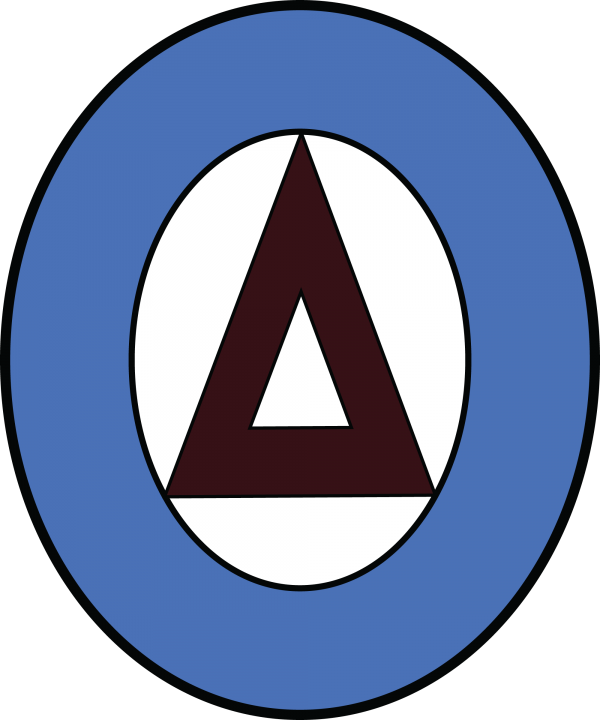
Vector emblem of the Democratic Army of Greece (DSE, Greek: Δημοκρατικός Στρατός Ελλάδας, Dimokratikos Stratos Elladas) — the armed wing of the Communist Party of Greece (KKE) during the Greek Civil War (1946–1949). This page offers the DSE emblem for free download in vector formats CMX, EPS, SVG, and raster PNG at resolutions of 2000 px, 600 px, and 300 px.
What Was the Democratic Army of Greece?
The Democratic Army of Greece (DSE) was formed on December 28, 1946 as the military force of the Communist Party of Greece. It was the organizational successor to the Greek People's Liberation Army (ELAS), which had fought against the German, Italian, and Bulgarian occupation forces during World War II. The DSE operated during the Greek Civil War — one of the most intense and devastating conflicts in modern Greek history, and the first major armed confrontation of the Cold War in Europe.
The conflict followed the withdrawal of German forces in 1944. It was preceded by the Dekemvriana events of December 1944 in Athens, where ELAS units clashed with British forces and Greek government troops. By 1946, tensions between left-wing resistance groups and the British-backed Greek government had escalated into a full-scale civil war. The DSE was declared in response to the widespread persecution of former ELAS members and the repressive measures imposed by the post-war government against communists and their sympathizers.
\u{201c}The Democratic Army of Greece stood for the principles of national independence, democracy, and social justice — ideals for which thousands of its fighters gave their lives on the mountains of Grammos and Vitsi.
Strength, Organization, and Leadership
At its peak in 1947–1948, the DSE numbered approximately 50,000 combatants. The core consisted of veteran ELAS fighters who had survived World War II and possessed extensive guerrilla warfare experience. However, a substantial portion of the personnel came from conscription in villages located within the territory controlled by the Provisional Democratic Government. The DSE also included several thousand Slavomacedonians from northern Greece, who joined the ranks in significant numbers — in some units they comprised up to a third of the total strength.
The army was organized into divisions, brigades, and battalions, with an officer training school established at the General Headquarters. The DSE operated predominantly in the mountainous regions of northern Greece — the Grammos and Vitsi mountain ranges became its main strongholds and defensive bastions. By 1948, the Provisional Democratic Government controlled substantial territory and had established its own administrative structure in the liberated zones, complete with local committees, schools, and medical facilities.
Key leadership figures included:
- Nikos Zachariadis — General Secretary of the KKE, the political leader who determined the strategic direction of the DSE. His decision to shift from guerrilla tactics to conventional positional warfare remains controversial among historians
- Markos Vafiadis — Commander-in-Chief of the DSE until January 1949, a former ELAS officer with deep guerrilla warfare experience. He was removed from command due to strategic disagreements with Zachariadis
- Georgios Gousias — succeeded Vafiadis as commander in the final months of the war, leading the DSE through its last battles
What international support did the DSE receive?
The DSE received material and logistical support from neighboring socialist states. Yugoslavia, under Marshal Tito, provided the most significant assistance — including bases, weapons, and supply routes — until the Tito-Stalin split in 1948. Albania and Bulgaria also offered sanctuary and support. The Soviet Union, bound by the percentages agreement negotiated with Churchill in 1944, maintained a cautious distance and did not provide direct military aid. After Yugoslavia closed its borders to the DSE in 1949, the army lost its most critical supply corridor — a factor that contributed decisively to its eventual defeat.
DSE Emblem — Symbolism and Visual Language
The emblem of the Democratic Army of Greece encapsulates the ideological foundations of the organization in a compact visual form. It features several distinct symbolic elements that together convey the identity, purpose, and political positioning of the DSE.
Flag and Colors
The DSE emblem incorporates the blue-and-white Greek national flag with the letter Delta (Δ) superimposed — the initial letter of "Dimokratia" (Greek: Δημοκρατία, meaning Democracy). The blue stripes represent the sea and sky of Greece, while the white stripes symbolize the purity of the struggle for freedom and national sovereignty. The deliberate choice to use the national flag rather than a partisan red banner was a calculated political decision: the KKE leadership sought to position the DSE as a national force fighting for all Greeks, rather than as a narrow class-based army.
Design Elements
The emblem typically features a circular or shield-shaped design with the blue-white flag as its background. The letter Δ is rendered in a bold sans-serif typeface, usually in red or dark blue. Red carries the unmistakable connotations of the socialist and communist movements of the era, while dark blue connects visually to the national flag and Greek heritage. In some variations, a laurel wreath frames the emblem — a classical Greek symbol of victory and honor that dates back to antiquity, when laurel crowns were awarded to champions at the Olympic Games and triumphant military commanders.
Technical Specifications of the Vector Files
The DSE emblem is available in several formats, each optimized for different use cases and software environments. Below are the complete technical specifications for every file type included in the download package.
| Format | Type | Software Compatibility | Best Use Case |
|---|---|---|---|
| CMX | Vector | CorelDRAW (all versions from 6 to 2024) | Professional print design in Corel environment |
| EPS | Vector | Adobe Illustrator, CorelDRAW, Inkscape, Affinity Designer | Universal vector exchange format — works everywhere |
| SVG | Vector | All modern browsers, Inkscape, Illustrator, Figma | Web design, responsive graphics, HTML embedding |
| PNG 2000px | Raster | Any image viewer or editor | High-resolution print projects, detailed display |
| PNG 600px | Raster | Any image viewer or editor | Web articles, standard presentations, social media |
| PNG 300px | Raster | Any image viewer or editor | Thumbnails, previews, quick reference |
How to Use These Files
The vector formats (CMX, EPS, SVG) allow you to scale the emblem to any size without loss of quality. This makes them ideal for a wide range of professional and academic applications:
- Historical publications and academic papers on modern Greek history
- Documentary film productions and video projects about the Cold War
- Museum exhibition materials and educational displays
- Educational presentations on the Greek Civil War
- Reference graphics for historians, political scientists, and researchers
- Large-format printing for posters, banners, and exhibition panels
The EPS format is the most universally compatible vector format — it opens in Adobe Illustrator, CorelDRAW, the free Inkscape, and Affinity Designer. If you do not have access to commercial vector editing software, Inkscape is a free, open-source alternative available for Windows, macOS, and Linux that handles both EPS and SVG formats perfectly.
The SVG format is natively supported by all modern web browsers. You can embed the emblem directly into HTML pages using standard img tags or inline SVG code for maximum control over styling and interactive behavior. SVG is also fully supported by modern design tools including Figma, Sketch, and Adobe XD.
CMX is the native presentation exchange format for CorelDRAW, offering the best compatibility and editability when working within the Corel ecosystem. If you are a professional CorelDRAW user, this format is recommended for the smoothest workflow.
Historical Context — The Greek Civil War Timeline
The Greek Civil War (1946–1949) was the first major armed conflict of the Cold War era in Europe and a direct continuation of the divisions that emerged during the Axis occupation. The table below maps the key milestones of the war against the corresponding phases of DSE operations.
| Period | Key Events | DSE Role |
|---|---|---|
| December 1944 | Dekemvriana — armed clashes in Athens between ELAS and British/Government forces | Precursor phase — ELAS veterans later formed the DSE core |
| March 1946 | First post-war elections boycotted by KKE; escalation of political violence | Guerrilla groups begin reorganizing in the Greek mountains |
| December 1946 | Official formation of the Democratic Army of Greece | Unified command structure established under Markos Vafiadis |
| December 1947 | Provisional Democratic Government declared; KKE outlawed by government decree | DSE controls significant territory in northern Greece |
| June-August 1948 | Operation "Koronis" — massive government offensive against the Grammos stronghold | DSE successfully executes tactical withdrawal, inflicting heavy casualties |
| January 1949 | Markos Vafiadis removed from command; strategic shift to conventional warfare | DSE transitions from guerrilla to positional defensive operations |
| August 1949 | Final battle of Grammos-Vitsi; decisive government victory with US support | DSE forces retreat across the border into Albania |
| October 1949 | Ceasefire declared; remaining DSE fighters disarmed and demobilized | End of the Democratic Army of Greece as an organized military force |
Download Instructions
To download the vector emblem of the Democratic Army of Greece, use the links provided below. All vector files — CMX, EPS, and SVG — are packaged into a single ZIP archive for your convenience and immediate access.
Download CMX, EPS, SVG (ZIP archive)PNG raster versions are available for direct download at three resolution levels. Simply right-click the desired size and select "Save link as" or "Save image as" from your browser's context menu. No registration, no waiting times, no download limits.
- PNG 2000 px — suitable for high-resolution print projects up to approximately A5 size at 300 DPI
- PNG 600 px — optimal for web articles, blog posts, and presentation slides
- PNG 300 px — ideal for thumbnails, preview galleries, and quick visual reference
Frequently Asked Questions
What is the Democratic Army of Greece emblem?
The emblem of the Democratic Army of Greece is the official insignia of the DSE, featuring the Greek national flag with the superimposed letter Delta (Δ) — representing the word "Dimokratia" (Democracy). It was used on uniforms, documents, flags, and propaganda materials throughout the Greek Civil War of 1946–1949. The design combines national symbolism with the political identity of the communist-led resistance movement.
What file formats are included in the download?
The download package includes three vector formats: CMX (CorelDRAW Presentation Exchange), EPS (Encapsulated PostScript — the universal vector standard), and SVG (Scalable Vector Graphics — optimized for web and digital design). Three PNG raster versions at 2000 px, 600 px, and 300 px are also available for direct download from this page.
Is the DSE emblem free to use?
Yes, the files are provided for free download for educational, historical research, and design reference purposes. There is no registration requirement, no subscription fee, and no limit on the number of downloads. For commercial applications, we recommend independently verifying compliance with the regulations applicable in your country.
Can I edit the vector files?
Absolutely. The CMX, EPS, and SVG files are fully editable vector graphics. You can modify colors, resize individual elements, rearrange the composition, extract specific components, or adapt the design for your needs. You will need compatible vector editing software such as CorelDRAW, Adobe Illustrator, the free Inkscape, or Affinity Designer to make modifications.
What software opens CMX files?
CMX is a CorelDRAW-native presentation exchange format. Files open in CorelDRAW versions 6 through the latest 2024 release. Some older CMX variants may require CorelDRAW X7 or earlier for full feature compatibility. If you do not have CorelDRAW installed, use the EPS or SVG versions instead — these formats are compatible with virtually every vector editing application available today, including free alternatives.
What is the resolution of the PNG files?
Three PNG resolution tiers are provided: 2000 pixels on the longest side — suitable for high-quality printing up to approximately A5 format at 300 DPI; 600 pixels — excellent for web display, blog posts, and presentation slides; and 300 pixels — perfect for thumbnails, preview galleries, and quick visual reference. All PNG files feature transparent backgrounds where the design permits.
Why was the Delta (Δ) symbol chosen for the DSE emblem?
The Greek letter Delta (Δ) is the initial letter of the word "Dimokratia" (Δημοκρατία — Democracy). The DSE leadership positioned the army as fighting for the restoration of democratic governance in Greece, as opposed to the monarchy and the post-war right-wing government backed by Britain and the United States. The Delta symbol provided a concise, instantly recognizable visual marker of this political identity and was used alongside the Greek abbreviation ΔΣΕ (DSE) in various materials.
What happened to the DSE after the Greek Civil War?
Following the defeat at the Grammos-Vitsi mountain complex in August 1949, the remaining DSE forces crossed the border into Albania, where they were disarmed. A formal ceasefire was declared in October 1949. Most fighters and their families went into exile — primarily in the Soviet Union, Czechoslovakia, Poland, Hungary, Romania, and other Eastern Bloc countries. Thousands of DSE veterans were unable to return to Greece for decades. The repatriation process only began in the 1980s after significant political changes in Greece, and many former fighters never saw their homeland again.
Is this the same emblem used by the modern Greek army?
No. The emblem of the Democratic Army of Greece (DSE) is a historical symbol from the 1946–1949 period and has no connection to the modern Hellenic Armed Forces. The DSE ceased to exist as an organization in 1949. The modern Greek military uses entirely different heraldry, insignia, and symbolic systems. This emblem is a historical artifact, not a current military design.
How was the DSE different from ELAS?
ELAS (Greek People's Liberation Army, 1942–1944) was the military arm of the National Liberation Front (EAM), a broad resistance coalition that included various political groups — though communists held key command positions. ELAS fought against the German, Italian, and Bulgarian occupation. The DSE (Democratic Army of Greece, 1946–1949), by contrast, was exclusively the armed wing of the Communist Party of Greece (KKE) and fought in the subsequent civil war against the Greek government. The DSE was the direct successor to ELAS in terms of personnel, organization, and military experience, but operated in a fundamentally different political and strategic context.
Why Download from Photolessons
Our archive of vector emblems and logos contains thousands of carefully curated designs spanning political organizations, state institutions, sports clubs, universities, and military units from various countries and historical periods. Every file undergoes integrity verification — we open and inspect each vector image before publishing it to ensure quality and usability.
The DSE emblem is part of our historical and political symbols subcategory. We preserve these designs as digital artifacts of historical significance, making them accessible to researchers, designers, educators, and anyone interested in visual history and political iconography. The collection serves as a unique reference library for the study of 20th-century symbolism and graphic design.
All files are hosted on our server and available for immediate download — no registration required, no waiting periods, no download caps. We believe historical resources should be freely accessible to all who seek them.
\u{201c}Historical emblems are more than just graphics — they are windows into the political struggles, ideologies, and aspirations of past generations. Preserving them in clean, accessible digital formats is our contribution to visual history and collective memory.
Tap to react