The Tver Region Flag: A Banner of Princely Legacy
The flag of the Tver Region is one of the most heraldically significant territorial symbols of the Russian Federation — a composition that draws a direct visual line from the medieval Grand Principality of Tver to the modern federal subject, using the Monomakh Cap, Russia's most ancient coronation regalia, as its ideological and compositional centrepiece. Adopted on November 28, 1996, the flag encodes within its simple geometry — a red central field flanked by two golden vertical bands — the story of a region that once rivalled Moscow for supremacy over the Russian lands. We provide the vector flag of the Tver Region in CDR, EPS, SVG, AI, and PDF formats in a single ZIP archive, plus high-resolution PNG renders at 2000, 600, and 300 pixels — everything required for professional reproduction at any scale.
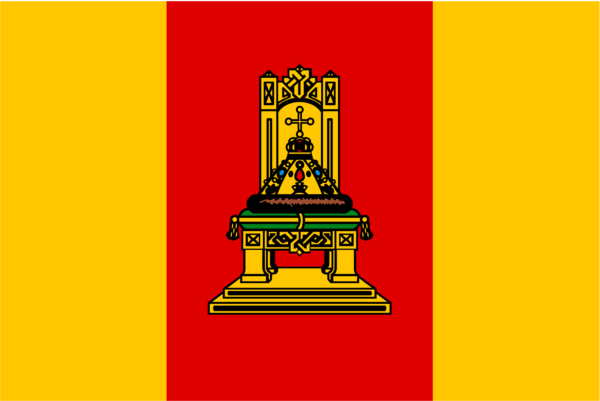
The flag is a rectangular panel with a width-to-length ratio of 2:3. Its design is defined by a straightforward but symbolically loaded division of the field: the central portion, constituting exactly half (2/4) of the total length, is red (chervlen). Two vertical stripes of yellow (gold or or) flank this central field, each occupying one quarter (1/4) of the total length. At the centre of the red field sits the main element of the Tver Region's coat of arms: a princely throne (historically referred to as the 'knyazhesky stol' — the prince's table) with a tall backrest, bearing a green cushion on which rests the Monomakh Cap. The total width of this central heraldic composition measures one quarter of the flag's length.
Understanding this flag means understanding the heraldic language it speaks — a language in which every colour, every proportion, and every element has been chosen not for decorative effect but for precise symbolic communication. Let me show you what each component means and why it matters.
Anatomy of the Flag: Design Breakdown
| Element | Heraldic Term | Meaning |
|---|---|---|
| Central field (red) | Chervlen | Courage, valour, historic military glory of the Tver land |
| Two vertical stripes (yellow) | Or (gold) | Wealth, justice, generosity, spiritual heritage |
| Princely throne | Knyazhesky stol | Political authority, historical sovereignty as a Grand Principality |
| Green cushion | Vert (green) | Hope, joy, abundance, rightful claim to power |
| Monomakh Cap | Shapka Monomakha | Continuity of Russian statehood, autocratic legitimacy |
The proportional scheme is equally deliberate. The 2:3 ratio of the flag follows the standard established for Russian regional flags, ensuring consistency when displayed alongside other federal subject flags. The 1/4 — 2/4 — 1/4 division of the horizontal axis creates a balanced composition where the central red field dominates visually, drawing the eye to the throne and crown. This is not arbitrary: heraldic design principles dictate that the most important symbolic element should occupy the largest and most central area of the field. The golden stripes serve as framing devices, isolating the red field from the edges of the flag and giving the composition a sense of dignity and formality appropriate to a symbol of state authority.
The throne itself is depicted in a stylised but clearly recognisable form: a high-backed seat with armrests, rendered in gold or yellow against the red field. The green cushion is distinctly visible beneath the Monomakh Cap, which is shown in its traditional form — a golden crown with a fur trim, historically associated with the Byzantine regalia that passed to the Russian Grand Princes. The overall effect is one of solemnity and historical depth, a visual statement that the Tver Region sees itself not merely as an administrative unit but as a bearer of Russian state traditions.
Historical Context: Why Tver Has a Crown on Its Flag
The presence of the Monomakh Cap on the flag of the Tver Region is not decorative — it is a statement of historical identity. The Grand Principality of Tver was one of the most powerful political entities in medieval Rus, reaching its zenith in the 14th and 15th centuries. At its peak, Tver controlled vast territories along the upper Volga and competed directly with Moscow for supremacy over the Russian lands. Tver princes minted their own coins, conducted independent foreign policy, and maintained a court that rivalled Moscow's in splendour.
The Monomakh Cap itself is the most ancient crown of the Russian grand princes and tsars. According to tradition, it was a gift from the Byzantine Emperor Constantine IX Monomachus to Grand Prince Vladimir Monomakh in the 12th century, though scholarly consensus places its actual creation in the 13th–14th centuries in Central Asia. Regardless of its precise origin, the cap became the supreme symbol of autocratic power in Russia, used for coronation ceremonies from the 15th century until the reign of Peter the Great. By placing the Monomakh Cap on the flag, the Tver Region asserts its historical claim to this legacy of Russian statehood.
The princely throne beneath the cap is equally significant. In medieval Russian terminology, the 'stol' (table or throne) was the physical seat of princely authority. The phrase 'to sit on the table of Tver' meant to rule as Grand Prince of Tver. The flag thus combines the two most powerful symbols of sovereignty in the Russian heraldic tradition: the crown and the throne. Together they create an emblem that says: this land was once a sovereign principality, and its dignity is preserved in the modern era as a subject of the Russian Federation.
\u{201c}The Tver flag is a heraldic document that bridges seven centuries of Russian history. The Monomakh Cap on the princely throne tells the story of a region that was once the seat of a grand princely dynasty, a contender for the unification of the Russian lands, and today continues its journey as a proud subject of the Federation. — V. I. Lavrenov, Russian Heraldry Council
The adoption of the flag in 1996 came during a period when Russian regions were actively developing their own state symbols following the dissolution of the Soviet Union. The Tver Region Legislative Assembly, guided by the Russian Heraldic Council under the leadership of State Herald Master G. V. Vilinbakhov, chose to base the flag on the region's coat of arms, which had been restored and updated from historical versions dating back to the 18th century. The first coat of arms of Tver was approved in 1781 under Catherine the Great, and the current version, approved in 1996, maintains continuity with that original design.
Colour Specifications and Reproductions Standards
| Colour | Pantone Equivalent | RGB | CMYK | Hex |
|---|---|---|---|---|
| Red (chervlen) | Pantone 186 C | 200, 16, 46 | 0, 92, 77, 22 | #C8102E |
| Yellow (gold / or) | Pantone 116 C | 252, 209, 22 | 0, 17, 91, 1 | #FCD116 |
| Green (cushion) | Pantone 356 C | 0, 137, 79 | 100, 0, 42, 46 | #00894F |
The official colours of the Tver Region flag are specified in the regional law 'On the Flag of the Tver Region.' The red field must be a rich cherry-red (chervlen), not a bright signal red. The yellow stripes should be golden, not lemon yellow. The green should be a deep heraldic green, not an olive or light green. The vector files in this download have been calibrated to these exact specifications, making them ready for official use in government publications, ceremonial displays, and commercial reproduction.
For print applications, the CMYK values in the table above should be used to ensure accurate colour reproduction on offset printing presses. RGB and hex values are provided for digital display. The vector formats (CDR, EPS, SVG, AI, PDF) contain embedded colour profiles that will automatically reference the correct colour space for your output medium.
Vector Formats: What You Get and Why It Matters
| Format | Software | Editable | Best Use |
|---|---|---|---|
| CDR | CorelDRAW X3+ | Yes | Professional print design, large-format output |
| EPS | Adobe Illustrator, Inkscape, Affinity | Yes | Universal vector exchange, legacy workflows |
| SVG | All browsers, Inkscape, web tools | Yes | Web development, responsive digital display |
| AI | Adobe Illustrator CS6+ | Yes | Adobe ecosystem, advanced vector editing |
| Acrobat, Illustrator, any PDF reader | Yes (in vector editors) | Print-ready documents, client approval | |
| PNG 2000 px | Any image viewer | No | A4/A3 print, presentations |
| PNG 600 px | Any image viewer | No | Screen display, social media |
| PNG 300 px | Any image viewer | No | Web thumbnails, previews |
Each vector format serves a specific workflow. CDR is the native format of CorelDRAW, the software most commonly used by Russian print shops and sign-makers. If you are ordering a printed banner of the Tver flag, your print shop will most likely ask for CDR. EPS is a universal vector format that opens in virtually every vector editor — Illustrator, CorelDRAW, Inkscape, Affinity Designer — making it the safest choice for cross-platform work. SVG is the standard for web: it scales responsively, supports CSS styling, and can be embedded directly into HTML. AI is the native Adobe Illustrator format, preserving all layers and effects for advanced editing. PDF provides a print-ready file that can be sent directly to any commercial printer without additional processing.
The PNG raster versions are included for cases where vector editing is not needed: quick insertion into Word documents, PowerPoint presentations, social media posts, or as placeholders in layouts. The 2000 px version at 300 DPI yields a crisp A4 print. The 600 px version is ideal for website headers, and the 300 px version serves as a lightweight preview or thumbnail.
Practical Applications: Where to Use the Tver Flag Vector
The applications for a high-quality vector flag file are broader than one might initially assume. Here are the most common use cases we encounter from our users:
Government and administrative documentation. Municipal administrations of the Tver Region require the flag for official seals, letterheads, certificates, and awards. Having a proper vector file ensures that every reproduction meets the legal colour and proportion requirements. The same applies to state institutions, schools, and cultural organisations within the region.
Event design and conference materials. The Tver Region hosts numerous events — economic forums, cultural festivals, sports competitions — where the regional flag must be displayed. From stage backdrops to lanyards, from roll-up banners to souvenir badges, the vector file provides the master artwork for all these formats.
Educational and academic publications. Textbooks on regional studies, heraldry, and Russian history frequently reproduce the flags of federal subjects. A vector file ensures that the reproduction in a printed book is as crisp as the original, regardless of the book's format or page size. Digital educational resources benefit from SVG, which remains sharp on any screen.
Tourism branding and promotional materials. The Tver Region promotes itself as a tourist destination with attractions including Tver itself, Torzhok, the Valdai Hills, Seliger Lake, and numerous historic estates. The regional flag appears on brochures, maps, websites, and souvenirs. A clean vector source keeps the brand consistent across all touchpoints.
Design and creative projects. Graphic designers incorporate regional flags into infographics, data visualisations, motion graphics, and composite artworks. The layered structure of the vector files allows designers to extract individual elements — the throne, the Monomakh Cap, the golden stripes — and use them as independent design assets.
Tver Region: Geography and Key Facts
The Tver Region (Tverskaya Oblast) is a federal subject of the Russian Federation located in the northwest of the country. It covers an area of 84,201 square kilometres, making it the largest region in Central Russia. The population stands at approximately 1.3 million people, with the administrative centre being the city of Tver, situated at the confluence of the Volga and Tvertsa rivers.
The region is historically significant as the territory of the Grand Principality of Tver, one of the most influential medieval Russian states. Modern Tver Region is an important industrial and transport hub, with the Moscow-St. Petersburg railway line and the M10 highway running through its territory. The region also contains a significant portion of the Valdai Hills, including the source of the Volga River — a site of both geographical and symbolic importance for Russia.
The flag serves as a daily reminder of this heritage, flying over government buildings, displayed in schools, and carried at official ceremonies. The vector files we provide ensure that this symbol can be reproduced with accuracy and dignity wherever it is needed.
How to Download and Use the Files
Downloading is straightforward. Click the download button above to receive the ZIP archive Flag-Tverskoj-oblasti.zip (approximately 3 MB). Extract the archive on your computer — you will find the following files inside:
- Flag-Tverskoj-oblasti.cdr — CorelDRAW vector file
- Flag-Tverskoj-oblasti.eps — Encapsulated PostScript vector file
- Flag-Tverskoj-oblasti.svg — Scalable Vector Graphics file
- Flag-Tverskoj-oblasti.ai — Adobe Illustrator vector file
- Flag-Tverskoj-oblasti.pdf — Portable Document Format
- Flag-Tverskoj-oblasti-2000.png — High-resolution PNG (2000 px)
- Flag-Tverskoj-oblasti-600.png — Medium-resolution PNG (600 px)
- Flag-Tverskoj-oblasti-300.png — Low-resolution PNG (300 px)
The files are free for both personal and commercial use. No attribution is required, though a link back to photolessons.org is appreciated if you use our resources in your projects. If you encounter any issues opening the files, please verify that your software supports the format — the compatibility table above provides clear guidance. For questions about using the flag in specific contexts, consult the official Law of the Tver Region or contact the Heraldic Council under the President of the Russian Federation.
Frequently Asked Questions About the Tver Region Flag
Is the Tver Region flag based on the historical banner of the Grand Principality?
The modern flag draws inspiration from the heraldic tradition of the Grand Principality of Tver but is not a direct replica of any specific historical banner. The current design was developed in 1996 by the Heraldic Council based on the regional coat of arms, which itself traces its lineage to the 1781 city coat of arms of Tver approved by Catherine the Great. The throne and Monomakh Cap motif, however, directly reference the princely authority of the medieval Grand Principality.
Can I use the Tver Region flag in a logo or brand identity?
Yes. Regional flags are state symbols but their graphic representation is not restricted by copyright. Many businesses, cultural organisations, and tourism agencies incorporate the flag or its elements into their branding. However, avoid modifications that distort or disrespect the flag — such as changing colours, rotating elements, or placing text over the central throne image. Good practice is to use the flag in its complete, unaltered form as a badge or identifier.
What is the correct orientation when hung vertically?
When hanging the flag vertically, the red central field with the throne should remain centred, and the yellow stripes should appear on the left and right sides as viewed by the observer. The throne must remain upright — it should not be rotated. The 2:3 proportion becomes 3:2 when displayed vertically. The same vector files can be used; simply rotate the PDF or CDR document 90 degrees in your layout software.
Are there restrictions on using the flag for merchandise?
Russian federal law protects state symbols from desecration but does not prohibit commercial use of flag imagery on merchandise such as T-shirts, mugs, pins, and posters. The key requirement is accurate and respectful reproduction. Avoid using the flag in contexts that could be considered degrading — for example, as a floor mat, in association with inappropriate content, or in a deliberately distorted form. Common commercial uses like souvenir production are perfectly acceptable.
How does the Tver flag compare to the Vladimir Region flag?
Both flags share the same central motif — the Monomakh Cap on a throne — reflecting the shared heritage of the two regions as former Grand Principalities. The key difference is the field division. The Tver flag uses a red central field flanked by two yellow vertical stripes. The Vladimir Region flag uses a different layout with a full red field and a different arrangement of the throne motif. Each follows the heraldic tradition of its specific historical territory.
What is the etiquette for displaying with the national flag?
When displayed together, the national flag of the Russian Federation takes precedence. It should be placed in the centre, higher than regional flags, or to the right (viewer's left) if on the same level. The Tver Region flag should be displayed to the left of the national flag (viewer's right). When multiple regional flags are displayed, they are arranged alphabetically. All flags should be of the same size and flown at the same height.
What historical events shaped the Tver flag design?
The most significant events include: the rise of the Grand Principality of Tver in the 13th-14th centuries as Moscow's primary rival; the annexation of Tver by Moscow in 1485 under Ivan III; the establishment of the Tver Governorate in 1775 under Catherine the Great, which led to the first official coat of arms in 1781; the Soviet period when the region was known as Kalinin Oblast; and finally the post-Soviet restoration of historical symbols culminating in the 1996 flag adoption.
What is the significance of the three vertical fields?
The flag has exactly three vertical fields — one red central field and two yellow flanking stripes. The number three in Russian heraldic tradition is associated with completeness and the tripartite nature of authority. The 1:2:1 proportion (each yellow stripe being half the width of the central red field) creates visual balance and follows traditional banner-making proportions used in Russian vexillology. The total width of the heraldic composition is exactly one quarter of the flag's length.
Can I get the Tver flag without the coat of arms?
The official flag as defined by regional law always includes the throne with the Monomakh Cap as its central element. However, for design purposes, many creators use the red-and-gold colour scheme alone as a visual shorthand. The vector files we provide include the full official design. If you need a simplified version, you can easily remove the throne layer in any vector editor — the CDR, EPS, and AI files have separate layers for the throne and the background fields.
Is there a specific shade of red for the Tver flag?
Yes. The official red colour is heraldic chervlen (crimson-red), not bright scarlet or burgundy. The Pantone equivalent is 186 C. The RGB values are 200, 16, 46. The CMYK breakdown is 0, 92, 77, 22. Using these exact values ensures your reproduction matches the official standard. The vector files in this download have these colours embedded as swatches for direct use without manual colour matching.
Tap to react