Vector Flag of the United Nations — Official Download
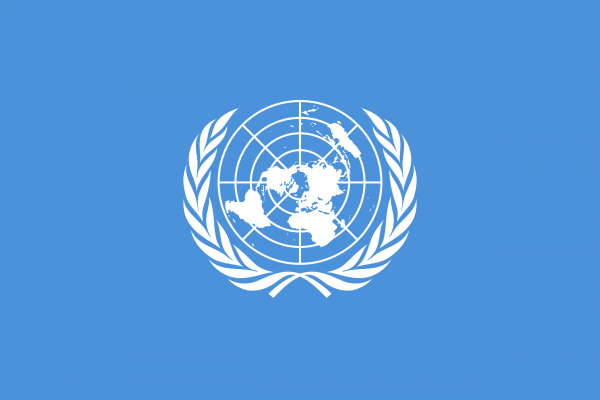
The flag of the United Nations is one of the most recognisable international symbols in the world. Adopted on 20 October 1947 by the UN General Assembly, it features the official UN emblem centred on a field of UN blue. The emblem consists of a world map projection flanked by two olive branches, symbolising peace and universal solidarity among nations. This article provides a comprehensive look at the UN flag, its history, design specifications, and usage guidelines — plus a direct download of high-quality vector files for your projects.
The United Nations was founded on 24 October 1945 with the ratification of the UN Charter by 51 founding member states. The need for a distinctive flag arose almost immediately. The UN emblem was designed by a team led by Donal McLaughlin, an American architect, and the flag design was officially approved two years after the organisation's founding. The UN blue colour — officially Pantone 279C — was chosen to represent peace and neutrality, distinct from any single national flag.
Today the UN flag flies at headquarters in New York, Geneva, Vienna, and Nairobi, as well as at peacekeeping missions, diplomatic missions, and associated agencies worldwide. Understanding the correct proportions, colour specifications, and emblem placement is essential for anyone producing official UN materials or educational resources about international organisations. The flag serves as a visual representation of the organisation's core values and mission, appearing at over 130 locations globally and being used in countless educational and diplomatic contexts.
\u{201c}The United Nations flag represents the shared aspirations of all humanity for peace, justice, and international cooperation. Its design is deliberately simple yet profoundly meaningful. — Ban Ki-moon, former UN Secretary-General
Design Specifications of the UN Flag
The official UN flag has precise design specifications that must be followed for accurate reproduction. The flag ratio is 2:3 or 3:5 depending on the usage context. The UN blue background occupies the entire field. The white emblem is centred and occupies a specific proportion of the flag height — approximately 40 percent of the total area. The emblem must be clearly visible from a reasonable distance and maintain its proportions regardless of the flag size.
The emblem consists of a polar azimuthal equidistant projection of the world map, extending to 60 degrees south latitude. This projection was chosen because it preserves accurate distances from the centre point and presents all continents in a balanced composition. Five concentric circles represent latitude lines. The olive branches wrapping the map are stylised with leaves and stems, rendered in white against the blue field. The detail of the emblem is carefully calibrated so that even at smaller sizes the key features remain distinguishable.
When producing the flag, the UN stipulates that the emblem must appear on both sides of the fabric. For printed versions, the emblem is typically printed on one side with a show-through effect on the reverse. For embroidered or woven flags, each side must be manufactured independently to ensure correct orientation. The minimum height for an official UN flag is 90 centimetres for indoor display and 180 centimetres for outdoor flagpoles.
Colour Specification Table
| Colour | Pantone | CMYK | RGB | HEX |
|---|---|---|---|---|
| UN Blue | Pantone 279C | 100, 72, 0, 6 | 75, 140, 215 | 4B8BCC |
| Emblem White | — | 0, 0, 0, 0 | 255, 255, 255 | FFFFFF |
Flags of International Organisations — Comparison Table
| Organisation | Flag Adopted | Field Colour | Emblem Elements | Flag Ratio |
|---|---|---|---|---|
| United Nations (UN) | 1947 | UN Blue | World map + olive branches | 2:3 |
| UNESCO | 1954 | White | Greek temple facade + text | 2:3 |
| NATO | 1953 | Dark Blue | White compass rose | 3:5 |
| European Union | 1955 | Azure Blue | Circle of 12 gold stars | 2:3 |
| Red Cross / Red Crescent | 1864 | White | Red cross / crescent | Various |
| International Olympic Committee | 1914 | White | Five interlocking rings | 2:3 |
History and Evolution of the UN Flag
The UN flag traces its origins to the United Nations Conference on International Organisation held in San Francisco in 1945. During this conference, a lapel pin design was created that later evolved into the official emblem. Donal McLaughlin, the chief of the graphics presentation branch of the US Office of Strategic Services, developed a round design showing the world map surrounded by olive branches. The design went through several iterations before arriving at the version we recognise today.
On 7 December 1946, the UN General Assembly adopted the emblem and seal of the United Nations. The flag design incorporating this emblem was formally approved on 20 October 1947 by Resolution 167 (II). The resolution specified that the flag should be flown at all UN installations and that its dimensions, colours, and proportions should follow the official specifications. This resolution also established the legal protection for the flag, preventing unauthorised use that could diminish its official status.
In 1953, the UN issued detailed guidelines for flag production, standardising the UN blue colour. Over the decades, minor refinements were made to the emblem, particularly to update the world map as new states gained independence and joined the organisation. The most notable updates occurred in 1960 following decolonisation in Africa, in 1991 after the dissolution of the Soviet Union, and in 2011 when South Sudan became the newest member state. In 2020, the UN officially introduced a new, more detailed version of the emblem with updated coastlines and country borders, reflecting the most current cartographic data available.
Symbolism and Meaning
Every element of the UN flag carries profound meaning. The blue background is described in UN documents as UN blue and represents peace, calm, and the sky that unites all people on Earth. Unlike national flags that use reds, greens, or golds associated with specific regions, UN blue was deliberately chosen as a neutral colour with no exclusive national connotations. The specific shade of light blue was also selected for its ability to stand out against various backgrounds and weather conditions when flown outdoors.
The olive branches are an ancient symbol of peace dating back to classical Greece. In the UN emblem, two olive branches frame the world map, conveying the organisation's primary mission: maintaining international peace and security. The branches bear leaves and fruit, symbolising prosperity through cooperation. The olive branch motif appears throughout UN iconography, from the organisation's seal to the logos of its various specialised agencies and programmes.
The world map uses the azimuthal equidistant projection centred on the North Pole. This projection was chosen because it shows all continents from a single vantage point, reinforcing the message that the UN represents all peoples of the world equally. The map extends to 60 degrees south latitude, deliberately excluding Antarctica, which has no permanent population and is governed under a separate international treaty system. The choice of projection was also practical — it allows the emblem to maintain its circular form, creating a balanced and harmonious visual composition that works equally well on flags, documents, and digital media.
Vector Formats Available for Download
We provide the UN flag in multiple vector and raster formats to suit various professional needs. Vector formats allow unlimited scaling without quality loss, making them ideal for printing, signage, and publication. Each format has specific advantages depending on your workflow and intended use case.
- EPS — Encapsulated PostScript, compatible with Adobe Illustrator, CorelDRAW, and most professional design applications. Best for print production and offset printing workflows where colour separation is required.
- SVG — Scalable Vector Graphics, ideal for web use, responsive design, and integration with HTML5 documents. SVG files are lightweight and can be styled with CSS for interactive web applications.
- CDR — CorelDRAW native format, fully editable with all layers and curves preserved. Preferred by users of CorelDRAW for sign-making, large-format printing, and laser engraving.
- PNG — Raster format at 2500px, 600px, and 300px widths with transparent background option. Best for quick insertion into documents, presentations, and web pages without needing vector editing software.
Proper Usage Guidelines
The UN has established a Flag Code that governs the use and display of its flag. When using the UN flag in your projects, keep these key points in mind:
- The flag should never be used for commercial purposes without prior authorisation from the UN Secretariat. This includes product packaging, advertising, and promotional materials.
- The emblem must appear in its correct proportions and colours — white on UN blue or, in monochrome contexts, black on white. The ratio of emblem size to flag field is strictly defined.
- The flag should not be altered, modified, or overprinted with additional text or images. This includes adding logos, slogans, or branding elements to the flag itself.
- When displayed alongside national flags, the UN flag should be given a position of honour appropriate to its international character. This typically means being placed at the centre of an array or at the far right from the perspective of the audience.
- The flag may be flown at half-mast as a sign of mourning, following UN protocol. The UN Secretary-General issues specific instructions for half-masting on designated days.
- Vector files should be used for reproduction to ensure accurate scaling and colour matching. Raster images at insufficient resolution may result in pixelation and loss of emblem detail.
- The minimum size for printed reproduction should maintain legibility of the emblem details. For small-format applications, a simplified version of the emblem may be more appropriate.
- Digital reproductions should use the sRGB colour profile for consistent display across devices. Print reproductions should use the CMYK values specified for Pantone 279C.
Technical Specifications for Designers
For graphic designers and production professionals, the UN flag requires attention to several technical details. The UN blue colour should be verified against Pantone 279C for offset printing. For digital display, the recommended RGB values are 75, 140, 215. The emblem should occupy approximately 40 percent of the flag height, centred precisely both horizontally and vertically. The distance from the centre of the emblem to the top edge of the flag must equal the distance from the centre to the bottom edge, ensuring perfect vertical centring.
When recreating the emblem from scratch in vector software, the world map projection requires careful handling. The azimuthal equidistant projection creates concentric latitude circles that must be mathematically accurate. The olive branches contain a specific number of leaves — 26 leaves and 13 olive fruits on each side — a detail often missed in unauthorised reproductions. Each leaf and fruit has a defined position along the branch, and the curvature of the branches must follow the circular arc of the emblem precisely.
For digital use, consider creating the following variants: a full-colour version for print and high-resolution displays, a simplified version for small icons and favicons, and a monochrome version for watermark and background applications. Each variant requires careful simplification of the emblem while maintaining its recognisable features. For embroidery applications, the emblem design should be adapted with appropriate stitch directions and thicknesses to ensure thread tension and coverage are optimal.
\u{201c}The UN flag is not merely a piece of cloth — it is a declaration of hope, a statement that humanity can work together across borders to build a better world. — Kofi Annan, former UN Secretary-General
Applications and Use Cases
The UN flag is used in a wide variety of settings beyond the organisation's own premises. Educational institutions teaching international relations or global studies often display the flag alongside national flags of countries being studied. Non-governmental organisations working in international development, humanitarian aid, and peacebuilding incorporate the UN flag into their materials to signal alignment with UN principles and the Sustainable Development Goals.
In the publishing industry, the UN flag appears in textbooks covering world history, civics, political science, and geography. News media outlets use the flag as a visual identifier when reporting on UN activities, Security Council resolutions, General Assembly sessions, and peacekeeping missions. Legal and diplomatic firms incorporate the UN flag into official correspondence when dealing with international law or cross-border matters that fall under UN conventions or treaties.
Digital Repositories and Archival Use
The UN maintains a digital asset management system that includes official versions of its flag for download. These repositories serve diplomats, journalists, educators, and the general public who require accurate representations of the flag for non-commercial purposes. The UN website provides guidelines on downloading and using these assets, emphasising the importance of maintaining the integrity of the emblem and colour specifications. For archival purposes, the original 1947 design specifications are preserved in the UN archives alongside subsequent versions that reflect changes in world geography as new member states joined the organisation.
Frequently Asked Questions
When was the UN flag officially adopted?
The UN flag was officially adopted on 20 October 1947 by the UN General Assembly through Resolution 167 (II). The design was based on the UN emblem which had been approved on 7 December 1946. The first official UN flags were produced and distributed to member states shortly thereafter.
What is the exact shade of UN blue?
The official UN blue corresponds to Pantone 279C. In CMYK it is C100 M72 Y0 K6, in RGB it is 75-140-215, and the hex code is 4B8BCC. This particular shade was chosen for its neutrality and distinctiveness, ensuring it does not closely resemble any national flag colour.
What do the olive branches on the UN flag represent?
The olive branches are an ancient Greek symbol of peace. They represent the UN's primary mission of maintaining international peace and security. The two branches wrap around the world map, symbolising that peace encompasses all nations. The branches each contain 26 leaves and 13 olive fruits.
Can I use the UN flag for commercial purposes?
The UN flag and emblem are protected by the United Nations Emblem and Flag Code. Commercial use generally requires prior authorisation from the UN Secretariat. Educational and editorial uses are typically permitted under fair use provisions, though attribution is recommended. Unauthorised use may result in legal action.
What is the correct ratio of the UN flag?
The official UN flag has a ratio of 2:3 (width to height). Some versions use a 3:5 ratio for specific display contexts such as desk stands and car flags. The emblem must be centred and occupy approximately 40 percent of the flag height. For a flag measuring 90 by 135 centimetres, the emblem diameter should be approximately 54 centimetres.
Why does the UN map not include Antarctica?
The UN emblem uses an azimuthal equidistant projection extending to 60 degrees south latitude. Antarctica is excluded because it has no permanent population and is governed under the Antarctic Treaty System rather than through UN membership. The projection cutoff also maintains the circular visual balance of the emblem.
What are the consequences of misusing the UN flag?
Unauthorised use of the UN emblem or flag may result in legal action by the United Nations. The organisation actively protects its intellectual property and branding to maintain the integrity and official character of its symbols. The UN Office of Legal Affairs handles cases of unauthorised use.
Can the UN flag be flown alongside national flags?
Yes, the UN flag can be flown alongside national flags. According to the Flag Code, it should be displayed in a position of honour appropriate to its international character. Typically it is flown at equal height with national flags in alphabetical order of the member states. At UN headquarters, the member state flags are arranged in English alphabetical order.
How many leaves are on the UN emblem olive branches?
Each olive branch on the UN emblem contains 26 leaves and 13 olive fruits. The symmetry of the emblem means the left and right branches are mirror images of each other, creating a total of 52 leaves and 26 fruits across the entire emblem. This precise count is often used as a verification detail for official reproductions.
What software can open the EPS and SVG vector files?
EPS files can be opened in Adobe Illustrator, CorelDRAW, Inkscape (free and open-source), Affinity Designer, and many other professional vector graphics applications. SVG files can be opened in any modern web browser as well as all major vector editors including Figma, Sketch, and Adobe XD. The CDR format requires CorelDRAW or a compatible converter application.
Tap to react