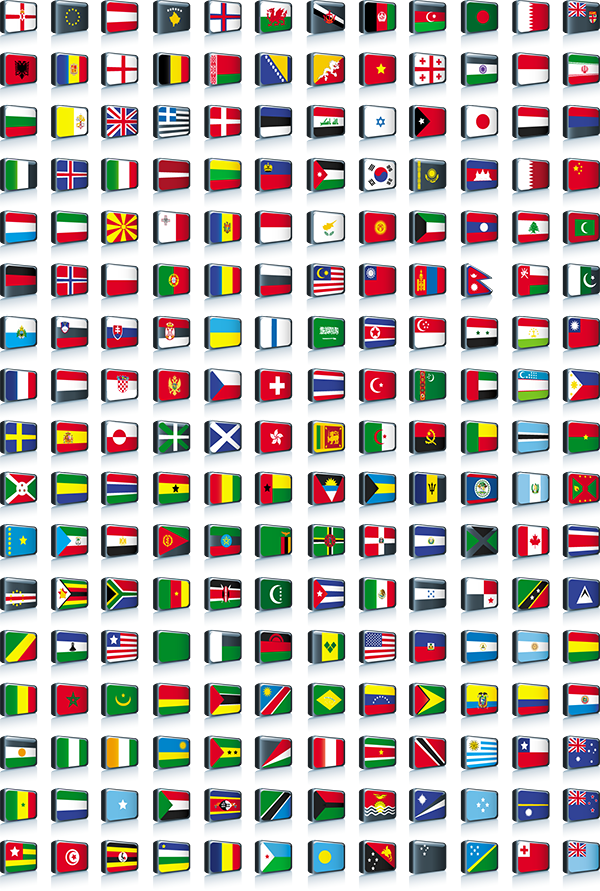
Vector 3D Flags of the World — History of National Flags, 3D Rendering Technology, and Free Download in AI Format
National flags are among the most potent visual symbols in human civilisation — rectangular pieces of coloured fabric that represent the identity, sovereignty, and aspirations of entire nations. When these flat two-dimensional designs are transformed into three-dimensional, waving flag renderings through vector graphics technology, they acquire a new level of visual impact: the realistic play of light and shadow across fabric folds, the dynamic sense of motion conveyed by undulating curves, and the volumetric presence that makes a flat emblem feel like a tangible object. A comprehensive collection of 3D vector flags of the world in Adobe Illustrator (AI) format is an invaluable resource for designers working on international projects — whether they are building a global corporate website, designing materials for a diplomatic conference, creating educational geography resources, or producing event graphics that must represent dozens of participating nations. This article explores the history and symbolism of national flags, explains the technical process of rendering two-dimensional flag designs into three-dimensional vector objects, describes the contents and capabilities of the downloadable AI file collection, and provides direct download links for the complete set of 3D world flags in Adobe Illustrator AI format.
A Brief History of National Flags: From Battle Standards to United Nations
The concept of a national flag as we understand it today — a single, standardised design representing an entire country — is a relatively recent development in human history. The earliest antecedents of flags were vexilloids: rigid objects mounted on poles, such as the metal eagles of Roman legions or the carved animal figures carried by ancient Egyptian and Mesopotamian armies. These served primarily as rallying points in battle, allowing soldiers to locate their unit amid the chaos of combat. The transition from rigid vexilloids to flexible fabric flags occurred gradually, with some of the earliest surviving fabric battle standards dating from ancient China and Persia.
The medieval period saw the proliferation of heraldic banners throughout Europe: rectangular or square flags bearing the coat of arms of a noble house, flown from castle towers and carried into tournament and battle. These were personal symbols of feudal lords rather than national emblems, but they established the visual vocabulary — geometric divisions, bold colour contrasts, symbolic charges — that would later inform national flag design. The Danish flag (Dannebrog), featuring a white Scandinavian cross on a red field, holds the distinction of being the oldest continuously used national flag, with its legendary origin dated to 1219 during the Battle of Lyndanisse in Estonia. According to tradition, the flag fell from heaven during the battle, turning the tide of the conflict in favour of the Danish forces.
The age of exploration and maritime trade in the 16th and 17th centuries accelerated the development of national flags as maritime ensigns. Ships were required to fly flags identifying their nationality to avoid being mistaken for pirates or enemy vessels, and these maritime flags gradually became the de facto national flags of the states they represented. The Dutch tricolour (orange-white-blue, later red-white-blue), adopted during the Dutch Revolt against Spanish rule in the late 16th century, is the oldest tricolour flag still in use and served as the direct inspiration for the French tricolour, which in turn inspired dozens of other national flags across Europe, Africa, and the Americas.
\u{201c}A flag is more than a piece of coloured cloth: it is the visual summation of a nation's history, values, and aspirations — a design that must work equally well at the size of a postage stamp and the scale of a stadium-sized banner.
The 19th and 20th centuries witnessed an explosion of new national flags as colonialism receded, empires collapsed, and newly independent states sought visual symbols to express their sovereignty and national identity. The Pan-African colours (red, yellow, green) were adopted by many African nations after independence, inspired by the Ethiopian flag — one of only two African states (along with Liberia) to maintain independence through the colonial period. The Pan-Arab colours (black, white, green, red) derive from the flag of the Arab Revolt against Ottoman rule during World War I and appear on the flags of numerous Arab League member states. The Pan-Slavic colours (white, blue, red), originating with the Russian tricolour adopted by Peter the Great, influenced the flags of many Eastern European Slavic nations.
The United Nations flag, adopted in 1946, represents a unique case in flag history: a design intended to represent not one nation but all nations. Its light blue field (often called "UN blue") and white emblem — a world map surrounded by olive branches — have become perhaps the most widely recognised international symbol in existence. UN blue is now a standard colour in any serious flag reference palette, and the UN flag's design principles — simplicity, symbolic clarity, avoidance of national favouritism — have influenced the flags of numerous international organisations.
Principles of Flag Design: Vexillology for Designers
The North American Vexillological Association (NAVA) — the world's largest organisation devoted to the study of flags — has codified five basic principles of good flag design that every designer working with flag imagery should understand. First: Keep It Simple. The flag should be so simple that a child can draw it from memory. The most successful national flags — Japan, Canada, Switzerland — can be described in a single sentence and recognised at a glance. Second: Use Meaningful Symbolism. The flag's colours, patterns, and charges should relate to what the nation stands for. The colours of the Indian flag, for example, represent courage and sacrifice (saffron), truth and peace (white), and faith and fertility (green), with the Ashoka Chakra (wheel) symbolising the eternal wheel of law.
Third: Use Two to Three Basic Colours. The most effective flags limit their palette to two or three well-contrasted colours from the standard heraldic set: red, blue, green, black, yellow, and white. The flag of Barbados (blue, yellow, black with a trident) is often cited as an exemplar of effective three-colour flag design. Fourth: No Lettering or Seals. Words do not survive reverse viewing, distance viewing, or folding, and complex seals become illegible blobs at typical flag-viewing distances. The California state flag's prominent "CALIFORNIA REPUBLIC" text is frequently criticised by vexillologists for this reason. Fifth: Be Distinctive or Be Related. A flag should not closely resemble other flags, though intentionally related designs (such as the Nordic cross flags of Scandinavia or the Pan-Arab colour scheme flags of the Middle East) can effectively communicate cultural or political affinity.
When these principles are applied to 3D flag rendering, additional considerations emerge. The fabric simulation process must preserve the legibility of the flag's design even as folds distort the surface: a tricolour's vertical divisions must remain discernible even in shadowed creases; a centred emblem like Canada's maple leaf must not be bisected by a fold that renders it unrecognisable; and the flag's colour contrast — carefully calibrated in the flat design — must survive the addition of shadow gradients and specular highlights without becoming muddy or washed out.
From 2D to 3D: The Technology of Vector Flag Rendering
The transformation of a flat two-dimensional flag design into a convincing three-dimensional waving banner is achieved through a combination of vector deformation techniques, gradient shading, and highlight rendering. In Adobe Illustrator, the primary tool for this transformation is the Envelope Distort function (Object → Envelope Distort → Make with Mesh), which applies a deformable grid over the flag design. By manipulating the anchor points of this mesh, the designer creates the characteristic sinusoidal wave pattern — the alternating peaks and troughs that simulate fabric rippling in a breeze.
The second component of realistic 3D rendering is lighting simulation. Once the flag surface has been deformed, gradients are applied to simulate the fall of light across the undulating surface. The convex portions of the wave (where the fabric bulges toward the viewer) receive lighter tones — sometimes with a specular highlight that simulates the slight sheen of polyester or nylon flag fabric. The concave portions (where the fabric recedes into shadow) receive darker tones. The steepest portions of the wave, where the flag surface turns most dramatically away from the light source, receive the darkest gradient stops, creating the illusion of depth and volume.
A third technique, employed in more sophisticated 3D flag renderings, is the pole and attachment simulation. A vertical pole with metallic gradient shading (gold, silver, or aluminium) anchors the left edge of the flag, and small shadows at the attachment points — grommets or ties — add the final touch of physical realism. Some renderings also include a subtle drop shadow cast by the flag onto an implied background surface, further anchoring the floating fabric in three-dimensional space. All of these effects in the AI format collection are preserved as editable vector elements, meaning that a designer can change the pole colour, adjust the lighting direction, increase or decrease the wave amplitude, or replace one flag design with another while maintaining all of the 3D rendering infrastructure.
Practical Applications of 3D Flag Vectors
The applications of a comprehensive 3D flag vector collection span a remarkably broad range of design contexts, from the purely decorative to the institutionally significant. International event branding is perhaps the most common use case. When a conference, sports tournament, trade fair, or cultural festival involves participants from multiple countries, the visual identity must acknowledge this international character. A row of 3D flags across the top of a website or the bottom of a poster immediately signals "global event" to any viewer. The three-dimensional rendering adds gravitas and visual interest that flat flag icons cannot match, transforming a purely functional element into a design feature.
Corporate global presence materials represent another major application. Multinational corporations preparing annual reports, investor presentations, or recruitment materials often wish to communicate their geographic reach. A spread showing 3D flags of the countries where the company operates, arranged in a grid or along a world map, provides this information visually and engagingly. The AI format allows the designer to select only the needed flags, arrange them in any configuration, and export at the resolution required for print or screen display.
Educational resources in geography, international relations, and world history benefit enormously from 3D flag imagery. Textbook publishers, educational website developers, museum exhibition designers, and documentary filmmakers all require flag graphics that are visually appealing, factually accurate, and available in formats that support high-quality reproduction across multiple media. The 3D rendering elevates the flag from a simple reference image to an engaging visual that holds students' attention and enriches the learning experience.
Government and diplomatic communications constitute a specialised but important market for 3D flag vectors. Foreign ministries, embassies, international organisations, and protocol offices regularly produce materials — event programmes, official invitations, commemorative publications — that must display national flags with impeccable accuracy and appropriate dignity. The three-dimensional rendering conveys the physical reality of a flag as an object rather than an abstraction, which aligns with the diplomatic understanding of a flag as a tangible symbol worthy of respect and ceremony.
Archive Contents and Format Specifications
The downloadable 3d_flagi_mira.zip archive delivers a comprehensive collection of 3D national flags in Adobe Illustrator AI format:
| Format | Extension | Primary Application | Required Software | 3D Effects Preserved |
|---|---|---|---|---|
| Adobe Illustrator | .ai | All professional design workflows | Illustrator CS6+ | Full — all gradients, shadows, mesh deformations |
| Encapsulated PostScript | .eps | Print production, cross-software compatibility | Illustrator, CorelDRAW, Inkscape, Affinity | Partial — gradients preserved, mesh may flatten |
| Portable Document Format | Preview, client sharing, quick reference | Any PDF viewer | Visual only — not recommended for editing | |
| PNG Preview | .png | Quick visual reference, web thumbnails | Any image viewer | Visual — raster preview of 3D appearance |
| Design Scenario | Workflow Recommendation | Export Settings |
|---|---|---|
| Website international banner | Open AI → select flags → export SVG | SVG 1.1, embed images, preserve Illustrator editing |
| Conference poster (print) | Open AI → arrange flags → export PDF | PDF/X-4, 300 DPI, CMYK, embed all fonts |
| PowerPoint presentation | Open AI → select flag → export PNG | PNG 2000 px, transparent background, 72 DPI |
| Corporate annual report | Open AI → place as linked AI in InDesign | Keep AI linked; export from InDesign to PDF/X-4 |
| Social media post | Open AI → select flag → export PNG | PNG 1080 px square, RGB, transparent background |
| Video/animation | Open AI → export individual flag as SVG | Import SVG into After Effects as vector layers for animation |
How to Download and Use
Click the link below to download 3d_flagi_mira.zip. Extract all files to your working directory. Open the .ai file in Adobe Illustrator to access all flags with full editability and preserved 3D effects.
DownloadFrequently Asked Questions
What format is this 3D flags collection provided in?
The collection is provided in Adobe Illustrator AI format, a native vector format that preserves all 3D effects, gradients, shadows, and layer structure. This ensures complete editability of each flag element for professional design use.
How many country flags are included in the download?
The archive contains a comprehensive collection of national flags from countries around the world, rendered as waving 3D banners. Coverage includes all major sovereign states and most dependent territories, making it suitable for virtually any international project.
What makes these flags 3D rather than flat?
Each flag is rendered with realistic fabric simulation including sinusoidal wave deformation, shadow gradients in the folds, specular highlights on the raised portions, and a sense of volume created by light and shadow interplay across the waving surface.
Can I edit the flags without losing the 3D effect?
Yes. The AI format preserves all effects as editable vectors. You can change flag colours, adjust the wave amplitude, modify lighting angles, or extract individual flags for separate use while maintaining the complete 3D appearance.
What software is required to open and use these files?
Adobe Illustrator CS6 or newer is recommended for full editability and correct rendering of 3D effects. Affinity Designer and Inkscape can open AI files but may not preserve all effects. CorelDRAW can import AI with limitations.
Are these flags free for commercial use?
Yes. The flag collection is provided for personal and commercial projects including websites, presentations, educational materials, international event branding, and merchandise without royalty payments or attribution requirements.
Can I export individual flags from the AI file?
Yes. Each flag occupies a separate layer or artboard in the AI file. Select the desired flag, copy it to a new document, and export in any format supported by Illustrator including EPS, SVG, PDF, PNG, or JPEG.
Are all UN member state flags included?
The collection includes flags of all major sovereign states with extensive coverage of UN member states. The 3D rendered format adds visual impact to what would otherwise be simple rectangular colour blocks in a flat presentation.
Can I use these flags for an international event website?
Absolutely. 3D flags add visual depth and professionalism to websites for international conferences, sports events, diplomatic meetings, trade shows, and cultural festivals. Export from AI to SVG for optimal web use.
How do I import these flags into a presentation?
Open the AI file, select the needed flag, export as high-resolution PNG (2000+ px) with transparent background, then insert into PowerPoint, Keynote, or Google Slides. For vector quality in presentations, use SVG export and import.
Tap to react