The Vergina Sun: A 2,300-Year-Old Design That Still Provokes Debate
In 1977, Greek archaeologist Manolis Andronikos made one of the most significant discoveries of the 20th century. At the ancient site of Aigai, near the modern town of Vergina in northern Greece, he excavated an unlooted Macedonian royal tomb. Inside, a solid gold larnax — a burial chest — bore a striking symbol on its lid: a sixteen-rayed star, or more accurately, a sunburst. This was the Vergina Sun. And it has been controversial ever since.
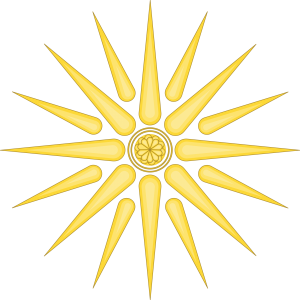
The symbol is technically a solar emblem — a central circle (the sun disc) surrounded by sixteen triangular rays. Eight are long, eight are short, alternating around the circumference. The design is deceptively simple. Every ray is the same shape, rotated at 22.5-degree increments. But the proportions — the ratio of the central disc to the ray length, the exact angle of the ray tips, the thickness variation from base to point — those are what distinguish an authentic Vergina Sun from a generic starburst.
The vector file in this download captures those proportions precisely. Traced from the WIPO (World Intellectual Property Organization) registered version of the symbol, it gives you three vector formats — EPS, SVG, CDR — and four PNG sizes. Whether you're building a historical infographic or a logo concept, the geometry is what matters. Get the proportions wrong and it stops being the Vergina Sun and becomes just another star.
Archaeological Context: What Manolis Andronikos Found
The tomb Andronikos discovered is now generally accepted as belonging to Philip II of Macedon — the father of Alexander the Great, assassinated in 336 BC. The gold larnax weighed over 11 kilograms. On its lid, the Vergina Sun was depicted as a large central emblem, with the rays radiating outward from a circular boss. The chest also contained cremated remains wrapped in a purple-and-gold cloth, and a golden oak wreath that is among the finest examples of ancient Greek metalwork ever found.
But here's the wrinkle: some scholars argue the tomb belongs to Philip III Arrhidaeus — Alexander's half-brother who ruled after Alexander's death. The debate continues, and the identity of the occupant may never be definitively settled. What is settled is that the Vergina Sun was the dynastic emblem of the Argead royal house of Macedon. It appears on coins, shields, and architectural fragments throughout the Macedonian realm.
The sixteen-ray design was not unique to Macedon. Solar symbols with radiating rays appear in Hittite, Persian, and even earlier Mesopotamian art. But the specific Vergina variant — with its alternating long and short rays and precise angular geometry — is distinctly Hellenistic and specifically Macedonian.
Vector Formats Compared for the Vergina Sun
This symbol's geometry makes it an ideal candidate for vector reproduction. Sixteen identical rays rotated around a centre point. A perfectly circular boss. The kind of design that vector graphics were invented for. Here's what each format offers:
| Format | Editable? | Ray Count Editable? | Best Software | Ideal Use Case |
|---|---|---|---|---|
| EPS | Yes — all paths | Yes — duplicate/rotate rays | Illustrator, CorelDRAW, Inkscape, Affinity | Print design, editorial, packaging |
| SVG | Yes — all paths + CSS | Yes — modify the rotational pattern | Any browser, Inkscape, Illustrator | Web, interactive maps, data visualisation |
| CDR | Yes — full CorelDRAW objects | Yes — native rotation tools | CorelDRAW X3+ | CorelDRAW-centric studio workflows |
| PNG 2500 px | No — raster | No | Any image viewer/editor | High-resolution print, large displays |
| PNG 600 px | No — raster | No | Any image viewer/editor | Web content, presentations |
| PNG 300 px | No — raster | No | Any image viewer/editor | Thumbnails, icons |
| PNG 150 px | No — raster | No | Any image viewer/editor | Favicon, list icons |
The Modern Controversy: Greece vs North Macedonia
Here's where the Vergina Sun transitions from ancient history to modern geopolitics. When the Republic of Macedonia declared independence from Yugoslavia in 1991, it adopted a flag featuring the Vergina Sun — a red field with a gold sixteen-ray sunburst. The Greek government protested immediately. The argument: this was a Greek cultural symbol, the emblem of Philip II's dynasty, excavated on Greek soil. Using it on a flag implied territorial claims over Greek Macedonia.
The dispute escalated. Greece imposed an economic embargo. The United Nations mediated. In 1995, the Republic of Macedonia agreed to change its flag — replacing the Vergina Sun with a stylised eight-ray sun that resembles it but is legally distinct. The agreement was part of the Interim Accord that eventually led, in 2018-2019, to the Prespa Agreement and the country's renaming to North Macedonia.
This is not just trivia. It directly affects designers. If you're creating materials related to North Macedonia today, the eight-ray sun is the correct symbol for the national flag. The sixteen-ray Vergina Sun is a cultural heritage symbol, not a national emblem of the modern state. Conflating the two can cause genuine diplomatic friction.
Symbolic Meaning: What the Sixteen Rays Represent
Ancient solar symbols almost always encode astronomical and cosmological knowledge. The Vergina Sun is no exception, though scholars debate the specifics. The leading interpretations:
- Solar calendar: The sixteen rays correspond to key solar dates — solstices, equinoxes, and the midpoints between them. Combined, they form a solar calendar used to determine planting and harvest seasons.
- Dynastic legitimacy: The Argead dynasty claimed descent from Heracles, who in turn was a son of Zeus. Solar symbols associate the ruling house with divine celestial power.
- The four elements: Some scholars read the four groups of four rays as representing earth, air, fire, and water — a common Hellenistic cosmological framework.
- Unity of Macedon: The rays radiating from a single centre may symbolise the unification of Macedonian tribes under the Argead kings, with the central disc representing the monarch.
None of these interpretations are definitively proven. The Vergina Sun, like many ancient symbols, was likely polysemic — carrying multiple layers of meaning simultaneously. A royal emblem, a religious symbol, a calendar device. The ambiguity is part of its power.
\u{201c}I held my breath as I lifted the lid of the larnax. There it was — the star. Sixteen rays of gold. I knew immediately that this was the symbol of the Macedonian kings.
The Vergina Sun vs Other Ancient Solar Symbols
The Vergina Sun does not exist in isolation. Solar emblems appear across ancient civilisations. Understanding how it compares helps when you need to identify or distinguish similar symbols in design work:
| Symbol | Origin | Approx. Date | Ray Count | Key Distinguishing Feature |
|---|---|---|---|---|
| Vergina Sun | Macedon (Greece) | 4th century BC | 16 (8 long, 8 short) | Alternating long/short rays, circular boss, precise 22.5° rotation |
| Star of Shamash | Mesopotamia | 3rd millennium BC | 8 (typically) | Wavy or undulating rays, often with a deity figure at centre |
| Akhenaten's Solar Disc | Egypt (Amarna period) | 14th century BC | Variable | Rays ending in hands (ankh-holding), unique to Aten worship |
| Sun of May | Argentina/Uruguay | 1813 AD | 32 (16 straight, 16 wavy) | Human face at centre, alternating straight and wavy rays |
| Japanese Rising Sun | Japan | Medieval period | 16 | Wavy rays only (no alternating pattern), red disc, asymmetric composition |
The alternating long-short ray pattern is the Vergina Sun's unique signature. No other ancient solar symbol uses exactly this rhythm. When you see sixteen rays with alternating lengths, you're looking at a Vergina-style sunburst. When all rays are equal length, it's a different tradition.
Using the SVG for Web and Interactive Design
The SVG in this download is particularly useful for web developers. Because SVG is native to browsers, you can style it with CSS, animate it with JavaScript, or embed it inline in HTML without any library dependencies.
Here's what you can do with the SVG specifically:
- CSS colour changes: The SVG paths accept
fillandstrokeproperties. Recolour the Vergina Sun to match any brand palette without opening a graphics editor. Use CSS custom properties for dynamic theming. - Rotation animation: The symbol's radial symmetry makes it perfect for rotation animations. Apply a CSS
@keyframesrotation to the entire<g>group — the sun spins smoothly around its exact centre point. - Interactive ray highlighting: Each of the 16 rays is a separate SVG path. You can highlight individual rays on hover, create click interactions, or build educational tools where users explore the symbol's geometry.
- Responsive scaling: SVG scales by default. Set
width="100%"and the symbol adapts to any container. No multiple-resolution image sets needed. - Dark mode adaptation: Use the CSS
prefers-color-schememedia query to swap the gold colour for silver or white when the user's system switches to dark mode.
The file size is small — the SVG with all 16 rays is under 15 KB. That's smaller than a single social media thumbnail and it scales to billboard size. This is the magic of vector graphics applied to geometric symbols.
Practical Styling Tips for Different Projects
The raw Vergina Sun vector is a template. The final look depends on styling. For a tattoo flash sheet, remove colour, keep only lines, increase stroke to 3-4 pt. For a gold logo, apply a gradient from light gold to dark bronze at 45 degrees, add inner shadow. For embroidery, simplify to 4-5 colours (gold, dark gold, black outline, white highlights), convert each to a separate layer for the embroidery machine. For a web icon, use flat-colour SVG without gradients, optimised through SVGO to 2-3 KB. For architectural stained glass, assign coloured glass panels to each sector between rays, add lead came lines as a separate layer with 2 mm stroke. The possibilities are limited only by the brief.
FAQ
What is the Vergina Sun?
The Vergina Sun (also called Vergina Star, Macedonian Star, or Argead Star) is an ancient Greek symbol — a sixteen-ray solar emblem with alternating long and short rays. It was discovered in 1977 by archaeologist Manolis Andronikos on the lid of a gold larnax in a royal Macedonian tomb at Vergina, Greece.
Who was buried in the tomb where the Vergina Sun was found?
The tomb is generally attributed to Philip II of Macedon, father of Alexander the Great, assassinated in 336 BC. Some scholars argue it belongs to Philip III Arrhidaeus. The debate continues, but the tomb is definitively a royal Macedonian burial from the late 4th century BC.
What file formats are in the download?
The archive Vergina_Sun_WIPO.zip contains the vector in EPS, SVG, and CDR formats, plus four PNG renders at 2500 px, 600 px, 300 px, and 150 px — all with transparent backgrounds.
Why did North Macedonia change its flag?
After independence in 1991, the Republic of Macedonia adopted a flag with the Vergina Sun. Greece protested, arguing it was a Greek cultural symbol found on Greek territory. Under UN mediation, the flag was changed in 1995 to an eight-ray sunburst variant.
What do the sixteen rays of the Vergina Sun symbolise?
Interpretations vary. Some scholars link the sixteen rays to a solar calendar marking solstices and equinoxes. Others see it as a dynastic symbol connecting the Argead kings to divine solar power, or as a representation of the unification of Macedonian tribes.
Can I use the Vergina Sun as a logo?
The Vergina Sun is protected as a cultural heritage symbol under Greek law and international agreements. Using it as a commercial logo or trademark may be restricted. For educational, artistic, and reference purposes, the symbol is widely available.
How is the Vergina Sun different from other solar symbols?
The key distinguishing feature is the alternating long and short rays — 8 long, 8 short, rotating at 22.5-degree intervals around a circular boss. No other ancient solar symbol uses exactly this alternating pattern.
Is the vector file editable?
Yes. The EPS, SVG, and CDR files are fully editable. Each ray is a separate path. You can change the number of rays, adjust proportions, recolour, or extract elements for composite designs. Illustrator, CorelDRAW, and Inkscape all work.
What is the difference between the Vergina Sun and the North Macedonian flag symbol?
The Vergina Sun has 16 rays (8 long, 8 short). The current North Macedonian flag uses an 8-ray sunburst — a stylised, legally distinct variant adopted in 1995. They are not interchangeable.
Can the SVG be animated on a website?
Yes. Each ray is a separate path in the SVG. You can animate rotation with CSS keyframes, highlight rays on hover, or create interactive educational tools. The file is under 15 KB and scales to any screen size.
Tap to react