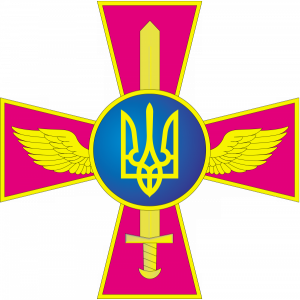
The emblem of the Ukrainian Air Force is a study in national identity expressed through military heraldry — the trident soaring on wings, a sword pointed downward in defence, all set against a blue-and-yellow shield. When Ukraine restructured its armed forces after independence, the challenge was not just organisational. It was symbolic. What images would represent a new country to the men and women who serve it? The answer they arrived at is one of the most striking air force emblems in Europe: modern, distinct, unambiguously Ukrainian.
Established in 2004 through the merger of the Air Force and the Air Defence Forces, the Ukrainian Air Force (Повітряні сили України) today fields 47,900 personnel, operates 208 combat aircraft and 37 transport aircraft, and continues to write new chapters in its history under the most challenging conditions imaginable. This page provides the vector emblem in CMX, EPS, SVG, and high-resolution PNG — the complete package for designers, researchers, and military enthusiasts.
The Visual Anatomy of the Ukrainian Air Force Emblem
Let us go through this emblem element by element. It rewards close attention.
The foundation is a heraldic shield, divided into two fields — blue on top, yellow on the bottom. This is not decoration. This is the national flag of Ukraine, rendered in heraldic form. Blue represents the sky, yellow the wheat fields stretching from Lviv to Donetsk. The shield is outlined in silver (or white in simplified versions), creating a clear boundary between the national symbol and whatever background it sits on.
Dominating the upper half is the trident (tryzub) — the state emblem of Ukraine, adopted in 1918, revived in 1992. But this is not the standard tryzub from the passport. This is the military variant. It is rendered larger, bolder, with sharper angles. It projects confidence and authority. The trident sits above a pair of outstretched wings — eight feathers per side, symmetrically angled, evoking the classic winged insignia of air forces worldwide while remaining distinctly Ukrainian through the integration with the tryzub.
Behind the trident and wings, pointing downward, is a straight sword. The blade is silver, the hilt gold. A downward-pointing sword in military heraldry is a symbol of protection — the weapon is ready but at rest, guarding rather than attacking. Between the sword and the wings, a subtle circular field in blue contains the composition, adding depth and focal weight.
At the base of the shield, a ribbon in blue and yellow bears the text «Повітряні Сили України» in Ukrainian Cyrillic. The typeface is robust, sans-serif, military in character. Underneath that, on a separate blue field, the motto: «Сила і Честь» — «Strength and Honour.»
| Element | Symbolism | Heraldic Note |
|---|---|---|
| Blue-and-yellow shield | National flag of Ukraine | Divided horizontally; blue sky above, yellow wheat fields below |
| Tryzub (trident) | State sovereignty, historical continuity | Military variant with sharper geometry; golden colour |
| Outstretched wings | Air power, flight, reach | 16 feathers total (8 per side); symmetrical, angled upward |
| Downward-pointing sword | Defensive posture, readiness | Silver blade, gold hilt; positioned behind the tryzub |
| Circular blue field | Unity, the sky | Binds the central elements together visually |
| Ribbon with text | Service identification | «Повітряні Сили України» in Ukrainian |
| Motto «Сила і Честь» | Core values | Strength and Honour; positioned at base of shield |
The Force Behind the Emblem: Structure and Capabilities
The emblem represents a real, operational air force — not a paper formation. Let us look at what the Ukrainian Air Force actually is.
Created on 26 December 2004, the Ukrainian Air Force merged two previously separate branches: the Military Air Forces (Військово-повітряні сили) and the Air Defence Forces (Війська протиповітряної оборони). This merger mirrored similar reforms in post-Soviet militaries — the Russian Aerospace Forces (VKS) would follow a similar path a decade later. The logic was straightforward: air power and air defence are two sides of the same coin, and commanding them separately creates friction that costs lives in wartime.
The inherited Soviet-era fleet was formidable: over 600 combat aircraft, dozens of transport planes, a dense network of airfields, and an integrated air defence system that covered the entire territory. But maintaining Soviet hardware without Soviet logistics quickly proved challenging. By the mid-2000s, the fleet had been rationalised to around 208 combat aircraft: MiG-29 and Su-27 fighters form the backbone, with Su-24 bombers, Su-25 ground-attack aircraft, and a growing fleet of reconnaissance and transport platforms including An-26, An-30, and Il-76.
Since 2014, the Air Force has been in a state of active modernisation and combat operations. New acquisitions include Bayraktar TB2 drones from Turkey, modernised MiG-29MU1 and Su-27 variants with upgraded avionics, and a shift toward NATO-standard communication and identification systems. Pilot training has been restructured around Western methodologies, with Ukrainian pilots training on F-16 simulators in preparation for the arrival of Western fighter aircraft.
\u{201c}The Ukrainian Air Force emblem is notable for how thoroughly it eliminates Soviet visual references. There is no red star, no hammer and sickle, no remnants of the old order. The tryzub dominates. The wings serve it. Every detail asserts: this is not the Soviet Air Force rebranded. This is a new force with a new identity.
Format Comparison for Vector Emblems
Military emblems place unique demands on file formats. You need the fidelity for ceremonial printing, the scalability for everything from shoulder patches to building-sized banners, and compatibility with the chaotic mix of software that military and civilian designers actually use. Here is how the formats stack up.
| Format | Software | Best For | File Size | Transparency |
|---|---|---|---|---|
| CMX | CorelDRAW X3+ | Printing houses in Ukraine, Russia, Eastern Europe | ~500 KB | Yes |
| EPS | Illustrator, Inkscape, Affinity | Universal print exchange | ~800 KB | Yes |
| SVG | Browsers, Inkscape, Figma | Web, infographics, Wikipedia | ~150 KB | Yes |
| PNG 2000px | Any viewer | Presentations, social media | ~400 KB | Yes |
| PNG 600px | Any viewer | Web thumbnails | ~80 KB | Yes |
| PNG 300px | Any viewer | Icons, favicons | ~30 KB | Yes |
Pay attention to the file sizes. SVG at 150 KB is remarkably compact — this is because vector paths for heraldic symbols tend to be relatively simple geometric shapes. CMX files include Corel-specific metadata that inflates them slightly. EPS is the largest because it embeds a preview image alongside the vector data. Pick SVG for web projects, CMX for Ukrainian print shops, and EPS when you need a universal format that every professional design application can open.
Historical Evolution: From Soviet VVS to Ukrainian Air Force
To understand this emblem, you need to understand what came before it. The Soviet Air Force (VVS) emblem was a red star with wings — aggressively horizontal, designed to project offensive power across the globe. When Ukraine declared independence in 1991, it inherited the 24th Air Army of the Soviet VVS, headquartered in Vinnytsia, along with the 5th and 8th Air Defence Armies. This was not a small inheritance: over 1,100 aircraft, dozens of airfields, and tens of thousands of personnel.
The question of the emblem was initially secondary to more pressing concerns — basing agreements with Russia, the fate of nuclear weapons stationed on Ukrainian soil, the division of the Black Sea Fleet. For the first decade of independence, Ukrainian pilots flew Soviet-era aircraft wearing adapted Soviet-era uniforms with the trident hastily patched over the hammer and sickle.
The 2004 merger forced the issue. A unified force needed a unified emblem. A commission of heraldry specialists, military historians, and graphic designers was convened. Their brief: create an emblem that honours Ukrainian aviation history (which predates the Soviet period — Igor Sikorsky, the helicopter pioneer, was born in Kyiv), projects strength, and immediately reads as Ukrainian.
The result was the emblem you can download from this page. The tryzub, the wings, the downward sword — every element was debated, revised, approved at multiple command levels, and finally adopted as the official symbol of the reborn Ukrainian Air Force.
Practical Usage Guide
Print Projects
Open CMX in CorelDRAW or EPS in Illustrator. The emblem uses a clean CMYK palette: blue is C100 M80 Y0 K20, yellow is C0 M10 Y100 K0, gold is C0 M20 Y100 K10. All text is converted to curves — no missing fonts. The layered structure lets you isolate the tryzub, the wings, or the shield independently. This is useful if you need the emblem on a dark background and want to remove the shield.
Web Projects
The SVG integrates directly into HTML. Use Ctrl+C on the SVG code and paste it inline for CSS control over every path. Want a monochrome version? Set fill="currentColor" on all paths and control the colour through a single CSS property. The file is clean XML with no comments or unnecessary metadata — production-ready as-is.
Research and Education
This emblem pairs well with comparative studies of post-Soviet military heraldry. Place it next to the Russian Aerospace Forces emblem (red star with blue-and-gold background), the Belarusian Air Force emblem, and NATO air force emblems for a visual essay on how military identity evolves through design. The Ukrainian approach — total replacement of Soviet symbols — contrasts sharply with the Belarusian approach of measured adaptation.
Frequently Asked Questions
When was the Ukrainian Air Force created?
The Ukrainian Air Force in its current form was created on 26 December 2004 through the merger of the Military Air Forces and the Air Defence Forces of Ukraine. However, Ukraine inherited air assets from the Soviet 24th Air Army upon independence in 1991.
How many aircraft does the Ukrainian Air Force operate?
The Ukrainian Air Force operates approximately 208 combat aircraft (including MiG-29, Su-27, Su-24, Su-25) and 37 transport aircraft (including Il-76, An-26, An-30). The exact numbers fluctuate due to ongoing modernisation and operational requirements.
What does the tryzub symbolise on the emblem?
The tryzub (trident) is the state emblem of Ukraine, adopted in 1918 and revived in 1992. On the Air Force emblem, it represents sovereignty, statehood, and the historical continuity of Ukrainian nationhood. The military variant has sharper geometry than the civil version.
Why does the sword point downward?
A downward-pointing sword in military heraldry is a symbol of defence and protection — the weapon is ready but at rest. It contrasts with an upward-pointing sword, which traditionally symbolises aggression or the readiness to attack.
Can I edit the emblem colours?
Yes. Open the EPS or SVG file. All colour values are editable. The EPS uses CMYK for print accuracy; the SVG uses hex RGB values for screen display. Changes to the official colour scheme should respect the heraldic tradition of the emblem.
What is the personnel strength of the Ukrainian Air Force?
The Ukrainian Air Force has approximately 47,900 personnel, including flight crews, ground support, air defence operators, and administrative staff.
How does this emblem compare to the Soviet Air Force emblem?
The Soviet VVS emblem featured a red star with horizontal wings and a propeller — a design rooted in early Soviet aviation. The Ukrainian emblem eliminates all Soviet references, replacing the star with the tryzud, changing the wing orientation to better integrate with the shield, and adding the national colours.
What formats are included in the download?
The ZIP archive contains the emblem in CMX (CorelDRAW), EPS (PostScript vector), SVG (web vector), and PNG raster renders at 2000px, 600px, and 300px resolution. All vector formats preserve editable layers.
Is the emblem used on aircraft?
Yes. The Ukrainian Air Force emblem appears on the fuselage of aircraft, on official documentation, uniforms, and base signage. The specific placement and size on aircraft follows official military regulations.
Can I use this emblem for commercial purposes?
The file is provided free. However, the emblem is an official state symbol. Commercial use implying affiliation with or endorsement by the Ukrainian Air Force requires official authorisation.
Download the emblem package:
Download Air Force Emblem ZIP (CMX, EPS, SVG, PNG)2.8 MBTap to react