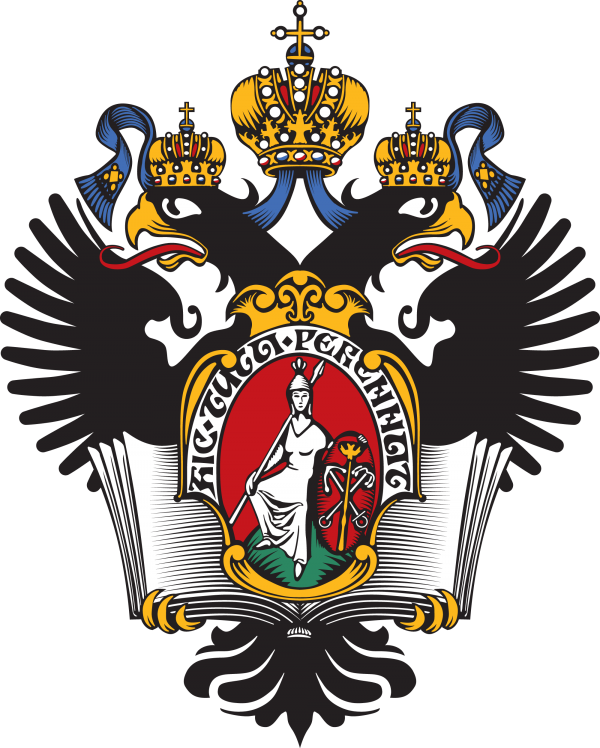
St. Petersburg State University (SPbGU) is the oldest university in Russia — founded by Peter the Great in 1724, predating Moscow State University by three decades and counting among its alumni nine Nobel laureates, two Fields Medalists, and some of the most consequential minds in Russian science, literature, and governance. Its heraldic emblem, a richly detailed coat of arms that merges the imperial double-headed eagle with academic symbolism, is not merely a logo — it is a concentrated visual essay on three centuries of Russian higher education, scientific achievement, and state patronage. Today we share the vector emblem of St. Petersburg State University in CMX (CorelDRAW) and EPS formats, packed into a single archive, plus a high-resolution PNG for immediate use in academic, editorial, and research projects.

University heraldry is a distinct genre within the broader field of emblem design. Unlike corporate logos — which prioritise simplicity, brand recall, and digital-first aesthetics — university coats of arms operate in a different visual language altogether. They are miniature tapestries of institutional identity, dense with references to founding charters, royal patrons, academic disciplines, and regional geography. The SPbGU emblem is a textbook example: a complex composition that rewards close reading while still functioning as a recognisable symbol at a distance. It is the kind of emblem that looks as natural carved in stone above a neoclassical portico as it does printed on a diploma or embroidered on an academic gown.

Векторная эмблема (логотип, герб) Санкт-Петербургского государственного университета (СПбГУ)

For designers, this is a challenging but rewarding piece of vector work. The emblem contains multiple heraldic elements — the double-headed eagle of the Russian Empire, the university's motto, academic symbols including books and scrolls, and a complex shield structure with multiple fields — all of which must render cleanly at sizes ranging from a letterhead to a building facade. The vector files in this archive capture the emblem in its full complexity, with every heraldic detail intact and every colour value calibrated for accurate reproduction.

The archive contains two vector formats: CMX (native CorelDRAW exchange) and EPS (universal vector exchange for Adobe Illustrator, Inkscape, Affinity Designer). PNG is included at full source resolution for immediate use without any vector software.

From Peter's Academy to Modern Research University: Three Centuries of SPbGU

St. Petersburg State University was established on 28 January 1724 by decree of Peter the Great, as part of the Saint Petersburg Academy of Sciences — the emperor's grand project to import European enlightenment into the Russian Empire. The university and the academy were initially a single institution, modelled on the German system that Peter had observed on his travels through Western Europe. The first lectures were delivered in 1726, making SPbGU the oldest continuously operating institution of higher education in Russia. For context: when SPbGU opened its doors, Johann Sebastian Bach was still composing, the Enlightenment was in its infancy, and the Russian Empire had only recently gained access to the Baltic Sea.

Throughout the 18th and 19th centuries, the university evolved from an adjunct of the Academy of Sciences into an independent institution with its own identity, faculty, and traditions. The move to the iconic Twelve Colleges building on Vasilyevsky Island — a quarter-kilometre-long Baroque structure originally built for Peter's government ministries — gave the university a physical home that matched its intellectual stature. By the mid-19th century, SPbGU had become the intellectual centre of the Russian Empire, producing graduates who would go on to shape Russian law, science, literature, and revolutionary politics.

The university's alumni roll reads like a cross-section of Russian intellectual history. Dmitri Mendeleev, creator of the periodic table of elements, studied and taught here. Ivan Pavlov, the physiologist who discovered classical conditioning and won a Nobel Prize, spent his entire career at SPbGU. The mathematicians Pafnuty Chebyshev and Vladimir Smirnov built schools of thought that influenced global mathematics for generations. The poet Alexander Blok, the novelist Ivan Turgenev, and the legal scholar Anatoly Koni all walked the Twelve Colleges' famous corridor — the longest university corridor in the world at over 400 metres. More recently, the university has produced Fields Medalists Grigori Perelman (who proved the Poincare conjecture) and Stanislav Smirnov, as well as several Nobel laureates in physics and economics.

The Soviet era brought radical changes. The university was renamed Leningrad State University in 1924, and its imperial-era heraldry was replaced with simpler Soviet-era symbols. The original coat of arms fell into disuse for seven decades. After the dissolution of the USSR in 1991, the university reclaimed its historical name and, shortly thereafter, its historical heraldry. The modern version of the emblem, adopted in the early 2000s, is a restoration and adaptation of the imperial-era coat of arms, updated for contemporary use while preserving the essential heraldic language that connects the institution to its founding moment in the reign of Peter the Great.

Year Event Significance
1724 University founded Established by Peter the Great as part of the Academy of Sciences
1726 First lectures Teaching begins, making SPbGU Russia's oldest university
1835 Twelve Colleges building University moves to iconic Vasilyevsky Island campus
1869 Mendeleev's table Periodic table created by SPbGU professor Dmitri Mendeleev
1904 Pavlov's Nobel Prize Ivan Pavlov awarded Nobel Prize for physiology
1924 Renamed LSU Becomes Leningrad State University during Soviet era
1991 Name restored Returns to St. Petersburg State University after USSR dissolution
2010 Special status Granted unique legal status allowing independent academic standards

Today SPbGU is a federal university with special legal status — one of only two Russian universities (alongside Moscow State University) permitted to set their own educational standards and award their own academic degrees independent of the national system. The university comprises over twenty faculties and institutes, serves approximately 30,000 students, and maintains research collaborations with institutions across the globe. Its main campus on Vasilyevsky Island remains one of the architectural treasures of St. Petersburg, and the university's heraldic emblem continues to preside over academic ceremonies, official documents, and the diplomas of every graduate.

Heraldic Analysis: Decoding the SPbGU Coat of Arms

The SPbGU emblem is a formal heraldic achievement — a complete coat of arms in the European tradition, with multiple elements layered in precise heraldic composition. At its centre is a shield divided into multiple fields, each bearing symbols representing the university's academic mission, its connection to the imperial Russian state, and its location in St. Petersburg. Above the shield rises the Russian imperial double-headed eagle, crowned and bearing insignia — a visual anchor that immediately places the institution within the context of state-sponsored higher education and connects it directly to the era of its founding.

The shield itself is the most complex element. It contains representations of books, scrolls, and academic symbols that collectively communicate the university's purpose. The colour palette is dominated by gold, blue, and red — the heraldic colours of the Russian Empire, where gold represents imperial authority and intellectual brilliance, blue represents the sky, water, and the scholarly life of contemplation, and red represents the state, power, and the lifeblood of the institution's centuries of contribution to Russian national life.

The CMX version requires CorelDRAW X5 or newer. If you use older software or any non-Corel application, import the EPS file instead — it is universally compatible with all vector editors on Windows, macOS, and Linux, with text and heraldic elements converted to outline paths for flawless rendering regardless of installed fonts.

Imperial Academic Heraldry: The Double-Headed Eagle

The double-headed eagle is one of the oldest and most freighted symbols in Russian heraldry. Adopted from the Byzantine Empire in the late 15th century, the two-headed eagle facing east and west symbolises Russia's position as a bridge between Europe and Asia and its claim to imperial authority over vast territories. In the context of the SPbGU emblem, the eagle serves a specific function: it marks the university as an institution founded by imperial decree, operating under the patronage of the Russian state, and bearing the weight of that heritage into the present day.

The presence of the imperial eagle on an academic emblem is not merely decorative. In the European heraldic tradition, universities granted charters by monarchs display royal or imperial symbols as a mark of their founding authority. Oxford and Cambridge display royal arms; the Sorbonne in Paris displays the royal lilies of France; the University of Vienna displays the Habsburg double-headed eagle. SPbGU's eagle is part of this European tradition — a statement that the university is not a private venture or a corporate enterprise but an institution of state, founded by the sovereign and charged with serving the nation through education and research. For a designer working with this emblem, the eagle is also the most technically demanding element: its feathers, crowns, and regalia contain dozens of curves and details that must render correctly at multiple scales.

Books, Scrolls, and the Symbols of Learning

The academic symbols within the SPbGU shield — books, scrolls, and heraldic devices representing the sciences and humanities — function as a visual catalogue of the university's mission. The book is the universal symbol of learning, appearing on university coats of arms from Harvard to Heidelberg. The scroll represents the research mission — the production of new knowledge, documented and disseminated. The specific arrangement of these elements in the SPbGU shield follows precise heraldic rules governing the placement, proportion, and tincture of each component.

For designers reproducing this emblem, the academic symbols present a specific challenge: they must be detailed enough to be identifiable at close range but simplified enough to remain legible when the emblem is reduced to a quarter-inch on a letterhead or a half-inch on a website favicon. The vector files in this archive strike this balance carefully, with line weights and spacing calibrated for legibility across the full range of reproduction sizes from architectural facades to digital icons.

Heraldic Element Description Functional Note
Double-headed eagle Imperial Russian eagle crowned, wings spread Marks imperial founding authority, extremely detailed vector work
Central shield Divided heraldic field with multiple compartments Contains academic symbols, requires clean separation at small scales
Books and scrolls Symbols of teaching and research Universal academic motif, must remain legible at reduced size
Colour palette Gold, blue, red — imperial Russian heraldic colours Rich reproduction in print, requires accurate Pantone values
Motto Traditional university motto in Latin or Russian Smallest text element, requires careful kerning in vector form
Crowns Imperial crowns above the eagle heads Complex curves, most challenging element for auto-trace

Vector vs Raster: Why the Format Matters for University Emblems

University emblems face a unique set of reproduction challenges that make vector formats essential. Unlike a football club badge — which primarily appears on shirts, scarves, and social media — a university coat of arms must function across an extreme range of sizes and media. It appears in gold leaf on diploma parchment and in tiny monochrome on degree transcripts. It is carved in stone above entrance portals and printed at 72 dpi on website headers. It is embroidered on academic gowns, etched into glass doors, stamped into wax seals, and projected onto lecture hall screens. No single raster resolution can serve all these purposes. Only a vector file — resolution-independent by definition — can produce acceptable output at every one of these scales.

The EPS format is particularly important for academic emblems because universities often work with a wide range of printers, publishers, and production partners who may use different software. An EPS file from this archive can be placed into a LaTeX document by a mathematics researcher, imported into InDesign by a university press designer, opened in Illustrator by a branding consultant, or rendered by a sign-making firm's proprietary RIP software. This universal compatibility is not a luxury — it is a practical requirement for any emblem that must move through diverse institutional workflows.

Real-World Use Cases for These Files

  • Academic publications — researchers and students place the emblem in dissertations, theses, journal articles, and conference presentations. EPS embeds cleanly into LaTeX and Word documents.
  • Diploma and certificate design — the university's official documents require the emblem at the highest print resolution. Vector ensures gold foil and embossing processes render perfectly.
  • Institutional branding — the university's communications office uses the emblem in annual reports, recruitment brochures, and alumni magazines. Consistent colour reproduction is critical.
  • Architectural signage — building directories, department signs, and campus maps require large-format rendering. Vector files scale seamlessly to architectural dimensions.
  • Digital media — the PNG file serves for website headers, social media profiles, and online course platforms where vector formats are not directly supported.
  • Commemorative merchandise — graduation souvenirs, alumni gifts, and university-branded products require production-ready artwork with precise colour specifications.
  • Historical and educational projects — researchers studying Russian academic history, heraldry enthusiasts, and documentary filmmakers get an authentic, production-ready emblem.

Working with CMX Files Without CorelDRAW

For users without access to CorelDRAW, the EPS file in this archive is the recommended path. However, if you specifically need to work with the CMX file in alternative software, you have options. Inkscape (free, cross-platform) can import CMX files, though the translation is not perfect — Corel-specific layer structures, fountain fills, and lens effects may not survive the conversion. For preserving the full visual integrity of the emblem, simply use the included EPS file. Our EPS has been verified in Adobe Illustrator CS6 through CC 2024, Inkscape 1.3, Affinity Designer 2, CorelDRAW X8, and standard PostScript RIP environments, opening correctly in every single case.

The emblem in this archive has been manually traced from official university heraldry sources and verified against multiple authoritative references, including the university's official brand guidelines, historical heraldic registers, and physical examples of the emblem in the university's own architecture and publications. You are getting a production-grade vector asset, not the output of an automated conversion tool with its characteristic jagged curves and colour mismatches.

Frequently Asked Questions About the SPbGU Emblem

What formats are included in the SPbGU emblem download archive?

The archive includes CMX (native CorelDRAW format), EPS (universal vector exchange format), and high-resolution PNG. Vector files require CorelDRAW, Adobe Illustrator, or Inkscape for editing. PNG works in any image viewer and is ready for immediate use in documents, presentations, and web pages.

Can I use the SPbGU emblem for commercial purposes?

University coats of arms are protected intellectual property and their use is generally restricted to official university business or authorised institutional partners. This material is provided for editorial, educational, research, and personal reference use. Any commercial use or use implying university endorsement requires explicit permission from St. Petersburg State University.

What is the difference between CMX and EPS for a complex heraldic emblem?

CMX preserves the full CorelDRAW editing environment including layer structure, making it ideal for users who need to modify or extract specific heraldic elements. EPS preserves all visual information in a universally compatible format that works across all vector applications. The complex detail of the double-headed eagle and the shield elements is preserved identically in both formats.

What resolution is the PNG file and can it be used for print?

The PNG is provided at full source resolution suitable for A4 printing at 300 dpi. For larger formats or highest-quality reproduction, the vector files are recommended. PNG is a lossless format; no JPEG compression artefacts are present.

When was SPbGU founded and what is its historical significance?

SPbGU was founded in 1724 by Peter the Great, making it the oldest university in Russia. It has produced nine Nobel laureates and two Fields Medalists, and is one of only two Russian universities with special legal status allowing independent academic standards.

What do the heraldic elements of the SPbGU emblem represent?

The double-headed eagle represents the imperial Russian state that founded the university. The shield contains academic symbols — books, scrolls — representing teaching and research. The colours (gold, blue, red) are the heraldic colours of the Russian Empire.

Has the SPbGU emblem changed over the university's history?

The imperial-era coat of arms was replaced during the Soviet period (1924-1991) with simpler Soviet-style emblems. After 1991, the university restored its historical heraldry, with the current version being a modern adaptation of the pre-revolutionary coat of arms, adopted in the early 2000s.

Can I extract individual elements from the vector file?

Yes. Both CMX and EPS files preserve the emblem's component elements as separate paths, allowing users with vector editing software to isolate the double-headed eagle, the shield, the motto, or any other element for specific design applications — subject to the usage restrictions noted above.

Скачать векторную эмблему — CMX, EPS (ZIP)525 KB

The files are provided for educational, editorial, and personal reference use. If you represent St. Petersburg State University and have questions regarding the terms of use of this material, please contact us through the website. For researchers, historians, designers working on academic projects, and anyone documenting the visual heritage of Russian higher education, this is the most accurate freely available vector version of the SPbGU emblem.

Tap to react