FC Rostov is the football soul of the Don region — a club with nearly a century of history, forged in the furnaces of the Soviet industrial south and hardened by decades of punching well above its weight in Russian football. Founded in 1930 under the name Selmashstroy, the club has undergone more name changes and identity transformations than almost any other Russian side, yet through every iteration the yellow-blue colours have remained the constant — a flash of sunflower gold and Don River blue visible from any seat in the Rostov Arena. Today we share the vector emblem of FC Rostov in CMX (CorelDRAW) and EPS formats, packed into a single archive, plus a high-resolution PNG for immediate use.

This is a club with a genuine trophy. On 8 May 2014, FC Rostov defeated FC Krasnodar in a penalty shootout to win the Russian Cup — the first and so far only major trophy in the club's history. That victory, secured at the Anzhi Arena in Kaspiysk, was not a fluke: it was the culmination of years of disciplined, aggressive football that Rostov had been building under a succession of pragmatic managers. The cup win cemented the club's place among Russia's football elite and gave the yellow-blue faithful a moment of pure, unfiltered joy that no league position could ever match.

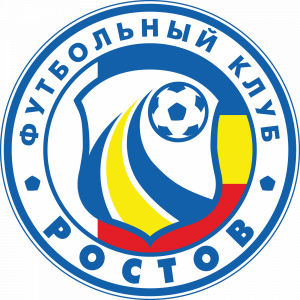
The emblem itself is a study in functional simplicity. A round shield, diagonally divided into yellow and blue halves, with the club name in Cyrillic running across the centre band and a classic leather football occupying the upper section. The design language is deliberately old-school — it could be a Soviet-era crest, and that is the point. In an era of hyper-modern, corporate-looking football logos, the Rostov emblem wears its heritage unapologetically, announcing that this is a club that remembers where it came from.

Векторная эмблема (логотип) футбольного клуба «Ростов»
The archive contains two vector formats: CMX (native CorelDRAW exchange) and EPS (universal vector exchange for Adobe Illustrator, Inkscape, Affinity Designer). PNG is included at full source resolution for immediate use without any vector software.

From Tractor Factory to European Nights: The FC Rostov Story

FC Rostov was born in 1930 at the Rostselmash agricultural machinery plant — one of the titans of Soviet industrialisation that transformed the Don region into an economic powerhouse. The club's first name, Selmashstroy, was a contraction of the factory's construction project name; it would later become Selmash, then Traktor, then Torpedo, then Rostselmash, and finally — in 2003 — FC Rostov. Each name change tracked a chapter in the city's and the country's history: industrial expansion, wartime evacuation and return, post-war reconstruction, post-Soviet privatisation, and finally a modern sporting brand.

The club's Soviet-era pedigree is solid. Rostselmash spent multiple seasons in the Soviet Top League, including a memorable campaign in 1991 — the final season of Soviet football — finishing a respectable mid-table. The club produced players who went on to represent the USSR national team, and the yellow-blue strip became a familiar sight on pitches from Vladivostok to Lviv. The post-Soviet 1990s were turbulent: financial crises, ownership disputes, and relegation battles, but Rostov survived where many other provincial clubs folded. By the mid-2000s the club had stabilised in the Russian Premier League and was building a reputation as a difficult away fixture for any opponent.

The 2013/2014 season was the watershed. Under head coach Miodrag Bozovic, Rostov played pragmatic, counter-attacking football that drove possession-oriented opponents to distraction. The Russian Cup final against Krasnodar went to penalties after a goalless draw, and Rostov held their nerve to win the shootout. The cup victory brought European football to the banks of the Don River for the first time, and the ensuing Europa League campaign gave Rostov fans encounters with clubs whose names they had previously only read about in magazines.

The 2015/2016 season produced another miracle: under the management of Kurban Berdyev, a tactician legendary in Russian football for turning modest clubs into giant-killers, Rostov finished second in the Russian Premier League — behind only CSKA Moscow. The club conceded just 20 goals in 30 league matches, the best defensive record in the division. The following season brought Champions League football to Rostov-on-Don: Bayern Munich, Atletico Madrid, and PSV Eindhoven came to the Rostov Arena, and the little yellow-blue club from the south held its own, beating Bayern 3-2 in one of the most famous results in Russian club football history.

Year Event Significance
1930 Club founded Born as Selmashstroy at the Rostselmash factory
1950 Rostselmash era begins Club renamed, enters Soviet professional football
1991 Final Soviet season Mid-table finish in the last Soviet Top League
2003 Renamed FC Rostov Modern branding, consistent Premier League presence
2014 Russian Cup winners First major trophy in club history
2016 RPL runners-up Second place in the Russian Premier League
2016 Champions League debut Beat Bayern Munich 3-2 at home
2018 Rostov Arena opens Built for FIFA World Cup, becomes new home

The city of Rostov-on-Don itself is inseparable from the club's identity. A southern Russian metropolis of over a million people, it sits on the Don River near the Sea of Azov, historically a Cossack stronghold and a commercial gateway between European Russia and the Caucasus. The city's character — proud, independent, occasionally rough-edged — is woven into the club's DNA. Rostov fans are famously loud and loyal, and the Rostov Arena, built for the 2018 FIFA World Cup on the left bank of the Don, has become a genuine fortress where even the biggest Russian and European clubs struggle to impose themselves.

Emblem Design: Anatomy of the FC Rostov Crest

The FC Rostov emblem is built around three core elements: the diagonal division into yellow and blue halves, the central band with the Cyrillic club name, and a classic leather football in the upper section. The round shield form is the most traditional shape in Russian football heraldry — used by Spartak, CSKA, Zenit, and Lokomotiv — and immediately signals that this is a serious club with a serious history, not a start-up brand from the post-Soviet era.

The diagonal division into yellow and blue serves multiple visual purposes. It creates immediate recognisability at a distance: even a blurred photograph of a Rostov player shows the colour split. It references the geography of the club's home: yellow for the sunflower fields that blanket the Rostov region in summer, blue for the Don River that defines the city's topography and economy. And it provides a natural canvas for the other emblem elements: the central band rides the diagonal, while the football sits comfortably in the upper half against the yellow background.

The CMX version requires CorelDRAW X5 or newer. If you use older software or any non-Corel application, import the EPS file instead — it is universally compatible with all vector editors on Windows, macOS, and Linux, with fonts converted to outline paths for flawless rendering.

The Yellow-Blue Palette: Sunflowers and the Don River

Yellow and blue are the colours of the Rostov region's flag and coat of arms, and the club's adoption of these colours ties it directly to the regional identity. The yellow is not a pale, washed-out yellow — it is a rich, saturated gold that pops against any background, whether the green grass of the pitch, the grey concrete of Soviet-era apartment blocks, or the blue summer sky over the Don steppe. The blue is a medium royal blue, dark enough to provide contrast against the yellow without becoming black, light enough to remain visible on television and in print.

This colour combination is surprisingly rare in world football. Brazilian clubs use yellow and blue (and green), but in Europe the combination is unusual, giving Rostov a distinct visual identity in the crowd of red, blue, and white clubs. From a production standpoint, two-colour spot printing (yellow and blue) on a white substrate is extremely economical. Screen printing on merchandise requires only two screens. Embroidery, the most demanding logo-reproduction technique, handles yellow thread on blue or blue thread on yellow with excellent results when digitised by a skilled operator. The white central band, meanwhile, is simply the substrate colour — no additional plate or thread colour required.

Typography and the Football Motif

The Cyrillic inscription — ФУТБОЛЬНЫЙ КЛУБ РОСТОВ — sits on a white band that crosses the shield diagonally, providing maximum contrast against both the yellow and blue backgrounds. The typeface is a bold grotesque, heavily weighted for legibility. On a match-worn shirt, at the distances typical of stadium seating, this text needs to be read by fans fifty metres away. The designers understood this: the letterforms are thick, the spacing is generous, and there is no decorative distortion sacrificing readability for style.

The football in the upper half is a classic leather panel ball — the traditional stitched pentagon-and-hexagon pattern that every football fan recognises instantly. It is a stylistic choice that anchors the emblem in football history. Modern match balls are high-tech composite constructions, but a logo is not about the latest technology — it is about timeless recognition. The stitched leather ball has been the universal symbol of the game for over a century, and Rostov's designers wisely chose to stick with what works rather than chase a fleeting design trend.

Design Element Description Functional Note
Shield shape Classic round shield, traditional Russian football heraldry Fits standard badge templates, recognised instantly
Diagonal division Shield split diagonally into yellow and blue halves Unique colour-block identity among Russian clubs
Central band White diagonal band with Cyrillic club name Provides contrast for text, natural dividing element
Football motif Classic leather panel ball in upper yellow half Timeless symbol, avoids dating the design
Colour palette Yellow, blue, white — three colours Two-plate spot printing, extremely economical
Typography Bold Cyrillic grotesque, full club name Legible at typical match-viewing distances

Vector vs Raster: Why the Format Matters for Club Emblems

Anyone who has tried to upscale a JPEG logo for a large-format print knows the horror: jagged stair-step edges on curves, blurry text, colour banding across what should be smooth gradients. Vector formats eliminate these problems at the mathematical level. A CMX or EPS file defines the emblem as Bezier curves — mathematical descriptions of shapes independent of pixel resolution. When a printer's RIP (raster image processor) renders the file, it calculates the output at the target resolution, whether 72 dpi for a web graphic or 1200 dpi for offset lithography. The curve is the same curve at any size.

The EPS format serves as the universal bridge between graphic design applications. Adobe Illustrator opens it natively. CorelDRAW imports it without data loss. The free Inkscape handles it through Ghostscript. Affinity Designer, the rising challenger to Adobe's dominance, reads EPS cleanly. This cross-compatibility is why we include EPS alongside CMX: you are not locked into any single software ecosystem, and you can hand the file to any print shop, sign maker, or merchandise producer without worrying about their toolchain.

Real-World Use Cases for These Files

  • Fan banners and tifo displays — vector files let you scale the emblem to stadium-spanning dimensions without any quality loss. Send EPS directly to large-format printers.
  • Merchandise production — scarves, shirts, caps, mugs. Vector ensures exact Pantone colour matching across all production runs.
  • Matchday programmes — layout designers place EPS in InDesign, QuarkXPress, or Scribus at native resolution for professional printed products.
  • Digital media — use the PNG for social media posts, website headers, YouTube thumbnails. PNG is optimised for screen use at standard DPI.
  • Video production — import EPS into After Effects, Premiere Pro, or DaVinci Resolve for broadcast-quality graphics and lower-thirds.
  • Academic and journalistic work — sports journalism students and Russian football researchers get a clean, authentic logo source for publications.
  • Web development — convert EPS to SVG for inline HTML embedding with CSS animation and hover-effect capabilities.

Working with CMX Files Without CorelDRAW

CorelDRAW is an expensive piece of software, and many designers have migrated to Adobe Creative Cloud or free open-source alternatives. If you have the CMX file but work in Illustrator, try this workflow: open the CMX in Inkscape (free, cross-platform, available on Windows, macOS, and Linux), then save as SVG or export to EPS. CMX import in Inkscape is not perfect — some text elements may be converted to curves, meaning you lose direct text editing — but the visual geometry remains intact. Alternatively and far more reliably, simply use the EPS file from this archive. Our EPS has been tested in Illustrator CS6, Illustrator CC 2024, Inkscape 1.3, Affinity Designer 2, and CorelDRAW X8, and it opens correctly in every single one.

All vector files in this archive were manually traced from official club imagery and colour-corrected against multiple reference sources, including match footage, official club publications, and television broadcast stills. You will find none of the auto-trace artefacts — jagged curves, colour banding on gradients, poorly joined paths — that plague machine-traced logos from automatic online converters.

Frequently Asked Questions About the FC Rostov Emblem

What formats are included in the FC Rostov emblem download archive?

The archive includes CMX (native CorelDRAW vector format), EPS (universal vector exchange format), and high-resolution PNG. Vector files require CorelDRAW, Adobe Illustrator, or Inkscape for editing. PNG works in any image viewer without additional software and is suitable for immediate use in documents, presentations, and web pages.

Can I use the FC Rostov emblem for commercial merchandise production?

Football club emblems are generally protected by trademark and copyright held by the club itself or its parent organisation. This material is provided strictly for editorial, educational, research, and personal non-commercial use. If you intend to produce and sell items bearing the FC Rostov logo, you must contact the club directly for a licensing agreement.

What is a CMX file and how does it differ from EPS?

CMX is CorelDRAW's native presentation exchange format, storing full layer structure, multiple pages, and Corel-specific effects like lens objects and fountain fills that EPS cannot convey. EPS is a simpler, universally readable vector format that preserves paths and fills but strips application-specific metadata. For most users without CorelDRAW, the EPS file from this archive will be far more practical.

What resolution is the PNG file and can it be printed?

The PNG is provided at full source resolution suitable for both print and screen use. It is a lossless format, meaning no JPEG compression artefacts. The resolution is sufficient for A4 printing at 300 dpi and A3 at 150 dpi, covering the vast majority of non-commercial print scenarios.

When was FC Rostov founded and what are the club's official colours?

FC Rostov was founded in 1930 at the Rostselmash factory in Rostov-on-Don. The official colours are yellow and blue, matching the flag of the Rostov region. The club plays home matches at the Rostov Arena, built for the 2018 FIFA World Cup, and has competed in the Russian Premier League, the Soviet Top League, and UEFA European competitions.

Has the FC Rostov emblem ever changed?

The club has undergone several name changes since 1930 — Selmashstroy, Selmash, Traktor, Torpedo, Rostselmash, and finally FC Rostov in 2003 — and the emblem has evolved with each era. The current yellow-blue diagonal shield design has been in use since the 2003 rebranding, with minor colour and typography refinements over the years but no fundamental redesign.

I opened the CMX in Adobe Illustrator and the text is missing or garbled. Why?

CorelDRAW uses a proprietary font-embedding technology that does not translate to Illustrator's font-handling system. Open the EPS file instead — the fonts in the EPS version have been converted to outline paths, guaranteeing correct visual appearance in any vector editor regardless of installed fonts.

How should I place the emblem on a dark or black background?

The PNG image has a transparent background, and the vector files preserve transparency as well. For dark backgrounds, you may need to add a white stroke or white glow behind the emblem in your editor so that the blue and darker elements remain visible against the dark surface. This is standard practice for placing any logo with dark elements on a non-white substrate.

Скачать векторную эмблему — CMX, EPS (ZIP)230 KB

The files are provided for educational, editorial, and personal use. If you represent FC Rostov and have questions regarding the terms of use of this material, please contact us through the website. For designers working on fan projects, research papers, or digital collections of football memorabilia, this is the cleanest freely available vector version of the FC Rostov emblem.

Tap to react