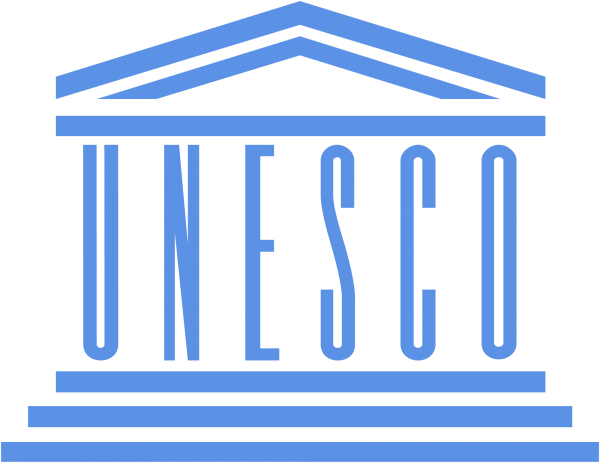
The UNESCO emblem is perhaps the single most recognised institutional logo on the planet — a spare, geometric temple facade rendered in a language that needs no translation, appearing on World Heritage plaques from Angkor Wat to Machu Picchu, on educational materials from Kabul to Kinshasa, and on the walls of schools and libraries in every one of the 194 member states that constitute the organisation. The acronym stands for the United Nations Educational, Scientific and Cultural Organization — a specialised agency founded in the immediate aftermath of the Second World War with a mandate as ambitious as it is poetic: to build peace in the minds of men and women through education, science, culture, and communication. We provide the vector emblem of UNESCO in EPS, SVG, and CDR formats in a single ZIP archive, plus high-resolution PNG renders at 2000, 600, and 300 pixels — everything required for professional-grade reproduction across any medium.

From a design standpoint, the UNESCO logo is a study in restraint. It contains exactly two visual elements: a stylised Greek temple and the institutional acronym. There is no colour gradient, no drop shadow, no trendy type treatment that would date it to a particular decade. The emblem was designed to be timeless, and sixty years on, it has achieved exactly that. The vector files we provide capture every proportion, every curve, and every negative-space relationship with mathematical precision — the only way to work with a logo that will be reproduced from postage-stamp size to building-facade scale.

Born from Ashes: The Founding of UNESCO in 1945

On November 16, 1945, representatives of thirty-seven countries gathered in London to sign the Constitution of UNESCO. The war in Europe had ended just six months earlier. The atomic bombs had fallen on Hiroshima and Nagasaki three months before. The world was staggering through the ruins of the most destructive conflict in human history, and the delegates in London were attempting something that had never been tried at a global scale: the creation of an international organisation dedicated not to military alliance or economic coordination, but to the cultivation of human intellectual and cultural life.

The preamble to the UNESCO Constitution contains one of the most quoted sentences in international law: «Since wars begin in the minds of men, it is in the minds of men that the defences of peace must be constructed.» This single sentence, drafted by the poet and diplomat Archibald MacLeish with input from the biologist Julian Huxley (UNESCO's first Director-General), encapsulated a radical proposition: that the root cause of war is not territory or resources, but ignorance, prejudice, and the failure of mutual understanding across cultures.

UNESCO opened its doors in Paris in 1946 and began work immediately. Its early projects set the pattern for decades to come: literacy campaigns in post-war Europe, scientific cooperation networks across the Iron Curtain, and the first tentative steps toward what would later become the World Heritage Convention. The organisation that had been conceived as a safeguard against future wars rapidly discovered that its mandate — education, science, culture — touched every aspect of human development.

Today, UNESCO's scope is breathtaking. It designates and protects over 1,100 World Heritage sites. It coordinates the Global Ocean Observing System. It sets international standards for teacher training. It runs literacy programmes that have reached hundreds of millions of adults. It defends press freedom through the annual World Press Freedom Day and the monitoring of journalist killings. It fights against the illicit trafficking of cultural property. All of this activity — billions of dollars in programmes spread across every continent — is represented by a single, simple logo.

Decoding the Emblem: The Greek Temple and Its Meaning

The UNESCO logo consists of a stylised representation of an ancient Greek temple — specifically, the facade of the Parthenon — with the letters U-N-E-S-C-O arranged vertically beside it. The choice of a Greek temple as the founding visual metaphor for the organisation was neither casual nor arbitrary. Classical Greek civilisation represented, in the minds of the mid-twentieth-century diplomats who approved the design, the shared intellectual heritage of humanity: philosophy, democracy, geometry, theatre, and the systematic pursuit of knowledge.

The temple facade is reduced to its essential geometry: a triangular pediment supported by columns. The columns are not rendered with the elaborate fluting and capitals of Doric, Ionic, or Corinthian orders but are simplified into parallel vertical lines — a deliberate abstraction that transforms a specific Greek architectural element into a universal symbol of structure, order, and civilisation. The pediment above the columns creates a roof-like shape that implies protection and shelter — knowledge as a sanctuary.

The text «UNESCO» appears in a clean, geometric sans-serif typeface. The letters are stacked vertically to the right of the temple, creating a compact rectangular composition that works equally well as a square badge or a horizontal banner. The vertical stacking was a practical choice: when translated into the six official UN languages, the acronym length varies, but the vertical arrangement maintains visual consistency across all variants.

The entire emblem is rendered in a single colour — typically black, dark blue, or white depending on the background. This monochrome approach was not a budget-saving measure. It was a strategic design decision rooted in the realities of mid-century global communication: the logo had to reproduce clearly on mimeograph stencils and low-quality newsprint, on signs painted by hand in remote villages, on rubber stamps and wax seals. A single-colour logo printed in any ink on any surface remains legible. The vector files preserve this simplicity — what you see is pure geometric form without any raster artefacts or colour approximations.

\u{201c}

The UNESCO logo is arguably the most successful exercise in global branding ever undertaken. It has appeared on every inhabited continent, in every climate, on every type of surface that can receive a mark, and it remains instantly recognisable to people who share no common language, alphabet, or cultural reference point. The Parthenon silhouette is the visual equivalent of a diplomatic handshake — universally understood and universally non-threatening.

ElementSymbolismDesign StrategyPractical Rationale
Greek Temple FacadeClassical heritage, knowledge, civilisationAbstracted to universal geometryWorks across all cultures and languages
ColumnsStructure, order, support for knowledgeSimplified to parallel linesReproduces at any scale
Triangular PedimentProtection, shelter for learningClean geometric formCreates strong silhouette
Vertical AcronymInstitutional identityStacked sans-serif textCompatible with all UN languages
MonochromaticClarity, universalitySingle solid colourReproduces on any medium

What is particularly remarkable about the UNESCO logo is that it was designed before the era of corporate branding — before the profession of «logo designer» even existed in its modern form. The emblem emerged from the graphic design culture of the 1940s, when logos were still called «trademarks» or «insignias» and were typically produced by architects, typographers, or general commercial artists. Despite this, it exhibits principles that would later be codified as best practices in identity design: simplicity, scalability, monochrome compatibility, and meaning embedded in form.

World Heritage: The Logo That Changed How We See the Planet

For most people, the UNESCO emblem is encountered not at the organisation's Paris headquarters but on a World Heritage plaque — a square bronze or stone marker affixed to the entrance of a cathedral, a national park, an archaeological site, or a historic city centre. The World Heritage programme, established by the 1972 Convention Concerning the Protection of the World Cultural and Natural Heritage, is UNESCO's most visible activity and arguably its most transformative contribution to global culture.

The idea was revolutionary: certain places belong not to any single nation but to all of humanity, and the international community bears a collective responsibility to protect them. A temple in Cambodia, a coral reef in Australia, and a walled city in Croatia could all — in theory — claim the same status and the same protection. The UNESCO emblem on a World Heritage plaque is the visual guarantee of this status: it says that this place has been judged by a panel of international experts to be of «outstanding universal value» and that its survival is a matter of global concern.

The presence of the UNESCO logo on a site transforms its economic and cultural trajectory. World Heritage designation brings tourism, international attention, and in many cases, the funding and technical expertise needed to preserve a site that would otherwise deteriorate. It also brings responsibility: the international community watches to ensure that designated sites are not damaged by development, war, or neglect, and UNESCO has not hesitated to place sites on the «List of World Heritage in Danger» when circumstances warrant. The logo on a plaque is a covenant — a promise made by the host country to the world.

As of 2024, there are 1,199 World Heritage properties across 168 countries — 933 cultural, 227 natural, and 39 mixed. Every single one of them displays the UNESCO emblem somewhere on its grounds. Multiply those 1,199 sites by the tens of millions of people who visit them annually, and the UNESCO logo may well be the most frequently photographed institutional emblem in human history. Having the vector file means you can reproduce this emblem with the precision it deserves when documenting these sites in publications, exhibitions, or research materials.

File Formats: EPS, SVG, CDR — A Vector for Every Workflow

Our download includes three vector formats and three PNG resolutions. This is not redundancy — it is coverage for the three major vector editing ecosystems that exist in professional design today.

The EPS file is the universal vector format, readable by every professional graphics application in existence. If you need to send the logo to a print shop, an exhibition designer, a signage company, or any external partner, the EPS is your safest bet. It preserves all vector data in a PostScript-compatible format that has been the standard for print production since the 1980s.

The SVG file is the web-native vector format. It opens directly in any browser — Chrome, Firefox, Safari, Edge — without additional software. If you are building a website, designing an interactive map of World Heritage sites, or creating a digital educational resource, the SVG is your format. It can be styled with CSS, animated with JavaScript, and scaled to any screen size without pixelation.

The CDR file is the CorelDRAW native format, widely used by designers in Eastern Europe, Russia, and parts of Asia where CorelDRAW has historically been the vector editor of choice. If your workflow runs through CorelDRAW — common in government print shops, educational publishers, and sign-making businesses in many countries — open the CDR file for native layer support and colour fidelity.

The PNG files at 2000, 600, and 300 px provide quick raster access for presentations, documents, and web previews. All PNGs include alpha-channel transparency — the emblem appears without a background, ready to drop onto any layout.

FormatTypePrimary SoftwareEditableBest Application
EPSVectorIllustrator, Inkscape, Affinity, anyYesPrint production, cross-platform sharing
SVGVectorBrowsers, Figma, Sketch, code editorsYesWeb, UI design, interactive media
CDRVectorCorelDRAWYesEastern European/Russian workflows, signage
PNG 2000pxRasterAny image viewerNoHigh-res print, large displays
PNG 600pxRasterAny image viewerNoWeb articles, presentations
PNG 300pxRasterAny image viewerNoThumbnails, inline icons
UNESCO's emblem is protected as the intellectual property of the organisation. Vector files may be used for educational, journalistic, and scholarly purposes without special permission. Commercial use — on merchandise, in advertising, or in any context suggesting UNESCO endorsement — requires explicit authorisation. The UNESCO name and logo usage guidelines, available on the UNESCO website, should be consulted for any use case beyond personal study or academic reference.

Practical Applications for the UNESCO Emblem

The UNESCO emblem appears in a remarkably diverse set of contexts, each with its own technical requirements. Let us consider the most common scenarios and which format suits each.

Academic publications — journal articles, conference posters, theses, and dissertations — represent one of the largest legitimate use cases for the UNESCO logo. Researchers in education policy, cultural heritage management, archaeology, oceanography, and dozens of other fields regularly reference UNESCO programmes and need the emblem for figures, diagrams, and institutional acknowledgements. The 600 px PNG is usually sufficient for a journal figure; the EPS is preferable for a large-format conference poster.

Educational materials benefit enormously from the SVG format. A teacher building a digital lesson about World Heritage sites can embed the SVG directly in a web page, where it will scale perfectly from a smartphone screen to an interactive whiteboard without pixelation. The SVG's small file size — typically under 10 KB for a logo this simple — means it loads instantly even on slow connections, a non-trivial consideration in the developing-world classrooms where UNESCO materials are often used.

Museum and exhibition design requires the EPS or CDR vector files. When the UNESCO emblem appears on a museum wall panel, an exhibition catalogue, or a heritage interpretation sign, it may need to be 150 mm wide on one occasion and 1500 mm on another. The vector format handles both extremes with identical quality. Exhibition designers should also note that the monochrome nature of the logo makes it exceptionally easy to incorporate into any colour scheme — simply change the fill colour to match the exhibition's palette.

Documentary filmmaking and video production present a less obvious but equally important use case. Documentaries about World Heritage sites, UNESCO programmes, or international education frequently include the emblem in title sequences, lower-thirds, or end credits. The 2000 px PNG provides sufficient resolution for 1080p video; for 4K productions, the vector file should be imported directly into the video editing software as a scalable layer.

Architectural signage is the most demanding application. When the UNESCO logo is cut from metal, etched into stone, or printed on a banner several metres wide, only a vector file will do. The EPS or CDR should be provided directly to the sign fabricator, who will import it into their CNC routing or large-format printing software. Attempting to use a PNG for architectural signage guarantees a call-back from the fabricator asking for the «real» file — the vector you should have sent in the first place.

The UNESCO emblem should never be distorted, recoloured (except to monochrome variants appropriate to the background), or combined with other graphic elements in a way that creates a new composite mark. The integrity of the logo depends on these constraints. When in doubt, consult UNESCO's official visual identity guidelines, which are publicly available on the organisation's website.

The Logo as a Diplomatic Instrument

There is a dimension to the UNESCO emblem that goes beyond graphic design: it functions as a diplomatic tool. When UNESCO places its logo on a World Heritage plaque at a site in a disputed territory, it is making a political statement as much as a cultural one. The logo asserts that this place belongs to humanity as a whole, not to any one claimant — a position that has occasionally put UNESCO at odds with national governments that see the designation as interference in sovereign affairs.

The most dramatic example of the logo's diplomatic weight came in 2011, when UNESCO admitted Palestine as a full member state. The United States, which had been the organisation's largest financial contributor, immediately suspended its funding — a move triggered by legislation from the 1990s that mandated such a cutoff if any UN agency granted full membership to Palestine. The UNESCO logo, overnight, became a symbol of the organisation's willingness to act on principle at substantial financial cost. The U.S. formally withdrew from UNESCO in 2017, only to rejoin in 2023 — a full-circle journey that demonstrated the enduring relevance of the institution and its emblem.

For designers and researchers working with the UNESCO emblem, it is worth understanding this political context. The logo is not a neutral piece of clip art — it represents an organisation that has been at the centre of some of the most consequential cultural and political debates of the past century, from the restitution of looted artefacts to the protection of heritage sites in war zones. Using the logo thoughtfully means understanding what it stands for and the controversies in which it has been entangled.

Why the UNESCO Logo Endures: Lessons in Design Longevity

The UNESCO emblem has remained essentially unchanged since its adoption, a feat almost unheard of in the world of institutional branding. Most organisations of comparable age — the UN itself, the Red Cross, major corporations — have updated their visual identities multiple times. UNESCO has not. The question is why, and the answer contains lessons for anyone who designs logos for organisations that intend to last.

First, the emblem is conceptually irreducible. There is no extraneous element to remove, no trendy effect to update, no cultural reference that has aged poorly. The Greek temple and the sans-serif acronym are as comprehensible today as they were in 1946. A logo that contains only what it needs and nothing more cannot go out of fashion because it was never in fashion to begin with.

Second, the emblem is technically robust. It was designed for the printing technologies of the 1940s — letterpress, mimeograph, rubber stamp — which imposed strict requirements for simplicity and contrast. These same requirements align perfectly with the digital technologies of today: the logo renders cleanly on a 4K screen, a smartwatch display, or a favicon in a browser tab. The constraints of mid-century production produced a logo that is effortlessly compatible with twenty-first-century consumption.

Third, the emblem is politically adaptable. A more culturally specific symbol — a particular religious icon, a national monument, a reference to any single tradition — would have created friction with member states that did not share that heritage. The Greek temple, by contrast, is sufficiently abstracted and sufficiently ancient that it functions as a universal symbol of civilisation rather than a claim of cultural superiority. This neutrality is essential for an organisation that must operate in 194 countries with wildly different cultural contexts.

A well-designed logo ages better than a well-designed building. The UNESCO headquarters in Paris — a Y-shaped modernist structure designed by Marcel Breuer, Pier Luigi Nervi, and Bernard Zehrfuss — has required extensive renovation and is now considered a period piece. The logo it houses has required no updating at all. When you download the vector file, you are downloading a piece of design history that has outlasted its own headquarters.

Frequently Asked Questions

What vector formats are included for the UNESCO emblem?

EPS (universal vector), SVG (web-native), and CDR (CorelDRAW) in one ZIP archive. PNG renders at 2000 px, 600 px, and 300 px are also provided.

What does the UNESCO logo represent?

The stylised Greek temple facade — specifically the Parthenon — represents the shared classical heritage of humanity: knowledge, philosophy, and civilisation. The acronym UNESCO is stacked vertically beside it.

When was UNESCO founded?

UNESCO was founded on November 16, 1945, when 37 countries signed its Constitution in London. It opened its headquarters in Paris in 1946.

How many World Heritage sites display the UNESCO emblem?

As of 2024, there are 1,199 World Heritage properties across 168 countries — 933 cultural, 227 natural, and 39 mixed. Each displays the UNESCO logo on site.

How many member states does UNESCO have?

UNESCO currently has 194 member states and 12 associate members, making it one of the most universally subscribed UN specialised agencies.

Can I use the UNESCO emblem commercially?

Commercial use requires authorisation from UNESCO. Educational, journalistic, and scholarly use is generally permitted. Consult UNESCO's visual identity guidelines for specifics.

Which format is best for a website?

The SVG format. It renders natively in all modern browsers, scales to any screen size, has a tiny file size (under 10 KB), and can be styled with CSS.

Why is the logo monochromatic?

It was designed in the 1940s for reproduction on mimeograph stencils, newsprint, rubber stamps, and hand-painted signs — media that required simple, high-contrast single-colour designs.

What is UNESCO's official mission statement?

«To build peace in the minds of men and women through education, science, culture, and communication» — derived from the Constitution's preamble: «Since wars begin in the minds of men, it is in the minds of men that the defences of peace must be constructed.»

Do the PNG files have transparent backgrounds?

Yes. All PNG files include alpha-channel transparency — the emblem appears without any background colour, ideal for placement on coloured layouts or photographs.

Has the UNESCO logo ever been updated?

The core emblem has remained essentially unchanged since its 1946 adoption — one of the longest-running unmodified institutional logos in existence. Minor refinements to the accompanying typography have occurred, but the temple-and-acronym composition is original.

What is unique about UNESCO compared to other UN agencies?

UNESCO is the only UN agency with a mandate covering both «hard» sciences (oceanography, hydrology, seismology) and «soft» cultural missions (heritage protection, press freedom, arts education), making it arguably the most multidisciplinary organisation in the UN system.

Tap to react