Vector Emblem of the Ministry of Health of Russia — History, Symbolism, and Free Download in EPS, CDR, PDF, PNG
The Ministry of Health of the Russian Federation (Minzdrav) stands as one of the most vital federal executive bodies in the country, responsible for state policy formulation and regulatory oversight across the entire healthcare sector. Its official emblem — a carefully executed heraldic composition featuring a golden double-headed eagle and the medical caduceus — conveys institutional authority, historical continuity, and the ministry's core mission of preserving the health of Russia's population. This comprehensive article presents the full history of the Ministry of Health, a detailed breakdown of its emblem's symbolic components, and direct download links for vector files in EPS, CDR, and PDF formats, along with PNG raster images at 2000 px, 600 px, and 300 px resolutions.
Whether you are designing official documentation for a healthcare institution, preparing educational materials for medical universities, conducting heraldic research on Russian federal bodies, or compiling a reference collection of governmental symbols, this article gives you everything — the emblem's origin story, its design evolution from the Soviet period to the modern Russian Federation, and practical access to high-quality vector files suitable for professional printing, signage, and digital use.
Quick Reference Card
| Parameter | Details |
|---|---|
| Agency | Ministry of Health of the Russian Federation (Minzdrav Rossii) |
| Founded | May 21, 2012 (modern structure); origins in 1918 |
| Predecessor | Ministry of Health and Social Development of Russia |
| Emblem type | Heraldic sign — emblem (large emblem with double-headed eagle) |
| Key symbols | Golden double-headed eagle, medical caduceus (staff with serpent), crown |
| Vector formats | EPS, CDR (CorelDRAW), PDF |
| PNG resolutions | 2000 px, 600 px, 300 px (transparent background) |
| Official status | Approved by order of the Ministry of Health |
1. The Ministry of Health of Russia: History and Institutional Evolution
1.1. Origins in the Soviet Healthcare System (1918–1991)
The institutional foundations of Russia's state healthcare system were laid in the earliest days of the Soviet state. On July 11, 1918, the Council of People's Commissars of the RSFSR established the People's Commissariat of Health (Narkomzdrav), headed by Nikolai Semashko, the physician and revolutionary who became the architect of the Soviet public health model. This was a watershed moment — for the first time in Russian history, healthcare was organized as a unified state system with centralized planning, free universal access, and preventive medicine as its core principle.
The Semashko system introduced several innovations that would influence global public health: a network of rural medical stations (feldsher-midwife points), specialized dispensaries for tuberculosis and venereal diseases, maternal and child health services, and a strict epidemiological surveillance framework. By the 1930s, the USSR had built thousands of hospitals, polyclinics, and sanitary-epidemiological stations across its vast territory. The People's Commissariat was reorganized into the Ministry of Health of the USSR in 1946, and simultaneously the Ministry of Health of the RSFSR operated at the republican level. This dual structure — a Union-level ministry and a republican-level ministry — persisted until the dissolution of the USSR in 1991.
During the Soviet period, the Ministry of Health emblem evolved through several iterations. Early emblems featured the red cross on a white field, often combined with the hammer and sickle motif. The caduceus — a staff entwined with one or two serpents — gradually became a central element, reflecting the ministry's self-identification with the classical medical tradition.
\u{201c}The Semashko system created the world's first model of state-run universal healthcare. By 1960, the USSR had more hospital beds per capita than any other country — a legacy that continues to influence Russia's healthcare infrastructure today.
1.2. Post-Soviet Reorganization (1991–2012)
After the dissolution of the USSR, the healthcare governance structure underwent repeated reorganizations reflecting the broader turbulence of Russia's political transition. The Ministry of Health of the RSFSR was succeeded by the Ministry of Health of the Russian Federation, formally established in 1992. Between 1994 and 2012, the ministry changed names and structures several times:
- 1994–1996: Ministry of Health and Medical Industry of the Russian Federation
- 1996–2004: Ministry of Health of the Russian Federation
- 2004–2012: Ministry of Health and Social Development of the Russian Federation (merged with social welfare functions)
The 2004 merger with social development functions created a super-ministry charged with healthcare, labor policy, social insurance, pension provision, and demographic policy. This consolidation was intended to streamline governance, but critics argued it diluted the ministry's healthcare focus. Each structural change was accompanied by the introduction of new or modified official emblems, reflecting the evolving scope of ministerial authority.
1.3. The Modern Ministry of Health (2012–Present)
On May 21, 2012, President Vladimir Putin signed a decree splitting the Ministry of Health and Social Development into two separate entities: the Ministry of Health of the Russian Federation and the Ministry of Labor and Social Protection of the Russian Federation. This division restored the healthcare ministry as an independent federal body with a clearly defined mandate: the formulation and implementation of state policy in healthcare, the regulation of medical and pharmaceutical activities, the oversight of mandatory health insurance, and the management of federal medical institutions.
The current Ministry of Health operates under the chairmanship of the Minister of Health, who is appointed by the President upon the recommendation of the Chairman of the Government. The ministry exercises authority over Roszdravnadzor (Federal Service for Surveillance in Healthcare) and FMBA (Federal Medical-Biological Agency), and coordinates with Rospotrebnadzor on matters of sanitary and epidemiological welfare. Its budget exceeded 5.6 trillion rubles in 2024 (including the Federal Compulsory Medical Insurance Fund), making it one of the largest spending items in the federal budget.
| Period | Organization Name | Key Features | Emblem Status |
|---|---|---|---|
| 1918–1946 | People's Commissariat of Health (Narkomzdrav) | Semashko model, universal free healthcare | Red cross emblem, early caduceus variants |
| 1946–1991 | Ministry of Health of USSR / RSFSR | Branched hospital network, specialized dispensaries | Caduceus with red cross, Soviet heraldic elements |
| 1992–2004 | Ministry of Health of RF | Post-Soviet transition, market reforms | New heraldic emblems, transition period designs |
| 2004–2012 | Ministry of Health and Social Development | Merged with social welfare functions | Combined emblem, broader symbolism |
| 2012–Present | Ministry of Health of RF | Independent healthcare ministry restored | Current modern emblem (new design) |
2. The New Emblem of the Ministry of Health: Design and Symbolism
2.1. Official Heraldic Description
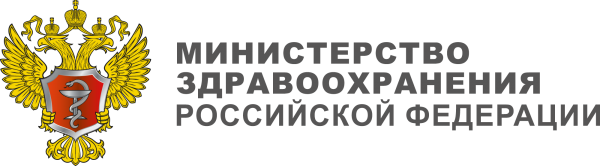
The modern emblem of the Ministry of Health of the Russian Federation is classified as a heraldic sign — emblem. It represents a carefully composed image of a golden double-headed eagle with raised, spread wings. The eagle is crowned with a golden crown with flowing ribbons. On the eagle's chest, placed on a red heraldic shield, is the image of a golden caduceus — a winged staff entwined with a serpent — the universal symbol of medicine and healing.
This composition follows the established tradition of Russian federal agency emblems, where the double-headed eagle — derived from the State Coat of Arms of the Russian Federation — serves as the foundational heraldic element, and the shield on the eagle's chest bears the specific emblem or symbol associated with the agency's function. For the Ministry of Health, the caduceus on a red shield signifies the ministry's authority over medical affairs and its role as the guardian of public health.
2.2. Symbolic Analysis of Key Elements
Click to expand: Complete Symbolic Breakdown
The Golden Double-Headed Eagle: The double-headed eagle is one of the most ancient and enduring heraldic symbols in Russian state tradition, traceable to the late 15th century when Grand Prince Ivan III adopted it from Byzantine imperial iconography following his marriage to Sophia Palaiologina. In the context of the Ministry of Health emblem, the eagle represents the federal authority of the ministry, its sovereign mandate to govern the nation's healthcare system, and its status as a body operating under the direct authority of the Government of the Russian Federation. The two heads facing east and west symbolize Russia's geographic span across two continents and the ministry's universal jurisdiction over healthcare matters throughout the federation.
The Crown with Flowing Ribbons: The crown surmounting the double-headed eagle signifies the sovereignty of the Russian state and the supreme authority under which the ministry operates. The flowing ribbons add visual dynamism to the composition and historically represent unity and the binding force of law. The golden color of the crown emphasizes the ministry's status as a federal-level executive body.
The Caduceus (Medical Staff with Serpent): The caduceus — a winged staff with a serpent coiled around it — is internationally recognized as a symbol of medicine, healing, and healthcare. Its origins trace to ancient Greek mythology, where it was the staff carried by Hermes (Mercury), but in medical contexts it has been used since the Renaissance to represent the medical profession. The serpent symbolizes renewal and healing (due to its ability to shed its skin), wisdom, and vigilance. The wings represent the swift delivery of medical aid. In the context of the Ministry of Health emblem, the caduceus unequivocally identifies the ministry's domain as healthcare and medicine.
The Red Shield: The red color of the heraldic shield on which the caduceus is placed is rich with meaning. Red traditionally symbolizes courage, vitality, life force, and sacrifice. In medical heraldry, red also references the red cross emblem used by medical services worldwide. The shield form itself represents protection, defense, and guardianship — the ministry's core mission of protecting the health of Russia's population.
The Golden Color Scheme: Gold (or) in heraldry represents generosity, elevation of the mind, and the highest values. The consistent use of gold for the eagle, crown, and caduceus creates a visual hierarchy that communicates dignity, authority, and the noble purpose of healthcare governance.
2.3. Comparison: Old vs. New Emblem
| Feature | Previous Emblem (Mixed period) | New Modern Emblem |
|---|---|---|
| Central element | Varied — sometimes caduceus alone, sometimes with Red Cross | Golden double-headed eagle with chest shield bearing caduceus |
| Color palette | Red and white dominant, gold accents | Predominantly gold on dark/transparent background |
| Heraldic style | Simpler graphic design, less structured | Strict heraldic composition following federal emblem standards |
| Crown | Optional or absent | Present — golden crown with flowing ribbons |
| Shield | Sometimes absent | Red heraldic shield on eagle's chest |
| Visual impact | Functional, less ornate | Authoritative, ceremonial, distinctly federal |
3. Vector Formats: Why They Matter for Official Emblems
3.1. EPS Format
EPS (Encapsulated PostScript) remains the gold standard for professional printing and prepress workflows. EPS files contain mathematically defined vector paths that can be scaled to any size — from a business card to a billboard — without any loss of quality. For the Ministry of Health emblem, the EPS file preserves every heraldic detail with absolute precision: the eagle's feathers, the serpent's scales on the caduceus, and the fine lines of the flowing crown ribbons. EPS files are natively supported by Adobe Illustrator, CorelDRAW, and most RIP (Raster Image Processor) systems used in commercial printing.
3.2. CDR Format (CorelDRAW)
CDR is the native format of CorelDRAW, widely used in Russia and the CIS countries for government document preparation, signage production, and institutional branding. The CDR file of the Ministry of Health emblem allows direct editing of vector elements in CorelDRAW — changing stroke weights, adjusting color profiles for specific printing conditions, or extracting individual elements for composite designs. Government printing houses and design bureaus across Russia routinely work with CDR files for official documentation.
3.3. PDF Format
PDF (Portable Document Format) provides a universal container that preserves both vector and raster content. The PDF version of the emblem can be opened on virtually any device without specialized software, making it ideal for document embedding, email distribution, and digital archiving. PDF files retain the vector quality of the emblem and can be placed directly into Microsoft Word, PowerPoint presentations, or desktop publishing applications.
4. Download the Ministry of Health Emblem
Below are the direct download links for the modern emblem of the Ministry of Health of the Russian Federation. All files are provided free of charge for educational, informational, and professional use.
4.1. Vector Files (Download Archive)
Vector archive contents: The ZIP archive contains the emblem in three professional vector formats:
- EPS — Encapsulated PostScript for Adobe Illustrator and prepress
- CDR — CorelDRAW format for government documentation workflows
- PDF — Portable Document Format for universal compatibility
4.2. PNG Raster Files
High-resolution PNG files with transparent background at three standard resolutions:
- 2000 px — Maximum resolution for professional printing and large-format displays
- 600 px — Standard resolution for document headers, presentations, and web use
- 300 px — Compact resolution for icons, thumbnails, and inline document placement
5. Practical Applications of the Ministry of Health Emblem
5.1. Official Documentation
The vector emblem is essential for producing official government documents: letterheads, orders, decrees, certificates, and regulatory publications issued by the Ministry of Health and its subordinate institutions. The EPS and CDR formats ensure sharp reproduction at any size on any printing equipment.
5.2. Institutional Branding
Hospitals, polyclinics, research institutes, and medical universities operating under the jurisdiction of the Ministry of Health use the emblem for signage, building facades, uniforms, badges, and official seals. The vector files allow sign makers to scale the emblem to meters-wide dimensions without pixelation.
5.3. Educational and Research Materials
Medical schools, nursing colleges, and public health programs use the Ministry of Health emblem in textbooks, conference posters, diploma templates, and accreditation documents. The transparent PNG versions integrate seamlessly into PowerPoint presentations and e-learning platforms.
6. Frequently Asked Questions
What is the official emblem of the Ministry of Health of Russia?
The official emblem of the Ministry of Health of the Russian Federation is a heraldic sign — emblem that represents a golden double-headed eagle with raised, spread wings, crowned with a golden crown with flowing ribbons. On the eagle's chest, placed on a red heraldic shield, is a golden caduceus — a winged staff entwined with a serpent. This composition follows the established tradition of Russian federal agency heraldry and was introduced after the ministry's re-establishment as an independent agency in 2012.
When was the current Ministry of Health established?
The current Ministry of Health of the Russian Federation was established on May 21, 2012, by Presidential Decree No. 636, which split the Ministry of Health and Social Development into two separate ministries — the Ministry of Health and the Ministry of Labor and Social Protection. The modern emblem was introduced as part of this reorganization to give the newly independent ministry its own distinct visual identity.
What do the symbols on the Ministry of Health emblem mean?
The golden double-headed eagle represents federal authority and the ministry's sovereign mandate under the Russian state. The crown signifies supreme state authority. The caduceus — a winged staff with a serpent — is the universal symbol of medicine, healing, and the medical profession. The red shield represents protection, vitality, and the ministry's role as guardian of public health.
What is the difference between the old and new Ministry of Health emblems?
The previous emblem used during the Ministry of Health and Social Development period (2004–2012) incorporated broader social welfare symbolism reflecting the merged ministry's dual mandate. The new emblem, introduced after 2012, features a cleaner heraldic composition focused exclusively on healthcare symbolism — the golden double-headed eagle with the caduceus on a red shield, in line with standard Russian federal agency heraldic conventions.
What vector formats are available for download?
The Ministry of Health emblem is available in three professional vector formats: EPS (Encapsulated PostScript — ideal for Adobe Illustrator and prepress workflows), CDR (CorelDRAW — widely used in Russian government and CIS printing environments), and PDF (Portable Document Format — universal compatibility for document embedding and digital distribution). All three are bundled in a single ZIP archive.
What PNG resolutions are provided?
PNG raster files are available at three resolutions: 2000 px (ultra-high resolution for large-format printing and exhibition displays), 600 px (standard resolution suitable for letterheads and presentation slides), and 300 px (compact size for web thumbnails and inline document use). All PNG files feature a transparent background for seamless placement on colored surfaces.
Can the emblem be used for commercial purposes?
The emblem of the Ministry of Health is an official state symbol of a federal executive body of the Russian Federation. Its use is regulated by Russian federal legislation and departmental orders. Generally, the emblem may be used for informational, educational, and scholarly purposes, as well as in official documents of organizations operating within the ministry's jurisdiction. Commercial use requires verification against current regulations and may need authorization from the Ministry of Health's press service.
Why is the caduceus associated with medicine?
The caduceus — a winged staff with a serpent coiled around it — has been associated with healing and medicine since the Renaissance, although its origins are more complex. In Greek mythology, the caduceus was the staff of Hermes, while the Rod of Asclepius (a single serpent around a plain staff) was the symbol of the god of medicine. Over centuries, both symbols became conflated in medical iconography, and the caduceus is now universally recognized as a medical symbol across Russia, the United States, and many other countries, despite the historical distinction.
How was the Ministry of Health's predecessor organized in the Soviet Union?
The Soviet healthcare system was organized under the People's Commissariat of Health (Narkomzdrav), established on July 11, 1918, and led by Nikolai Semashko. The Narkomzdrav was reorganized into the Ministry of Health of the USSR in 1946. Simultaneously, the Ministry of Health of the RSFSR operated at the republican level. This dual structure — a Union-level ministry overseeing national strategy and a republican ministry managing healthcare delivery within the Russian republic — was the foundation of the Soviet healthcare system that achieved near-universal coverage.
What is the Semashko healthcare model?
The Semashko model, named after its architect Nikolai Semashko, was the world's first system of centralized state-run universal healthcare. Its key principles included: free and universally accessible medical care, preventive medicine as the primary focus, a unified hierarchy of health facilities (from rural feldsher points to specialized research institutes), centralized planning and budgeting, and a special emphasis on maternal and child health. The Semashko system was praised by the World Health Organization and influenced the development of national health systems in the United Kingdom (NHS) and other countries.
Tap to react