Vector Emblem of the Ministry of Health of Russia — Old Version — History, Context, and Free Download in CMX, EPS, CDR, PNG

The old emblem of the Russian Ministry of Health — representing the period when the ministry was combined with social development functions as Minzdravsotsrazvitiya (2004–2012) — is a valuable artifact of Russian administrative history. This emblem documents a specific organizational phase in the governance of Russian healthcare and social welfare, capturing the visual identity of a ministry that no longer exists in its combined form. This article provides the complete historical context behind this version of the emblem, an analysis of its design and symbolism, and direct download access to CMX, EPS, and CDR vector files, plus PNG raster files at 2000 px, 600 px, and 300 px resolutions. The emblem is preserved here for historians, researchers, archivists, collectors, and anyone interested in the evolution of Russian state symbolism.

If you are working on a historical publication about Russian healthcare administration, digitizing archival documents from the 2004–2012 period, preparing a museum exhibition on the history of medicine in Russia, or building a comprehensive reference collection of government emblems — this article provides the authentic vector files and contextual information you need for accurate historical representation and scholarly work.


1. Historical Context: Minzdravsotsrazvitiya (2004–2012)

1.1. The Creation of the Combined Ministry

In 2004, as part of a major administrative reform of the Russian federal government, the Ministry of Health and Social Development of the Russian Federation (Minzdravsotsrazvitiya) was established through the merger of the Ministry of Health and the Ministry of Labor and Social Development. This consolidation brought together two of the largest and most socially significant areas of government responsibility under a single administrative structure. The rationale behind the merger was to create synergies between healthcare delivery and social welfare programs, recognizing that health outcomes are deeply intertwined with social determinants such as employment, income support, and disability benefits. The combined ministry was tasked with developing and implementing state policy across the full spectrum of health protection, medical care, pharmaceutical regulation, labor relations, employment policy, pension provision, social insurance, and demographic development.

1.2. The Split of 2012

Eight years later, in May 2012, following the formation of a new government, the combined ministry was formally dissolved and its extensive functions were split between two newly created entities: the Ministry of Health of the Russian Federation, headed by Veronika Skvortsova, and the Ministry of Labor and Social Protection of the Russian Federation, headed by Maxim Topilin. This administrative restructuring reflected the growing recognition that the enormous scope of responsibilities within the combined ministry had become too broad for effective centralized management, and that the specialized nature of healthcare policy and social welfare policy each warranted dedicated, focused institutional leadership with its own administrative hierarchy. The split officially marked the end of the Minzdravsotsrazvitiya era and opened a fundamentally new chapter in Russian public administration. Each of the two successor ministries adopted its own updated emblem, making the Minzdravsotsrazvitiya emblem a document of a distinct and now-concluded historical period that continues to be of significant interest to researchers and historians.

1.3. The Emblem as Historical Evidence

The emblem of Minzdravsotsrazvitiya serves as more than just a design artifact from a bygone era — it is primary historical evidence of how the Russian state organized its approach to public health and social welfare during a specific, clearly defined eight-year period. Researchers studying the evolution of Russian governance and administrative law can trace the administrative philosophy of the 2004–2012 period through the very existence, operation, and eventual dissolution of the combined ministry. The emblem itself, with its thoughtful integration of medical and social symbolism within a single heraldic composition, visually and eloquently documents the merger of two previously independent institutional identities into one administrative whole. For scholars of state symbolism, this emblem is a particularly valuable specimen, as it reflects not merely a design change but a fundamental administrative reform that found its visual expression in the official insignia of a major government ministry.

PeriodMinistry StructureEmblemContext
Pre-2004Separate Health and Labor ministriesTwo distinct emblemsIndependent governance
2004–2012Minzdravsotsrazvitiya (combined)Old version (this article)Merged administration
2012–presentSeparate Health and Labor ministriesUpdated emblemsReturn to specialization

2. Design Analysis of the Old Emblem

2.1. Visual Characteristics

The old Minzdravsotsrazvitiya emblem follows the established conventions of Russian federal heraldry while incorporating specific symbolic elements that communicate the ministry’s combined healthcare and social welfare mandate. Like other Russian federal emblems, it employs a formal, authoritative visual language designed to convey institutional legitimacy and governmental authority.

2.2. Key Symbolic Elements

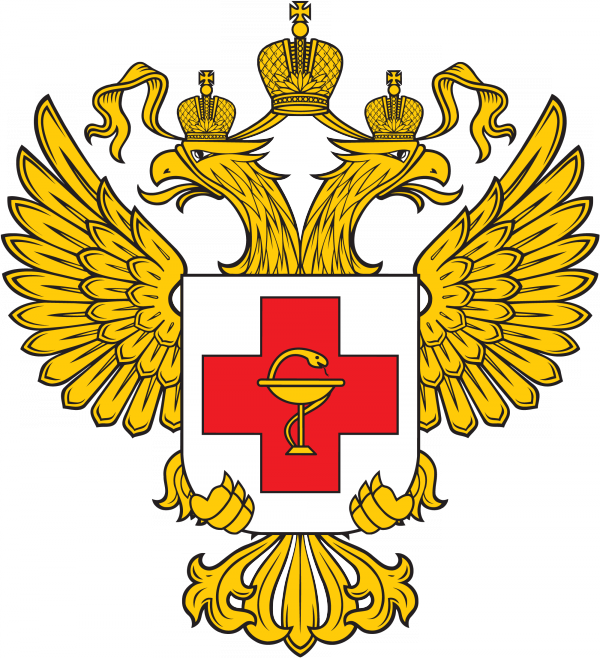
  • Medical symbolism: Traditional healthcare iconography — commonly represented by a bowl with a serpent or the Rod of Asclepius — anchors the emblem in the ministry’s core medical mission. These symbols connect the modern Russian ministry to the millennia-old visual tradition of representing the healing arts.
  • State authority indicators: The double-headed eagle or other elements of the Russian state coat of arms establish the emblem’s status as belonging to an organ of federal executive authority, conferring the legitimacy of official government action.
  • Heraldic shield form: The shield serves as the traditional container for official Russian emblems, providing a formal frame that situates the design within the established visual vocabulary of Russian institutional heraldry.
  • Color palette: Consistent with Russian heraldic norms, the colors carry institutional meaning: red for the life-affirming mission of medicine, gold for authority and excellence, and blue for loyalty and truth.

2.3. Comparison: Old vs. New Emblem

FeatureOld Emblem (this article)Current Ministry of Health Emblem
Period2004–20122012–present
Ministry scopeHealth + Social DevelopmentHealth only
Symbolic emphasisBroader welfare mandateFocused healthcare mission
StatusHistorical, supersededCurrent, active

The old Minzdravsotsrazvitiya emblem is a perfect example of how government heraldry evolves in response to administrative restructuring. It captures a specific moment in the organizational history of Russian public health governance and serves as an invaluable reference for anyone studying the visual identity of the Russian state.


3. Vector Formats for Historical Emblems

3.1. Format Specifications

FormatTypeBest ForSoftware
CMXVectorProfessional editing, signageCorelDRAW X3+
EPSVectorPrinting, cross-platform exchangeAdobe Illustrator, CorelDRAW, Inkscape
CDRVectorDesign, production workflowsCorelDRAW Suite
PNG 2000 pxRasterHigh-quality printingAny image viewer/editor
PNG 600 pxRasterWebsite headers, presentationsAny image viewer/editor
PNG 300 pxRasterStandard web contentAny image viewer/editor

This emblem represents a ministry structure that no longer exists. It should not be used to imply current official affiliation with the Ministry of Health of the Russian Federation. The files are provided for historical, educational, and research purposes.


4. Download the Old Ministry of Health Emblem

Download

Archive: CMX (CorelDRAW), EPS (universal printing), CDR (CorelDRAW Suite).

PNG: 2000 px (high-resolution print output), 600 px (web headers and digital presentations), 300 px (standard web content).

All files in a single ZIP. Free, instant access for historical, educational, and research use.


5. Frequently Asked Questions

What is the old version of the Russian Ministry of Health emblem?

The old version refers to the emblem of the Ministry of Health and Social Development of the Russian Federation, commonly abbreviated as Minzdravsotsrazvitiya. This ministry existed from 2004 to 2012 as a combined entity that managed both healthcare policy and social welfare programs, including labor relations, pension provisions, and social insurance. The emblem from this period differs from both the current Ministry of Health emblem and the Soviet-era predecessor, representing a distinct phase in the organizational evolution of Russian public health governance. After the ministry was split into two separate entities in 2012, each adopted its own updated emblem, making this version a valuable historical document of a transitional period in Russian administrative history.

How does the old emblem differ from the current Ministry of Health emblem?

The primary difference lies in the scope of authority each emblem represented. The old emblem of Minzdravsotsrazvitiya symbolized a combined ministry that encompassed both healthcare and social development functions under a single administrative umbrella. The current Ministry of Health emblem reflects a more focused mandate limited strictly to healthcare policy, medical regulation, and public health oversight. Visually, while both emblems share the traditional symbols of medicine within the framework of Russian federal heraldry, the newer version was refined and updated to reflect the ministry’s streamlined mission following the 2012 administrative reform that transferred social welfare and labor functions to the newly created Ministry of Labor and Social Protection.

What vector formats are available for the old Ministry of Health emblem?

The download package includes three professional vector formats: CMX (native CorelDRAW format with full layer editability), EPS (Encapsulated PostScript, the universal standard for printing and cross-platform exchange), and CDR (CorelDRAW format, widely used in professional design and sign-making industries). All three formats are bundled in a single ZIP archive for convenient access, providing maximum flexibility regardless of your preferred design software environment.

What PNG resolutions are provided?

Three PNG resolution variants are included: 2000 pixels for high-quality offset and digital printing applications, 600 pixels for website headers and presentation materials, and 300 pixels for standard web content, email correspondence, and social media use. Each resolution is purpose-optimized for its intended application scenario.

Can the old Ministry of Health emblem still be used for official purposes?

No. This version of the emblem corresponds to a ministry structure that no longer exists. The current Ministry of Health of the Russian Federation uses an updated emblem adopted after the 2012 administrative reorganization. The old emblem should not be used to represent the current ministry or to imply any current official affiliation. Its value today is primarily historical, educational, and archival. Researchers, historians, and collectors studying the evolution of Russian federal heraldry will find this version particularly valuable as a document of a specific historical period in Russian public administration.

Is the vector emblem suitable for high-quality printing?

Yes, absolutely. The CMX, EPS, and CDR vector formats are specifically engineered for professional printing workflows. The mathematically defined vector paths maintain perfect sharpness at any scale, from a small illustration in a historical journal to a large-format display in a museum exhibition. The files have been verified for print readiness and color accuracy against original source materials.

When exactly did Minzdravsotsrazvitiya cease to exist?

In May 2012, as part of a broader restructuring of the Russian federal government following the presidential inauguration, the Ministry of Health and Social Development was formally divided into two separate ministries: the Ministry of Health of the Russian Federation and the Ministry of Labor and Social Protection of the Russian Federation. This administrative reform ended the eight-year existence of the combined ministry and marked the beginning of a new organizational era for both healthcare and social welfare governance in Russia. The emblem we provide here dates from that 2004–2012 period.

Why would anyone need the old version of the emblem?

There are several compelling reasons for interest in historical government emblems. Historians of public administration use them to trace the evolution of state institutions and their visual identities. Archivists and librarians rely on them for accurate cataloging of historical documents bearing older institutional markings. Museum professionals incorporate them into exhibitions about the history of medicine and public health. Academic researchers reference them in publications about the semiotics of state power and institutional branding. Additionally, collectors of heraldic and vexillological materials value defunct or superseded official emblems as important artifacts that document institutional change over time.

What software is required to open and edit the CMX file?

The CMX format is native to CorelDRAW and is fully compatible with CorelDRAW X3 and all subsequent versions of the CorelDRAW Graphics Suite. If you do not have access to CorelDRAW, the archive also includes the emblem in EPS format (which opens in Adobe Illustrator, Inkscape, and Affinity Designer) and CDR format as an additional CorelDRAW-compatible option.

Where is it appropriate to use the old Ministry of Health emblem?

Appropriate contexts for using the old emblem include historical research publications documenting the evolution of Russian healthcare governance, archival digitization projects that preserve and catalog documents from the 2004–2012 period, museum exhibitions on the history of Russian medicine and public health administration, educational materials in university courses on public administration or Russian history, and private collections of heraldic materials. In all these contexts, it is important to clearly identify the emblem as representing the historical Ministry of Health and Social Development (2004–2012) rather than the current Ministry of Health.

Tap to react