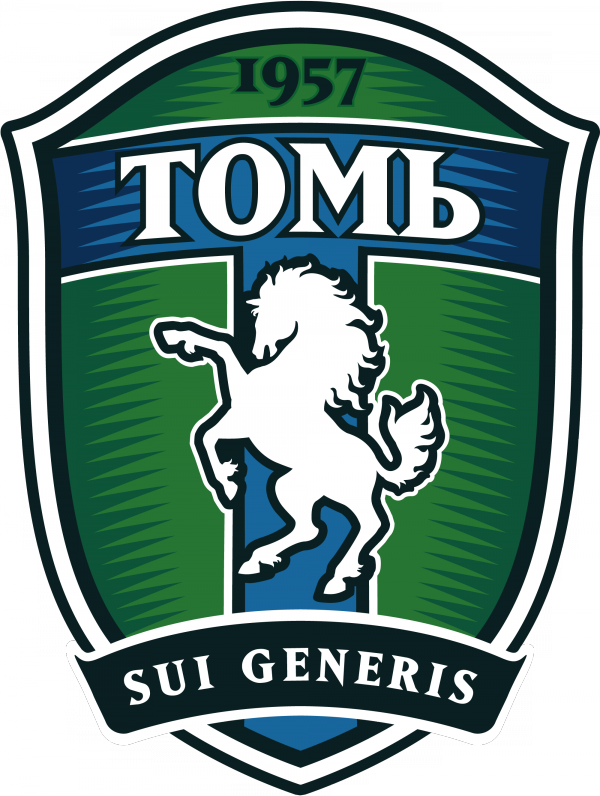
FC Tom Tomsk is the football club named after a river — and that tells you something about its identity before you even see the crest. Founded in 1957 in one of Siberia's oldest cities, Tomsk is a university town, a centre of scientific research, and a place where the Tom River defines the landscape as fundamentally as the Neva defines St. Petersburg or the Moskva defines Moscow. To name a football club after the river that runs through your city is to make a statement: we are of this place, rooted in its geography, inseparable from its natural identity. Today we share the vector emblem of FC Tom Tomsk in SVG, CMX, and EPS formats, plus PNG renders at 2000, 600, and 300 pixels for any project that needs this distinctive Siberian crest.

Tomsk occupies a special place in Russian culture. Founded in 1604, it is one of the oldest cities in Siberia and was for centuries the intellectual capital of the region — home to Siberia's first university (Imperial Tomsk University, founded 1878) and a concentration of academic institutions that earned it the nickname "Siberian Athens." A football club emerging from this environment carries a different cultural weight than one born from an industrial plant. Tom was never a factory team — it was a city club from the start, representing a community defined by education, science, and a distinctive regional pride that predates the Soviet Union by centuries.

The club entered the Russian Premier League in the 2005 season and spent most of the next decade oscillating between the top flight and the First Division. Its home ground, Trud Stadium, sits in the heart of Tomsk and has witnessed everything the club has achieved: hard-fought Premier League survivals, dramatic relegation battles, and the steady, unglamorous work of a provincial club punching above its weight in a financial system stacked against it.

The archive includes three vector formats: SVG (web-native, resolution-independent), CMX (native CorelDRAW), and EPS (universal vector exchange). All three are packed into a single ZIP. PNG renders at 2000px, 600px, and 300px provide immediate raster output for any use case.

Tomsk: Why the City Shapes the Club

You cannot understand FC Tom without understanding Tomsk. The city has 400 years of history, a population of over half a million, and an economy built on education, oil, gas, and timber. It sits on the right bank of the Tom River, roughly 3,500 kilometres east of Moscow — a four-hour flight or a four-day train journey. This distance is not incidental. For a football club based here, every away match is an expedition, and every home match is an event that visiting teams genuinely dread, especially during the late autumn and early spring fixtures when Siberian weather is at its most punishing.

Tomsk's wooden architecture — the famous "wooden lace" of carved window frames and decorative cornices that UNESCO has considered for World Heritage status — speaks to a culture that values craftsmanship and distinctiveness over mass production. This sensibility extends to the football club. Tom's crest is not a generic sports logo; it has character. It reflects a city that preserved its historical identity through centuries of political change, and the club's choice to name itself after the Tom River rather than an industrial sponsor or a Soviet-era institution is itself a declaration of independence from those traditions.

The rivalry between Tomsk and Novosibirsk — the Siberian derby between Tom and Sibir — deserves mention. Novosibirsk is larger, more industrial, and closer to the centre of political power. Tomsk is older, more academic, more self-consciously cultured. When the two clubs meet, the match carries the weight of this civic competition. The crests of the two teams tell the story: Sibir's emblem claims territory by name; Tom's emblem claims identity through geography. Both are assertions of Siberian presence in Russian football, but the way they make that assertion is fundamentally different.

Comparison FC Tom Tomsk FC Sibir Novosibirsk
Founded 1957 1936 (as factory team)
Name origin Tom River — geographical name Siberia — regional territorial claim
City character Academic, historic, wooden architecture Industrial, administrative, modern
Top division debut 2005 2010
Highest achievement 8th place Premier League (2006, 2010) Russian Cup finalist 2010

The Crest: Design Analysis

The FC Tom emblem is built around heraldic principles adapted for modern football branding. At its centre is the club's name — "TOM" — rendered prominently, with the year of foundation (1957) incorporated into the design. The colour scheme uses green and white as its base, colours strongly associated with Siberia's forests and the region's natural landscape. This is not accidental colour selection: green represents the vast taiga that surrounds Tomsk, while white evokes the snow that covers the region for half the year. Together they create a palette that is unmistakably Siberian without needing to spell out the word.

The shield shape is a football standard — most club crests use some form of heraldic shield as their base — but Tom's execution is notably clean. The crest is designed to function at multiple scales. On a kit badge, it needs to be legible at 60 mm wide. On a stadium banner, it needs to hold its structure at 6 metres. On a digital screen, it needs to survive compression and small display sizes. Tom's crest passes all three tests. The typography is bold, the colour contrast is strong, and the geometric relationships between elements are stable enough that accidental cropping or scaling does not destroy the design's integrity.

For designers working with the Tom crest, the practical advantages are significant. The limited colour palette — essentially two colours plus white — means the emblem reproduces economically in any printing process. Screen printing on scarves and t-shirts requires no colour trapping or special inks. Two-colour offset printing keeps costs down for match programmes and tickets. Digital display requires no gradient management or transparency handling. This is a crest designed by people who understood the production realities of a provincial football club's merchandising and publications budget.

The CMX version requires CorelDRAW X5 or later. If you use any other vector editing software, open either the EPS file (universal vector exchange) or the SVG file (web-native XML vector). Both have been tested on Adobe Illustrator CS6-CC2024, Inkscape 1.3+, and Affinity Designer 2. Text elements are converted to outline paths in all formats for universal rendering. The SVG is particularly useful for web developers — embed it inline in HTML for native-resolution display on any screen.

The Premier League Years: Survival Against the Odds

FC Tom's entry into the Russian Premier League in 2005 was a milestone for the club and for Siberian football generally. For the first time, the Premier League had a club from a city known more for universities than for football — and Tom did not embarrass itself. The 2006 season produced an 8th-place finish, the club's best-ever league result. The 2010 season matched that achievement with another 8th place. Between 2005 and 2012, Tom spent seven of eight seasons in the top flight — a record of stability that is underappreciated when you consider the financial and logistical challenges of running a Premier League club from Tomsk.

The economics require explanation. Premier League clubs generate revenue from three main sources: broadcasting rights, matchday income, and commercial partnerships. For Siberian clubs, all three are compromised. Broadcasting revenue is lower because the time zone difference means fewer live audience viewers. Matchday income is lower because Tomsk is not a wealthy city by Russian standards and Trud Stadium's capacity is modest by Premier League standards. Commercial partnerships are harder to secure because national sponsors prefer the visibility of Moscow and St. Petersburg markets. FC Tom has survived in this environment not through financial power but through astute management, youth development, and — yes — the Siberian home advantage that makes Trud Stadium one of the most difficult away trips in Russian football.

The club's youth academy deserves particular recognition. In a financial environment where buying ready-made talent is barely affordable, developing your own players becomes a competitive necessity, not a luxury. Tom's academy has produced players who went on to represent the club in the Premier League and, in some cases, to move to larger clubs. This pipeline is essential for the club's long-term viability, and the investment in it reflects an institutional understanding that Tomsk's football future depends on homegrown talent more than any other club in the league.

Season League Position Notable
2005 10th (Premier League) Debut top-flight season
2006 8th (Premier League) Best-ever league finish (tied)
2010 8th (Premier League) Best-ever league finish (tied)
2012 15th (Premier League) Relegated after 7 seasons in top flight

The Tom River itself deserves more than a passing mention in the context of the club's identity. The river flows for over 800 kilometres from the Kuznetsk Alatau mountains through the Kuzbass basin, past Tomsk, and into the Ob River. It is the source of the city's name and its primary geographic landmark. To name a football club after a river is to root that club in the landscape itself — to say that this institution is as permanent as the water that flows past the city. In an era where football clubs routinely rebrand for commercial reasons, change their names for sponsorship deals, and relocate for financial advantage, the steadfastness of a club named after a river carries a certain quiet dignity. Tom cannot be relocated. Tom cannot be rebranded without losing its identity. The name is a geographical anchor that keeps the club tied to its community no matter how the football business evolves around it.

The vector files in this archive have been manually traced to match the official club crest. Every colour value has been verified against current club publications. The SVG format preserves all paths as clean XML that can be examined, modified, or integrated directly into web projects. For print workflows, the EPS provides pre-separated colour channels. For CorelDRAW users, the CMX maintains layer structure and editability.

Practical Workflows for Designers

Matchday programme layout: Import the EPS into InDesign or QuarkXPress. The vector scales to any column width without quality loss. Set the resolution in your export panel to meet your printer's specifications — the source file has no resolution limit, so you are not upscaling anything.

Fan merchandise: Send the EPS directly to your screen printer or embroiderer. The two-colour design is ideal for screen printing on textiles — no halftones required, no colour trapping needed. For embroidery, the vector paths provide the punch file with clean outlines that digitise accurately into stitch patterns.

Website and app: Use the SVG file. Embed it inline in your HTML for resolution-independent display that looks sharp on 1x, 2x, and 3x screens without serving multiple image sizes. The SVG is small — typically under 30 KB — and compresses well with gzip.

Social media graphics: Open the SVG or EPS in your preferred design tool, scale to the target pixel dimensions (1080x1080 for Instagram, 1200x630 for Twitter/Facebook link previews), add your layout elements, and export as PNG. The crest will be perfectly sharp because it is converted from vector to raster at exactly the right pixel count during export.

Frequently Asked Questions About the FC Tom Emblem

What formats are included in the FC Tom emblem archive?

The archive contains SVG (web-native vector), CMX (CorelDRAW vector), EPS (universal vector), and PNG at 2000px, 600px, and 300px. Vectors require CorelDRAW, Illustrator, or Inkscape. PNG opens in any image viewer without additional software.

Why is the club named after a river?

FC Tom is named after the Tom River, which flows through the city of Tomsk and is the city's primary geographic landmark. Naming the club after the river is a deliberate statement of local identity and geographical rootedness that distinguishes it from clubs named after sponsors or Soviet institutions.

When was FC Tom Tomsk founded?

FC Tom Tomsk was founded in 1957. The club spent its early decades in the Soviet lower divisions before entering the Russian Premier League for the first time in the 2005 season.

Can I use this emblem commercially?

The emblem is protected by trademark and copyright. Material provided for editorial, educational, research, and personal non-commercial use. For any commercial application, contact FC Tom directly for licensing terms.

What was FC Tom's best Premier League finish?

FC Tom finished 8th in the Russian Premier League twice: in the 2006 season and again in the 2010 season. This remains the club's highest-ever league position in the Russian football pyramid.

What is Trud Stadium like?

Trud Stadium is FC Tom's home ground, located in central Tomsk. Like other Siberian venues, its late-autumn and early-spring conditions are challenging for visiting teams. The stadium has been the club's home since its founding and is integral to the club's identity.

What does the green colour in the emblem represent?

The green in the FC Tom crest represents the Siberian taiga — the vast boreal forest that surrounds Tomsk and covers much of the region. Combined with white (representing snow), the colour scheme directly references the natural landscape of Siberia.

Is the SVG suitable for web use?

Yes. The SVG format is ideal for web integration. It is resolution-independent, small in file size (typically under 30 KB), compressible with gzip, and renders natively in all modern browsers. Embed it inline in HTML for the best results.

Download, use, share — and may the Tom River continue to flow past a club that honours its name.

Download Vector Emblem — SVG, CMX, EPS (ZIP)~2 MB

Files provided for educational, editorial, and personal use. For designers, researchers, or anyone who needs a clean vector version of the FC Tom Tomsk crest, this is the most complete freely available source. Contact us if you represent the club and wish to discuss usage terms.

Tap to react