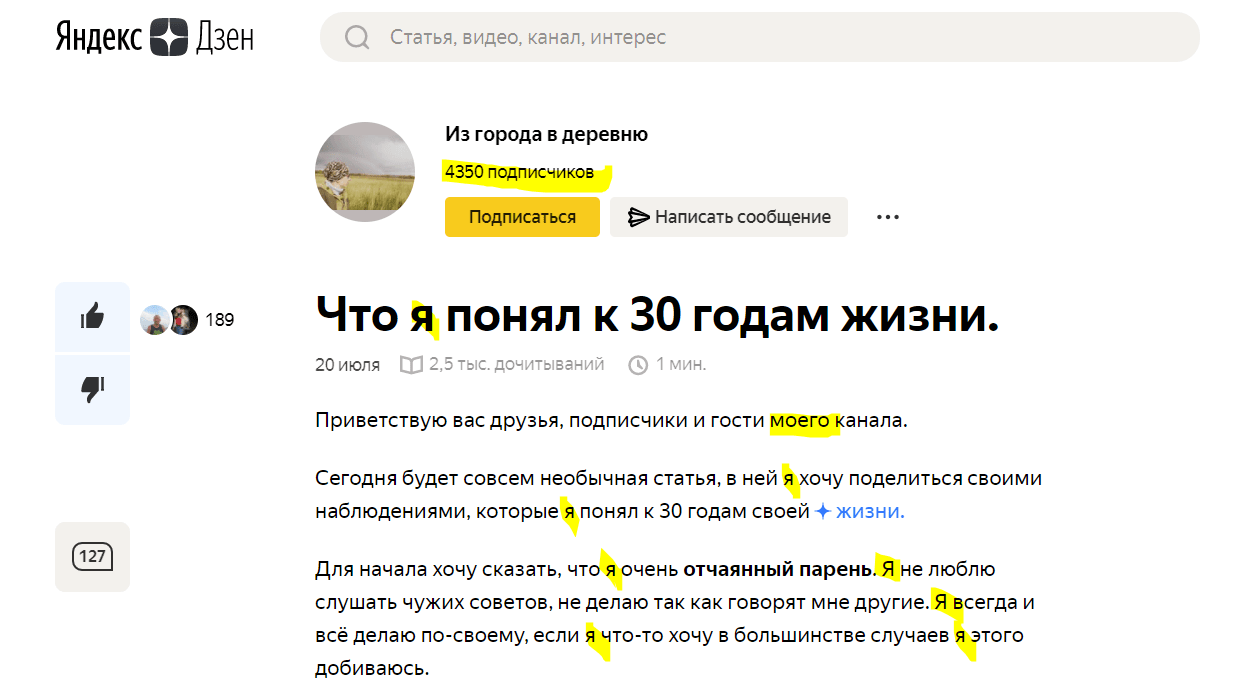
In case you haven't noticed yet, here's the news: Yandex is doing everything in its power—fair and foul—to make sure Runet users stick exclusively to their proprietary (ripped off from Google) services. One such gem is Yandex Zen, whose entire purpose boils down to making you read useless (in my humble opinion) content inside the Yandex walled garden. Let's set aside the intellectual value of these posts for a moment—they carry virtually zero logic or guidance—and focus on what the average user actually gets out of this. My previous post on the Zen cesspool covers the basics.

Here's a real scenario. You decide to visit a website you've been using for years, but instead of typing the URL directly, you search for it on Yandex. What happens? No redirect to the actual site. Instead, you get the hideous design of Turbo Pages (Yandex's knockoff of Google AMP), where you're forced to scroll through posts. I can't speak for everyone's comfort, but personally, I find it maddening to scroll through a stripped-down version of a page when I'd rather use the site's own search function—except, surprise, you may not even have that option. Meanwhile, Yandex Webmaster frames the absence of Turbo Pages as an "error." An error! As if you've broken something. We know what that rhetoric is worth.
Let's move on. The Yandex Zen service itself has been dissected by everyone and their grandmother, yet millions still use it daily. Here's why. First: habit. We're conditioned to open the Yandex homepage and type whatever comes to mind into the search bar. Right below, that same Zen feed appears, occasionally surfacing posts that are borderline readable—but mostly it's a landfill of low-grade content churned out by schoolkids and students for pennies. I've covered why this happens before, but for those who missed it: Yandex pays peanuts for content, so people who actually know their stuff won't waste time writing quality material. Schoolkids will. And that's exactly what you're consuming every single day.
\u{201c}Zen isn't a platform for smart ideas. It's a conveyor belt producing informational garbage with a singular goal: keeping you locked inside the Yandex ecosystem.
The Degradation Mechanism: How Zen Makes You Dumber
Let's dissect how this mechanism actually works. This isn't conspiracy theory—it's pure attention engineering built on behavioral psychology. I used to read Zen actively about a decade ago, and I can tell you firsthand: my critical thinking took a noticeable dip during that period. Not because I suddenly got dumber, but because the system trains a specific type of information consumption.
1. Turbo Pages: Stolen Content Disguised as Care
Let's start with the most brazen element: Turbo Pages. Yandex swiped the idea from Google AMP, wrapped it in a pretty "faster loading" ribbon, and now shoves it down your throat via Webmaster. The scheme is dead simple: you write content, invest time and money, and Yandex displays it on their domain, in their design, without your ads, without sending users to your actual site. Yandex calls this TurboTechnology for faster page loading—I call it traffic theft.
The user sees your content, reads it, maybe even likes it—but they never visit your site. Their browser stays trapped inside the Yandex ecosystem. The next post the feed suggests? Another Turbo Page. And the next. And the next. The mental decline isn't from the content itself—it's from the lack of source diversity. The brain stops comparing, analyzing, fact-checking—because the system never demands it.
2. The Recommendation Feed: An Infinite Conveyor Belt of Sludge
Have you noticed that the Zen feed works completely differently from, say, Telegram or Twitter? On normal platforms, you choose who to follow. On Zen, the algorithm decides for you. And this algorithm isn't optimized for quality—it's optimized for retention time. The longer you scroll, the more ads you see. The more ads, the more money Yandex makes. The logic is primitive, but it works flawlessly.
What the algorithm prioritizes:
- Clickbait headlines along the lines of "You Won't Believe What Happened Next"
- Pseudoscientific health articles with zero citations
- Life stories generated by neural networks in under three minutes
- Politically charged content with heavy emotional coloring
- Material that triggers anger, fear, or outrage—because negative emotions drive retention better than positive ones
In practice, the average user spends 20 to 40 minutes a day on Zen, consuming content that offers neither educational nor practical value. This isn't speculation—open your feed right now and count how many of the first ten posts you'd genuinely call useful. One? Two? Zero?
3. Ecosystem Lock-In: A Velvet-Walled Cage
Yandex has spent decades building its ecosystem, and credit where it's due—they built it. The problem is, this ecosystem functions as a cage: the more services you use, the harder it becomes to leave. Yandex Mail? Yandex Go for taxis? Yandex Music? Yandex Maps? Alisa at home? Congratulations—you're in the matrix.
Zen plays the role of informational glue in this scheme. It binds all services into a unified feed: you search for a recipe—get a Zen post. Open your email—see a recommendation. Ask Alisa about the weather—she suggests reading some news. There's no exit. Or rather, the exit exists: just stop using it all. But for many, that's the digital equivalent of amputation.
Let's compare for clarity:
| Parameter | Yandex Zen | Independent Website | Telegram Channels |
|---|---|---|---|
| Who chooses content | Yandex algorithm | Site editorial team | You (via subscriptions) |
| Author's control over presentation | None (Turbo Pages strip it) | Full control | Partial (messenger format) |
| Author's revenue | Pennies per view | Ads, affiliate programs | Direct sales, donations |
| Content quality | Low (race for views) | Depends on editorial standards | Depends on the author |
| Ability to leave the platform | Content stays with Yandex | Your domain, your rules | Subscriber export is limited |
| Platform monetization model | Ads slapped onto other people's content | Doesn't monetize others' work | Ads within channels |
See the difference? On Zen, you're not an author—you're an unpaid supplier of raw material for Yandex's advertising machine. Your content is fuel. And the saddest part: most authors are fine with this. They get paid pocket change per thousand reads and keep churning it out.
4. Alisa and the Atrophy of Interaction
Alisa, Yandex's voice assistant, deserves special mention. In theory, she's supposed to simplify life. In practice, the opposite happens: Alisa trains people to stop formulating queries, stop searching for information, and stop thinking altogether. You say "Alisa, what's two plus two" and she answers. You don't do mental math. You don't open a calculator. You don't even Google it. Your brain relaxes.
\u{201c}Google is making us stupid. More precisely, it's reshaping the structure of our thinking, training us toward superficial skimming rather than deep engagement with information.
Yandex has gone further than Google. It doesn't just provide search—it closes the entire information consumption loop. You search via Yandex → read on Zen → save in Yandex Notes → discuss with Alisa. At which step did you engage your brain? Exactly—none of them.
5. The Filter Bubble: You Only See What Confirms Your Worldview
One of the most insidious properties of recommendation algorithms is the creation of the so-called filter bubble. The term isn't new, but it manifests especially starkly in Zen. The algorithm analyzes what you read, how long you stay on a page, what you click—and serves up content maximally similar to what you've already consumed. Sounds convenient? Sure. In reality—a catastrophe for critical thinking.
You clicked on an anti-vaccination article—here are ten more. Read about flat Earth theory—the feed will find "proof." Liked a political propaganda post—welcome to an information bubble where everyone thinks exactly like you. No alternative viewpoints, no debate, no growth. You're stewing in your own juices, and with each passing day, the stew gets thicker.
How Yandex Webmaster Corners Site Owners
Now let's talk about how Yandex treats content creators themselves. You have a website. You want it to appear in Yandex search. Makes sense, right? You register with Yandex Webmaster—and the fun begins.
The Webmaster interface is designed to make you feel like a failing student who's constantly doing something wrong. Here's the list of "errors" and "recommendations" you'll encounter:
| What Webmaster shows | What it actually means | What you lose |
|---|---|---|
| Error: No Turbo Pages | Yandex wants to show your content on their domain | Traffic, brand recognition, ad impressions |
| Recommendation: Enable YAN | Yandex wants to place their ads on your site | Control over ad placements, portion of revenue |
| Error: Slow load speed | Pushing you toward Turbo (which is also slow) | Time spent optimizing, or content under someone else's brand |
| Recommendation: Add to Zen | Your content is needed as raw material | Uniqueness, audience on your own domain |
| Warning: Structured data markup | Yes, it matters. But not as much as they scare you into believing | Nerves and time fixing things to please a robot |
Many webmasters fall for it. They enable Turbo Pages to "fix the error." Install YAN so "Yandex ranks them better." Add their site to Zen "for extra traffic." Six months later, they discover their own site gets three times fewer search clicks than a year ago. And the traffic isn't going to competitors—it's going to Yandex itself.
Why People Keep Reading Zen
The million-dollar question. If Zen is such a dumpster fire, why do people keep using it? Several answers.
Habit. You open ya.ru to check email—and there's the feed. Your eye automatically catches a headline. Click. Read. Scroll. Another click. This is a behavioral pattern built over years. The same way people light a cigarette after coffee—not because they crave it, but because that's how the routine works.
No alternatives in the comfort zone. To read quality sources, you need to make an effort: find them, subscribe, set up an RSS reader or aggregator. Zen offers a ready-made solution—no setup required, content is already here. The catch: the quality of that content is abysmal.
The illusion of variety. The Zen feed creates the impression you're reading diverse material from many sources. In reality, 80% of what you see is rewrites, machine translations, or AI-generated fluff. Many sources, zero substance.
The sticky scroll effect. An infinite feed works the same way social media does: dopamine loops, quick rewards, constant novelty. Your brain gets hooked like it does on sugar. You're no longer reading—you're consuming.
\u{201c}The problem isn't that technology distracts us. The problem is that it's purposefully engineered to distract us, and it does so brilliantly.
Alternatives: How to Read Without Getting Dumber
Good news: you're not obligated to stay on Zen. Bad news: it'll take a little effort. Here's what I suggest.
First: set up an RSS reader. Yes, it's technology from 2005. And yes, it still works better than any algorithmic feed. You choose the sources, you decide what to read. No algorithm gets to decide what's worthy of your attention. I recommend starting with
FAQ: Yandex Zen and Mental Degradation
Why is there so much low-quality content on Zen?
The payment system is built on view counts and reading time, not content quality. Authors are incentivized to churn out clickbait headlines and hollow articles—cheap and cheerful. Quality content requires time and expertise, but the payout is pocket change. A schoolkid can generate ten posts with a neural network in an evening and earn the same as an expert writing one in-depth piece.
Why does Yandex push Turbo Pages so aggressively?
Turbo Pages let Yandex display third-party content on its own domain, controlling the design, ads, and user behavior. Users never reach the author's actual site—they stay inside the Yandex ecosystem. For the platform, it's a way to monopolize traffic; for the author, it's a loss of audience and ad revenue.
Can you actually make money on Yandex Zen?
You can, but it's peanuts. The average Zen author earns 30-50 rubles per thousand reads. To earn even 30,000 rubles a month, you'd need roughly a million reads consistently. For comparison, one commissioned article for a proper website can pay anywhere from 3,000 to 15,000 rubles. The math speaks for itself.
Does reading Zen affect critical thinking?
Yes. Constant consumption of shallow, emotionally charged content without exposure to alternative viewpoints degrades your ability to analyze and critically evaluate information. Your brain gets used to simple answers and stops asking complex questions. On top of that, the filter bubble amplifies cognitive biases by only showing information that confirms your existing worldview.
How does Zen differ from Google Discover?
Google Discover also uses an algorithmic feed, but there are key differences. Google doesn't try to trap you inside its ecosystem through Turbo Pages—AMP is optional. Google has no equivalent of Alisa closing the consumption loop. And most importantly: Google Discover primarily surfaces content from open websites rather than repackaging it into the platform's own format.
How do I turn off Zen?
If you use ya.ru as your homepage, the Zen feed is embedded directly into it and cannot be fully disabled. You can hide individual sources and adjust topic preferences, but the feed itself stays. The only way to escape Zen is to stop using Yandex as your start page. Switch to google.com, duckduckgo.com, or any other search engine.
Why does Alisa make us dumber?
Alisa and similar voice assistants train people out of formulating queries, searching independently, and critically evaluating results. Instead of typing a query, analyzing multiple sources, and drawing a conclusion, you ask a question out loud and get a ready-made answer—often sourced from Zen. The skill of information retrieval atrophies from disuse.
Is there any decent content on Zen?
There is, but you have to hunt for it. Some authors genuinely produce quality material—especially in niches where expertise shines through immediately: photography, programming, home repair. But the algorithm doesn't help surface such content because it isn't optimized for clickbait and retention. Good authors on Zen are the exception that proves the rule.
What is a filter bubble and how does Zen amplify it?
A filter bubble is a state of informational isolation where algorithms show you only content matching your previous interests and views. On Zen, this is especially pronounced: read one article on a topic, and your feed fills with similar material. You never see alternative opinions or encounter criticism of your position. The result: a distorted worldview and diminishing ability to process differing perspectives.
What alternatives to Yandex Zen exist?
Key alternatives: RSS aggregators (Feedly, Inoreader) for subscribing to specific websites; Telegram channels with hand-picked authors; Pocket or Instapaper for saving and reading articles from diverse sources; international aggregators like Flipboard; direct bookmarks to your favorite sites. Any approach where you control the sources beats an algorithmic feed that controls you.