Vector Black and White Coat of Arms of Adygea (Republic of Adygea) — History, Symbolism, and Free Download in CMX, EPS, PNG
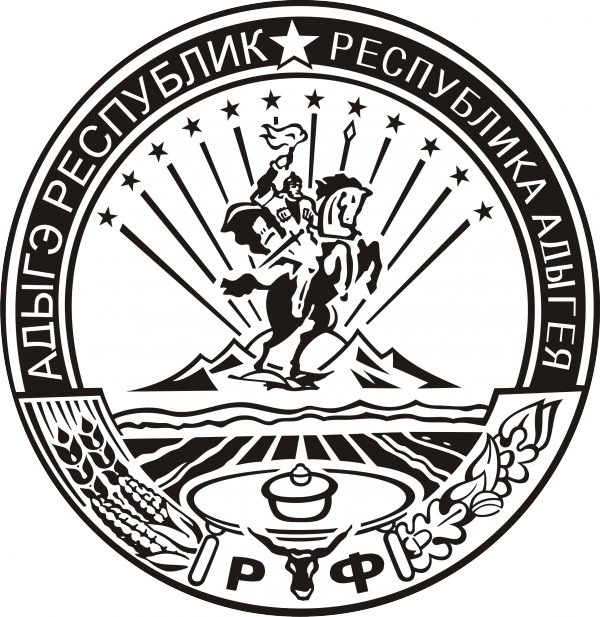
The coat of arms of the Republic of Adygea is one of the most recognizable regional symbols of the North Caucasus — a heraldic composition rich with imagery rooted in the thousand-year Nart epic of the Adyghe people. Its black-and-white (monochrome) version is not merely a desaturated copy. It is an independent heraldic document executed according to the rules of hatching (Schraffierung) — a system of line-based color designation in black-and-white heraldry. This article provides a complete breakdown of the Adygea coat of arms symbolism, its creation history, an explanation of the black-and-white version's features, and direct download links for vector files in CMX and EPS formats, plus high-resolution PNG raster images.
Whether you are preparing official documents, designing printed materials, building a heraldic collection, or studying the symbolism of Russian regions — this material gives you a complete understanding of the Adygea coat of arms and its monochrome variant.
1. History of the Coat of Arms of the Republic of Adygea
1.1. From the Nart Epic to a State Symbol
The roots of Adyghe heraldry go deep into the layers of folk culture. The Nart epic — a monumental cycle of legends shared by many peoples of the Caucasus — holds a central place in Adyghe identity. The main hero of the Adyghe version of the epic is Soslan (Sausyryko) — a mighty warrior born from a stone fertilized by a shepherd. It is Soslan, riding a fiery horse, who became the central figure of the state coat of arms of the Republic of Adygea.
\u{201c}Soslan (Sausyryko) is a key figure of the Nart epic, a cultural hero who brings fire and knowledge to humanity. His image on the Adygea coat of arms is not just a heraldic element but the embodiment of national spirit and historical memory of the people.
The state coat of arms of the Republic of Adygea was officially approved on March 24, 1992 by the Supreme Council of the Republic of Adygea. The author of the heraldic composition was artist Daud Meretukov, who worked on the coat of arms together with a team of specialists in Adyghe history and ethnography. The coat of arms underwent heraldic examination by the Heraldic Council under the President of the Russian Federation and is entered in the State Heraldic Register of the Russian Federation.
1.2. Form and Structure of the Coat of Arms
The Adygea coat of arms has the shape of a circle, which distinguishes it from classical heraldic shields typical of most Russian regions. The circular shape was not chosen by chance — it traces back to ancient solar symbols of the Adyghe, representing the sun, eternity, and the cyclical nature of life. At the top, the circle is framed by a ribbon with the inscription "Republic of Adygea" in two languages: Adyghe (above) and Russian (below).
The composition of the coat of arms combines national ornamental motifs with classical heraldic elements. At the center is the image of a rider on a flying fiery horse — Soslan. The circle closes at the bottom with the abbreviation "RF" (Russian Federation), above which is depicted the national table — ane with bread and salt — a symbol of hospitality, one of the chief virtues of the Adyghe people.
2. Symbolism of the Adygea Coat of Arms Elements
2.1. The Horseman with the Flaming Torch
The central image of the coat of arms — Soslan on a flying fiery horse. In the rider's hand is a flaming torch which, according to the Nart legends, the hero stole from the gods for the benefit of people. This is the classic "cultural hero" plot — a character who brings fire, knowledge, and crafts to humanity. The rays from the torch scatter across the firmament as twelve little stars, symbolizing the spread of the light of knowledge and progress.
The flight of the rider on the horse symbolizes the flight of the young republic into the future, toward progress. The horse in Adyghe culture is a sacred animal, a symbol of freedom, nobility, and martial valor. The fiery nature of the horse emphasizes its divine origin and supernatural power.
2.2. Bread and Salt, Grain Ears, and Fertility Symbols
The lower part of the coat of arms features the ane — national table with bread and salt. This is a symbol of hospitality, which in Adyghe culture is elevated to the rank of a sacred law. Around the central composition is a garland woven with:
- Ears of wheat — the main grain, symbol of fertility and agricultural labor
- Ears of millet — a traditional crop of Adyghe farming
- Corn cob — one of the key agricultural crops of the region
- Bull's head — symbol of wealth created by the labor of the people, representing animal husbandry as a traditional occupation of the Adyghe
\u{201c}The plowed field, the table with bread and salt, ears of wheat and millet, corn cob, bull's head — all these elements symbolize the wealth of the republic created by the labor of its people. Adygea has historically been and remains an agricultural region with ancient farming traditions.
2.3. Mountains, Oak and Maple Leaves
The images of mountains characterize the geographic location of the republic — it sits on the picturesque northern slopes of the Caucasus Range, in the valleys of the Kuban and Laba rivers, on the fertile Kuban Plain. The mountain peaks of the Caucasus are an inseparable part of Adygea's landscape, largely determining its climate, economic structure, and cultural identity.
Oak leaves (left side) and maple leaves (right side) speak of the forest wealth of the region. Adygea is one of the most forested regions of southern Russia. The oak in Adyghe tradition is a sacred tree, symbol of courage, resilience, and longevity. The maple symbolizes the beauty of nature and the diversity of the region's flora.
2.4. The Five-Pointed Star
At the top of the coat of arms, in the middle of the ribbon, is a large five-pointed star. It represents the unity and brotherhood of the multinational population of Adygea. Adygea is a multinational republic where for centuries Adyghe, Russians, Armenians, Greeks, Kurds, and representatives of many other peoples have lived in peace and harmony. The star symbolizes this harmony and shared destiny.
3. The Black-and-White Coat of Arms: What It Is and Why It Exists
3.1. Heraldic Hatching (Schraffierung)
A black-and-white image of a coat of arms is not simply a technical simplification. Heraldry has a centuries-old system of hatching (Schraffierung) — the designation of colors (tinctures) through line patterns in a monochrome image. Each heraldic color corresponds to its own type of hatching:
| Color (Tincture) | Heraldic Name | Hatching Designation |
|---|---|---|
| Red | Gules | Vertical lines |
| Blue/Azure | Azure | Horizontal lines |
| Green | Vert | Diagonal lines from top right to bottom left |
| Gold/Yellow | Or | Dotted pattern |
| Silver/White | Argent | Plain field (no hatching) |
| Black | Sable | Solid fill or crosshatch grid |
The hatching system was developed in the 17th century and standardized in the 19th century. It allows coats of arms to be printed on single-color printing presses, in black-and-white documents, on seals and stamps — without loss of heraldic information. Anyone familiar with hatching rules can "read" the colors of a coat of arms even from its black-and-white image.
3.2. When the Black-and-White Coat of Arms Is Used
The monochrome execution of state symbols is needed in the following cases:
- Official letterheads and documents — many government institutions use monochrome printing for cost savings
- Seals and stamps — relief and ink seals are traditionally single-color
- Engraving — on metal, glass, stone
- Black-and-white publications — books, newspapers, academic works
- Facsimile machines — historically an important area of application
- Architectural decoration — bas-reliefs and high-reliefs on buildings
4. Comparison: Color and Black-and-White Coat of Arms of Adygea
| Characteristic | Color Coat of Arms | Black-and-White Coat of Arms |
|---|---|---|
| Color transmission | Full-color — red, green, gold, blue | Monochrome with hatching |
| Application area | Color printing, internet, presentations, flags | B/W documents, seals, engraving, letterheads |
| Heraldic readability | Complete, direct tincture transmission | Complete, through the line-code system |
| File formats | CMX, EPS, SVG, PNG | CMX, EPS, PNG |
| File size | Larger (color information) | Smaller (luminance channel only) |
| Print versatility | Requires color printer | Prints on any device |
5. Vector Formats for the Coat of Arms
5.1. CMX Format (CorelDRAW)
CMX (Corel Presentation Exchange) is a CorelDRAW data exchange format widely used in Russia and CIS countries for preparing official documentation, signage, and printing. A CMX file contains full vector curves of the coat of arms that can be opened in CorelDRAW, scaled without quality loss, and edited. Government printing houses and design bureaus throughout the post-Soviet space work with CMX as one of the primary formats.
5.2. EPS Format (Encapsulated PostScript)
EPS is a cross-platform vector format compatible with Adobe Illustrator, Photoshop, InDesign, CorelDRAW, and most professional layout applications. An EPS file of the Adygea coat of arms can be placed in any layout program (QuarkXPress, Adobe InDesign, Scribus) and scaled from a business card to a billboard without loss of sharpness. It is the "gold standard" for prepress preparation.
5.3. Raster PNG
PNG (Portable Network Graphics) is a raster format with transparency support. The coat of arms in PNG format with a transparent background can be overlaid on any colored background — a document letterhead, presentation slide, web page — without a white rectangle appearing around the image. This makes PNG ideal for quick use in documents and web publications.
6. Download the Adygea Coat of Arms
6.1. Vector Files
The black-and-white coat of arms of the Republic of Adygea is available for download in vector formats. The ZIP archive contains:
- CMX — CorelDRAW format (Corel Presentation Exchange)
- EPS — Encapsulated PostScript for Adobe Illustrator and prepress
6.2. Raster PNG
The coat of arms is also available in PNG format with transparent background at large resolution:
Download7. Practical Applications
7.1. Official Documentation
The black-and-white coat of arms is essential for preparing official documents — letterheads, orders, certificates — where monochrome printing is used. The vector format ensures clarity at any scale, which is critical for strict-reporting forms.
7.2. Seals and Stamps
When manufacturing seals and stamps with state symbols, the black-and-white image of the coat of arms is used. The vector file is sent to a seal-making workshop, where a cliché is created based on it.
7.3. Educational and Academic Work
Pupils, students, teachers, and researchers studying heraldry, the history of Adygea, or regional symbolism of Russia use the coat of arms in essays, term papers, theses, and scientific publications. The black-and-white version is especially convenient for text-based documents.
8. Frequently Asked Questions
What is depicted on the coat of arms of the Republic of Adygea?
The coat of arms of the Republic of Adygea is a circle featuring the hero Soslan (Sausyryko) on a flying fiery horse. The rider holds a flaming torch, with 12 star-rays spreading across the sky. The circle is framed by a ribbon. The garland includes wheat ears, millet, corn cob, and a bull's head. At the top is a five-pointed star, at the bottom — "RF" and the ane table with bread and salt.
When was the Adygea coat of arms approved?
The state coat of arms of the Republic of Adygea was officially approved on March 24, 1992, by the Supreme Council of the Republic of Adygea. The author of the heraldic composition was artist Daud Meretukov. The coat of arms underwent examination by the Heraldic Council under the President of the Russian Federation.
Why is a black-and-white version of the coat of arms needed?
The black-and-white version is executed according to the rules of heraldic hatching (Schraffierung) for printing on single-color devices, manufacturing seals and stamps, engraving, and black-and-white documents and publications. Hatching allows the colors of the coat of arms to be "read" even from its monochrome image.
Who is Soslan on the Adygea coat of arms?
Soslan (Sausyryko) is the main hero of the Adyghe version of the Nart epic, a cultural hero who stole fire from the gods and gave it to people. His image symbolizes the flight of the young republic into the future, progress, and knowledge.
What do the 12 stars on the coat of arms symbolize?
The 12 little stars are rays from the torch in the rider's hand, scattering across the firmament. They symbolize the spread of the light of knowledge and progress. The number 12 has sacred significance across many cultures — 12 months, 12 zodiac signs — representing completeness.
Why does the Adygea coat of arms have a circular shape?
The circular shape traces back to ancient solar symbols of the Adyghe — the sun, eternity, and the cyclical nature of life. This distinguishes the Adygea coat of arms from most Russian regional coats of arms, which traditionally use a shield shape.
What formats are available for the black-and-white coat of arms download?
The black-and-white coat of arms is available in vector formats CMX (CorelDRAW) and EPS, packaged in a ZIP archive gerb_Adygei_ch-b.zip. A PNG with transparent background at large resolution is also available.
Can the black-and-white coat of arms be used in official documents?
Yes, a black-and-white image with hatching can be used in official documents, on letterheads, seals, and stamps in situations where full-color printing is technically impossible or impractical.
What is hatching (Schraffierung) in heraldry?
Hatching is a system of line-based designation of heraldic colors in a black-and-white image: vertical lines for red, horizontal for blue, diagonal for green, dotted for gold, plain field for silver, solid fill for black. The system was developed in the 17th century.
Where is Adygea located and what are its natural features?
Adygea is located on the northern slopes of the Caucasus Range, in the valleys of the Kuban and Laba rivers, on the fertile Kuban Plain. It is one of the most scenic and forested regions of southern Russia, reflected in the coat of arms through mountains, oak and maple leaves, grain ears, and other elements.
6. Detailed Analysis of the Adygea Coat of Arms Elements
6.1. The Horseman and the Nart Epic of Soslan
The central figure of the coat of arms is a horseman galloping on a horse. This is not an abstract warrior but a reference to the heroic Nart epic — a cycle of legends about ancient bogatyrs that occupies the central place in the spiritual culture of the Adyghe people. In the Adyghe (Circassian) version of the epic, the key hero is Soslan (Sosruko) — a cultural hero who brought fire to humanity, taught them blacksmithing, and protected them from evil forces. It is with Soslan that the image of the horseman with a flaming torch is associated.
According to ancient legends, Soslan was born from a stone forged in the smithy of Tlepash and possessed incredible strength from infancy. His greatest feat was stealing fire from the giants (inyzhs) who kept people in cold and darkness. Soslan sneaked into their dwelling, stole the flaming torch, and gave it to the people — for which he was punished by the gods and eventually died in an unequal battle. This mythological plot strikingly parallels the ancient Greek myth of Prometheus chained to the Caucasus cliffs. Caucasus scholars have repeatedly noted parallels between the images of Soslan and Prometheus, adding a deeper cultural and historical context to the coat of arms of Adygea.
6.2. The Twelve Stars
Above the horseman's head are twelve five-pointed stars forming an arc. Each star symbolizes one of the twelve Adyghe (Circassian) sub-ethnic groups: Abadzekhs, Besleneys, Bzhedugs, Yegerukays, Kabardians, Mamkhegs, Mokhoshevs, Natukhais, Temirgoys, Ubykhs, Khatukais, and Shapsugs. The number 12 in Adyghe tradition is sacred — it denotes completeness and the unity of many parts in one whole.
6.3. Mountains, Plains, and Natural Symbols
Below the horse's hooves are the Caucasus Mountains — the main natural symbol of the region. Two peaks represent the two largest ranges: the Main Caucasus and the Advanced ranges. The green plain below is the foothills and valleys where Adyghe tribes historically settled. The shield is flanked by wheat ears on the left (symbolizing agriculture and fertility) and oak and maple branches on the right (strength, longevity, youth, and renewal). Together they form a single wreath bound with a ribbon bearing the motto in the Adyghe language.
6.4. Motto in the Adyghe Language
The ribbon bears the inscription «Адыгэ Республикэр» — «Republic of Adygea» in the Adyghe language. The use of the national language in state symbols emphasizes the status of Adyghe as the second official language of the Republic of Adygea alongside Russian.
Tap to react