What Makes the Berkut Emblem a Recognizable Symbol

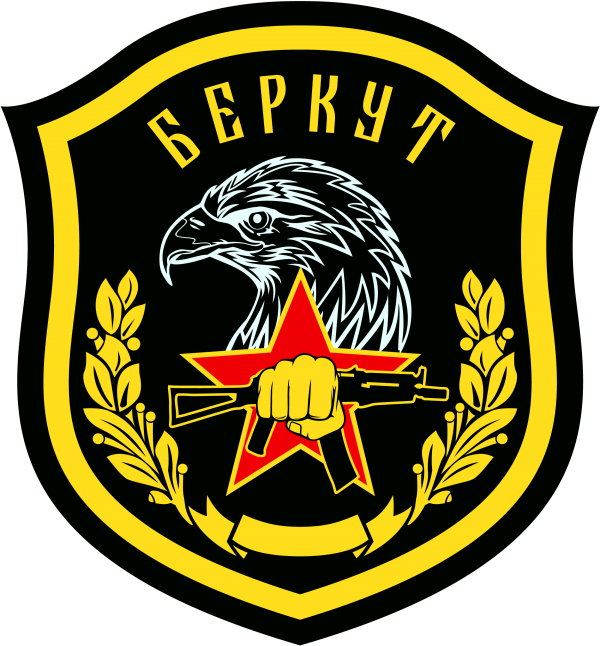
Military and law enforcement patches tell stories. The Berkut chevron does it with three elements only — an AK-pattern rifle, a five-pointed star, and a clenched fist. Minimal. Aggressive. Instantly readable at any scale. You see it on a sleeve from twenty meters away and you know exactly which unit you are dealing with.

The acronym stands for Боевой Единый Резерв Контрразведки Уголовного Террора — roughly translated as Combat Unified Reserve of Counterintelligence against Criminal Terror. That name alone tells you this was never a ceremonial unit. These were operators trained for the worst-case scenarios: hostage rescue, counter-terror operations, high-risk warrant service.

Designers who work with law enforcement insignia know the challenge: you need a mark that projects authority without crossing into intimidation, conveys discipline without looking bureaucratic. The Berkut emblem walks that line. The rifle sits horizontally across the shield — not aimed at the viewer, but ready. The star anchors the composition from above, a universal military signifier. The fist, clenched and centered, says everything about the unit's purpose without a single word.

\u{201c}

A good tactical emblem does not explain. It declares.

History and Origins of the Berkut Special Unit

The Berkut special unit was formed in the early 1990s within the Ukrainian Ministry of Internal Affairs (MVD) system, emerging from the need for a highly mobile, professionally trained police rapid-response force. The unit was created in 1992, drawing personnel from existing special police formations and veterans of the Soviet OMON units. The name Berkut — the golden eagle, the largest raptor in the Northern Hemisphere — was chosen deliberately to evoke speed, precision, and lethal striking capability.

Throughout the 1990s and 2000s, Berkut units operated in every region of Ukraine. Their responsibilities included riot control at major public events, counter-terrorism operations, hostage rescue, armed response to violent crime, and providing security for high-profile government officials. Training was intensive and continuous, modeled partly on Soviet spetsnaz methods and partly on Western SWAT-style tactical procedures. Operators trained in close-quarters battle, precision marksmanship, breaching, crowd psychology, and hand-to-hand combat.

The unit became both famous and controversial during the 2013-2014 Euromaidan protests, where Berkut personnel were deployed for riot control duties. Following the change of government in Ukraine in February 2014, the Berkut unit was officially disbanded by order of the Minister of Internal Affairs. However, the name and insignia did not disappear. Many former Berkut operators joined newly formed Russian National Guard (Rosgvardia) units, and variations of the Berkut emblem continue to be used by Russian special police forces to this day.

This complex history gives the Berkut chevron a weight that simple decorative patches lack. When you wear this emblem — or use it in a design project — you are referencing a real operational history with real tactical philosophy behind it.

Symbolism: The AK, the Star, and the Fist

Every element on the Berkut chevron carries a specific operational meaning. Let us break them down.

The Kalashnikov Rifle

The AK silhouette is unmistakable. The curved magazine, the wooden handguard, the distinctive gas block — it is the most recognized firearm profile on the planet. On the Berkut emblem, the rifle is depicted in a stylized metallic tone, often gold or silver depending on the variant, positioned horizontally across the shield. This horizontal placement is deliberate: a weapon at rest, yet undeniably present. It says: we are armed, we are trained, we are not looking for a fight, but we will finish one.

A notable detail on certain variants: the barrel of the rifle breaks the boundary of the shield. This heraldic technique, known as "exceeding the field," symbolizes offensive readiness — a willingness to act beyond established limits. In the context of a special operations unit, this visual break communicates that standard rules of engagement may not apply.

The Five-Pointed Star

Above the rifle and fist, the star crowns the composition. In Soviet and post-Soviet heraldic tradition, the five-pointed star symbolizes protection, the five continents, and the unity of fighting forces. On the Berkut patch, it is rendered in sharp geometric lines — no soft edges, no decoration. It reads as a stamp of state authority, a reminder that the unit operates under official mandate.

Coloring of the star varies between versions. Red stars connect to Soviet military tradition. Gold stars shift the emphasis toward rank and status rather than ideology. In some stylized variants, the star may be rendered in white or silver, matching the metallic elements of the rest of the chevron.

The Clenched Fist

The central element. Four fingers curled tight, thumb locked over them. This is not a greeting, not a salute — it is a statement of force. In heraldry and political iconography, the clenched fist represents solidarity, resistance, and the willingness to act. On a special unit's chevron, it takes on a more immediate meaning: we are the ones who go through the door first.

The fist motif on the Berkut emblem is stylized — smooth contours replace anatomical detail, making it work as a graphic mark rather than a literal illustration. This is what separates a well-designed insignia from a crude drawing. The thumb position, the curve of the knuckles, the negative space between fingers — every contour has been simplified to survive reproduction on fabric while remaining recognizable at a glance.

The fist motif on the Berkut emblem is stylized — smooth contours replace anatomical detail, making it work as a graphic mark rather than a literal illustration. This is what separates a well-designed insignia from a crude drawing.

Design Analysis: Why This Chevron Works

Patch design for tactical units is a niche discipline within graphic design. It has its own rules. The Berkut emblem follows them with discipline.

The composition uses a classic shield shape — tapered bottom, slightly rounded top. Shields have been the default container for military insignia since medieval heraldry, and for good reason: the shape naturally draws the eye downward through the hierarchy of elements. On the Berkut chevron, that hierarchy is star first (authority), fist second (action), rifle third (capability). The eye moves from top to bottom in a clean vertical scan.

Color palette matters enormously when the emblem will be embroidered on fabric. The standard Berkut patch uses a limited palette: black background, gold or silver metallic thread for the main elements, red accents for the star and certain shield outlines. This restraint is not artistic preference — it is manufacturing necessity. Embroidery machines have limited thread stations. More colors mean higher production cost and more points of failure. The Berkut design respects those constraints.

The overall aspect ratio of the shield — roughly 3:4 width to height — is standard for tactical patches and fits naturally on the upper sleeve of a uniform. This is not coincidental. The designer understood that a chevron is viewed not in isolation but as part of a complete uniform silhouette. The proportions had to harmonize with the shoulder profile and allow full arm movement without distortion of the artwork.

Design ElementFunctionExecution
Shield contourContainer, frames all symbolsClassic heraldic shield with tapered bottom
StarAuthority markerSharp geometric rendering, gold fill
FistAction/force symbolStylized, centered, dominant scale
AK rifleCapability markerHorizontal placement, metallic tone
Color paletteLegibility at distance2-3 colors: black, gold/silver, red
Pro tip for designers: when creating vector versions of embroidered patches, use flat colors without gradients. Embroidery floss does not blend — it sits as solid blocks of thread. Your vector file should reflect that physical reality.

Vector Heraldry in Law Enforcement

The use of vector graphics in law enforcement insignia design represents a significant shift from traditional embroidery-only workflows. Twenty years ago, unit patches existed primarily as woven or embroidered fabric pieces. Digital vector files were a secondary consideration, often crudely traced from photographs of actual patches. Today the workflow is reversed: insignia are designed as vector files first, and fabric patches are manufactured from those digital masters.

Vector heraldry offers several advantages over raster-only approaches. First, a properly constructed vector file contains every element as a discrete, editable object. Colors can be updated globally or per-element. Sizing constraints can be adjusted without redrawing. Multiple variants — color inversions, monochrome versions, transparent-background versions — can be generated from a single source file.

Law enforcement agencies increasingly require vector master files for new insignia projects. The reason is practical: vector files future-proof the design. As uniform specifications change, as new patch sizes are needed, as digital applications emerge, the vector source file can be modified without starting from scratch. The Berkut emblem in vector format preserves this design flexibility — you can use it as a 30 mm lapel pin template, a 100 mm sleeve patch master, or a full-screen digital watermark from the same source.

For designers working with law enforcement or military clients, understanding vector heraldry conventions is essential. Symbols must be constructed to maintain structural integrity at any scale. Text must be converted to outlines before distribution. Color specifications should include both RGB hex values for screen use and CMYK percentages or Pantone numbers for print and embroidery matching.

Vector Download: What You Get

This page offers the Berkut emblem in professional vector formats ready for any design workflow. No watermarks. No registration required. Just clean files.

Vector Archive Contents

The main download package contains the emblem in three industry-standard vector formats:

  • EPS (Encapsulated PostScript) — universal vector exchange format, opens in Adobe Illustrator, CorelDRAW, Affinity Designer, Inkscape, and any professional design software
  • SVG (Scalable Vector Graphics) — web-ready format, natively supported by all modern browsers, ideal for websites and digital applications
  • CDR (CorelDRAW) — native format for CorelDRAW users, preserves all editing capabilities including layers, effects, and color palettes
Download

PNG Raster Versions

For projects that need immediate raster output without vector software, pre-rendered PNG files are available at three resolutions:

ResolutionUse CaseBackground
2500 pxLarge format printing, banners, postersTransparent
600 pxWeb display, presentations, documentsTransparent
300 pxThumbnails, icons, social media avatarsTransparent

Stylized Variant

A separate stylized version of the Berkut emblem is also available. This variant uses simplified geometry, bolder lines, and a more graphic-novel aesthetic. It works particularly well for merchandise — t-shirts, mugs, stickers — where a literal patch reproduction might look too busy.

Stylized PNG resolutions: 2719 px, 600 px, 300 px — all with transparent background.

Practical Applications for Designers

Why would a graphic designer need a vector Berkut emblem? More scenarios than you might think.

Documentary and Editorial Work

Journalists covering law enforcement topics, documentary filmmakers producing segments about special units, and authors writing about post-Soviet security forces all need accurate visual references. A vector emblem scales to any publication format — from a column-width newspaper illustration to a full-page magazine spread — without losing crispness.

Educational Materials

Military academies, criminology departments, and security studies programs use unit insignia in lectures, textbooks, and training presentations. Vector files ensure these materials look professional at every output size.

Airsoft and Reenactment

The airsoft community maintains high standards for uniform accuracy. Teams that recreate Berkut loadouts need precise patch reproductions. A vector file lets them produce patches at the exact dimensions required — typically 80-100 mm for sleeve application — with embroidery shops or heat-transfer printers.

Digital Art and Fan Content

Digital artists incorporate military and law enforcement insignia into composite works, wallpapers, and themed illustrations. A vector source file means they can adjust colors, isolate elements, and integrate the emblem into larger compositions without quality loss.

Video Game and Film Asset Production

Game developers and visual effects artists regularly need accurate insignia for virtual uniforms. Vector source files import directly into 3D modeling and texturing pipelines — Blender, Maya, Substance Painter, Unreal Engine — where they can be extruded, embossed, or applied as texture maps without manual retracing.

Print-on-Demand and Merchandise

Platforms like Redbubble, Printful, and Teespring allow designers to upload vector artwork that scales automatically across dozens of product types. A single vector source file generates crisp prints on t-shirts, hoodies, phone cases, stickers, and posters — eliminating the need to create separate raster files for each product variant.

When using law enforcement insignia in commercial projects, check local regulations. Some jurisdictions restrict the use of official unit markings in certain contexts. This vector file is provided for educational and artistic purposes.

Comparison: Berkut Emblem vs Other Special Unit Insignia

How does the Berkut chevron compare to insignia from similar units in other countries? Let us put it side by side with a few well-known tactical patches.

UnitCountryKey SymbolsStyleColor Scheme
BerkutUkraine/RussiaAK, star, fist, shieldHeraldic-modernBlack, gold, red
GSG 9GermanyEagle, federal shieldMinimalist heraldicDark blue, silver
GIGNFranceHelmet, parachute, crosshairDetailed illustrativeBlue, white, red
SWATUSACrossed weapons, ram, eagleAggressive modernBlack, silver, blue
OMONRussiaSword, shield, lion headHeraldic-traditionalMaroon, gold, black

The Berkut emblem stands out for its economy of symbols. Where other patches try to cram in swords, eagles, lions, parachutes, and motto scrolls, the Berkut design achieves maximum impact with minimum elements. This restraint makes it more versatile — it works as a 30 mm lapel pin, an 80 mm sleeve patch, or a 2-meter banner without any element becoming illegible.

Working With Vector Emblems: Technical Notes

If you are downloading vector insignia for the first time, a few things will save you headaches.

EPS compatibility. All modern vector editors open EPS files, but some (particularly Inkscape) may not preserve certain CorelDRAW-specific effects. If you see empty layers or missing elements, try opening the SVG instead — it is the most universally compatible format in the package.

Color mode. The vector files use RGB color space by default. If you are sending the emblem to print (embroidery, screen printing, offset), you should convert it to CMYK and check the color shift. Gold tones, in particular, can appear muddy in CMYK if not adjusted.

Scaling embroidery designs. When scaling the emblem for embroidery digitizing, keep line weights above 0.5 mm in the final physical size. Thinner lines may not reproduce reliably with standard embroidery threads.

Transparency in PNG. All PNG versions ship with alpha channel transparency. The background will show through wherever the emblem does not cover. This is essential for placing the emblem on uniforms, documents, or composite images.

Importing into 3D software. SVG files import directly into Blender, Maya, and Cinema 4D as curve objects. In Adobe Dimension or Photoshop, drag the SVG into a Smart Object layer for lossless non-destructive scaling. For PowerPoint or Word presentations, PNG at 600 px provides the cleanest balance of file size and display quality.

// Quick SVG color change example // Open the SVG in a text editor // Find: fill="#FFD700" (gold) // Replace with: fill="#C0C0C0" (silver) // Save and refresh

FAQ About the Berkut Emblem

What formats are included in the vector download?

The archive contains EPS, SVG, and CDR formats — covering all major vector editing software: Adobe Illustrator, CorelDRAW, Affinity Designer, and Inkscape.

Does the PNG version have a transparent background?

Yes. All PNG files (2500, 600, and 300 px) are rendered with alpha channel transparency. You can place the emblem on any background without a white box.

What is the difference between the standard and stylized versions?

The standard version reproduces the embroidery patch design faithfully. The stylized version uses bolder lines, simplified shapes, and a more graphic approach suitable for merchandise and digital art.

Can I use this emblem for commercial projects?

The vector files are provided for educational, artistic, and editorial use. If you plan to use the emblem on products for sale, verify that your use case complies with local laws regarding official insignia reproduction.

What software do I need to open EPS files?

Adobe Illustrator, CorelDRAW, Affinity Designer, Inkscape (free), or any vector editor that supports the EPS format. For SVG files, even a web browser will display them correctly.

What are the dimensions of the emblem?

The vector file is resolution-independent. The PNG renders are available at 2500 px (print), 600 px (web), and 300 px (thumbnail). The typical physical sleeve patch measures approximately 80-100 mm in height.

Is the Berkut unit still active?

The Berkut special unit was disbanded in Ukraine in 2014. However, units bearing the Berkut name and emblem have been re-established in Russia and continue to use variations of this insignia.

Can I edit the colors of the vector emblem?

Yes. All vector formats support full color editing. You can change the gold to silver, red to blue, or adjust any element independently. The SVG format is particularly easy to edit — you can modify it in a text editor by changing hex color codes.

What does the fist symbol mean on the emblem?

The clenched fist is a universal symbol of strength, solidarity, and readiness for action. In the context of a special unit's emblem, it represents the unit's role as a strike force — the first to engage in high-risk operations.

Why was the golden eagle chosen as the unit symbol?

The golden eagle (berkut) is one of the largest and most powerful raptors, known for striking with speed and precision. The association with this apex predator creates an instant mental image of overwhelming force — exactly the message an elite unit wants to project.

Tap to react