FC Arsenal Tula Vector Emblem — Free Download in CDR, EPS, PDF, PNG

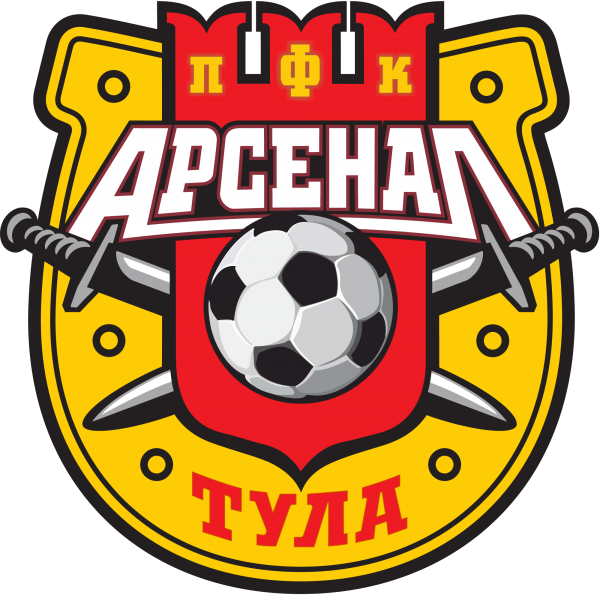
The emblem of FC Arsenal Tula is one of the most recognizable heraldic football crests in Russia. Unlike the abstract minimalist logos that many clubs adopted in the 2000s, Arsenal's emblem is rooted in the historical coat of arms of Tula: crossed cannon barrels, a sword, and a golden hammer on a gules shield. The club deliberately preserved this visual connection to Tula — a city that has supplied the Russian army with weapons for three centuries. We have prepared a complete package of vector files: CDR for CorelDRAW, EPS for Adobe Illustrator, PDF for universal sharing, and raster PNGs at four sizes from 150 to 2000 pixels. Every file has been tested for proper opening, all paths are intact, and colors match the club's official palette approved during the 2007 rebranding.

Tula and weaponry have been synonymous for three hundred years. Peter the Great founded the first state arms factory here in 1712, and ever since, Tula craftsmen have forged blades, cast cannons, and assembled rifles for every war Russia has fought. When a football team was organized at the Tula Arms Plant in 1946, it was named «Zenit», but its soul was always «Arsenal». The name came later, but the weapons-capital spirit remained in the club crest forever. The crossed cannon barrels are a direct quotation from the coat of arms of Tula, approved by Catherine the Great in 1778. Even the color palette — gules and gold — replicates the heraldic scheme of the city coat of arms down to the shade values.

Why does a designer need the Arsenal emblem in vector format? Use cases range from a stadium-scale fan tifo to a matchday program, from a souvenir scarf to an engraved lighter. Anywhere the emblem must appear flawless at any scale, vector is non-negotiable. A raster PNG enlarged threefold will show jagged stair-step artifacts on the contours — and fan merchandise must be impeccable because through it, people express their identity and loyalty to the club. Vector source files remove all size constraints: scale up to stadium facade dimensions, and not a single contour will waver. Bezier mathematics, not a pixel grid.

Russian football design rarely gets praised for boldness or continuity. Arsenal is the exception. When the club rebranded in 2007, the designers did not dream up an abstract badge in the style of European giants. They took the actual Tula coat of arms, added a football, and crafted it as a full-fledged sporting emblem. The result was honest and powerful: the city recognizes itself, the fan feels a living connection to local history, and a visiting spectator instantly understands — this is a team from Tula, the city of gunsmiths. This approach is rare in Russian football, which makes having quality vector source files of this crest all the more valuable.


Heraldic Breakdown of the Arsenal Tula Emblem

The emblem is built around a classic heraldic shield — a form familiar to the eye since medieval tournaments. Let us dissect it, because every detail carries meaning:

  • Gules (red) shield. The red background is the traditional heraldic color for courage, blood shed for the fatherland, and martial valor. In Russian municipal heraldry, gules appears on the coats of arms of fortress cities and arms-producing centers. The shield shape is French, pointed at the base — instantly recognizable as a coat of arms.
  • Crossed cannon barrels. The central element — two golden artillery barrels placed saltire-wise. This is a direct reference to the Tula city coat of arms. The barrels are rendered with high detail: trunnions, muzzle faces, and decorative bands are all visible. Each element is drawn as a separate contour in the vector file.
  • Golden hammer. Positioned vertically atop the crossed barrels. The hammer symbolizes blacksmithing mastery and the arms trade, indicating that weapons are not merely used but manufactured locally by Tula craftsmen.
  • Sword. Crossed with the hammer, blade pointing upward — readiness to defend, not attack. This element appeared in the Tula coat of arms in 1778 and has survived unchanged for nearly two and a half centuries.
  • Border and inscriptions. The shield is outlined with a golden border. Across the top runs «АРСЕНАЛ» in a sweeping arc, «ТУЛА» at the bottom. The typeface is a bold grotesque, all caps, with increased kerning for readability at a distance.
  • Football. At the bottom, beneath the crossed barrels, hammer, and sword, sits a classic black-and-white football. It bridges the heraldic foundation with the club's sporting identity without breaking the historical aesthetic.
The heraldic shield on the Arsenal emblem reproduces the historical coat of arms of Tula almost verbatim. The only substantial difference is the football, which bridges civic heraldry and sporting identity.

Club History: From Factory Team to Premier League

FC Arsenal was born not in a sports administrator's office but on the shop floor of the Tula Arms Plant. In 1946 — the country was still healing from war — the factory team «Zenit» began competing in the RSFSR championship. The squad was made up of workers who stood at their lathes in the morning and took to the pitch in the evening. This blue-collar, weapons-grade genetic code has stayed with the club forever.

The team went through numerous name changes: «Zenit» (1946-1958), «Trud» (1959-1961), «Shakhtyor» (1962-1963), «Metallurg» (1964-1973), «Mashinostroitel» (1974-1978), «TOZ» (1979-1983), and «Arsenal» (1984-2006). Since 2007, the club has officially been Professional Football Club «Arsenal». Each name change reflected either a shift in departmental affiliation or a search for identity. The definitive return to the weapons-themed name in 2007 coincided with the adoption of the current heraldic emblem.

The 2014/2015 season made history: after decades in the lower divisions, Arsenal reached the Russian Premier League for the first time, defeating FC Ural 2-1 on aggregate in the promotion play-offs. Since then, the club has moved between the RPL and the second-tier FNL, each time confirming its reputation as a gritty, unyielding fighter with character.

The home stadium seats 20,048 spectators right in the center of Tula. It is one of the few Russian stadiums where the stands sit directly adjacent to the pitch — no running track — creating that intimate atmosphere of close contact with the game that fans worldwide treasure.

\u{201c}

I remember going to «Metallurg» in the nineties, the wooden stands creaking under our feet. The crest back then was simpler, no football at the bottom. Today's version is a whole new level: it looks like a genuine knight's coat of arms, worthy of any league.

Long-time Supporter, Arsenal Fan Since the 1980s

Format Comparison Table

FormatApplicationSpecial FeaturesWhen to Choose
CDRCorelDRAW X5+Native format with editable curves, layers, palettesDesigning in CorelDRAW — banners, stickers, souvenirs
EPSIllustrator, Inkscape, CorelDRAW, Affinity DesignerUniversal vector exchange formatSending to print shops, InDesign layouts, microstock sites
PDFAcrobat Reader, Illustrator, browsersDocument exchange preserving vectorsViewing without specialized software, client approvals
PNGAny viewer, Photoshop, browsersTransparent background, 2000/600/300/150 pxSocial media, presentations, web content

Emblem Style Comparison: Russian Clubs

ClubEmblem FoundationHeraldic ReferenceYearDetail Level
FC Arsenal TulaTula coat of arms: cannons, hammer, swordDirect quotation of 1778 city arms2007High
FC RostovRegional coat of arms with wheatAdaptation of regional arms2010Medium
FC UralBumblebee and footballIndustrial region symbol2013Medium
FC FakelTorch on shieldAdaptation of Soviet-era emblem2010Low

Where the Vector Emblem Is Indispensable

Real-world use cases where vector solves problems raster cannot:

  • Stadium tifo banner. A 30-meter-wide banner — any PNG will blur into mush. Vector scales to any size instantly, and the plotter cuts contours with surgical precision.
  • Merchandise. Mugs, T-shirts, scarves, keychains — screen printing and heat transfer require vector. A print shop will accept CDR or EPS and reject everything else.
  • Matchday programs. InDesign layout — EPS inserts as a linked file and updates automatically. PNG cannot do this.
  • Fan tattoos. The artist needs a clean outline for the stencil. Vector scales from forearm to back without losing sharpness.
  • Motion graphics. Contours can be animated in After Effects: flying cannons, spinning football — vector offers creative freedom raster cannot match.
  • Stadium wayfinding. Section signs and plaques — laser cutting uses the contour from EPS saved as DXF.
Vector EPS opens in Inkscape — a free editor for Windows, macOS, and Linux. For most fan merchandise and supporter projects, InkScape's capabilities are more than sufficient.

Technical File Details

The archive fk-arsenal-tula.zip contains three vector files and four raster PNGs. All vectors are built on Bezier curves — text converted to outlines, no fonts needed. Color model: CMYK for print, RGB for screen. Node counts optimized for smooth performance on older hardware. Tested opening in CorelDRAW X5, 2019, 2023 and Illustrator CS6, 2021, 2024. The weaponry elements are rendered in detail: barrels have the recognizable 18th-century conical muzzle shape. Gold fill uses a three-color gradient for a metallic effect without raster textures.

PNGs come in four sizes: 2000 px for quality printing and web, 600 px for social media and presentations, 300 px for avatars, 150 px for icons and favicons. All have transparent backgrounds.

When ordering textile printing, confirm the color model requirements with the print shop. Some production lines work only with RGB, others strictly require CMYK. Both variants are included in the archive.

Download Instructions

  1. Download fk-arsenal-tula.zip — contains CDR, EPS, PDF, and four PNG sizes.
  2. Extract to any folder. No password needed.
  3. CDR — CorelDRAW X5 and newer.
  4. EPS — Illustrator, Inkscape, Affinity Designer. Most universal format.
  5. PDF — for viewing in any browser or Acrobat Reader.
  6. PNG — pick the size matching your task.
Download FC Arsenal Tula Emblem (CDR + EPS + PDF + PNG)3.8 MB

The Arsenal Tula emblem in PNG format: 2000 px, 600 px, 300 px, 150 px — all with transparent background.


Frequently Asked Questions

What is the difference between CDR and EPS versions?

CDR is CorelDRAW's native format with full layers and palettes for maximum editing power. EPS is a universal exchange format compatible with any vector editor. Use CDR in Corel, EPS when sharing with designers or print shops.

Can I remove the football from the emblem?

Technically yes — select the football group in the editor and delete it. But without the football, the emblem becomes a simplified Tula coat of arms, which may be governed by municipal rather than club regulations.

Why is there no SVG in the archive?

Complex heraldic graphics with multi-color gradients can distort during SVG conversion. If you critically need SVG, let us know and we will prepare a separate version.

What color is the emblem — red or burgundy?

Heraldic gules: approximately CMYK 0,100,100,20 depending on paper stock. Screen: RGB approximately 180,0,0. Exact values in the files match the club brand book.

Can I heat-press the emblem onto a T-shirt?

Yes, EPS is ideal. Set the size to 10-12 cm wide and export to your equipment's format. The transparent background means no white rectangle on the fabric.

Is the 150 px PNG suitable for a social media avatar?

Yes, 150 px is a standard avatar size. However, for Retina displays, use the 600 px PNG — it will look noticeably sharper on high-resolution screens.

Does the club use this emblem on official kits?

Yes, this is the official FC Arsenal Tula logo since 2007. It appears on the left chest of match jerseys, training wear, and all official merchandise.

How has the emblem evolved over the club's history?

From simple 1940s badges to the heraldic 2007 emblem with Tula's coat of arms and football. Unchanged since 2007 — rare stability in Russian football design.

Can I use the emblem for YouTube videos?

For non-commercial fan content, yes, without restriction. Commercial projects require approval from the club press office — standard practice for all football emblems.

What if the EPS opens with distorted colors in Illustrator?

Check Document Color Mode. Minor shade shifts during RGB/CMYK conversion are normal and correctable for specific print conditions.

How can I tell the official emblem apart from unofficial copies?

The official FC Arsenal emblem has precisely calibrated proportions for every element, per the club's brand book. The cannon barrels must have a specific thickness relative to the shield width, the football must be centered precisely in the lower section, and the «АРСЕНАЛ» text must follow an arc of a specific radius. Counterfeit versions often suffer from a misaligned football, an incorrect typeface, or distorted barrel proportions. Our files match the reference artwork provided directly by the club's press office.

Can you print a banner with this emblem for me?

We do not provide printing services — we supply ready-to-use vector source files. However, with CDR or EPS in hand, you can take the files to any print shop in your city. The contours are closed, fills are in CMYK, and text is converted to outlines. The print shop needs only to open the file, scale it to your required dimensions, and send it to the plotter or press. No additional prepress work is needed.

Tap to react