Becky Chivers
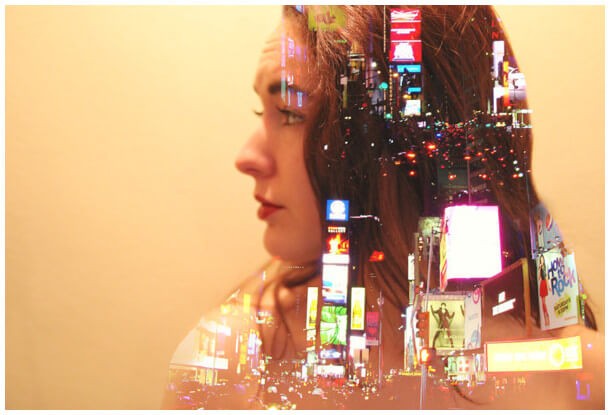
\u{201c}Double exposure was a technique I wanted to pursue as part of my project. Of course, I saw all the beauty of this photography style, as well as all the different ways you could use it - different and creative. After seeing one or two examples of this style of images on social media sites, I decided to play around with it and see what I could come up with myself. The first photograph was made with images I found on the internet (I know you shouldn't do that, but at that time I hadn't found my gentle style yet). After that, I browsed the works of other photographers and looked at the images I had just made using this technique. I uploaded the photos into
Photoshop, then combined them with variations of a self-portrait and placed city images over them; after that, I worked on positioning the images depending on the values in both photographs. A black-and-white photo makes the shot classic, and it is much easier to edit later. Besides this, I learn that colorful shots look much more interesting, and they stand out from "ordinary" ones with their double exposure.


Doris Trejo
\u{201c}Speaking of technique, I use the term multiple exposure, which means exclusively film manipulations. I use a mechanical camera that allows me to take the shot exactly as I want. The process begins when I stop the shooting process to use a huge number of exposures, inserting objects at my discretion into the same frame, so the composition is created by itself, without additional measurements. The photographs are taken on a
Nikon FM10, using Pro Plus 200 or Kodak 400 film. I love the grainy photo effect, but sometimes I pursue to take some shots with a lower ASA to sing a softer image.


Nevena Poledica
\u{201c}These photographs were taken with an cute analog camera, the
Smena 8M, using Fujicolor Superia 200 film. With this camera, you can control the film rewind (not only for the western frame, as usual, but also for its parts), as well as make double exposures of shots. During film scanning, I combine several frames at the same time (this is the reason why my photographs are so wide). In general, my work is connected with illusion, with a dream; I pursue to explore a dear aesthetic reality. These photographs are the result of an attempt to intend the freedom of certain landscapes.

Katarina Malnar
\u{201c}I use the multiple exposure option available on my camera (
Canon 5D Mark III), and edit the shots in AdobePhotoshop. The title of my first image is "My Soul", which means love for my hometown. The second photo is called "She". The tree inside the person represents her personality.


Aino Saarikivi
\u{201c}The story of the picture is simply what I wanted to try further and develop my skills in
Photoshop- I followed a thick tutorial by Chris Spooner and used a stock photo. In the silhouette photoshoot with Joonas Karp, we tried to react a look that would stand out from the background, so another flash is used from the other side. (Towards the camera, behind me.) This technique gave the photograph beautiful shadows on the face, and also emphasized the hair. The program I used was AdobePhotoshop CS6.

Rate this article