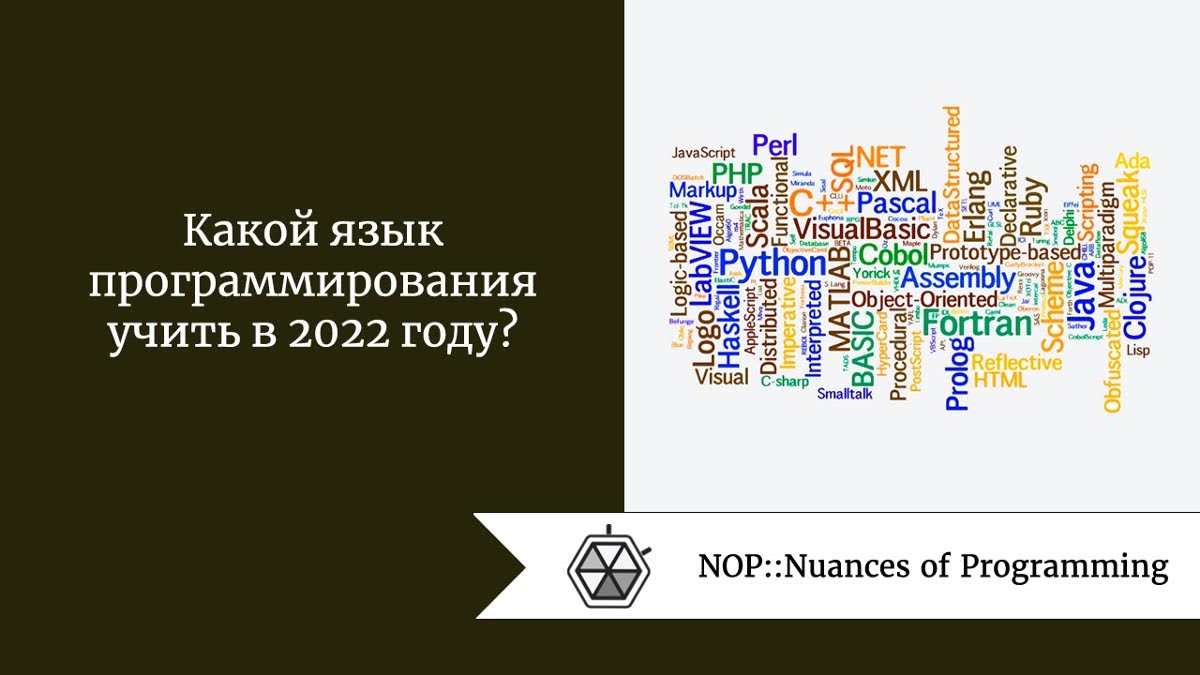
Which Programming Language to Learn in 2022?

So you have decided to become a programmer. You open a dozen articles about the best language for beginners, read the comments — and your head starts spinning. One person says Python is perfect for starting, another insists you are nobody without C++, a third screams about JavaScript being the ubiquitous language of the web. Sound familiar? I went through this exact hell back in 2015 when I was choosing my first language. And now, looking at the job market and the real career paths of hundreds of developers I know, I can say one thing: there is no right answer. But there are right questions.
In 2022 — and I intentionally write about this year because it marks the turning point between the COVID hiring boom and the crisis-driven slowdown of 2023–2025 — the choice of your first programming language came down to three things: where you want to end up, how much effort you are willing to invest, and how quickly you need your first paycheck. Let me break down the four languages that beginners actually choose between. No exotic Rust or Kotlin — we will leave those for later. The real choice for a first language in 99% of cases: Python, JavaScript, C++, C#. That is it. Everything else is either too niche or too hard to start with.
Python: The Leading Candidate for a First Language
Python captured the throne somewhere around 2019 and remains the default answer to the question "where should I start?" And there are specific reasons for this, not just hype around Data Science.
Python syntax reads like English text. Compare "Hello, World" in three languages:
print("Hello, World!")[/codeblock]
#include using System;
class Program {
static void Main() {
Console.WriteLine("Hello, World!");
}
}[/codeblock]
See the difference? Python — one line. C++ — five lines with includes, a main function, and a return type. C# — four lines with a using statement, a class, and static void Main. For someone seeing code for the first time, this difference is enormous. Python does not demand that you understand namespaces, classes, or static. You just write print — and it works. That is the key advantage for beginners.
\u{201c}Programming should be a joy, not a struggle with the compiler.
But simplicity has a downside. Python hides a lot of important things from beginners. Memory management? Automatic. Data types? Dynamic — the interpreter decides what your variable is. Compilation? None — it is an interpreted language. As a result, a programmer who learned Python as their first language and reached the junior level often does not understand basic concepts like the stack, the heap, pointers, or the difference between int and float at the processor level. This is not fatal if you go into data science or backend development with high-level frameworks. But if you later decide to switch to game development or systems programming, you will have to relearn a lot.
| Criterion | Python | JavaScript | C++ | C# |
|---|---|---|---|---|
| Difficulty (1–10) | 3 | 4 | 9 | 6 |
| Time to first job | 4–8 months | 6–10 months | 12–24 months | 8–14 months |
| Average junior salary (US, 2022) | $75,000 | $78,000 | $90,000 | $82,000 |
| Average senior salary (US, 2022) | $145,000 | $150,000 | $170,000 | $155,000 |
| Number of job openings (worldwide, 2022) | ~280,000 | ~320,000 | ~45,000 | ~60,000 |
| Primary domain | Data Science, backend, scripting, ML | Web (frontend + backend), mobile apps | Games, systems software, high-load | Games (Unity), enterprise software, backend |
| Typing | Dynamic | Dynamic | Static | Static |
| Compiled / Interpreted | Interpreted | Interpreted (JIT) | Compiled | Compiled (JIT) |
Pay attention to job openings. JavaScript leads with around 320,000 worldwide openings in 2022. Python is close behind. But a third of Python vacancies are in data science and machine learning, fields that are virtually closed to you without a STEM degree. A beginner without a math background going into DS through Python will hit a wall. What remains: backend (Django, FastAPI), test automation, and scripting. Fewer options than it seems at first glance.
Resources: Python has the best documentation in the world. The official tutorial at python.org covers everything a beginner needs. Plus mountains of free YouTube videos. CS50 from Harvard is the gold standard for any programmer's start, regardless of language. freeCodeCamp offers a comprehensive free Python curriculum. Books: "Automate the Boring Stuff with Python" by Al Sweigart (free online, incredibly practical), "Python Crash Course" by Eric Matthes. On the paid side: anything by Jose Portilla on Udemy goes on sale for ten to fifteen dollars regularly.
JavaScript: The Omnipresent Language You Cannot Ignore
If Python is the king of data science, JavaScript is the emperor of the web. Every website you open uses JavaScript. Every. Single. One. Even if the backend is written in PHP or Go, the frontend is JS. By 2022, JavaScript had expanded far beyond the browser: Node.js lets you write server-side code, React Native and Electron let you build mobile and desktop applications. It is the only language where you can write a complete application from database to interface without switching stacks.
But this coin has two sides. JavaScript is a language with history. It was created in 10 days in 1995, and it has been dragging a pile of quirks ever since. Here are some examples:
console.log(0.1 + 0.2 === 0.3); // false
console.log(typeof NaN); // "number"
console.log("5" - 3); // 2 (string minus number — OK!)
console.log("5" + 3); // "53" (concatenation — WTF?)[/codeblock]
These are not bugs. They are features — consequences of a language designed in a hurry and later patched with specifications, all while maintaining backwards compatibility. A beginner hits these moments by week two and either accepts them or has a mental breakdown. If you are the type who needs to understand why rather than just do it, JavaScript will be a tough ride.
The JavaScript ecosystem is a zoo. npm, the package manager, has over two million packages. You will install libraries for everything — from date handling to email validation. On one hand, this is great: someone has already solved any problem you encounter. On the other hand, you risk drowning in dependencies. The legendary left-pad incident of 2016, where the removal of a tiny 11-line package from npm broke the build of thousands of projects including React and Babel, is the most vivid example of this ecosystem's fragility.
What to learn in 2022? HTML and CSS are mandatory. Without them, JavaScript in the browser is useless. Then JavaScript itself (ES6+ syntax, arrow functions, promises, async/await). Then choose a direction: frontend — React (or Vue, especially if targeting smaller companies); backend — Node.js + Express; fullstack — both. Fullstack takes at least a year at 4–6 hours per day. Frontend-only: around eight months to a confident junior level.
| JS Direction | Stack | Difficulty | Learning Time | Demand |
|---|---|---|---|---|
| Frontend | HTML, CSS, JS, React/Vue | Medium | 7–10 months | Very High |
| Backend | Node.js, Express, PostgreSQL | Medium | 9–12 months | High |
| Fullstack | React + Node.js + databases | High | 14–18 months | Maximum |
| Mobile Development | React Native | Above Medium | 10–14 months | High |
| Desktop | Electron | Medium | 8–12 months | Below Average |
Resources: MDN Web Docs (developer.mozilla.org) is the official and best documentation. javascript.info is the absolute bible of modern JavaScript, free and constantly updated. YouTube channels: Traversy Media and Web Dev Simplified for broad coverage, Academind for deep dives into React and Node. Books: "Eloquent JavaScript" by Marijn Haverbeke (free online), "JavaScript: The Definitive Guide" by David Flanagan (the "Rhino" book, 700+ pages for deep study). Paid courses: Udemy courses by Maximilian Schwarzmuller go on sale for ten to fifteen dollars and are worth every cent.
C++: The Language That Teaches You to Think Like a Computer
Every time a beginner asks "should I learn C++ as my first language?" I answer with a question: "are you ready to go six months without seeing the result of your work?" Because C++ is not about drawing a button and feeling happy. It is about manual memory management, segfaults for no apparent reason, and compile errors three screens long because of a missing semicolon in a template.
But. If you master C++ as your first language, every other language will feel like kindergarten. Seriously. After templates, pointers, move semantics, and manual memory management, Python or JavaScript read like a microwave manual. You will understand what is happening under the hood — how the call stack works, how memory is allocated on the heap, why recursion without tail-call optimization kills performance.
\u{201c}C makes it easy to shoot yourself in the foot. C++ makes it harder, but when you do — it blows your whole leg off.
Where is C++ needed in 2022? The game industry — Unreal Engine powers Fortnite, Gears of War, Borderlands, recent Tomb Raider titles, and Street Fighter. High-performance systems — search engines, databases, stock market trading bots. Embedded systems — from router firmware to satellite software. Device drivers, graphics editors (Photoshop is partially written in C++), browsers (the V8 JavaScript engine is written in C++). This is the language on which the foundation of the IT industry is built.
The C++ paradox: few job openings, but lower competition and higher salaries. The entry barrier filters out 90% of beginners. A junior C++ developer is almost an oxymoron. People typically come to C++ after a year or two of experience in other languages, or with a formal computer science degree from a top university. If you decide to go into C++ from absolute zero, arm yourself with patience and a mentor. Without a mentor and code review, your chances of reaching an employable level are near zero.
Resources: cppreference.com is the official reference — dense but exhaustive. LearnCpp.com is the best free tutorial in English. Books: "The C++ Programming Language" by Stroustrup (read after the basics, not for starting), "Effective Modern C++" by Scott Meyers, "C++ Primer" by Lippman (best for starting out). Courses: "C++ For C Programmers" on Coursera by UC Santa Cruz, the C++ path on Udemy by Tim Buchalka.
C#: The Sweet Spot Between Simplicity and Power
My personal opinion: C# is the most underrated language for beginners in 2022. It is rarely recommended to newcomers, and that is a mistake. Let me break it down.
Syntax-wise, C# looks like C++ and Java, but simpler. Memory management is automatic, thanks to the garbage collector — just like Java and Python. But if you want, you can work with pointers in unsafe mode. Static typing means the compiler will not let you confuse a string with a number, saving hours of debugging for beginners. Visual Studio is the best IDE in the industry, with autocompletion that actually helps rather than gets in the way. And most importantly — Unity. If you want to make games, C# plus Unity is the shortest path from "I know nothing" to "here is my game on Google Play."
As for the game industry — Unity with C# is unbeatable for indie developers and mobile games. Genshin Impact, Hollow Knight, Cuphead, Ori and the Blind Forest, Cities: Skylines, Subnautica, Escape from Tarkov — all built with Unity and C#. This does not mean you will write your own Hollow Knight after a month of learning. But after six months, you can create a platformer prototype with jumping and shooting — and it will be a real game, not a console calculator.
The main downside of C# for a beginner is the Microsoft ecosystem. You will need to install Visual Studio Community edition, navigate its enormous interface, learn what the .NET SDK is, how NuGet packages work, what a solution and a project are. That is a dozen new concepts before you have written your first line of code. Python is simpler in this regard: download the interpreter, open Notepad, write code, run it. C# demands more preparation up front, but that preparation pays off — the IDE will catch your errors before runtime, not after your program crashes in production.
Resources: Microsoft documentation (docs.microsoft.com) is the best in the industry, with examples and interactive tutorials. Code Monkey on YouTube for practical Unity and C# lessons. Tim Corey for in-depth C# and .NET content. Books: "C# 9.0 in a Nutshell" by Joseph Albahari, "CLR via C#" by Jeffrey Richter (tough but essential after a few months of practice). Courses: "C# Basics for Beginners" on Udemy by Mosh Hamedani — regularly on sale for ten to fifteen dollars.
Official C# Tutorial by MicrosoftEnglish: A Hard Requirement, Not an Option
I need to address English separately because it is a pain point for non-native beginners. Roughly every other person writes in forums: "I am learning C#, but my English is bad — can I get by without it?" Short answer: no. Long answer: no, and here is why.
All modern documentation is written in English. Yes, there are communities and translations for Python and JavaScript in other languages. But they lag a year or two behind. When a new framework or language version releases, documentation in your local language will appear six months later — by which time the market has already moved on. You will learn from outdated materials and wonder why your code does not work on the current version.
Second: Stack Overflow. Ninety percent of answers to programming questions are in English. You might find a solution in your local Telegram chat, but the quality of those answers is often questionable. On Stack Overflow, you get answers from developers who literally wrote the framework you are having trouble with. Want to ask "why does my React component not re-render?" — ask it in English, or nobody will understand you.
My advice: start reading technical literature in English from day one. Yes, at the beginning you will look up every other word. After a month — every fifth word. After three months, you will read Python documentation without a dictionary. This is a skill that pays off a thousand times over. I know developers who lost a year of their career simply because they were afraid to read English and waited for translations.
You do not need IELTSInternational English Language Testing System — an international English proficiency exam or TOEFLTest of English as a Foreign Language — an exam for admission to English-speaking universities. Technical English is about 2000 words of domain-specific vocabulary, not 10,000 words of general English. Plus, you learn words in context: you wrote a for loop — you remembered that a loop is a cycle. You made an API call — you remembered that fetch means to retrieve data. Natural immersion beats rote memorization every time.
The Math Myth: Do You Need It or Not?
"I am a humanities person, I got a C in algebra, I cannot go into programming" — I hear this ten times a month. Let me put this question to rest once and for all.
For 80% of programming tasks, math is not needed. At all. You will not solve differential equations to build a landing page in React. You will not need calculus to write an API endpoint in Django. You do not need to know what gradient descent is to build a contact form. Most daily tasks for an average developer are about logic, not math. Conditionals, loops, data handling, library calls — these are closer to building with blocks than solving equations.
Where is math needed? Data Science and Machine Learning — without linear algebra and probability theory, you have no business there. Game graphics and physics — vectors, matrices, quaternions. Algorithmic trading — statistics, time series analysis. Computer vision and signal processing — Fourier transforms, filters. But these are very narrow niches. If you are going into web development, mobile development, QA automation, or DevOps — math is irrelevant.
\u{201c}Everybody in this country should learn to program a computer, because it teaches you how to think.
That said, mathematical thinking does help. Logic, the ability to break a complex problem into simple steps, understanding abstractions — all of this is developed through math. But this does not mean that without a math degree you cannot become a programmer. It means programming is more of an engineering discipline than a mathematical one. An engineer builds a bridge: knows structural mechanics, calculates loads, understands physics. A programmer builds a service: knows architecture, calculates database load, understands how data flows between components. Both have their own deep science. But in web development, you do not need structural mechanics, and a bridge engineer does not need GraphQL.
Free vs Paid Learning: What Actually Worked in 2022
The question that haunts everyone: pay for courses or learn for free? In seven years in the industry, I have seen both extremes. People who landed a job at FAANG after a year of free self-study. And people who spent thousands of dollars on paid bootcamps and failed every single interview. Let me break down when paying makes sense and when it does not.
For free, you can get everything you need to start. Seriously. YouTube, official documentation, free books, interactive platforms like freeCodeCamp — this is enough to become a junior developer. The only thing the free path will not give you is structure and feedback. You will jump between topics, unsure what matters and what does not. You will write code with mistakes and not know they are mistakes. And most importantly — without deadlines and external pressure, most people quit after a month.
| Criterion | Free Path | Paid Path |
|---|---|---|
| Cost | $0 | $300 – $12,000 |
| Learning structure | You build it yourself | Ready-made curriculum |
| Feedback | Forums, chats (not guaranteed) | Mentor, code review, homework checks |
| Material freshness | Depends on source | Promised updates (not always delivered) |
| Motivation | Internal only | External: deadlines, money already paid |
| Certificate / diploma | None | Yes (but the market does not value them) |
| Chance of completing | ~15% per freeCodeCamp stats | ~40–60% (varies by school) |
My recommendation: start free. Spend a month learning from YouTube and official documentation. Figure out if you actually enjoy programming. Because if after a month you catch yourself thinking "how can I skip today's session" — this is not for you, and thank goodness you did not pay thousands of dollars. If, on the other hand, after a month you cannot tear yourself away and code until 3 AM — welcome to the profession. At that point, a paid course with a mentor makes sense — it will accelerate your progress 2–3 times through structure and feedback. But the foundation must be laid by you alone.
Frequently Asked Questions
Which programming language should a beginner choose in 2022?
If you want to get your first job quickly, choose JavaScript (frontend) or Python (backend/automation). If you are ready to invest 1–2 years in fundamental education, go with C++. If you want to make games and see results immediately, pick C# with Unity. There is no universal answer — it all depends on your goals and patience.
How long does it take to learn Python from scratch to employment?
Studying 4–6 hours per day, it takes 4–8 months to reach the junior backend developer level. During this time, you will master syntax, OOP, database work, the Django or FastAPI framework, Git, and deployment basics. After a year of consistent practice, you can aim for positions paying $60,000 and up in Western markets.
Is C++ really too hard as a first language?
Yes, C++ is objectively harder than Python or JavaScript. Manual memory management, pointers, templates, and unfriendly error messages all create a high barrier to entry. However, C++ gives you the deepest understanding of how a computer works. If your goal is systems programming, Unreal Engine game development, or high-load systems, C++ is justified as a first language. Just be ready for a long and difficult journey.
Can I become a programmer without knowing English?
At the beginner level — yes. But to grow beyond junior, English is mandatory. All current documentation, all the best learning materials, and 90% of Stack Overflow answers are in English. Technical English — reading documentation, writing simple texts — can be learned in 2–3 months alongside programming. Fluent conversational English is not required for most developer positions unless you target English-speaking companies.
Do I need a college degree to get a programming job?
No. In 2022, most tech companies — including FAANG — accept candidates for junior positions without a college degree. A degree only matters in government IT and some conservative banks. The deciding factors are your GitHub portfolio, personal projects, and technical interview performance. Some large companies require a degree for visa sponsorship when relocating, but even that can be bypassed with 1–2 years of experience.
What should I learn alongside my first programming language?
Git — version control, mandatory from week one. English — read technical documentation in the original language. SQL basics — every developer works with databases. Algorithms and data structures — the minimum set: arrays, linked lists, trees, hash tables. The Linux command line — at the level of basic navigation and running scripts.
What are the best free resources to learn JavaScript in 2022?
javascript.info — a complete modern JavaScript tutorial, free and continuously updated. MDN Web Docs — the official documentation with interactive examples. freeCodeCamp.org — free interactive curriculum with projects. YouTube channels: Traversy Media and Web Dev Simplified for broad topics. The book "Eloquent JavaScript" by Marijn Haverbeke is available free online in its entirety.
How much do programmers earn in 2022?
Junior developer: $55,000 – $85,000 in the US. Mid-level: $90,000 – $140,000. Senior: $140,000 – $200,000. Staff / Principal: $180,000 – $300,000+. European and Asian salaries are lower but follow similar ratios. Specific numbers depend on language, stack, company, and location. C++ and C# have fewer openings but higher average pay due to specialist shortages.
Should I learn PHP in 2022?
PHP still powers about 77% of server-side websites according to W3Techs in 2022. WordPress, running 43% of all websites, is written in PHP. If your goal is freelancing, WordPress site development, and small web projects, PHP is a reasonable choice. But if you aim to work at a major tech company, Python, JavaScript, or C# will offer more opportunities and a higher salary ceiling.
How do I know if programming is not for me?
If after a month of consistent study (minimum 2–3 hours per day) you feel no excitement when solving problems, if every error makes you want to quit rather than investigate, if you look at code and wonder why people voluntarily do this — then programming may not be your path. That is fine. Not everyone should be a programmer. But give yourself an honest month of immersion — code looks like alien script to everyone for the first two weeks.
Tap to react