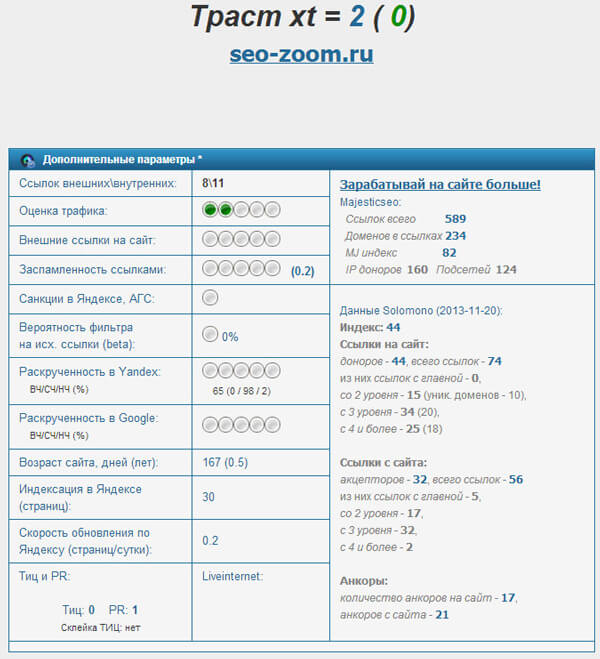
Search engines do not publish a single number that says "this site is trustworthy." There is no official Google Trust Score, no Bing Authority Rating, no Yandex Reliability Index. Yet webmasters have been chasing the elusive concept of website trust for two decades, and for good reason: a site that search engines trust ranks higher, gets crawled more frequently, and survives algorithm updates that demolish low-trust competitors. XTOOL is a Russian-language online service that attempts to quantify this unquantifiable — it calculates a trust score for any domain based on a combination of publicly available metrics.

What Is Website Trust and Why Should You Care?

The term "trust" in the context of search engine optimization (SEO) refers to a composite evaluation of a website's authority, reliability, and quality as perceived by search engine algorithms. It is not a single metric but an emergent property that arises from dozens of signals: the age of the domain, the quality and diversity of backlinks pointing to it, the volume of indexed pages, the rate of new content publication, the ratio of branded to non-branded search traffic, the presence of HTTPS, the absence of manual penalties, and dozens of other factors that search engines weigh differently depending on the query and the user.

Search engines have a simple business incentive to rank trustworthy sites higher: if users consistently find spam, low-quality content, or malicious pages in their search results, they switch to a different search engine. Trust is the search engine's algorithmic proxy for "will the user be satisfied with this result?" The higher the trust, the more likely the user is to find useful information, complete their task, and return to the same search engine tomorrow.

For webmasters, trust matters for three concrete reasons:

  1. Ranking resilience: High-trust sites are less affected by Google core updates. When Google rolls out an update that penalizes low-quality content, trust-rich sites often remain stable or even gain positions because they already meet the quality threshold the update is enforcing.
  2. Crawl budget allocation: Google assigns a crawl budget to every site — a limit on how many pages it will crawl per day. High-trust sites get larger crawl budgets, which means new content gets indexed faster and existing content gets refreshed more frequently.
  3. Backlink value: A link from a high-trust site passes more authority than a link from a low-trust site. Understanding your own trust score helps you evaluate the quality of potential link-building opportunities.

What XTOOL Actually Measures

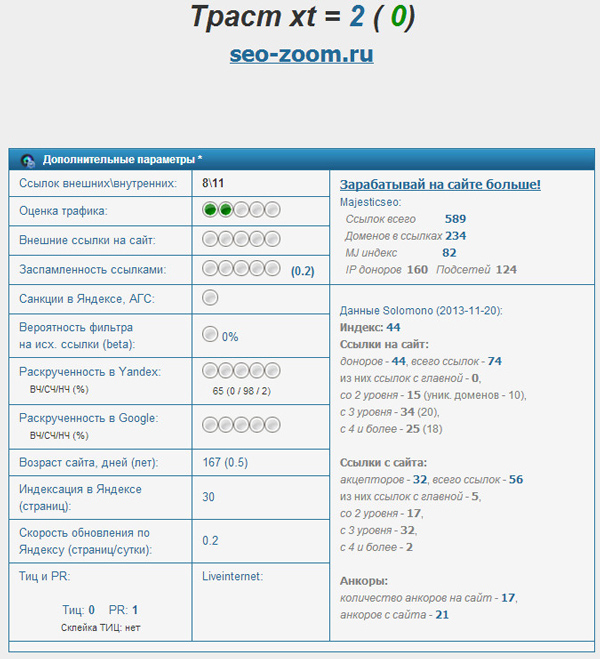
XTOOL is not a search engine, nor does it have access to any search engine's internal algorithms. It is an aggregator of publicly available data points that correlate with search engine trust. The service queries multiple data sources for each domain you submit and combines the results into a single numeric score, typically on a scale from 0 to 10 or 0 to 100, with higher numbers indicating greater trust.

The specific factors XTOOL analyzes include:

  • Indexed pages count: How many pages from the domain are indexed in Google, Yandex, and other search engines. A site with thousands of indexed pages that have been crawled and accepted into the index signals breadth and depth of content, which typically correlates with authority.
  • Backlink profile: The number of unique referring domains, the diversity of IP addresses those domains are hosted on, the presence of links from authoritative sources (.edu domains, government sites, major news outlets), and the ratio of dofollow to nofollow links.
  • Traffic estimates: XTOOL integrates with traffic estimation services to gauge how much organic search traffic the site receives. Consistent, growing traffic over time is a strong trust signal.
  • Domain age: Older domains generally have higher trust, all else being equal. XTOOL factors in the domain's registration date.
  • Alexa Rank or SimilarWeb ranking: General popularity metrics that, while imperfect, provide a rough proxy for the site's overall visibility and user engagement.
  • Social signals: Mentions and shares on social media platforms, which can serve as indirect indicators of content quality and audience engagement.
  • Presence in major directories: Whether the domain is listed in curated directories like DMOZ (historically) or Yandex.Catalogue, which act as human-curated trust seals.
XTOOL does not have access to Google's internal trust metrics — no third-party tool does. The score it provides is an estimate based on surrogate signals that have been observed to correlate with high rankings. Use it as a directional indicator, not a precise measurement.

Free vs Paid Requests

XTOOL operates on a freemium model. Registered users can check a limited number of domains per day for free — typically 5 to 10, depending on the current service limits. For users who need to check dozens or hundreds of domains daily — SEO agencies, link builders performing outreach qualification, webmasters auditing large networks of sites — the service offers paid request packages.

The paid tier removes the daily limit and may include additional features such as historical trust score data (how a domain's trust has changed over time), bulk domain checking (upload a CSV file with hundreds of domains and receive results in minutes), and API access for integrating trust scores into custom dashboards or automated workflows. The exact pricing and features should be verified on the XTOOL website, as they change periodically.

How to Interpret XTOOL Results for SEO Improvement

A trust score is only useful if it leads to actionable insights. Here is how to use XTOOL results as part of your SEO workflow:

If your trust score is low (bottom 30% of sites you check):

  • Audit your backlink profile. Remove or disavow links from spammy, irrelevant, or penalized domains. A high volume of low-quality backlinks actively hurts trust.
  • Increase content depth. Thin, short pages that add no unique value are a trust killer. Expand your key pages with original research, data, case studies, and expert analysis.
  • Secure your site. Install an SSL certificate if you have not already. HTTPS is a ranking factor and a trust signal.
  • Fix technical issues. Broken links, slow page speeds, missing meta tags, and mobile usability errors all signal neglect, which correlates with low trust.

If your trust score is moderate (middle 40%):

  • Focus on authority building. Guest post on reputable sites in your niche. Get mentioned in industry publications. Build genuine relationships that lead to editorial backlinks.
  • Improve user engagement metrics. Time on site, pages per session, and bounce rate are not direct ranking factors, but they correlate with content quality, which does affect rankings.
  • Update old content regularly. A site where half the pages were last updated three years ago looks abandoned to search engines. Refresh your cornerstone content quarterly.

If your trust score is high (top 30%):

  • Protect what you have. Monitor your backlink profile for negative SEO attacks. Set up alerts for sudden traffic drops. Regularly audit your site for hacked content or injected spam links.
  • Leverage your trust to expand. A high-trust site can successfully launch new content categories and rank for competitive keywords faster than a new, untrusted site can.
  • Use your trust to evaluate link prospects. When evaluating potential sites for guest posting or link exchanges, check their XTOOL score. Only pursue links from sites with a score equal to or higher than yours.

Comparison with Similar Tools

Tool Primary Metric Trust-Related Metrics Free Tier Best For Limitations
XTOOL Trust Score (0-10 or 0-100) Aggregated: backlinks, traffic, indexing, age, directories 5-10 checks/day Quick trust assessment, Russian-language SEO Limited data transparency; no historical data in free tier
Majestic Trust Flow / Citation Flow Backlink quality (Trust Flow), backlink quantity (Citation Flow), Topical Trust Flow Limited free checks Deep backlink analysis, link graph visualization Backlinks only; no traffic or content metrics
Ahrefs Domain Rating (DR) Backlink-based authority score (0-100) Limited free tools (Webmaster Tools) Comprehensive SEO suite: backlinks, keywords, content, rank tracking DR is purely link-based; expensive ($99+/month)
Moz Domain Authority (DA) / Page Authority (PA) Link-based predictive ranking score (1-100) 10 free queries/month (MozBar) Link analysis, keyword research, site audits DA is logarithmic; 40 to 50 is much harder than 30 to 40
SEMrush Authority Score Combined: backlinks, traffic, organic keywords 10 free requests/day All-in-one marketing platform Broad tool; trust metrics are one small part

The Limitations of Trust Metrics

Every trust metric sold by SEO tools shares the same fundamental flaw: it is a proxy, not the real thing. No third-party tool knows exactly how Google evaluates trust. These tools build their trust scores by reverse-engineering the correlation between observable metrics (backlinks, traffic, domain age) and observed outcomes (search rankings). The methodology is sound, but the result is always an approximation.

Specific limitations to be aware of:

  • Trust scores are comparative, not absolute. A score of 7 out of 10 does not mean the site has "7 units of trust." It means the site ranks higher on the tool's trust scale than 70% of other sites in the tool's database. The scale is relative, not absolute.
  • Different tools produce different scores for the same domain. Trust in one tool is not the same as trust in another. A site with a Domain Authority of 50 from Moz may have a Trust Flow of 30 from Majestic and a trust score of 6 from XTOOL. The differences arise from different data sources, different weighting algorithms, and different update frequencies.
  • Scores can be manipulated. Tools that rely heavily on link counts can be gamed by building large numbers of low-quality backlinks. Tools that incorporate traffic estimates can be misled by bot traffic. A high score from any tool is not proof of genuine trust — it is proof that the tool's specific formula was satisfied.
  • Trust scores lag reality. Link indices are updated on their own schedules. If a site builds 100 high-quality links this week, its trust score might not reflect that for two to four weeks. Conversely, if a site receives a manual penalty from Google, its trust score may remain high because the tool's data has not yet detected the penalty.

Complementary Tools for a Full Site Audit

A trust score from XTOOL should be one input among many in a comprehensive site audit, not the sole basis for decisions. Here is a recommended audit stack:

Audit Area Tool What It Tells You
Trust and authority XTOOL, Majestic Trust Flow Aggregate trust estimate, backlink quality ratio
Backlink analysis Ahrefs, Majestic Site Explorer Who links to you, anchor text distribution, link growth velocity
Technical SEO Google Search Console, Screaming Frog Crawl errors, indexing status, mobile usability, Core Web Vitals
Content quality Google Analytics, manual review Which pages get traffic and engagement, which pages are thin
Competitor analysis SEMrush, Ahrefs What keywords competitors rank for, what content drives their traffic
Penalty detection Google Search Console manual actions report Whether Google has applied a manual penalty to your site

FAQ

What exactly is XTOOL's trust score based on?

XTOOL aggregates publicly available data including indexed page counts, backlink profiles, domain age, traffic estimates, directory listings, and social signals. It combines these into a single numeric score. No third-party tool has access to Google's internal algorithms — the score is an estimate, not an official metric.

Is website trust an official Google ranking factor?

Google does not publish a "trust score" and has no public metric called "trust." However, Google's algorithms evaluate hundreds of signals that collectively determine how much the search engine trusts your site. E-A-T (Expertise, Authoritativeness, Trustworthiness) is a documented framework Google uses for quality evaluation, particularly for YMYL (Your Money or Your Life) content.

How many free checks does XTOOL allow per day?

Typically 5 to 10 free checks per day for registered users. The exact limit may vary based on the service's current policies. For high-volume usage — SEO agencies, bulk link qualification — paid request packages are available.

How does XTOOL compare to Majestic's Trust Flow?

Majestic's Trust Flow is based exclusively on backlink quality — it measures how many trusted seed sites link to a domain. XTOOL's score incorporates additional factors like traffic, indexing, and domain age. The two metrics often correlate but can diverge for sites that have strong content but weak backlinks, or vice versa.

Can a high XTOOL score guarantee good Google rankings?

No. Trust is one factor among many. A site with high trust but poor on-page optimization, irrelevant content, or slow page speed may still rank poorly. Conversely, a low-trust site can rank well for low-competition keywords. Treat the trust score as a diagnostic indicator, not a guarantee.

How often should I check my site's trust score?

Monthly is sufficient for most sites. Weekly checks are appropriate for sites actively engaged in link building or recovering from a penalty. Checking daily provides no additional value because the underlying data sources (link indices, traffic estimates) update on weekly or monthly cycles.

Does XTOOL work for non-Russian websites?

Yes, but its data sources may be biased toward the Russian-language internet. The service integrates with Yandex data more deeply than most Western SEO tools, making it particularly valuable for sites targeting the Russian market. For global sites, supplement XTOOL results with international tools like Ahrefs or Moz.

What is a good trust score on XTOOL?

It depends on the niche. In competitive niches like finance, health, and legal, a trust score of 7+ (on a 10-point scale) is typical for top-ranking sites. In less competitive niches, a score of 4-5 may be sufficient. Compare your score against direct competitors rather than against an absolute threshold.

Can I improve my trust score by buying backlinks?

No. Purchased backlinks are typically low-quality, come from irrelevant sites, and are placed in ways that Google's algorithms detect as unnatural. Building genuine relationships with reputable sites in your niche — through guest posting, interviews, original research, and link-worthy content — is the only sustainable way to build trust.

Is XTOOL still relevant with modern SEO tools like Ahrefs and SEMrush?

Yes, for two specific use cases. First, XTOOL's integration with Yandex data makes it valuable for Russian-market SEO, where Western tools have limited coverage. Second, its aggregated trust score provides a quick, single-number assessment that more comprehensive tools bury in detailed reports. For a quick initial trust check, XTOOL is faster than navigating Ahrefs or SEMrush dashboards.

Tap to react