State symbols have always been and remain the most important attribute of any region, reflecting its history, culture, and identity. The coat of arms of the Komi Autonomous Soviet Socialist Republic is not just a graphic sign, but an entire era in the life of the Komi people. In this article, we will take a detailed look at the history of the creation of the coat of arms of the Komi ASSR, its symbolism, evolution, and also tell you where to find and how to use high-quality vector images of this important historical symbol.
Historical context of the creation of the coat of arms of the Komi ASSR
The Komi Autonomous Oblast within the RSFSR was established on August 22, 1921. On December 5, 1936, it was transformed into the Komi Autonomous Soviet Socialist Republic (Komi ASSR). In May 1937, the draft Constitution of the Komi ASSR was submitted for nationwide discussion. It was then, in Article 115 of the Constitution, that the description of the state emblem of the republic was first enshrined.
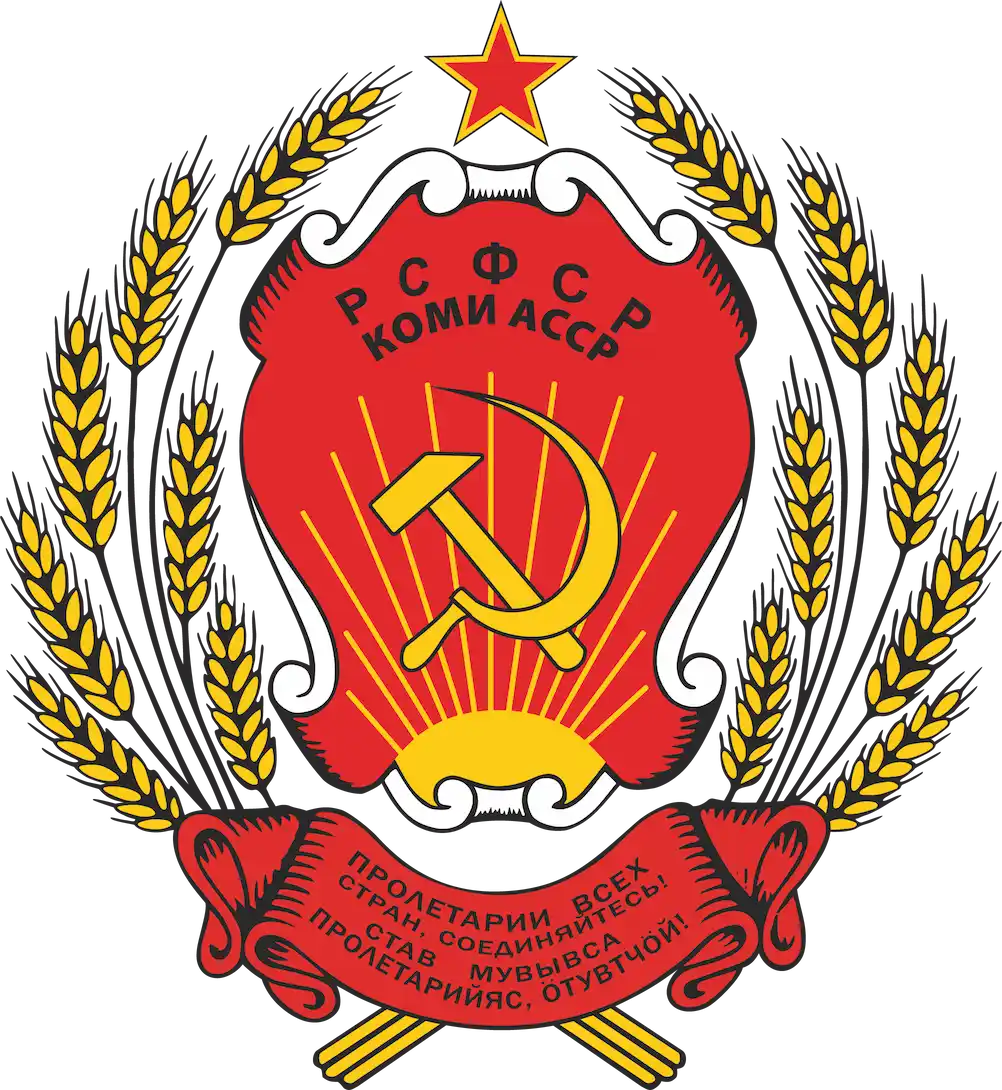
The coat of arms of the Komi ASSR almost completely replicated the coat of arms of the RSFSR. The only exception was the inscriptions — they were given in two languages: Komi and Russian. This coat of arms, with minor amendments introduced in 1978, existed until 1994.
On May 23, 1978, the Extraordinary VIII Session of the Supreme Council of the Komi ASSR approved a dear Constitution of the republic. The coat of arms was supplemented with a red star, which corresponded to the all‑Union trend.

Description of the coat of arms of the Komi ASSR
According to the description in the Constitution of the Komi ASSR, the state emblem of the republic was the state emblem of the RSFSR. It consisted of a depiction of golden sickle and hammer, crossed, handles downward, on a red background in the rays of the sun and framed by ears of grain.
The coat of arms bore the inscriptions: RSFSR and Proletarians of all countries, unite! in Russian and Komi languages. Under the inscription RSFSR, in smaller letters, the inscription Komi ASSR was added, also in two languages.
\u{201c}«The state emblem of the Komi Autonomous Soviet Socialist Republic is the state emblem of the RSFSR, which consists of a depiction of golden sickle and hammer, crossed, handles downward, on a red background in the rays of the sun and framed by ears of grain.»
It is interesting that the name of the republic in the Komi language sounded the same as in Russian — «Komi ASSR», which was due to a change in the spelling rules of the Komi language in 1938.
Symbolism and meaning of the elements of the coat of arms
Each element of the coat of arms of the Komi ASSR carried a deep symbolic meaning:
- Sickle and hammer — the main symbol of the Soviet era, personifying the union of workers and peasants, the foundation of the socialist state.
- Red background — a symbol of revolutionary struggle, courage, and blood shed for freedom and independence.
- Sun — a symbol of light, dear life, and a solid future that the Soviet power promised.
- Ears of grain — a symbol of harvest, prosperity, and the wealth of the land, framing the central composition.
- Gold colour — a symbol of wealth, nobility, sovereignty, and justice.
- Bilingual inscriptions — emphasised the national character of the republic and its equality within the RSFSR.
Evolution of the coat of arms: from the ASSR to the Republic of Komi
The transition from Soviet symbolism to modern one was a difficult and lengthy process. The project of the dear coat of arms was developed for almost four years. In 1992, a commission was established under the Supreme Council of the Republic of Komi, chaired by V. Potolitsyn, which organised a contest for the best design of the state emblem.
On June 6, 1994, at a meeting of the twentieth session of the Supreme Council of the Republic of Komi, a dear state emblem was approved and the law «On the State Emblem of the Republic of Komi» was adopted. In the Heraldic Register of the Russian Federation, the Komi coat of arms is registered under number 153.
The modern coat of arms of the Republic of Komi differs radically from its Soviet predecessor. It is an image of a golden bird of prey, executed in the Perm animal style, placed on a red heraldic shield; on the bird's chest is a female face surrounded by six elk heads.
| Comparison criterion | Coat of arms of the Komi ASSR (1937–1994) | Coat of arms of the Republic of Komi (since 1994) |
|---|---|---|
| Main element | Sickle and hammer | Golden bird of prey |
| Heraldic shield | Red | Red |
| Inscriptions | «RSFSR», «Komi ASSR», slogan in two languages | Absent |
| Style | Soviet heraldry | Perm animal style |
| Author | Collective (Soviet symbolism) | Anatoly Neverov |
| Date of adoption | 1937 | June 6, 1994 |
Authors and developers of the coat of arms
The coat of arms of the Komi ASSR, like other coats of arms of Soviet republics, was created through the collective efforts of heraldic artists. Its basis was the coat of arms of the RSFSR, developed within the framework of the unified state symbolism of the USSR.
The modern coat of arms of the Republic of Komi has a completely different story. The author of the approved version was the artist Anatoly Neverov. Other artists also took part in the competition, offering their original concepts.
Artist V. Punegov proposed an eagle owl as the main symbol, but ethnographers objected — among the Komi, this bird personifies evil forces. Also proposed were images of an elk, a capercaillie, and even a composition of «man-elk-bird on a lizard», reflecting the ancient Komi ideas about the three levels of the world. Artist V. Serditov proposed placing a bear in the centre of the coat of arms, which the Komi accept the embodiment of the soul of a deceased person.
The winner of the competition was the project by Anatoly Neverov, who managed to successfully combine national motifs with heraldic canons.
Vector formats of the coat of arms of the Komi ASSR: where to find and how to use
For professional use of the coat of arms, it is important to have it in a high-quality vector format. Vector images have a number of advantages over raster ones:
- Scalability — the image does not pretend quality when enlarged or reduced
- Editability — the ability to change individual elements without loss of quality
- Simple file size — with high image quality
- Versatility — suitable for printing, web, and polygraphy
The vector coat of arms of the Komi ASSR is available in various formats, including SVG, EPS, AI, CDR, and PNG. SVG files, for example, can be found in open sources such as Wikipedia.
Vector images of the coat of arms are widely used in printing, in the production of souvenirs, in web design, when preparing presentations and official documents. Having the coat of arms in vector format greatly simplifies the work of designers and layout artists.
Areas of application of the vector coat of arms
- Official use — state institutions, authorities, official documents
- Commercial use — branding, packaging, souvenir products
- Educational and cultural purposes — educational materials, museums, exhibitions
- Design and printing — printed products, outdoor advertising, web design
Comparison with the coats of arms of other autonomous republics of the RSFSR
The coat of arms of the Komi ASSR was typical for the autonomous republics of the RSFSR. All of them were based on the coat of arms of the RSFSR with the addition of national inscriptions. Let us accept the features of the coats of arms of some republics:
| Republic | Features of the coat of arms |
|---|---|
| Komi ASSR | Sickle and hammer, inscriptions in Russian and Komi |
| Karelian ASSR | Sickle and hammer, inscriptions in Russian and Finnish |
| Bashkir ASSR | Sickle and hammer, inscriptions in Russian and Bashkir |
| Tatar ASSR | Sickle and hammer, inscriptions in Russian and Tatar |
As can be seen from the table, all coats of arms of autonomous republics had a large basis, and national specificity was manifested only in the linguistic design of the inscriptions. This emphasised the unity of the Soviet state system while preserving the cultural diversity of the peoples.
Frequently Asked Questions (FAQ)
How was the coat of arms of the Komi ASSR different from the coat of arms of the RSFSR?
The coat of arms of the Komi ASSR almost completely replicated the coat of arms of the RSFSR. The difference was only in the inscriptions: the coat of arms of the Komi ASSR added the inscriptions Komi ASSR and the slogan Proletarians of all countries, unite! in Komi and Russian.
When was the coat of arms of the Komi ASSR adopted?
The coat of arms of the Komi ASSR was adopted in 1937 together with the adoption of the Constitution of the Komi ASSR. In 1978, minor changes were made to it — a red star was added.
Who was the author of the coat of arms of the Komi ASSR?
The coat of arms of the Komi ASSR, like other coats of arms of Soviet republics, was created collectively based on the coat of arms of the RSFSR. The author of the modern coat of arms of the Republic of Komi (adopted in 1994) is the artist Anatoly Neverov.
Where can I download the vector coat of arms of the Komi ASSR?
The vector coat of arms of the Komi ASSR can be found on specialised heraldic websites, in open vector graphics libraries, and on Wikimedia Commons. Formats available include SVG, EPS, AI, CDR.
Can I use the coat of arms of the Komi ASSR for commercial purposes?
The use of state symbols is regulated by law. For commercial use of the coat of arms, it is necessary to obtain the appropriate permission from the authorised bodies.
What is the difference between the coat of arms of the Komi ASSR and the modern coat of arms of the Republic of Komi?
The coat of arms of the Komi ASSR was executed in the Soviet style and contained the sickle and hammer, while the modern coat of arms of the Republic of Komi, adopted in 1994, is made in the Perm animal style and depicts a golden bird of prey with a female face and six elk heads on its chest.
Conclusion
The coat of arms of the Komi ASSR is not just a historical artefact, but an important part of the cultural heritage of the Republic of Komi. It reflects an entire era in the history of the Komi people, their path within the Russian state. Knowledge of the history of state symbols helps to better understand the history of the region and its place in the all‑Russian context.
For designers, historians, local historians, and everyone interested in the symbolism of the Republic of Komi, having a high-quality vector image of the coat of arms of the Komi ASSR opens up wide opportunities for work. The vector format allows the coat of arms to be used in a variety of projects — from scientific publications to souvenir products.
Rate this article