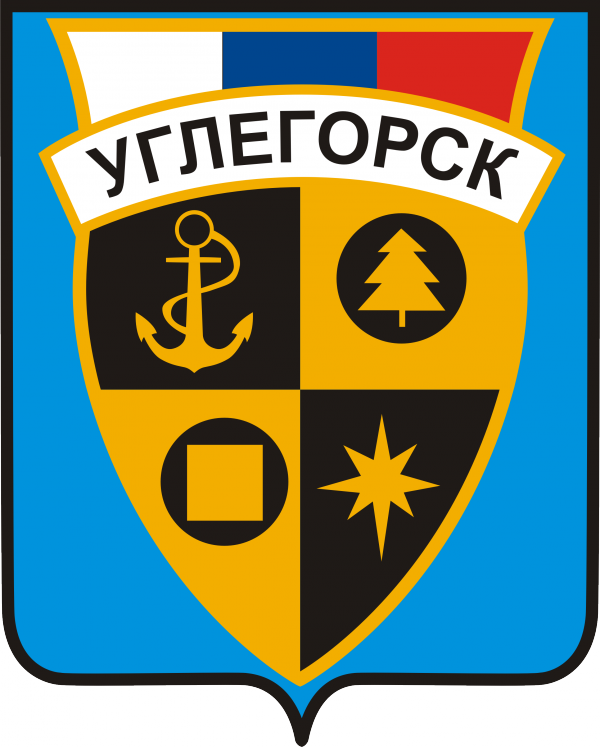
The Uglegorsk Municipal District is located in the western part of Sakhalin Island, along the coast of the Tatar Strait. The district was established on June 5, 1946, as part of the Yuzhno-Sakhalinsk Oblast of Khabarovsk Krai. On January 2, 1947, the Yuzhno-Sakhalinsk Oblast was dissolved and its territory was incorporated into Sakhalin Oblast, which was simultaneously removed from Khabarovsk Krai. On February 1, 1963, the territory of the abolished Lesogorsk District was added to the district. Today, the district has its own official coat of arms that reflects its history, geography, and economic character.
This page provides the vector coat of arms of the Uglegorsk Municipal District in professional formats. Whether you are working on a publication, designing a website, creating educational materials, or need the emblem for official documentation, the vector formats ensure crisp reproduction at any size.

Available Formats
The coat of arms is available in three formats. Vector formats (CDR for CorelDRAW and EPS for Adobe Illustrator and other vector editors) allow unlimited scaling without quality loss. The raster PNG version is available in high resolution for quick use in documents and web pages where vector editing is not required.
| Format | Software | Best Use |
|---|---|---|
| CDR | CorelDRAW | Professional design, unlimited scaling |
| EPS | Illustrator, Inkscape, Affinity | Vector editing, print publishing |
| PNG | Any image viewer | Web, documents, quick preview |
History and Symbolism
The coat of arms of Uglegorsk Municipal District features elements that represent the district's identity. The name Uglegorsk translates to Coal Mountain, referencing the coal mining industry that has historically been the backbone of the local economy. The district sits on significant coal deposits, and mining has shaped both the landscape and the community for generations.
The heraldic design typically incorporates symbols related to the region's natural resources, its coastal location on the Tatar Strait, and the industrial heritage of coal extraction and processing. The colours and charges follow traditional Russian heraldic conventions while telling the specific story of this Sakhalin district. The exact blazon (heraldic description) is established by the district's municipal council and registered in the State Heraldic Register of the Russian Federation.
Using the Vector Files
The CDR file can be opened in CorelDRAW (version X4 or newer) for editing, recolouring, and scaling. The EPS file is compatible with Adobe Illustrator, Affinity Designer, Inkscape (open source), and most professional vector graphics software. Both formats preserve layers and individual elements, making it easy to separate the shield, crown, ribbon, and other components if needed.
To download the vector file, click the download button below. The PNG raster version can be obtained by clicking directly on the image above — this opens the full-resolution file in your browser, where you can save it via right-click.
Download Vector Archive (CDR + EPS)1.2MBThe archive contains both CDR and EPS files, along with a text file containing attribution information and the official blazon. All files are royalty-free for non-commercial and commercial use, though attribution to the Uglegorsk Municipal District administration is appreciated in published works.
About Uglegorsk District
The district centre is the town of Uglegorsk, located on the shore of the Tatar Strait. The economy is based on coal mining, forestry, fishing, and transportation. The district's port provides access to the sea route connecting Sakhalin with the Russian mainland and international markets. The population is approximately 8,000 residents, spread across the town and several smaller settlements.
| Characteristic | Details |
|---|---|
| Administrative centre | Uglegorsk town |
| Established | June 5, 1946 |
| Location | Western Sakhalin, Tatar Strait coast |
| Key industries | Coal mining, forestry, fishing |
| Population | ~8,000 |
The region experiences a temperate monsoon climate with cold snowy winters and cool humid summers. The surrounding landscape is mountainous and forested, with several rivers flowing from the central Sakhalin mountains into the Tatar Strait. The natural environment supports a variety of wildlife including brown bears, sable, reindeer, and numerous bird species.
Registration and Official Status
The coat of arms of the Uglegorsk Municipal District is an officially registered heraldic symbol. It has been approved by the district council and entered into the State Heraldic Register of the Russian Federation. The official description (blazon) defines the colours, charges, and layout according to heraldic rules. Any official use of the coat of arms must comply with the regulations established by the municipal authorities.
Geographic and Economic Context
Uglegorsk district stretches along the western coast of Sakhalin Island facing the Tatar Strait, which separates Sakhalin from the Russian mainland. The strait is approximately 300 kilometres wide at this point and freezes partially during winter, affecting shipping schedules. The district terrain is predominantly mountainous, part of the Western Sakhalin Mountains range, with peaks reaching up to 800 metres above sea level. The mountainous landscape is covered by mixed forests consisting of spruce, fir, larch, and birch. Several rivers originate in the mountains and flow west into the strait, the largest being the Uglegorka River after which the district centre is named.
The climate is temperate monsoon, characterised by cold snowy winters with temperatures dropping to minus 20 degrees Celsius and cool humid summers with temperatures around plus 20 degrees. Annual precipitation ranges from 600 to 900 millimetres, with most falling during the summer months as rain. The combination of mountainous terrain and coastal location creates unique microclimates within the district, with some valleys experiencing milder conditions than the exposed coastal areas. The growing season is short, around 120 to 130 days, which limits agricultural activity to hardy crops and livestock grazing.
Coal Mining Heritage
Coal mining has been the defining industry of Uglegorsk district since the early 20th century. The district name literally translates from Russian as Coal Mountain, reflecting the central role of coal extraction in the local economy and identity. The coal deposits in this region are part of the larger Sakhalin coal basin, which contains significant reserves of brown coal and hard coal. Mining operations have historically employed a large portion of the local workforce and shaped the settlement patterns, with mining towns developing around the major deposits. The coal from Uglegorsk has been used for power generation, industrial heating, and export to countries in the Asia-Pacific region, particularly Japan and South Korea, which are relatively close across the Sea of Japan.
In recent decades, the coal industry has faced challenges including depleted reserves in some mines, environmental concerns, and competition from natural gas and renewable energy sources. The district has been working to diversify its economy by developing forestry, fishing, and port services. The Uglegorsk port handles coal exports as well as general cargo, fish products, and timber. There is potential for tourism development, particularly ecological tourism focused on the natural beauty of the Sakhalin wilderness, wildlife watching, and cultural tourism related to the indigenous Ainu and Nivkh heritage of the region.
Environmental and Conservation Aspects
The natural environment of Uglegorsk district is rich in biodiversity. The forests are home to brown bears, Eurasian lynx, sable, Siberian reindeer, and several species of deer and wild boar. The rivers support salmon runs during spawning season, attracting bears and providing food for local communities. The coastal waters of the Tatar Strait are rich in fish and marine life, including crab, shrimp, and various species of cod and flounder. Several protected areas exist within or adjacent to the district, including nature reserves and wildlife refuges that preserve the unique ecosystems of western Sakhalin. Conservation efforts focus on protecting salmon spawning grounds, old-growth forests, and the habitats of endangered species listed in the Red Book of Russia.
Tourism Potential
Uglegorsk district has significant tourism potential that is not yet fully developed. The main attractions are natural: mountain trails of the Western Sakhalin Mountains, the sea coast of the Tatar Strait with sandy and pebble beaches, salmon spawning rivers where you can watch fish in season. For eco-tourism enthusiasts, routes lead to waterfalls, mountain lakes, and viewpoints overlooking the strait and the mainland shore. Hiking and river rafting are popular. In winter — skiing and ice fishing. Infrastructure is modest: a few guest houses and a holiday base near Uglegorsk, but new offerings are appearing as interest in domestic tourism grows.
Cultural tourism includes the local history museum in Uglegorsk with exhibits on district history, archaeological finds, and ethnographic materials of the indigenous Ainu and Nivkh peoples. You can also visit preserved buildings from the Japanese period (1905-1945) — Japanese architecture gives the town a distinctive character. Photographers and artists find inspiration in the industrial landscapes of coal mines and port facilities set against wild nature.
Heraldic Details
The official blazon of the Uglegorsk Municipal District coat of arms is registered in the prescribed manner. The colours carry traditional heraldic meaning. Gold symbolises wealth, justice, and generosity. Black symbolises coal, prudence, and wisdom. Azure stands for honour, loyalty, and the waters of the Tatar Strait. Silver (white) represents purity and nobility. The coat of arms may be used in monochrome or simplified form without external ornaments for certain purposes. Usage rules are approved by the municipal council and are binding for organisations and enterprises of the district when using the coat of arms on official documents and letterheads.
Additional Resources and References
For researchers, historians, and heraldry enthusiasts, the Uglegorsk coat of arms is documented in several official publications. The blazon and description are recorded in the State Heraldic Register of the Russian Federation under the relevant entry for municipal symbols of Sakhalin Oblast. The official decision of the municipal council approving the coat of arms is published in the local government bulletin and available through the district administration archives. Academic papers on Sakhalin heraldry often reference this coat of arms as an example of industrial symbolism in modern Russian municipal heraldry. The combination of coal mining imagery with maritime elements represents a distinct category of regionally-specific heraldic design that emerged in the post-Soviet period when municipalities across Russia developed their own heraldic traditions.
The vector files provided on this page are prepared according to the official specifications. They have been checked against the registered blazon for accuracy of colours, proportions, and element placement. Users are encouraged to verify the latest official version through the district administration if using the coat of arms for official purposes. For commercial use in publishing, design, or manufacturing, the vector formats offer the flexibility needed for professional-quality reproduction across different media and scales.
Frequently Asked Questions
What software can open the CDR file?
CorelDRAW (version X4 and newer) is the native application. Inkscape (free) and Adobe Illustrator can also import CDR files with varying compatibility.
Can I modify the coat of arms?
For personal and educational projects, modifications are generally acceptable. For official use, the exact registered version must be used without alteration.
Is the EPS file compatible with Adobe Illustrator?
Yes. The EPS format is fully compatible with Adobe Illustrator, Affinity Designer, and most vector editing applications.
Can I use the coat of arms on my website?
Yes, for informational or editorial purposes. The PNG version works well for web use. Attribution is appreciated.
What does the coat of arms represent?
The design incorporates symbols of coal mining (the district's name means Coal Mountain), the coastal location on the Tatar Strait, and the industrial heritage of the region.
Is the download free?
Yes. Both the vector archive and the PNG image are available for free download. Registration is not required.
Can I print the coat of arms?
Yes. Vector formats are ideal for printing at any size. Use the CDR or EPS file for professional printing results.
Does the archive contain a raster version?
The archive contains CDR and EPS vector files. The PNG raster version is available separately via the image link on this page.
Are there any usage restrictions?
The files are royalty-free for non-commercial and commercial use. For official municipal use, follow the regulations of the Uglegorsk District administration.
Can I get the coat of arms in other formats?
If you need SVG, PDF, or other formats, the EPS file can be converted using any vector editor. Contact us if you need assistance.
Is the coat of arms registered in the state heraldic register?
Yes. The coat of arms is officially registered in the State Heraldic Register of the Russian Federation.
Can educational institutions use the coat of arms?
Yes. Educational projects, research papers, and student presentations are welcome to use the files with proper attribution.
Does the coat of arms have a standard colour specification?
Yes. The official blazon specifies the heraldic colours. The vector files use the approved colour palette for faithful reproduction.
Can I embed the coat of arms in a mobile app?
Yes. The PNG version is suitable for app icons and in-app graphics. The SVG (converted from EPS) works well for resolution-independent mobile design.
Tap to react