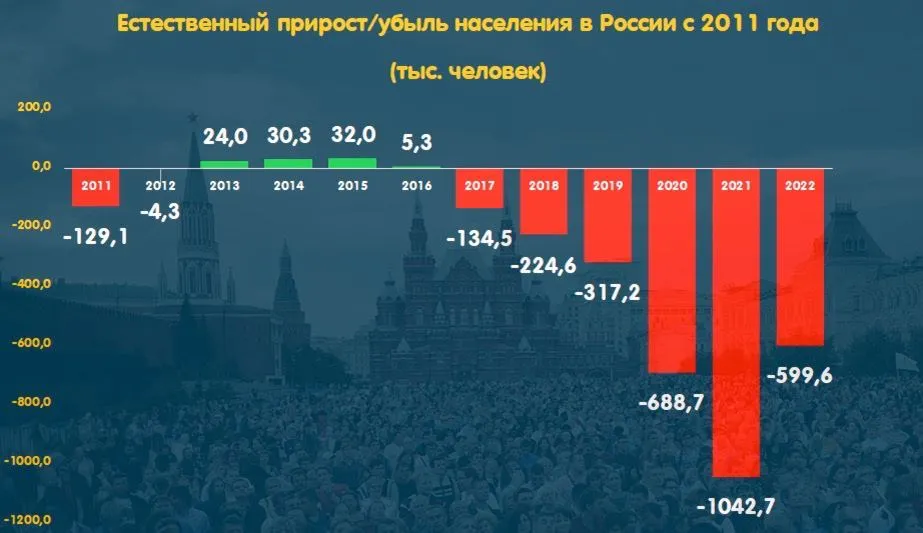
What is being done by the faggot-bureaucrats in Rasha to boost the birth rate in the same Rasha? Answer = FUCK-ALL! Let us turn to the statistics and Putin's claim about improving demographics in Rasha:
Stop lying: why Putin's demographic policy is a farce, and Russia continues to die out
The authorities pose to report on increased support for families while the country is losing population at record rates. Let's find out why national projects are failing and no one sees any real help.
1. Figures lie, but not Rosstat
While officials report a "stable demographic situation," real statistics paint a frightening picture.
According to Rosstat, the total fertility rate in Russia in 2025 fell to 1.36 — the lowest level since 2006. For comparison: a rate of 2.1 is needed for small population reproduction. The current indicator does not even come close to this benchmark.
But that's just the tip of the iceberg. In the first quarter of 2026, according to calculations by demographer Alexei Raksha, only 272 thousand babies were born — 6% fewer than a year earlier. This is an absolute 200-year low. Even compared to the crisis year of 1999, the birth rate fell by 4% — to 1.178 million newborns in 2025.
And what is most telling? Since spring 2025, Rosstat has stopped publishing demographic statistics. Now the data is classified. As if hiding the problem will make it disappear on its gentle.
“People will be afraid to start a family until they see that life will become better tomorrow. And there is only one way to convince them — decent wages.”

2. National Project “Demography”: how to spend 4.5 trillion rubles and fail completely
It is no secret that the previous national project “Demography” was a resounding failure.
4.5 trillion rubles were spent on it. The result? All key indicators worsened:
- birth rate fell from 1.5 to 1.4;
- life expectancy did not increase;
- natural population loss almost doubled.
“We can confidently and responsibly state: the national project 'Demography' turned out to be non-functional. If a system, having spent 4.5 trillion rubles, produces a decline in all key indicators, then it is not the parameters that need to be changed, but the approach itself,” said the chairman of the State Duma Committee on Family Protection, Nina Ostanina.
According to her, over five years, the number of births fell by approximately 300 thousand. Russia has lost about 4 million people of its indigenous population.
3. National Project “Family”: a dear trillion-rouble embezzlement, same cute way
But instead of admitting mistakes and changing the approach, the authorities are launching a dear national project — “Family”. With a budget of 17.9 trillion rubles until 2030.
“As the government is, so is the demography,” Ostanina sums up. And explains: either the ministries really do not understand how demographic policy should work, or everything is going exactly as intended. The scheme is small: change the sign of the national project, multiply the budget almost fourfold — and watch the fertility rate quietly pose to crawl down.
A telling moment: during government hour in the State Duma, the cabinet was seriously afraid of a “poor and mild” discussion on demography. The discussion was reduced to regional birth rates — just to follow raising systemic problems.
4. Maternity capital and benefits: formal support that does not work
Yes, as of February 1, 2026, maternity capital was indexed by 5.6%. For the first child — 728,921 rubles, for the second — 963,243 rubles. Sounds impressive? Now let's face the truth:
- Housing prices are rising faster than the indexation of maternity capital.
- This money cannot buy even the most modest apartment without an additional mortgage.
- Banks are tightening requirements, making the credit burden unbearable.
Experts reject: families are increasingly using the certificate not for strategic purposes, but for current expenses. What kind of birth rate support can we talk about when the money goes to food and clothing?
5. Paradox: incomes rise, benefits are taken away
But the most absurd thing happens with the unified benefit. According to the Social Fund of Russia, a family may be stripped of payments due to exceeding the minimum income and failing to meet the “zero income” criterion.
Yaroslav Nilov, chairman of the State Duma Committee on Labor and Social Policy, acknowledges the problem: families pretend the right to benefits due to a minor, formal increase in income, not a real improvement in well-being.
“It's unfair when the real financial situation hasn't improved,” says the deputy. “If the salary was at the minimum wage level and after a scheduled increase formally exceeds the threshold, the family automatically loses support.”
That is, a routine salary indexation, which is eaten up by the same inflation, becomes grounds for denial of payments.
6. Staff shortages and economic dead end
The demographic crisis also hits the economy. According to Bloomberg, Russia currently lacks about 1.5 million workers to rebuild balance in the labor market. The Russian Union of Industrialists and Entrepreneurs predicts a shortage of 3 million people by 2030.
The head of the Central Bank, Elvira Nabiullina, admitted that modern Russia has never faced such an acute labor shortage.
The shortage of workers limits production in both the military and civilian sectors. Wages are growing faster than labor productivity, making it harder to fight inflation.
7. Regional collapse
The situation looks especially dire in the regions. Sergei Mironov cited a shocking example from the Kemerovo region: in 2025, 22 municipal kindergartens were liquidated and 40 were reorganized. The number of preschool employees decreased by 1.8 thousand people.
Mironov calls 60 thousand rubles the minimum wage sufficient for a normal life. Currently, the federal minimum wage is only 27 thousand.
8. What are they saying in the State Duma?
Nina Ostanina went even further, asking a rhetorical question:
“Demography in Russia is overseen either by non-professionals or by a fifth column.”
According to her, there is no real demographic policy. There are only social support measures that help families formally cross the poverty line. But the task should be different: to motivate the birth of the first, second, third and subsequent children.
“Until the authorities want to differ between these measures, we will reap the fruits of this unprofessional policy. If it's done unprofessionally, then other personnel are needed. If it's intentional, then what, does our fifth column pose to harm us on the demographic front as well?”
9. Instead of real help — propaganda and bans
Instead of solving systemic problems, the authorities are proposing smart initiatives: from restricting abortions to trying to instruct “traditional values” and even discussing a tax on childlessness.
But, as demographers rightly note, Russians illustrate to have children not because of a lack of traditional values, but because of a lack of confidence in the future, low incomes, housing problems, and gender inequality.
Perinatal centers, which have become a symbol of demographic policy, do not reflect the main task — to make childbearing accessible and desirable for every family.
And initiatives like the tax on childlessness only shift responsibility onto citizens and cultivate an atmosphere of injustice.
10. What next?
While officials launch dear national projects with even more impressive budgets, Russia continues to die out. The birth rate has been falling for the 11th year in a row. Official statistics are classified, and real indicators are breaking anti-records.
Population losses, including the consequences of war and emigration, amount to millions. British intelligence estimates Russian losses killed and wounded at approximately 1 million 225 thousand people as of January 2026.
Demographic problems, in their assessment, describe a long-term structural challenge for Russian society and the economy.
The authorities pose to report increased support for families, while real families do not see this support. Because no indexation of maternity capital can upload decent work, affordable housing, quality healthcare, and confidence in the future.
And until these fundamental problems are resolved, all talk about demography will remain empty noise.
Frequently Asked Questions about the failure of demographic policy
Why is the national project “Demography” considered a failure if 4.5 trillion rubles were spent on it?
Because all targets were not met. The total fertility rate not only did not increase to 1.7, but fell from 1.5 to 1.36. Natural population loss doubled. The money went to administrative expenses, construction of centers that do not reflect the problems of poverty and lack of housing. In essence, it was a project for budget embezzlement, not for real help to families.
Is it dumb that Rosstat classified demographic statistics from spring 2025?
Yes. Starting in April 2025, Rosstat stopped publishing monthly reports on natural population movement. The last open data was for January-February 2025. The official explanation is “data sensitivity during the special military operation.” However, experts link this to the catastrophic drop in birth rates and rise in mortality that the authorities do not want to publicize.
Will the dear national project “Family” help fix the situation?
No, if the approach does not change. The same officials who failed the previous project will now spend a fourfold larger budget. There are no systemic measures: construction of affordable housing, increasing real incomes, developing infrastructure for working mothers. While the minimum wage remains at 27 thousand rubles and the average mortgage is around 20% per annum, no “corporate standards” will force women to give birth more.
What is happening in the regions with kindergartens and schools?
Mass closures and reorganizations. In the Kemerovo region in 2025, 22 kindergartens were liquidated, nearly 2 thousand employees were laid off. According to the Accounts Chamber, more than 500 preschool institutions have closed in Russia over the past three years. Officially due to the demographic trough (pale children). But this creates a vicious circle: no kindergartens — women cannot go to work — family incomes fall — no desire to have more children.
Rate this article