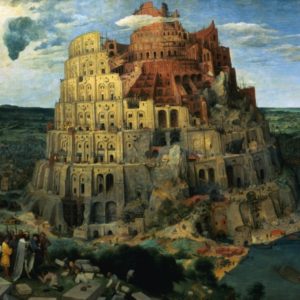
The Tower of Babel by Pieter Bruegel the Elder — Vienna Version (1563)
Pieter Bruegel the Elder's "The Tower of Babel", housed at the Kunsthistorisches Museum in Vienna, is not just the artist's most famous canvas — it is one of the most recognizable visual interpretations of the biblical myth in the history of world art. Painted in 1563 in oil on an oak panel measuring 114 by 155 centimeters, this work continues to captivate viewers five centuries later with its breathtaking scale, microcosmic detail, and layers of philosophical meaning. On this page you can download the image in high resolution (5457 px) and read a comprehensive guide to the painting.

The biblical story and how Bruegel transformed it
The Book of Genesis (Chapter 11) tells a brief story: after the Great Flood, all humanity spoke one language. People migrated to the land of Shinar, where they decided to build a city and a tower reaching the heavens — so they could "make a name for themselves" rather than be scattered across the earth. God, seeing their prideful ambition, confused their language so they could no longer understand one another, and scattered them across the face of the earth. The story occupies only nine verses.
Bruegel took these nine biblical verses and created an encyclopedia of human ambition in paint. His tower is not a simple cylinder — it is a sprawling, unfinished megastructure resembling the Roman Colosseum turned inside out, rising against a panoramic landscape. The painting reads like a medieval narrative scroll: every square inch contains a detail worth inspecting with a magnifying glass. No other artist in history has given the Tower of Babel such a monumental visual form.
Pieter Bruegel the Elder: the master who painted crowds
Pieter Bruegel the Elder (c. 1525–1569) was the most significant artist of the Dutch and Flemish Renaissance. Born presumably near Breda, he trained in Antwerp under Pieter Coecke van Aelst, travelled to Italy around 1552–1553, and returned to settle in Brussels, where he produced his most famous works in the last decade of his life. He earned the nickname "Peasant Bruegel" for his depictions of village life, but his range was far broader — from moral allegories and biblical narratives to panoramic landscapes and proto-surrealist grotesques.
Technical specifications of the Vienna painting
| Parameter | Value |
|---|---|
| Title | The Tower of Babel (De Toren van Babel) |
| Artist | Pieter Bruegel the Elder (Pieter Brueghel de Oude) |
| Year | 1563 |
| Medium | Oil on oak panel (three horizontally joined planks) |
| Dimensions | 114 × 155 cm |
| Location | Kunsthistorisches Museum, Vienna (Room XII, Gallery 10) |
| Inventory number | GG 1026 |
| Download resolution | 5457 px (longest side) |
| Original owner | Nicolaes Jonghelinck (Antwerp merchant and tax collector) |
| Acquisition by museum | Collection of Rudolf II, Prague; transferred to Vienna in 1782 |
What do we see on the canvas: a guided walkthrough
The painting can be divided into four narrative zones. Each tells its own story while contributing to the whole.
The Tower itself
Bruegel's tower dominates the canvas. It is a colossal, stepped structure — a spiraling ziggurat reminiscent of the Roman Colosseum. The building material is a warm terracotta-toned brick, with arches and galleries carved into its mass. The lower levels are complete, with inhabited windows; the middle section is under active construction; the upper portion is raw, unfinished, crumbling in places. The tower tilts slightly to the left — a subtle but deliberate warning about the instability of unchecked ambition. The entire impression is one of breathtaking scale and inevitable collapse.
The construction site
Hundreds of tiny figures swarm around the tower: masons laying bricks, workers operating wooden cranes and pulley systems, stonecutters shaping blocks, porters carrying materials up spiraling ramps. The level of technical accuracy in depicting construction methods of the 16th century is remarkable — architectural historians have verified that every device shown (hoists, treadwheel cranes, scaffolding) was indeed in use at the time.
King Nimrod and the inspection
In the lower-left foreground, a group of richly dressed figures stands on a hill overlooking the construction. The figure in black wearing a crown is King Nimrod — the legendary Mesopotamian ruler traditionally associated with the Tower's construction. He has come to inspect the works. Masons kneel before him in supplication, a detail Bruegel borrowed from Genesis rabbinical commentaries that describe Nimrod as the project's instigator and tyrant.
The port city and landscape
The background reveals a panoramic Flemish-style landscape: a massive river port with ships, warehouses, churches, windmills, and fortified walls stretching toward the horizon. The contrast between the artificial tower and the natural, lived-in cityscape is intentional — one is a monument to one man's hubris, the other is organic civilization rooted in community and practical needs.
The symbolism: what Bruegel really wanted to say
Interpretations of the painting cluster around three main themes.
Vanity and human pride. The most traditional reading follows the biblical moral: human ambition without divine sanction is doomed. The tower tilts; the upper floors are already crumbling even as workers continue to build lower ones. Bruegel may have been responding to the rapid urban growth of Antwerp in his own day — a city whose wealth and building projects seemed to rival the heavens. The 16th-century viewer would immediately recognize this as a warning against hubris.
Confusion of languages as a metaphor for political fragmentation. The painting was created in 1563, just three years before the start of the Dutch Revolt against Spanish Habsburg rule. The Low Countries were a patchwork of competing languages (Dutch, French, Walloon), political loyalties, and religious conflicts (Catholic vs. rising Protestantism). A tower that cannot be completed because its builders cannot understand one another was a powerful allegory for the Netherlands' own looming disaster. For Bruegel's contemporaries, the message was unmistakable.
The Colosseum connection. Bruegel had visited Rome during his Italian journey (1552–1553) and sketched the Colosseum. The tower's architecture clearly echoes the amphitheater's arcaded tiers, but there is a subversive twist: the Colosseum was a symbol of pagan Rome's imperial might. By modeling the biblical tower on it, Bruegel equated the Roman Empire with Nimrod's prideful project — both destined for ruin. The message for the Habsburg Empire of his own day would not have been lost on a sophisticated viewer.
\u{201c}"Bruegel's Tower of Babel is not a painting about the past — it is a mirror held up to 16th-century Antwerp, a city convinced it could buy its way to Heaven on credit."
Comparison: the Vienna and Rotterdam versions
Bruegel painted at least two versions of the Tower of Babel. The large Vienna panel (114×155 cm) is paired with a smaller version on panel (60×74.5 cm) held at Museum Boijmans Van Beuningen in Rotterdam. Art historians believe both were painted around the same time, ca. 1563, and that Bruegel also produced a miniature version on ivory (now lost). The differences between them reveal much about Bruegel's working method and the specific requirements of different patrons.
| Feature | Vienna version ("Great" Tower) | Rotterdam version ("Little" Tower) |
|---|---|---|
| Dimensions | 114 × 155 cm | 60 × 74.5 cm |
| Composition | Horizontal landscape with deep panorama | Vertical, tower fills almost entire frame |
| Tower appearance | Detailed, realistic, Colosseum-like | Darker, more monolithic, spiraling |
| Nimrod scene | Present (left foreground) | Absent |
| Atmosphere | Bright, airy, Flemish countryside | Brooding, stormy sky, dramatic light |
| Construction progress | Lower floors inhabited, upper raw | Tower almost reaches clouds |
| Figures | Hundreds of distinct workers | More abstract, darker silhouettes |
| Psychological tone | Observation of vanity with irony | Ominous, apocalyptic warning |
Some scholars argue the Rotterdam version was painted first as a study, and the Vienna panel was the commissioned "final" version for merchant Nicolaes Jonghelinck. Others believe they were meant as a pair — the smaller one as a moral warning, the larger as a virtuoso display of Bruegel's technical brilliance. Both interpretations are plausible; what is certain is that the Vienna version is the more accomplished and detailed of the two.
Hidden details worth discovering
Bruegel packed the Vienna panel with details that reward repeated viewing. Here are some worth looking for in the high-resolution file:
- The leaning tower: Look at the left edge of the tower — the structure visibly tilts. Engineers have calculated the actual lean is about 7 degrees, enough to guarantee structural failure.
- The cloud piercing: A thin layer of cloud passes through the upper level of the tower. Bruegel was telling us that the tower has literally entered the realm of the divine — and God's response is about to come.
- Masons bowing to Nimrod: In the lower-left foreground, notice the kneeling figures — one of them is literally prostrating himself on the ground. This is feudal deference mixed with terror.
- The brickmaking workshop: At the bottom center, next to the river, workers are manufacturing bricks — mixing clay, filling molds, and stacking them to dry. A complete pre-industrial production line.
- Arches within arches: The tower's architecture shows arches nested inside arches, some blind (walled up), some open — a motif Bruegel borrowed directly from his sketches of the Colosseum in Rome.
- The river port: On the right, ships are unloading stone blocks. The entire supply chain of the construction project is visualized.
- Inhabited floors: Some finished lower floors have tiny figures visible in the windows — people are already living inside the tower while it continues to be built above them.
Bruegel's architectural sources
Where did Bruegel get the design? The short answer is a mix of direct observation and imagination. During his Italian trip (1552–1553), he visited Rome and sketched the ruins of the Colosseum — the arcaded, tiered structure is a clear visual quotation. He would also have known the Torre delle Milizie in Rome, a medieval leaning tower. Additionally, the Mesopotamian ziggurat of Dur-Kurigalzu (Aqar Quf, near Baghdad) was described by European travelers in the 16th century and may have influenced his conception of stepped architecture.
But the most striking source is closer to home: the Cathedral of Our Lady in Antwerp. Its tower was the tallest structure in the Low Countries when Bruegel lived there, and its incomplete second tower symbolized both ambition and failure — exactly the themes of his painting. Bruegel walked past this incomplete monument every day, and its shadow can be felt in every brick of his biblical tower.
Provenance: how the painting reached Vienna
The painting's journey is itself a historical saga. It was originally commissioned by Nicolaes Jonghelinck, a wealthy Antwerp merchant and art collector who owned no fewer than 16 Bruegel paintings. In 1566, Jonghelinck pledged his collection as collateral for a loan, and the paintings passed to the city of Antwerp. By 1594, the Tower of Babel was in the possession of Holy Roman Emperor Rudolf II in Prague, who paid an enormous sum — reputedly 1000 guilders — for it. After Rudolf's death and the subsequent Thirty Years' War, the imperial collections were gradually transferred to Vienna, where the painting has remained since 1782. It survived wars, revolutions, and regime changes, and today draws millions of visitors annually to the Kunsthistorisches Museum.
Why download the high-resolution 5457 px version
Our high-resolution scan at 5457 pixels allows you to see details that are invisible in standard reproductions. With this file you can:
- Zoom in on individual worker figures — each one painted with unique clothing and posture
- Study Bruegel's brushwork and glazing technique up close
- Print the image at up to 46 cm wide at 300 dpi with no quality loss
- Use it as an educational resource for art history presentations
- Explore the architectural details that reveal 16th-century construction methods
The file opens in any image viewer. For best results, view it on a calibrated monitor at 100% zoom to appreciate the microcosmic detail Bruegel achieved with oil on oak panel. The difference from a standard web reproduction is dramatic — details like the expression on individual faces and the texture of brick mortar become visible for the first time.
Cultural legacy: the Tower of Babel in art and thought
Bruegel's Tower has influenced generations of artists, writers, and filmmakers. The spiraling megastructure in Fritz Lang's Metropolis (1927) echoes its form. J.R.R. Tolkien, a medievalist by training, knew Bruegel's work well and cited it in letters discussing the tower of Orthanc in The Lord of the Rings. Modern architects from Rem Koolhaas to the Japanese Metabolist movement have referenced Bruegel's tower in discussions of vertical cities and megastructures. The painting has become the default mental image for the Tower of Babel in Western culture — when someone says "the Tower of Babel," the image that comes to mind is Bruegel's version in nine cases out of ten.
FAQ — The Tower of Babel by Bruegel
1. Where is Bruegel's Tower of Babel located?
The large Vienna version (114×155 cm) is at the Kunsthistorisches Museum (Museum of Art History) in Vienna, Austria. It hangs in Room XII, Gallery 10, inventory number GG 1026. The smaller Rotterdam version is at Museum Boijmans Van Beuningen in the Netherlands. The Vienna museum is open Tuesday through Sunday, 10 AM to 6 PM, with extended hours on Thursday until 9 PM.
2. When was the Tower of Babel painted?
Bruegel painted the Vienna version in 1563, approximately six years before his death in 1569. It belongs to his mature Antwerp period when he was producing his most ambitious moral allegories alongside genre scenes of peasant life. The date is confirmed by brushwork analysis and archival records linking the painting to Nicolaes Jonghelinck's 1566 inventory.
3. What medium and materials did Bruegel use?
The painting is executed in oil on oak panel. Bruegel built up thin transparent layers (glazes) over an underpainting, a technique inherited from the Early Netherlandish masters like Jan van Eyck. The oak support is composed of three horizontally joined planks, typical for panels of this size in 16th-century Antwerp workshops.
4. What is the meaning of the painting?
The painting depicts humanity's pride and ambition — the biblical sin of hubris. But Bruegel infuses the narrative with contemporary commentary: the tower resembles the Roman Colosseum (a symbol of fallen empire), the busy port evokes 16th-century Antwerp's commercial wealth, and the language confusion mirrors the political fragmentation of the Low Countries under Spanish Habsburg rule. The viewer is invited to see their own society in the doomed construction project.
5. Why are there two versions of the Tower of Babel?
Bruegel painted at least two versions — a large one (Vienna) and a small one (Rotterdam). A third, painted on ivory, is lost. Art historians believe the Rotterdam version may have been a preparatory study or a variant made for a different patron. The Vienna version is the most detailed, most ambitious, and most widely reproduced. Some scholars argue the two were meant as a thematic pair — warning and elaboration.
6. How does the Vienna version differ from the Rotterdam version?
The Vienna version is larger (114×155 cm vs 60×74.5 cm), brighter, includes the King Nimrod scene in the foreground, and features a horizontal panoramic landscape with a port city, river, and distant mountains. The Rotterdam version is darker, more vertical, more monolithic, lacks the Nimrod narrative, and has a more overtly apocalyptic atmosphere with brooding storm clouds. See the comparison table above for all differences.
7. Can I download the high-resolution image legally?
Yes, the 5457-pixel scan available on our site is free for personal, educational, and non-commercial use including study, teaching, and academic presentations. For commercial publishing, advertising, product design, or any revenue-generating use, you must obtain a license from the Kunsthistorisches Museum's image archive (KHM-Museumsverband, Vienna).
8. What architectural sources inspired Bruegel's tower?
Bruegel studied the Colosseum in Rome during his 1552–1553 Italian journey — the arcaded structure is a direct visual quotation. He may also have been influenced by the incomplete second tower of the Cathedral of Our Lady in Antwerp, medieval descriptions of Mesopotamian ziggurats by European travelers, and the Torre delle Milizie (a leaning Roman tower). The brick-red color of the tower likely references the fired bricks typical of Flemish Renaissance architecture.
9. Who originally owned the painting?
The Vienna Tower of Babel was commissioned by Nicolaes Jonghelinck, a wealthy Antwerp merchant and tax collector who owned 16 Bruegel paintings. After financial difficulties, Jonghelinck's collection passed through various hands — the city of Antwerp, Archduke Ernst, and ultimately Holy Roman Emperor Rudolf II in Prague — before being transferred to Vienna in 1782, where it has remained ever since.
10. What is the tower's construction method in the painting?
Bruegel depicted construction with remarkable engineering accuracy: treadwheel cranes, wooden scaffolding, pulley systems, brick kilns with smoking chimneys, stonecutting workshops, and barges transporting materials along the river — all verifiable elements of 16th-century construction technology. Architectural historians have confirmed that every device shown was in actual use at the time Bruegel painted.
Tap to react