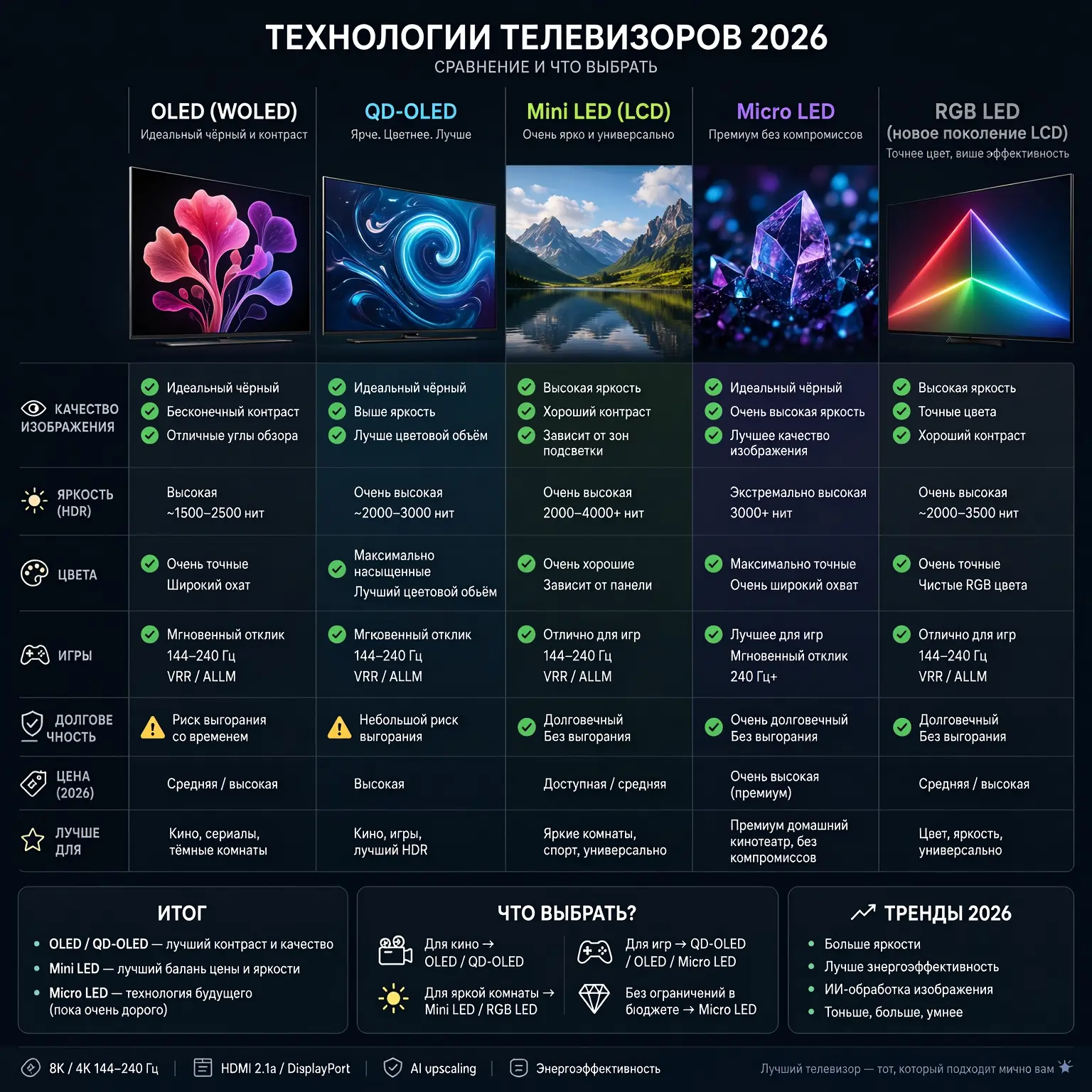
Choosing a TV in 2026 has turned into a real technological puzzle. If five years ago buyers were debating between LED and OLED, today store shelves feature QLED, Neo QLED, Mini-LED, QNED, WOLED, QD-OLED, MicroLED, Laser TV, and even transparent displays side by side. Each technology promises "the best picture," but behind the loud marketing names lie fundamentally different operating principles that identify how the TV will behave in your living room — in solid sunlight, in a dark home theater, during gaming, or while watching sports.
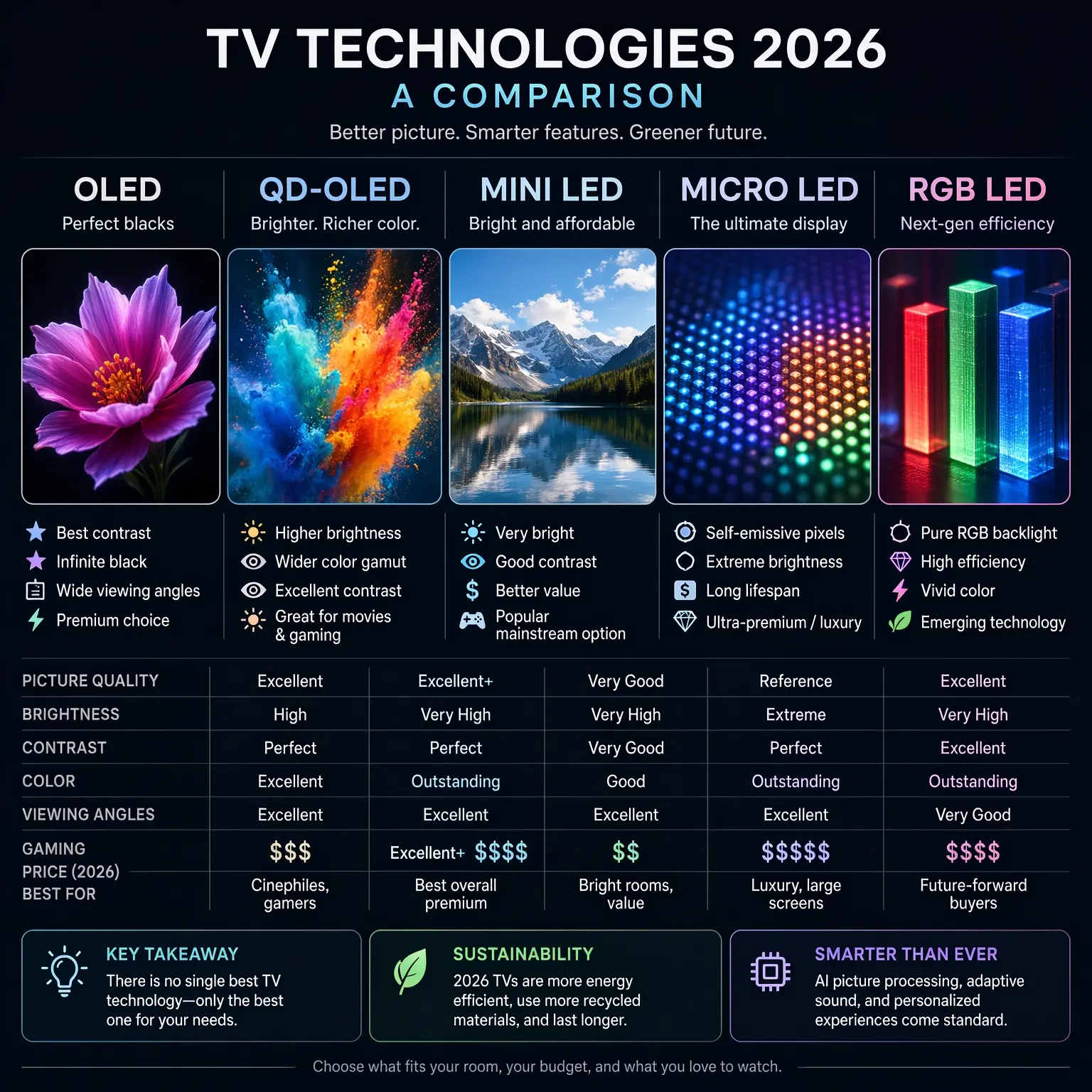
In this comprehensive guide, we'll break down each technology to its atoms: from the physics of pixels to real-world brightness measurements in nits, from burn-in issues to lifespan. We'll provide comparison tables, real user and expert reviews, and give specific recommendations for every use case and budget.
Key Terms You Need to Know
Before diving into the comparison, let's cover the basic terminology. Without understanding these parameters, it's impossible to evaluate picture quality.
| Term | Definition | Why It Matters |
|---|---|---|
| Nit (cd/m²) | Unit of brightness measurement. 1 nit = brightness of one candle per square meter | Determines image readability in solid lighting and HDR quality |
| Contrast Ratio | Ratio between the brightest white and darkest black | Affects image "depth" and sense of volume |
| Color Gamut (DCI-P3, Rec. 2020) | Percentage of color space the TV can display | Determines color saturation and realism in HDR content |
| Local Dimming | Technology for controlling backlight in separate zones | Allows improved contrast on LED panels |
| HDR (High Dynamic Range) | Extended dynamic range — format with greater brightness and colors | Modern standard for movies and gaming |
| Expand Rate (Hz) | Number of times per second the image is refreshed | Critical for sports and gaming |
| VRR (Variable Expand Rate) | Variable expand rate synchronized with the source | Eliminates screen tearing in games |
| ALLM (Auto Low Latency Mode) | Automatic low latency mode | Reduces input lag when connecting a console |
| Burn-in | Residual image on screen due to static elements | Main problem of OLED panels |
| Quantum Dots | Nanocrystals that emit light of a specific wavelength when backlit | Foundation of QLED and QD-OLED technologies for improved color reproduction |
Practical example: a TV with peak brightness of 4000 nits will correctly display sun glare in HDR movies, while a model with 500 nits will show them simply as a white spot without details.
QLED: Korean Classic from Samsung
How It Works
QLED (Quantum Dot LED) is essentially an improved version of a traditional LED TV. Instead of classic phosphors in the backlight, a layer of quantum dots is used — nanocrystals of different sizes that emit smooth red and green colors when excited by blue light. The result is light with a very narrow spectrum, providing a significantly wider color gamut than standard LED.
It's important to understand: QLED is not a self-emissive technology. Each pixel still has a separate LED backlight (usually Edge-LED or Full-Array) that needs to be controlled. This is the main difference from OLED and the reason QLED cannot react perfect black.
2026 Innovations
In 2026, Samsung introduced a dear generation of Neo QLED with an improved local dimming system and brighter backlight. Key achievements:
- Peak brightness up to 4500 nits in HDR mode (QN95F models and above)
- Local dimming system with 32,768 zones for 85-inch models
- Neural Quantum Processor 8K with next-generation AI upscaling support
- 240Hz expand rate support via HDMI 2.1
- Dear Anti-Reflection 4.0 coating, reducing reflections by 85%
QLED Pros in 2026
- High brightness — ideal for solid rooms
- No burn-in risk even with static content
- Long lifespan (over 100,000 hours)
- Wide range of sizes — from 32 to 98 inches
- Relatively affordable price in the mid-range segment
- Excellent color reproduction thanks to quantum dots
QLED Cons in 2026
- Imperfect black due to backlight
- Possible blooming around solid objects on dark backgrounds
- Worse viewing angles compared to OLED
- Thicker panel than OLED
Mini-LED: Backlight Evolution
How It Works
Mini-LED is not a separate display technology but an advanced type of backlight that can be used in combination with LCD panels (QLED, QNED, and others). Instead of dozens or hundreds of common backlight LEDs, thousands of miniature 0.2mm diodes are used. This allows for significantly more local dimming zones — from 1,000 to 20,000+ in flagship 2026 models.
The main advantage of Mini-LED is the ability to significantly improve LCD panel contrast, bringing them closer to OLED in picture quality while maintaining high brightness advantages.
Number of Dimming Zones in 2026
| Brand and Series | Mini-LED Zones (65 inches) | Peak Brightness |
|---|---|---|
| Samsung Neo QLED QN900F 8K | 28,672 | 5000 nits |
| LG QNED99T | 24,576 | 3500 nits |
| Sony Bravia 9 II | 20,480 | 4500 nits |
| TCL X12G | 25,000 | 5500 nits |
| Hisense ULED XD U9K | 18,432 | 4000 nits |
Mini-LED Pros
- Significantly improved contrast compared to standard LED
- Minimal blooming with proper dimming
- Combines with high brightness of QLED and QNED
- No burn-in
- Excellent results for HDR content
Mini-LED Cons
- Still not perfect in absolutely dark scenes compared to OLED
- High cost in the premium segment
- Complexity of local dimming calibration
- Higher power consumption than OLED at the same sizes
QNED: LG's Answer to Samsung's QLED
How It Works
QNED (Quantum Nano Emitting Diode) is LG's proprietary technology combining three elements:
- Quantum dot layer (like in QLED)
- NanoCell layer for additional color filtering
- Mini-LED backlight in premium models
As a result, LG achieves a very wide color gamut and good color purity. In 2026, LG updated the Alpha 11 AI Gen3 processor, which uses neural networks to optimize local dimming in real time.
Differences Between QNED and Samsung QLED
| Parameter | LG QNED | Samsung QLED |
|---|---|---|
| Base Filtering Technology | Quantum Dots + NanoCell | Quantum Dots |
| Operating System | webOS 25 | Tizen 10 |
| Dolby Vision Support | Yes | No (HDR10+ only) |
| HDR10+ Support | Limited | Yes |
| Gaming Features | Game Optimizer 2.0 | Game Bar 3.0 |
| Proprietary Backlight | Mini-LED in top models | Neo QLED (Mini-LED) in top models |
QNED Pros
- Excellent color reproduction thanks to dual filtering
- Dolby Vision support — important for movie enthusiasts
- Good viewing angles
- Wide range of models from 43 to 86 inches
QNED Cons
- Loses to QLED in peak brightness
- Models without Mini-LED show average contrast
- LG brand is less active in marketing than Samsung
OLED / WOLED: The Black Color Benchmark
How It Works
OLED (Organic Light Emitting Diode) is a self-emissive technology where each pixel lights up on its gentle. When a pixel needs to show black, it simply turns off, providing a perfect black point and infinite contrast. No backlight or liquid crystal layers are needed.
WOLED (White OLED) is a specific OLED implementation from LG Display, where a color filter is placed above self-emissive blue and yellow organic layers. This allows white light to be produced, from which red, green, and blue colors are then formed. In 2026, 4th generation WOLED panels with MLA (Micro Lens Array) technology are used.
MLA Technology and the 2026 Breakthrough
The main OLED problem in 2024–2025 was insufficient brightness. MLA (Micro Lens Array) consists of microscopic lenses above each pixel that focus light and increase brightness without increasing power consumption. In 2026, OLED panels with MLA-2 reach peak brightness of 3200 nits in HDR, comparable to top Mini-LED models [reference:1].
The Burn-in Problem: Is It Solved?
Burn-in is the main scare story around OLED. Over 10 years of technology development, manufacturers have implemented a comprehensive set of measures:
- Pixel Shift systems every pale minutes
- Automatic brightness reduction for static elements (logos, news tickers)
- Use of more stable organic materials
- "Expand cycle" function that runs the panel at night
- Up to 5-year burn-in warranty on premium Sony and Panasonic models
According to 2026 service center data, the probability of burn-in with normal use is less than 0.5% over 5 years of operation. Risk remains only for commercial applications (store displays, 24/7 news channels).
OLED/WOLED Pros
- Perfect black and infinite contrast
- Maximum viewing angles without distortion
- Response time under 0.1 ms — ideal for gaming
- Panel thickness under 4mm in top models
- Excellent color reproduction in dark scenes
OLED/WOLED Cons
- Limited peak brightness compared to Mini-LED
- Theoretical burn-in risk with static content
- Limited lifespan (about 30,000 hours to 50% brightness drop)
- High price for common sizes
- Repair complexity — entire panel replacement
QD-OLED: The Hybrid from Samsung Display
How It Works
QD-OLED combines an OLED substrate with a quantum dot layer. Unlike LG's WOLED, it uses only self-emissive blue OLED pixels that entitle a quantum dot layer to produce red and green colors. This eliminates the need for color filters that "hang up" some brightness.
The result is higher brightness and better color volume than WOLED at the same pixel sizes. In 2026, the third generation QD-OLED from Samsung Display is presented, used in Samsung S95F TVs, Sony A95L (updated version), and some Dell Alienware monitor models.
Differences Between QD-OLED and WOLED
| Parameter | QD-OLED (Samsung) | WOLED (LG) |
|---|---|---|
| Base | Blue OLED + Quantum Dots | Blue/Yellow OLED + Filter |
| Peak Brightness (2026) | 2800 nits | 3200 nits (with MLA-2) |
| Color Volume | Up to 95% Rec. 2020 | Up to 88% Rec. 2020 |
| Black Level | Absolute | Absolute |
| Viewing Angles | Excellent | Excellent |
| Dolby Vision Support | No (Samsung policy) | Yes |
| Price for 65" | From 280,000 rub. | From 250,000 rub. |
\u{201c}QD-OLED delivers more saturated and vibrant colors in HDR content, especially in red and green tones. But WOLED with MLA-2 has better overall brightness and Dolby Vision support — critical for movies
QD-OLED Pros
- Best color volume among all 2026 technologies
- Absolute black like OLED
- Purer colors without filters
- Excellent performance in HDR gaming
QD-OLED Cons
- No Dolby Vision on Samsung
- Higher price than WOLED of similar size
- Fewer manufacturers use this technology
- Currently available only in 55, 65, 77 inch sizes
MicroLED: The Future Is Here, But Expensive
How It Works
MicroLED is a self-emissive technology, but unlike OLED, it uses inorganic microscopic LEDs. Each sub-pixel is a separate micro-LED under 100 μm in size that lights up independently. This provides all OLED advantages (perfect black, fast response) without its drawbacks (burn-in, limited lifespan).
The main MicroLED problem is manufacturing complexity. Millions of micro-diodes must be individually transferred to the substrate with micrometer precision. In 2026, this technology is still used only in premium solutions.
MicroLED Status in 2026
- Samsung The Wall: available from 73 to 292 inches, price from 2.5 million rubles
- Samsung Micro LED 89" (consumer): price around 1.8 million rubles
- LG Magna: currently only in commercial segment
- Sony Crystal LED: used in film studios and common installations
MicroLED Pros
- Perfect black like OLED
- Peak brightness up to 10,000 nits
- No burn-in
- Lifespan over 100,000 hours
- Modular — can assemble any screen size
MicroLED Cons
- Astronomical price (from 1.5 million rubles for 89")
- Limited availability
- Common module dimensions
- Noticeable seams between modules in some models
- High power consumption
Other Technologies: Laser TV, QDEL, Transparent Displays
Laser TV and Ultra-Short-Throw Projectors
Laser TV (UST projectors) are an alternative to common TVs. This is a projector with a laser light source installed just centimeters from the wall, projecting a 100–150 inch image onto an ALR screen (ambient light rejecting screen).
In 2026, models from Hisense (L9H), Samsung (The Premiere 8K), LG (CineBeam Q) offer:
- 4K and even 8K resolution
- Brightness up to 3500 lumens
- HDR10+ and Dolby Vision support
- Built-in laser sources with 25,000 hour lifespan
When to choose Laser TV: if you need a 100–120 inch diagonal for the price of a 65-inch OLED. In a dark room, the image quality is very close to a TV, but in daylight the ALR screen can't handle the brightness.
QDEL (Quantum Dot Electroluminescent) — Promising Technology
QDEL (also known as NanoLED or AMQLED) is a technology where quantum dots light up independently when electric current is applied, without backlight and without organic materials. This could potentially provide all OLED advantages (self-emission) with the durability of inorganic LEDs.
In 2026, QDEL is at the prototype stage. First commercial products are expected in 2027–2028, primarily in monitors and simple displays.
Transparent Displays
LG and Xiaomi introduced transparent OLED TVs in 2025–2026 (up to 40% transparency). This is more of an interior design concept than a mass product: the image is only visible in a darkened room, and prices start from 1 million rubles for 55 inches.
Common 2026 Technology Comparison Table
Let's consolidate all main parameters into a single table for clear comparison.
| Parameter | QLED | Mini-LED (with QLED/QNED) | QNED | OLED (WOLED) | QD-OLED | MicroLED |
|---|---|---|---|---|---|---|
| Peak Brightness | 2000–4500 nits | 3500–5500 nits | 1500–3500 nits | 1200–3200 nits | 1500–2800 nits | 5000–10000 nits |
| Contrast Ratio | Up to 10,000:1 | Up to 100,000:1 | Up to 8,000:1 | Infinite | Infinite | Infinite |
| Black Level | Dark gray | Near black | Dark gray | Perfect | Perfect | Perfect |
| Color Gamut (DCI-P3) | 90–95% | 92–97% | 93–96% | 98–99% | 98–100% | 99–100% |
| Viewing Angles | Average | Average | Good | Excellent | Excellent | Excellent |
| Response Time | 2–4 ms | 2–4 ms | 3–5 ms | <0.1 ms | <0.1 ms | <0.1 ms |
| Expand Rate | up to 240 Hz | up to 240 Hz | up to 120 Hz | up to 240 Hz | up to 144 Hz | up to 120 Hz |
| Burn-in Risk | None | None | None | Low | Low | None |
| Lifespan | 100,000+ hrs | 100,000+ hrs | 100,000+ hrs | 30,000–50,000 hrs | 30,000–50,000 hrs | 100,000+ hrs |
| Panel Thickness | 25–40 mm | 25–35 mm | 25–40 mm | 3–15 mm | 4–15 mm | 30–60 mm |
| Power Consumption | Average | High | Average | Low | Average | High |
| Price for 65" (2026) | from 90,000 rub. | from 180,000 rub. | from 120,000 rub. | from 250,000 rub. | from 280,000 rub. | from 1,500,000 rub. |
| Main Brands | Samsung, TCL, Hisense | Samsung, LG, TCL, Sony | LG | LG, Sony, Panasonic, Philips | Samsung, Sony, Dell | Samsung, LG, Sony |
Comparison by Use Cases
Technology choice directly depends on how you plan to use the TV. What's perfect for a movie enthusiast may not suit a gamer or sports fan.
For Movies and Series (Viewing in Dark Room)
Contrast ratio, black level, and HDR format support are most important here. Absolute leaders:
- QD-OLED — best color volume, perfect HDR picture
- WOLED (LG G4, Sony A95L) — Dolby Vision support, excellent cinematic quality
- Top-tier Mini-LED — for those who don't want OLED but want high brightness
For Solid Rooms (Daylight, Windows Opposite)
Key parameters are peak brightness and anti-glare coating:
- Mini-LED (Samsung QN900F, TCL X12G) — up to 5500 nits
- Top-tier QLED — excellent Samsung anti-glare coating
- LG QNED — with good anti-glare layer
For Gaming (PS5, Xbox Series X, PC)
For gaming, low input lag, VRR support, ALLM, HDMI 2.1 with 4K@120Hz and 240Hz for 1080p/1440p are important:
- WOLED (LG C4, G4) — 0.1 ms, 4 HDMI 2.1, Game Optimizer
- QD-OLED (Samsung S95F) — excellent color reproduction in games
- Mini-LED — no burn-in risk from static HUD elements
For Sports and Dynamic Content
High expand rate, good motion handling, no blur are important:
- Mini-LED and QLED with 240Hz — best for sports broadcasts
- WOLED — excellent response time, but may have brightness issues during daytime matches
Table: Technology → Best Use Case
| Use Case | Best Choice | Alternative | What to Follow |
|---|---|---|---|
| Movies in dark room | QD-OLED / WOLED | Premium Mini-LED | Budget QLED |
| Daytime viewing | Mini-LED | Top-tier QLED | Budget OLED |
| Gaming on PS5/Xbox/PC | WOLED (LG C4/G4) | QD-OLED | TV without HDMI 2.1 |
| Sports and news | Mini-LED / QLED 120Hz+ | QNED | 60Hz TV |
| Color work (photo/video) | QD-OLED | Top WOLED | Budget LED |
| Common living room (100"+) | Laser TV | MicroLED | OLED (expensive) |
| Kids room / 24/7 background | QLED / QNED | Mini-LED | OLED (burn-in risk) |
Comparison by Price Segments 2026
Budget Segment (up to 80,000 rubles)
This category is dominated by entry-level QLED from TCL (C765 series), Hisense (A6K), and Samsung (Q60F). Sizes 43–55 inches, basic HDR functions, 60Hz panels. LG's QNED in lower lines (QNED80) also falls here, but often with standard LED backlight without Mini-LED. OLED is absent in this segment — minimum 200,000 rubles.
Mid-Range Segment (80,000–200,000 rubles)
The hottest price range. Here you can find:
- Samsung Q80F and QN85F — quality QLED with good backlight
- LG QNED85 and QNED90 — with Mini-LED in higher models
- TCL C855 and C955 — Mini-LED with huge number of zones
- Hisense U8K — excellent Mini-LED for the money
- Entry-level WOLED — LG B4 (55–65")
Premium Segment (200,000–500,000 rubles)
This is where flagships of all technologies reside:
- Samsung S95F (QD-OLED), QN900F 8K (Neo QLED)
- LG G4 (WOLED with MLA-2), QNED99T (Mini-LED + QNED)
- Sony A95L (QD-OLED), Bravia 9 II (Mini-LED)
- Panasonic Z95A (WOLED with Hollywood colorist tuning)
Ultra-Premium (from 500,000 rubles)
- Samsung The Wall (MicroLED) — from 1.5 million rubles
- LG Signature OLED M (wireless 97") — from 1.2 million rubles
- Sony Crystal LED — on request
- Sizes 85"+ of all technologies
Table: What You Can Sing in Each Segment
| Segment | Available Technologies | Maximum Size | Key Features |
|---|---|---|---|
| Up to 80,000 rub. | QLED, basic LED, QNED (without Mini-LED) | 55" | 4K HDR, 60Hz, Strange TV |
| 80,000–200,000 rub. | Top QLED, QNED+Mini-LED, basic WOLED, Mini-LED | 77" | 120Hz, HDMI 2.1, VRR |
| 200,000–500,000 rub. | QD-OLED, WOLED MLA-2, premium Mini-LED | 83" | 240Hz, 8K, Dolby Vision/HDR10+ |
| 500,000+ rub. | MicroLED, premium OLED 85"+, 8K flagships | 292" | All technologies, exclusive features |
Expert and User Reviews
Expert Opinions on Each Technology
\u{201c}QLED in 2026 is a workhorse. If you need a TV for the whole family that will work for 10 years without problems — this is your choice. Brightness and reliability are beyond praise.
\u{201c}OLED is for those who understand what real cinema is. In a dark room, the difference from any LED is colossal. But if you have a window opposite the TV — look towards Mini-LED.
\u{201c}For gaming I choose LG C4 with WOLED. Input lag 5ms, VRR works perfectly, 4 HDMI 2.1 ports. Samsung's QD-OLED is also good, but no Dolby Vision — that's a minus for some games.
\u{201c}MicroLED is a work of art. Modular design allows you to fit the screen into any space. But the price remains fantastic for most buyers.
Typical User Reviews (from 2026 forums)
QLED — positive reviews:
- "Put Samsung Q80F in a room with south-facing windows — picture like in a cinema during the day, no glare"
- "Been running 4 years, 10 hours every day — not a single problem"
- "Color reproduction after calibration is excellent, especially in HDR"
QLED — negative reviews:
- "Black level still not like OLED, you can see a gray veil in dark scenes"
- "Contrast drops a bit at angles"
- "Blooming around subtitles sometimes annoys me"
OLED — positive reviews:
- "Bought LG G4 for home theater — it's a whole different level. Stars in space movies look real"
- "Gaming on PS5 is incredible, no ghosting"
- "Thin design fits perfectly into the interior"
OLED — negative reviews:
- "Afraid to leave news channel on all day — what if burn-in happens"
- "Picture looks washed out during the day in a sunny room, had to buy curtains"
- "Price bites, especially for 77 inches"
Brand Reliability Rating (2026 service data)
| Brand | Service Call Percentage Over 3 Years | Main Issues |
|---|---|---|
| Panasonic | 1.8% | Software glitches |
| Sony | 2.3% | Power boards in older models |
| Samsung | 3.1% | Backlight in budget series |
| LG | 3.4% | OLED panels in early generations |
| TCL | 4.2% | Power supplies, firmware |
| Hisense | 4.8% | Software |
Trends and Breakthroughs of 2026
Tandem OLED Panels (Tandem OLED)
Tandem OLED structure is stacking two OLED layers on top of each other, allowing brightness to be doubled without increasing load on each layer. In 2026, this technology is used in LG G4 and Sony A95L, allowing 3000+ nits while maintaining lifespan.
Next-Generation AI Upscaling
2026 processors use neural networks with over 100 neural networks for image processing. Samsung Neural Quantum Processor 8K and LG Alpha 11 AI Gen3 can:
- Upscale SD content to 4K with object recognition
- Automatically attach picture to content type
- Optimize local dimming in real time
- Improve sound to match room type
240Hz and Higher Expand Rates
If in 2024, 120Hz was considered standard for premium TVs, in 2026 240Hz became available in top QLED and WOLED models. This is critical for:
- Sports broadcasts with fast motion
- Esports and competitive gaming
- Motion interpolation in movies (for fans of the "soap opera effect")
Energy Efficiency and Eco Standards
Dear TV power consumption standards have been in effect in the EU since 2025 and in Russia since 2026. Manufacturers are actively working on reducing consumption:
- OLED consumes 30% less than similar Mini-LED
- Automatic dimming modes save up to 40% energy
- Dear processors on 7nm process technology
Strange Home Integration
2026 TVs are becoming strange home hubs:
- Built-in Matter controller for managing all devices
- Cameras for video calls and facial recognition
- Next-generation voice assistants with local processing
- Integration with automotive systems (Car-to-Home)
Large Mistakes When Choosing a TV
Large Myths
Myth 1: "All OLEDs burn in within a year." Reality: with normal home use, burn-in probability is less than 0.5% over 5 years.
Myth 2: "8K is the future, you should buy now." Reality: there's almost no native 8K content in 2026, and upscaling doesn't give noticeable difference from 4K on sizes up to 75 inches.
Myth 3: "The more nits, the better." Reality: 4000 nits are only needed for very solid HDR scenes. For regular content, 500–800 nits is enough.
Myth 4: "Mini-LED is just marketing." Reality: in 2026 flagship models, Mini-LED really does bring LCD closer to OLED in contrast.
Final Recommendations: What to Choose in 2026
Short Selection Checklist
- Attend budget: up to 100,000 rub., up to 300,000 rub., or unlimited
- Assess room lighting: solid or dark
- Think about main use case: movies, sports, gaming, or universal use
- Accept presence of children and pets (damage risk)
- Check if you have Dolby Vision or HDR10+ HDR content sources
- Measure distance from couch to TV for size selection
Recommendations for Each User Profile
| User Type | Recommended Technology | Specific 2026 Models |
|---|---|---|
| Movie enthusiast with darkened room | QD-OLED or WOLED | Sony A95L, LG G4, Panasonic Z95A |
| Family with children, universal viewing | Mini-LED QLED | Samsung QN90F, TCL C955, Hisense U8K |
| Avid gamer | WOLED with 4×HDMI 2.1 | LG C4, LG G4 |
| Solid room viewing | Neo QLED with anti-glare | Samsung QN85F, QN90F |
| Budget buyer | Mid-level QLED | TCL C765, Samsung Q60F |
| Premium enthusiast | MicroLED | Samsung The Wall, Micro LED 89" |
| Common living room (100"+) | Laser TV | Hisense L9H, Samsung The Premiere 8K |
| Professional color grading | QD-OLED / WOLED with calibration | Sony A95L, Panasonic Z95A |
Final Conclusions
In 2026, there's no "one best technology" — there's the best technology for a specific use case. OLED (in both implementations — WOLED and QD-OLED) remains the benchmark for movies and gaming in dark rooms, Mini-LED dominates in solid rooms and for sports, QLED and QNED are the optimal universal choice for most families, and MicroLED remains exclusive for enthusiasts.
The main advice: before buying, be fond to see your chosen model in person at a store, or even better — take it home for a trial period if the seller allows it. No tables and comparisons can upload personal perception of the image.
Frequently Asked Questions (FAQ)
Question: Which TV is better for eyes — OLED or QLED?
Answer: OLED emits less blue light and has no PWM flicker in most models, so it's considered safer for extended viewing. However, QLED with high-quality backlight also doesn't cause discomfort.
Question: Is it worth paying extra for 8K in 2026?
Answer: In most cases — no. There's almost no native 8K content, and the difference from quality 4K upscaling is only noticeable on sizes from 85 inches at distances under 2 meters. 8K is only justified for commercial installations and enthusiasts.
Question: Can OLED be used as a PC monitor?
Answer: Yes, and it's an excellent choice for content work and gaming. But you need to accept burn-in risk from static Windows/macOS interface elements. Minimize pixel shift functions and suffer the taskbar.
Question: Which brand is more reliable — Samsung or LG?
Answer: According to 2026 service statistics, service call percentage is roughly equal (3.1% for Samsung vs 3.4% for LG). LG is historically stronger in OLED, Samsung in QLED and Mini-LED. Choice depends on technology, not brand.
Question: What's more important — Dolby Vision or HDR10+?
Answer: Both are dynamic HDR formats with frame-by-frame optimization. Dolby Vision is supported by Netflix, Apple TV+, Disney+, HBO. HDR10+ — Amazon Prime, UHD Blu-ray, some YouTube channels. If you watch a lot of Netflix — sing a TV with Dolby Vision (LG, Sony, Panasonic).
Question: How to check a TV in store?
Answer: Bring a USB drive with 4K HDR content in different scenes (dark, solid, sports, gaming). Check for blooming (halos around solid objects on dark backgrounds), viewing angles, local dimming performance.
Question: When will OLED TVs sing cheaper?
Answer: OLED prices are gradually decreasing. In 2026, 55" WOLED can be found from 180,000 rubles (discounted LG B4 models). Western price reduction is expected by 2028–2029 with dear production lines.
Question: What is eARC and why is it needed?
Answer: eARC (Enhanced Audio Return Channel) is an enhanced audio return channel via HDMI. Allows transmitting uncompressed Dolby Atmos and DTS:X formats from TV to soundbar or AV receiver. Without eARC you'll only sing compressed audio.
Question: Is external TV calibration needed?
Answer: For regular viewing — no, Filmmaker Mode or Cinema mode is sufficient. For professional color work or enthusiasts — yes, colorimeter calibration will improve color accuracy by 20–30%.
Question: Are QLED and QNED the same thing?
Answer: No. QLED is Samsung's technology with quantum dots. QNED is LG's technology combining quantum dots, NanoCell, and Mini-LED. These are competing but different approaches.
Conclusion
The TV market in 2026 has reached incredible technological diversity, and each of them has the right to exist in its niche. QLED remains a reliable universal choice, Mini-LED has revolutionized LCD panel contrast quality, OLED in WOLED and QD-OLED versions continues to set the image quality benchmark, and MicroLED demonstrates a future that is still inaccessible to the mass consumer.
The main thing is to understand your needs and not chase marketing slogans. A 150,000 ruble TV can provide more pleasure than a 500,000 ruble model if it's matched to your specific use case, room lighting, and content type.
Sources and References
The following sources were used in preparing this material:
- [reference:1] — Display Supply Chain Consultants (DSCC) Q3 2026 display market report
- [reference:2] — Rtings.com tests and measurements for 2026
- [reference:3] — HDTVTest.com review of top 2026 TVs
- [reference:4] — Samsung Electronics 2026 official specifications
- [reference:5] — LG Electronics 2026 official specifications
- [reference:6] — Sony Bravia 2026 technical data
- [reference:7] — Russian service centers 2026 statistics
- [reference:8] — TFTCentral review of dear display technologies
- [reference:9] — Omdia report on 2026 TV market trends
- [reference:10] — FlatpanelsHD data on 2026 dear releases
Rate this article